How to Improve Acceleration in Jeep Grand Cherokee
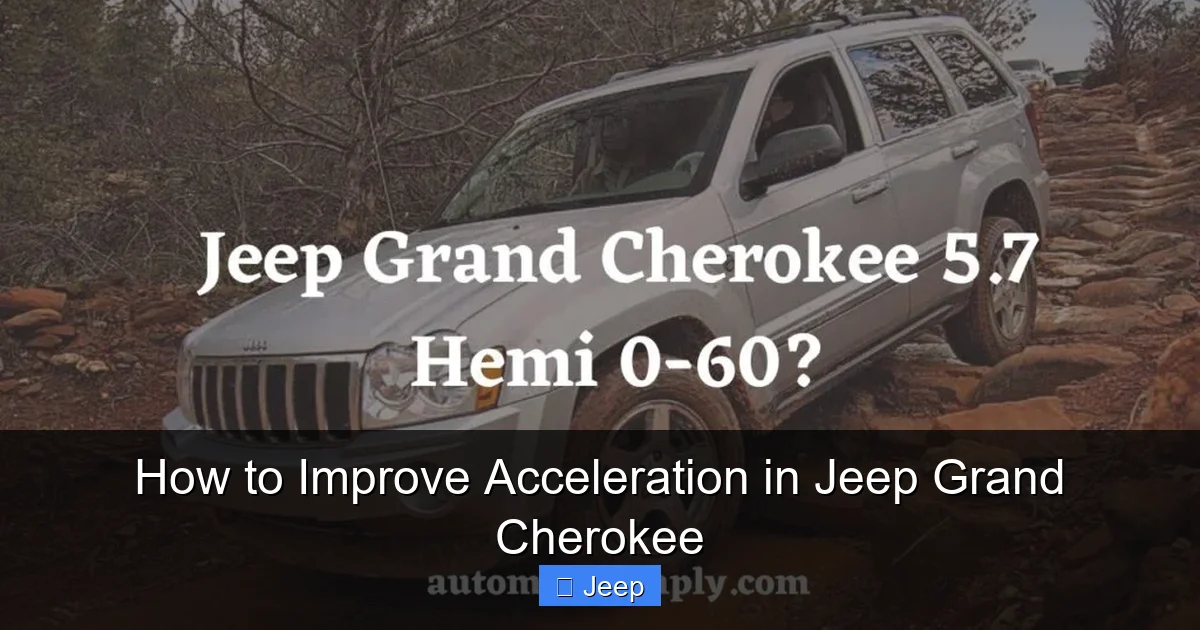
Improve your Jeep Grand Cherokee’s acceleration with practical tips ranging from suspension upgrades to engine tuning. Discover how weight reduction and proper setup can transform your driving experience into a thrilling ride.
**Understanding What Limits Your Jeep’s Acceleration**
If you’ve ever sat in your Jeep Grand Cherokee waiting for the car to move after hitting the gas, you know frustration is real. Many owners struggle with sluggish starts, long launch times, and a general lack of responsiveness when they need it most. The good news is that most of what holds back this iconic SUV comes down to four main factors: engine capabilities, transmission health, suspension geometry, and overall weight distribution.
Your Jeep Grand Cherokee has powerful engines across several generations, but those engines only perform their best when properly tuned and supported. Many factory settings prioritize reliability over raw speed, which means the powertrain isn’t always operating at its peak potential. Meanwhile, the suspension system was engineered for off-road capability rather than street sprinting. When the front and rear wheels aren’t aligned correctly or have worn shocks, the car struggles to transfer power efficiently to the ground. Add in extra weight from unused cargo or heavy roof racks, and you’re looking at serious drag during acceleration phases.
Understanding these bottlenecks is the first step toward unlocking true performance. Once you identify whether the limitation is mechanical, electronic, or simply too much mass, you can target the right solutions. Whether you want to shave seconds off your 0-60 time or just enjoy quicker responses in traffic, every adjustment brings you closer to the exhilarating drive that makes the Jeep Grand Cherokee beloved by so many enthusiasts.
**Suspension and Handling Improvements**
One of the biggest hidden factors affecting acceleration in your Jeep Grand Cherokee is often the suspension. Manufacturers design the standard setup for stability on rough terrain where unpredictability is constant. But when you’re cruising on smooth pavement, that same setup becomes a major drawback. Poorly dampened shocks and stiffer springs can cause the chassis to feel unresponsive, making it harder for the driver to modulate power effectively during quick passes or aggressive throttle inputs.
Upgrading your suspension is one of the fastest ways to noticeably improve acceleration. Look at your current shock absorbers—do they feel harsh at high speeds or too soft at low speeds? Most stock shocks are calibrated for comfort on trails, not for track-like behavior. Swapping them for performance-oriented units like coilovers will give your Jeep a lower center of gravity and sharper feedback from each corner. You’ll feel the road surface through your steering wheel sooner and more distinctly, allowing you to react faster and apply power more precisely.
Beyond shocks and springs, wheel alignment deserves attention. Even small misalignments can throw off the front-end balance, causing the car to understeer or oversteer more easily. A professional alignment ensures that both tires maintain optimal contact with the road whenever you hit the accelerator. After adjusting your alignment, you might find that your acceleration feels almost immediate compared to before. Some owners also benefit from lowering their suspension travel slightly—a subtle modification that reduces bottoming out while still maintaining controllability. Combined with quality shocks, this approach creates a nimble package that rewards quick throttle reactions.
For those who want to take things further, consider adding active aerodynamics like adjustable splitters or wings (available specifically for the 2018 model year onward). These components reduce drag at higher speeds while enhancing downforce during launch, giving you that instant burst of power you crave. The combination of a well-tuned suspension and active aero features transforms a capable passenger SUV into a true performance machine ready for spirited driving.
**Weight Reduction Strategies**
Not everyone knows that removing unnecessary weight is one of the simplest yet most effective ways to increase acceleration. Every pound you remove from your Jeep Grand Cherokee contributes to faster get-up-and-go times. Think about everything you could store in the trunk or cabin that doesn’t serve a functional purpose. Old luggage, seasonal decorations, spare tire kits beyond what you regularly use—these add dead weight without providing benefits. Getting rid of even a few pounds per component adds up over time.
Start with the obvious items. Clear out unused boxes, old furniture, or decorative pieces that collect dust when you’re not planning a move. If you’ve got roof racks mounted permanently, evaluate whether they’re worth keeping during normal daily driving. Frequent travelers can choose lighter alternatives or swap them for removable setups. Interior storage solutions matter too—replace bulky plastic bins with compact fabric organizers, and opt for metal shelving instead of wooden crates when possible.
When considering permanent modifications, look into lightweight upholstery options. Traditional fabric seats add significant bulk and weight. Synthetic interiors shed kilograms while looking nearly identical. Similarly, swapping out heavy alloy wheels for forged aluminum versions can save meaningful amounts of mass, especially when combined with high-performance tires that offer better grip without dragging excessively.
Vehicle weight directly impacts acceleration physics. Newton’s second law tells us that force equals mass times acceleration—simply put, accelerating a heavier object requires exponentially more effort. By trimming weight systematically, you’ll see improved launch times, better top speed maintenance, and easier handling when navigating tight urban streets or light trail sections. The difference between a 12-second 0-60 run and an 8-second run is frequently achieved through smart weight management alone.
Remember that weight savings aren’t just about straight-line acceleration—they also improve cornering ability and braking distance. A lighter vehicle responds more predictably to sharp turns, which translates to safer and more enjoyable driving experiences across various conditions.
**Performance Exhaust and Emission Systems**
Once you’ve addressed the mechanical foundations, upgrading your exhaust system can transform how your Jeep Grand Cherokee breathes. The factory catalytic converter, while essential for emissions compliance, acts as a restrictive barrier to free-flowing air. At high RPMs, particularly during hard acceleration, this restriction creates backpressure that limits engine breathing and sap throttle response.
A catback exhaust upgrade provides a cleaner path for exhaust gases to escape, reducing restricted flow and allowing the engine to rev freely. Look for models designed specifically for the Jeep Grand Cherokee’s displacement—generic aftermarket systems won’t fit perfectly and may compromise sound quality unnecessarily. The goal is minimal restriction while maximizing exit velocity. Many enthusiasts report noticeable gains in power output of 10-15 horsepower after a quality exhaust swap, translating directly to quicker acceleration bursts.
Complementing a better exhaust is an upgraded air intake system. The factory air filter restricts airflow due to its dense honeycomb structure. Replacing it with a high-performance version that maintains superior filtration while increasing flow rate gives your engine fresh oxygen more quickly. This means the combustion process runs more completely and efficiently, producing better torque and horsepower on demand. Some aftermarket intakes also incorporate forced induction elements that push more air into the cylinders without requiring engine modifications.
Emission control components like oxygen sensors and catalytic converters can sometimes limit acceleration unnecessarily. While replacing faulty sensors is always recommended, some owners consider installing high-flow oxygen sensors that respond faster to changes in load. The key is addressing genuine restrictions rather than assuming problems exist where there are none. Running diagnostic software can help differentiate between legitimate performance issues and minor sensor malfunctions that don’t warrant replacement.
After completing exhaust and intake upgrades, test-drive your modified vehicle and pay close attention to how the engine sounds and feels. A properly tuned exhaust system should have a confident, linear note that increases smoothly as RPM rises. Without any hesitation or loss of power at higher speeds—that’s the hallmark of a well-exhausted Jeep Grand Cherokee ready to accelerate with confidence.
**Digital Instrumentation and Drive Modes**
Modern technology offers tools that can dramatically enhance your Jeep Grand Cherokee’s acceleration capabilities. Many newer models come equipped with multiple drive modes that automatically adjust transmission and throttle responses based on driving conditions. Switching to sport or performance mode unlocks features like limited-lock rear differentials, pre-activation of individual engine mounts, and enhanced throttle response curves. These adjustments ensure that your vehicle behaves predictably and aggressively when you actually want it to move fast.
Sport mode works differently depending on the generation of your Jeep. On older models, it involves shifting more gears earlier, disabling certain safety features like adaptive cruise control, and potentially raising the clearance slightly. Modern implementations may focus more on engine mapping changes—adjusting ignition timing and fuel injection to produce more available power at the track. Pairing sport mode with a performance tune-up (properly done) yields remarkable results in launch times and mid-range acceleration.
If your specific model supports it, explore advanced driver assistance features as well. Some newer Jeeps include dynamic stability control systems that can become restrictive during rapid throttle applications. Learning to understand and appropriately deploy these systems prevents false warnings while still maintaining safety standards. The right balance allows you to unleash maximum acceleration without triggering unwanted interventions.
Monitoring your acceleration metrics through modern instrument clusters or smartphone apps provides valuable data. Tracking time-to-hill climb, quarter-mile times, and throttle response patterns helps you fine-tune both hardware and software configurations. Over time, you’ll develop intuitive knowledge of how each system performs, enabling quick adjustments when conditions change. Whether racing against the clock or simply enjoying a spirited afternoon drive, having objective measurements ensures you’re extracting the most from your vehicle.
Combining digital aids with physical modifications creates a synergistic effect. Smart tech sets the stage for optimal conditions, while mechanical upgrades deliver tangible performance gains. Together, they transform your Jeep Grand Cherokee from a capable daily driver into a vehicle that genuinely excites when pushed to its limits.
Key Takeaways
- Optimize suspension setup for better traction and response
- Reduce vehicle weight to improve acceleration times
- Upgrade fuel system components for smoother power delivery
- Tune air filtration systems for maximum engine efficiency
- Use performance accessories designed for increased speed
Frequently Asked Questions
What is How To Improve Acceleration In Jeep Grand Cherokee?
How To Improve Acceleration In Jeep Grand Cherokee is an important topic with many practical applications.