How to Tell If Jeep Grand Cherokee Is 4wd
Knowing whether your Jeep Grand Cherokee is 4WD or 2WD matters for maintenance, off-roading, and resale value. You can determine your drivetrain by checking the transfer case, VIN, dashboard indicators, and physical components under the vehicle. This guide walks you through every reliable method.
Key Takeaways
- Check the transfer case: A transfer case with a rotary knob or button confirms your Jeep Grand Cherokee 4WD system is present.
- Look at the VIN: The eighth character of your VIN reveals the drivetrain configuration directly.
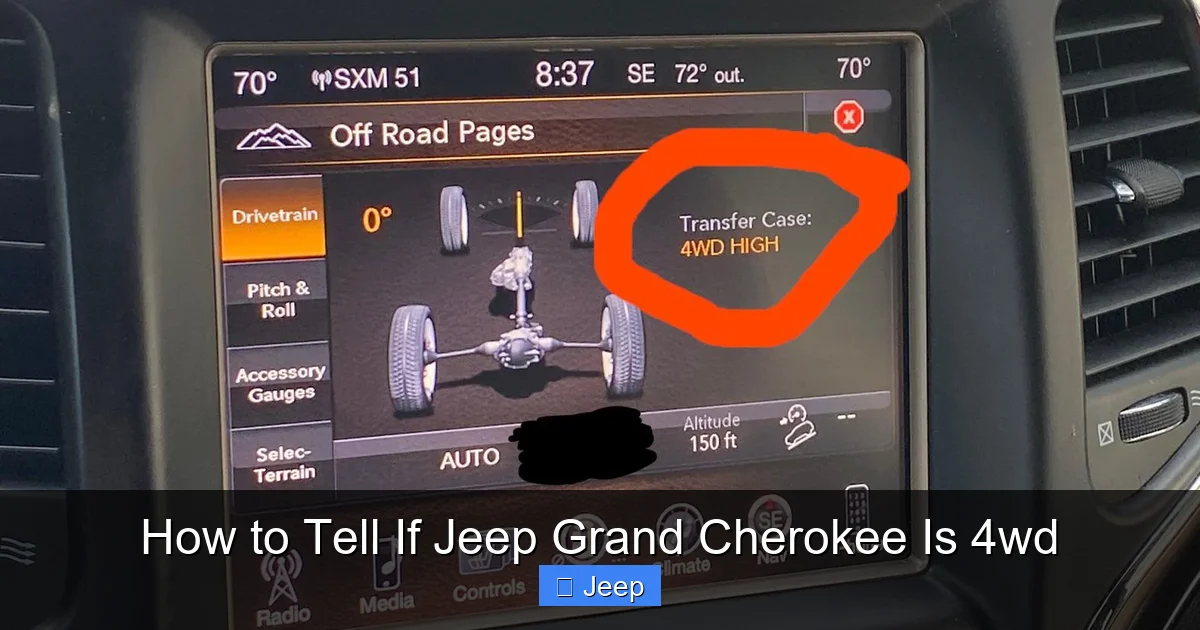
- Dashboard indicators: Modern Grand Cherokee models display 4WD modes on the infotainment screen or dashboard cluster.
- Physical inspection: Extra components like a front driveshaft and transfer case under the vehicle signal a 4WD setup.
- Badging and trim levels: Certain trims like Trailhawk and Summit 4×4 come factory-equipped with 4WD.
- Consult the owner’s manual: Your manual provides definitive confirmation of your specific drivetrain option.
📑 Table of Contents
- Understanding 4WD vs 2WD in the Jeep Grand Cherokee
- Visual and Physical Signs Your Grand Cherokee Is 4WD
- Check the VIN and Documentation
- Using the Dashboard and Transfer Case Controls
- Trim Levels That Come With 4WD
- Lift the Vehicle and Inspect the Drivetrain
- Common Questions About Jeep Grand Cherokee 4WD
- Final Thoughts
Understanding 4WD vs 2WD in the Jeep Grand Cherokee
If you own or are thinking about buying a Jeep Grand Cherokee, one of the first things you need to figure out is whether it has 4WD or 2WD. It sounds simple, but there are a few details that trip up a lot of owners. The difference between these two systems is huge. It affects how your vehicle handles, what terrain you can tackle, and even how much your car weighs.
A 2WD (two-wheel drive) Grand Cherokee sends power to either the front or rear wheels only. Most Grand Cherokee models come in rear-wheel drive (RWD) by default. A 4WD (four-wheel drive) system sends power to all four wheels at the same time or on demand. This gives you better traction on slippery roads, mud, snow, and rocky trails.
Here is the thing. Many people assume every Jeep is 4WD. That is not true. Jeep has offered 2WD options in the Grand Cherokee lineup for years. So how do you tell for sure? Let us break it down step by step.
Why It Matters
Knowing whether your Jeep Grand Cherokee 4WD system is active or absent is more than a fun fact. If you plan to tow heavy loads or drive in snowy mountain passes, 4WD can be a lifesaver. It also impacts your fuel economy. 4WD vehicles typically weigh more and use slightly more gas. If you are comparing the Jeep Grand Cherokee weight with other models, the drivetrain plays a role.
Visual and Physical Signs Your Grand Cherokee Is 4WD
The easiest way to spot a 4WD Jeep Grand Cherokee is by looking at the vehicle itself. There are several external and undercarriage clues that give it away fast.
Visual guide about How to Tell If Jeep Grand Cherokee Is 4wd
Image source: i.ytimg.com
Check for the 4×4 Badge
Most 4WD Grand Cherokees have a “4×4” or “4WD” badge on the rear tailgate or on the lower rear fender. Look closely near the taillights or along the side of the vehicle. Jeep usually places these badges in visible spots. However, some trims keep things clean and skip the badge entirely, so this method alone is not foolproof.
Inspect the Undercarriage
If you can safely get under the vehicle or use a lift, look for two key components. First, check for a transfer case. This is a bulky metal unit mounted behind the transmission. It connects to the rear driveshaft and splits power to the front and rear axles. A 2WD model will not have this component at all.
Second, look for a front driveshaft. This is a long metal shaft running from the transfer case to the front differential. If you see both the transfer case and front driveshaft, your Jeep Grand Cherokee 4WD setup is confirmed. A 2WD model only has a rear driveshaft and no front one.
Notice the Front Differential
On a 4WD model, you will find a front differential mounted on the front axle. It is usually a rounded or oval-shaped housing. This part does not exist on 2WD models. Together, these physical components form the backbone of any 4WD system.
Check the VIN and Documentation
Your Vehicle Identification Number holds a wealth of information. It can tell you the exact drivetrain configuration of your Jeep Grand Cherokee without ever stepping outside.

Visual guide about How to Tell If Jeep Grand Cherokee Is 4wd
Image source: vehq.com
Decoding the VIN
The VIN is a 17-character code found on the driver-side dashboard or door jamb. The eighth character in the VIN specifically indicates the engine and drivetrain type. For most Jeep Grand Cherokee models, a “K” in the eighth position typically corresponds to a 4WD or 4×4 configuration. However, VIN decoding varies across model years, so it is always smart to double-check with an online VIN decoder or your dealer.
You can use free tools like the NHTSA VIN decoder or Jeep’s own VIN lookup tool. Just enter your VIN, and the report will list your drivetrain among other specs. This is one of the most accurate methods available.
Owner’s Manual and Window Sticker
Your owner’s manual is another goldmine. It will explicitly state whether your vehicle is equipped with 4WD, 2WD, or an active-on-demand system. The window sticker (Monroney label) from when the car was new also lists the drivetrain option. If you bought the car used and no longer have the sticker, the manual still has all the details you need.
Using the Dashboard and Transfer Case Controls
Modern Jeep Grand Cherokee models make it really easy to identify and switch between drivetrain modes right from the cabin.
Dashboard Indicators
On newer models, the infotainment screen or instrument cluster shows your current 4WD mode in real time. You may see indicators like “4H” (four-wheel high), “4L” (four-wheel low), or “N” (neutral). If your dashboard shows any of these, your vehicle is 4WD capable. A 2WD model will not display these options at all.
Transfer Case Controls
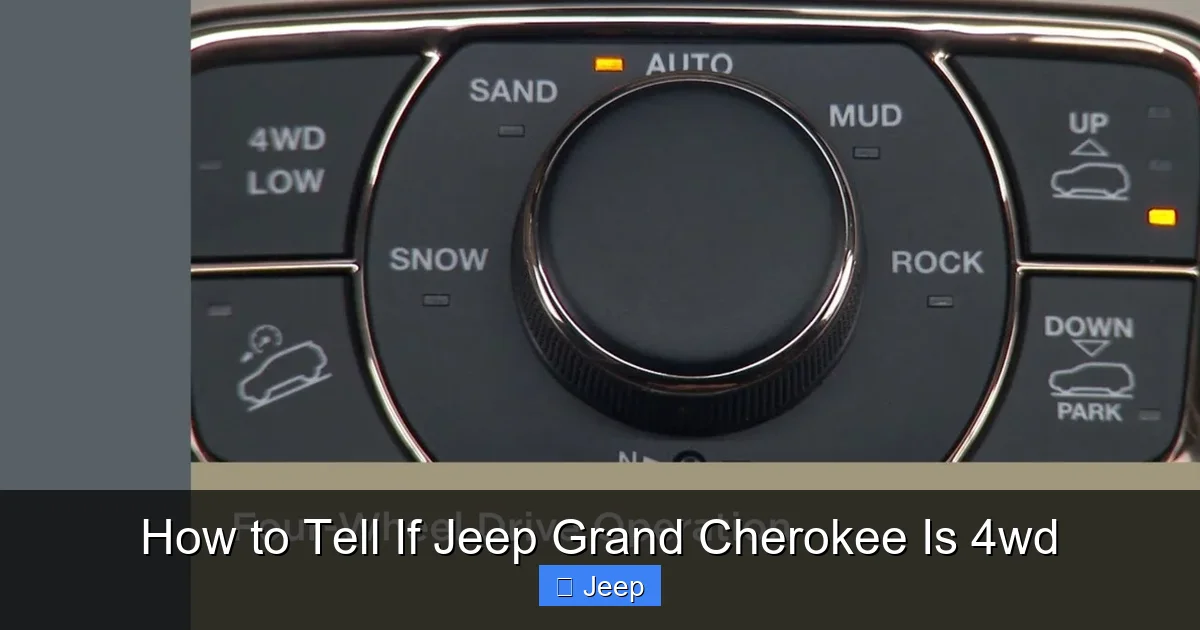
Look for a rotary knob, toggle switch, or push-button control near the center console or gear shifter. Jeep has used different designs over the years. Some models have a dial marked with 2H, 4H, N, and 4L. Others use a simple push-button system. If you find any of these controls, your Jeep Grand Cherokee 4WD system is factory-installed. This is one of the fastest and most reliable ways to confirm your drivetrain type.
Selec-Terrain and Selec-Track Systems
Higher trims may feature Jeep’s Selec-Terrain or Selec-Track traction management systems. These let you choose driving modes like Mud, Sand, Snow, and Rock. If your vehicle has these settings, it almost certainly includes a 4WD system. These modes are specifically designed to manage power delivery to all four wheels.
Trim Levels That Come With 4WD
Not every Jeep Grand Cherokee trim includes 4WD. In fact, base models often come in 2WD only. Here is a general breakdown to help you figure out what to expect.
Trims That Typically Include 4WD
Higher-end and off-road-oriented trims are much more likely to be 4WD. Think of models like the Trailhawk, Overland, Summit, and Summit Reserve. The Trailhawk trim is built specifically for off-roading and always comes with a 4WD system, a raised suspension, and skid plates. The Summit and Summit Reserve trims also typically include 4WD as standard or a common option.
Trims That May Be 2WD Only
The base Laredo and mid-level Limited trims sometimes come with rear-wheel drive only, especially in earlier model years. However, 4WD was usually available as an upgrade. Always confirm before assuming. Jeep also offered a special Trailhawk version that was specifically designed for serious off-roading. If you want to upgrade your Trailhawk’s suspension components, you might want to check out the best struts available for your specific model year.
Year-to-Year Differences
Drivetrain availability has changed across generations. The ZJ generation (1993-1998) offered both 2WD and 4WD. The WK generation (2005-2010) followed the same pattern. The current WL generation (2022 and beyond) continues to offer both. Always check the specific model year you are interested in, because configurations can shift.
Lift the Vehicle and Inspect the Drivetrain
For the most hands-on confirmation, physically inspecting the drivetrain is the gold standard. This method works on any Jeep Grand Cherokee regardless of year or trim.
What You Need
You will need a safe lift or jack stands, a flashlight, and a clean rag. Make sure the vehicle is on a flat, level surface with the parking brake engaged. Never rely solely on a jack without proper support.
Step-by-Step Inspection
Start at the rear. You should see a single driveshaft running from the transmission to the rear axle. That is standard for both 2WD and 4WD models. Now move forward. On a 4WD Jeep Grand Cherokee, you will find a second driveshaft running from the transfer case down to the front axle. The transfer case itself sits just behind the transmission and is connected to the engine via the input shaft.
If you see only one driveshaft and no transfer case, your vehicle is 2WD. If you see two driveshafts and a transfer case, you have confirmed 4WD. This method is 100% reliable and does not depend on badges, VINs, or dashboard settings.
When to Seek Professional Help
If you are not comfortable going under the vehicle, take it to a trusted mechanic. A quick inspection can confirm your drivetrain type in minutes. They can also check the condition of your 4WD components, including the transfer case fluid and front differential. Regular maintenance of these parts keeps your Jeep Grand Cherokee 4WD system running strong for years.
Common Questions About Jeep Grand Cherokee 4WD
Even with all the methods above, some questions still come up frequently. Let us clear up a few of the most common ones.
Can a 2WD Jeep Grand Cherokee Be Converted to 4WD?
Technically, yes, but it is extremely expensive and rarely practical. You would need a complete 4WD drivetrain swap, including a transfer case, front driveshaft, front differential, and upgraded suspension. In most cases, it makes far more sense to buy a 4WD model from the start. The cost and complexity of a conversion usually exceed the value difference between the two trims.
Does 4WD Affect Fuel Economy?
Yes, it does. A Jeep Grand Cherokee 4WD typically gets slightly fewer miles per gallon than the 2WD version. The added weight of the drivetrain components and the mechanical drag from the transfer case both contribute. If fuel efficiency is a priority, a 2WD model might be the better choice for daily driving.
Is 4WD the Same as AWD?
No, they are different. 4WD systems usually have a manual or electronic transfer case that lets you lock into a specific mode like 4H or 4L. AWD (all-wheel drive) systems send power to all wheels automatically and continuously, but usually without a low-range gear. Jeep Grand Cherokee 4WD systems are more versatile for serious off-roading, while AWD is better for on-road traction in rain or snow.
What Should I Do If My 4WD Light Comes On?
If a 4WD warning light appears on your dashboard, do not ignore it. It could indicate a problem with the transfer case, front actuator, or speed sensors. Try switching between 2H and 4H to see if the light clears. If it stays on, have your vehicle inspected promptly. Driving with a faulty 4WD system can cause further damage.
Can I Switch Between 2WD and 4WD While Driving?
On most Jeep Grand Cherokee models with an electronic transfer case, you can switch between 2H and 4H while driving at low speeds, typically under 55 mph. However, you should always come to a complete stop before engaging 4L. Check your owner’s manual for the exact speed limits and procedures for your specific model.
Does Towing Affect the 4WD System?
If you are towing with a 4WD Jeep Grand Cherokee, you should switch to 2WD when towing on flat, paved roads. Running 4WD while towing on dry pavement can cause unnecessary wear on the transfer case and drivetrain components. Switch back to 4WD when you encounter rough terrain, snow, or mud. This simple habit can extend the life of your system significantly.
Final Thoughts
Figuring out whether your Jeep Grand Cherokee is 4WD is not as hard as it might seem. You can check the badges, decode the VIN, inspect the dashboard controls, or get underneath the vehicle and look at the drivetrain directly. Each method gives you a reliable answer, and combining two or three of them makes it virtually certain.
Knowing your drivetrain type helps you make smarter decisions about maintenance, driving habits, and even future purchases. Whether you are heading off-road in a Trailhawk or cruising the highway in a 2WD Limited, understanding your Jeep Grand Cherokee 4WD system gives you more confidence behind the wheel. Take the time to verify your setup today, and you will always know exactly what your vehicle is capable of.
Frequently Asked Questions
How do I know if my Jeep Grand Cherokee is 4WD or 2WD?
The fastest way is to check for a transfer case and front driveshaft under the vehicle. You can also look for a 4×4 badge on the tailgate, check the eighth character of your VIN, or look for 4H/4L controls on the dashboard or center console.
Can I switch from 2WD to 4WD while driving?
On most modern Grand Cherokee models, you can switch from 2H to 4H while driving at speeds below 55 mph. However, you should always come to a stop before switching to 4L. Refer to your owner’s manual for exact guidance.
Is every Jeep Grand Cherokee equipped with 4WD?
No. Many Grand Cherokee models, especially base trims like the Laredo, come in 2WD only. Higher trims such as Trailhawk, Summit, and Overland are more likely to include 4WD, but you should always confirm for the specific model year and trim.
Does 4WD reduce fuel economy on the Jeep Grand Cherokee?
Yes. A Jeep Grand Cherokee 4WD typically gets slightly lower MPG than the 2WD version due to added drivetrain weight and mechanical friction. The difference varies by model year but is usually around 1-2 MPG combined.
What is the difference between 4WD and AWD on the Grand Cherokee?
4WD systems have a transfer case with selectable modes like 4H and 4L for off-road use. AWD systems send power to all wheels automatically but usually lack a low-range gear. Jeep Grand Cherokee 4WD models are better suited for serious off-roading.
How much does a Jeep Grand Cherokee weight differ between 2WD and 4WD?
The 4WD version is typically 100-200 pounds heavier than the 2WD model due to the transfer case, front driveshaft, and front differential. If you want detailed weight specs, you can check a dedicated weight guide for your specific model year.