A Truck and a Car Are Moving with Equal Velocity
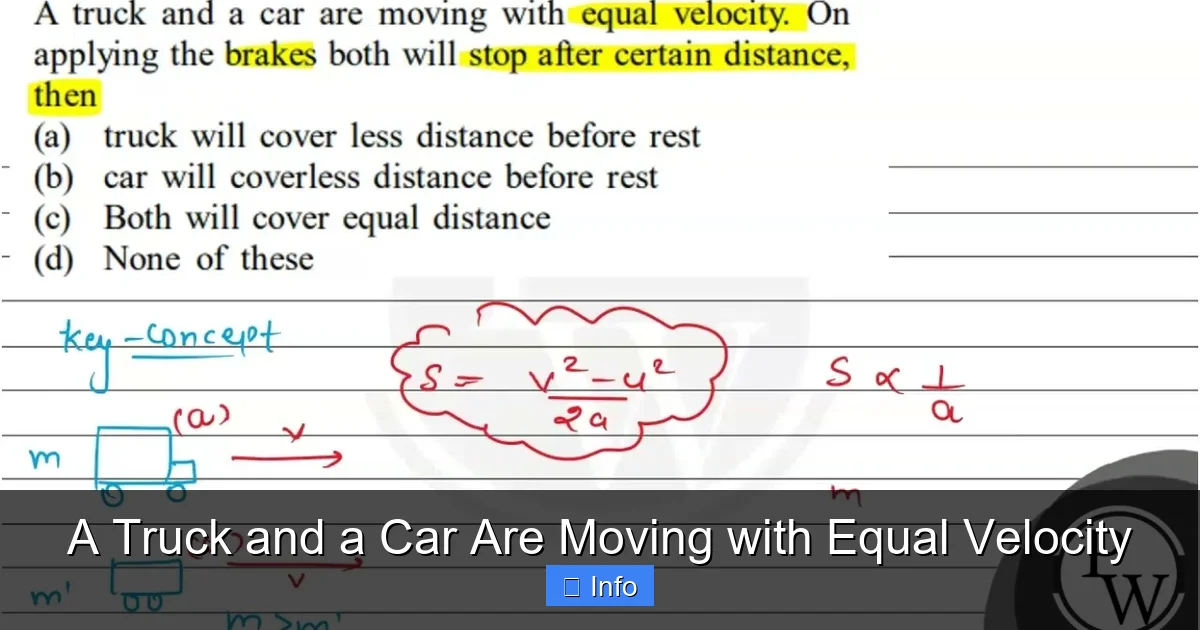
Even at equal velocity, a truck and a car are not physically identical in motion because mass dictates momentum and kinetic energy. The heavier truck needs more distance to brake and exerts far more force during impact, making velocity alone an incomplete measure of danger. This distinction is critical for understanding vehicle safety, collision dynamics, and real-world physics.
Key Takeaways
- Point 1: Both vehicles share identical speed and direction.
- Point 2: Truck’s greater mass results in higher momentum.
- Point 3: Braking distance will be longer for the truck.
- Point 4: More force is needed to accelerate the truck.
- Point 5: Fuel consumption varies with vehicle weight.
📑 Table of Contents
- A Truck and a Car Are Moving with Equal Velocity
- Understanding Velocity and What It Means on the Road
- The Physics of Mass: Why Weight Matters at the Same Speed
- Braking and Stopping Distance: Can They Stop in Time?
- Kinetic Energy and Collision Impact: The Force of Difference
- Practical Driving Tips: Sharing the Road Safely
- Conclusion: Respecting the Physics of the Road
A Truck and a Car Are Moving with Equal Velocity
Have you ever been driving on a highway and noticed a large semi-truck cruising right alongside a small sedan? They seem to be going the exact same speed, keeping pace with each other. But looks can be deceiving. When a truck and a car are moving with equal velocity, the physics of the situation are anything but equal. In everyday driving, we often think of speed in simple terms—how fast we are going. However, when we look closer at a truck and a car are moving with equal velocity, the differences in their mass, momentum, and energy create vastly different safety profiles. Understanding this difference is not just for physics class; it is essential for staying safe on the road. Let’s dive into what really happens when these two very different vehicles share the same speed.
Understanding Velocity and What It Means on the Road
Speed vs. Velocity: The Basics
When we talk about a truck and a car are moving with equal velocity, we are referring to both their speed and their direction of travel. In physics, velocity is a vector quantity, meaning it has both magnitude (speed) and direction. If both vehicles are traveling at 65 miles per hour in the same lane, their velocities are identical. However, in real-world driving, perfect alignment is rare. Even a slight change in direction or speed alters the velocity. For drivers, understanding that a truck and a car are moving with equal velocity helps us realize that they are not in the same physical state despite looking synchronized from a distance.
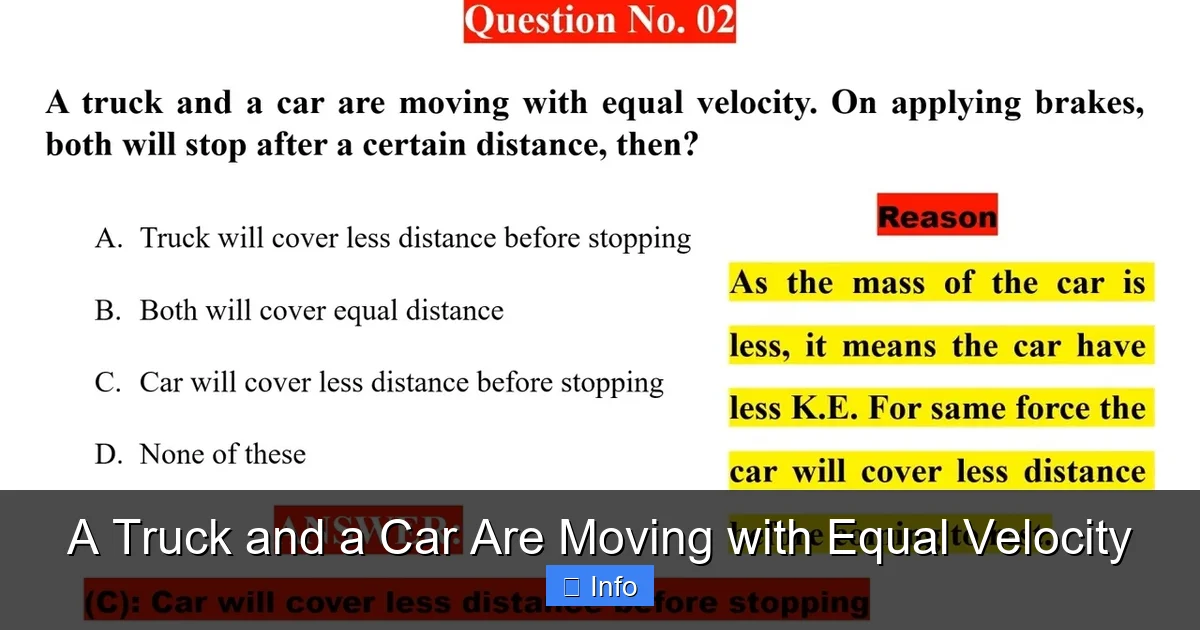
Visual guide about A Truck and a Car Are Moving with Equal Velocity
Image source: i.ytimg.com
Real-World Driving Scenarios
In practice, you will rarely see a truck and a car are moving with equal velocity for a long period. Traffic flow, hills, and wind constantly change speeds. But when they do align, it is a reminder that speed is only one part of the equation. The visual of a massive truck next to a small car at the same speed can be misleading because our brains naturally equate speed with safety. In reality, the physical properties of the two vehicles are completely different, making their behavior on the road highly unpredictable if either driver makes a sudden move.
The Physics of Mass: Why Weight Matters at the Same Speed
The Role of Inertia
Inertia is the resistance of any physical object to any change to its velocity. When a truck and a car are moving with equal velocity, the truck has much more mass, and therefore much more inertia. This means the truck will resist stopping or slowing down far more than the car. Imagine you are pushing a shopping cart versus pushing a loaded delivery truck. Even if both are moving at a walking pace, the truck requires immense force to stop. This is the same principle on the highway. The greater mass of the truck means it carries a massive amount of momentum.
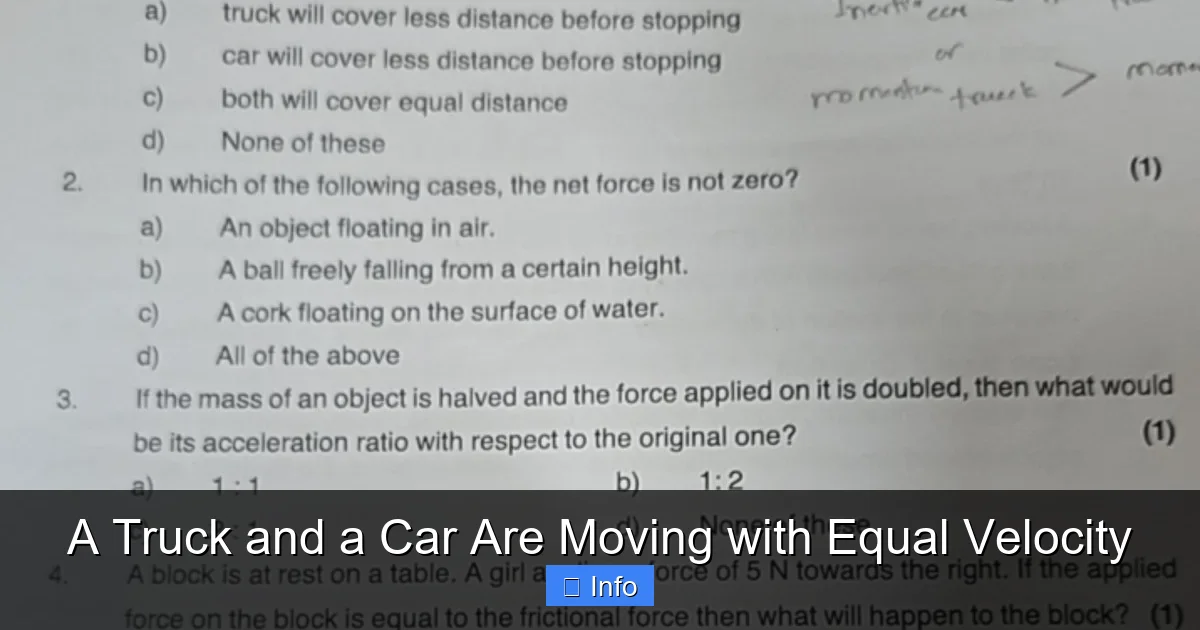
Visual guide about A Truck and a Car Are Moving with Equal Velocity
Image source: storage.googleapis.com
Momentum and Its Real-World Effects
Momentum is calculated by multiplying mass by velocity. Since a truck and a car are moving with equal velocity, the truck’s momentum is several times greater because of its weight. If you have ever tried to merge in front of a large truck, you know that even a small speed difference can create a dangerous situation because the truck’s momentum keeps it moving forward for a much longer time. To manage this, drivers should always maintain a safe following distance. When you are behind a truck, or when a truck and a car are moving with equal velocity, remember that the truck’s massive momentum means it cannot stop on a dime. This is why understanding the weight distribution and overall mass of your vehicle is crucial for safe driving.
Braking and Stopping Distance: Can They Stop in Time?
How Brakes Work Under Load
One of the most critical differences when a truck and a car are moving with equal velocity is their stopping distance. While modern trucks have powerful air brake systems, the sheer weight of the truck means the brakes must dissipate a massive amount of kinetic energy. A fully loaded semi-truck can weigh up to 80,000 pounds, while a typical car weighs around 3,500 pounds. Even if both are moving at the same speed, the truck requires up to two to three times the distance to come to a complete stop. This is why truck drivers need to leave plenty of space ahead of them.
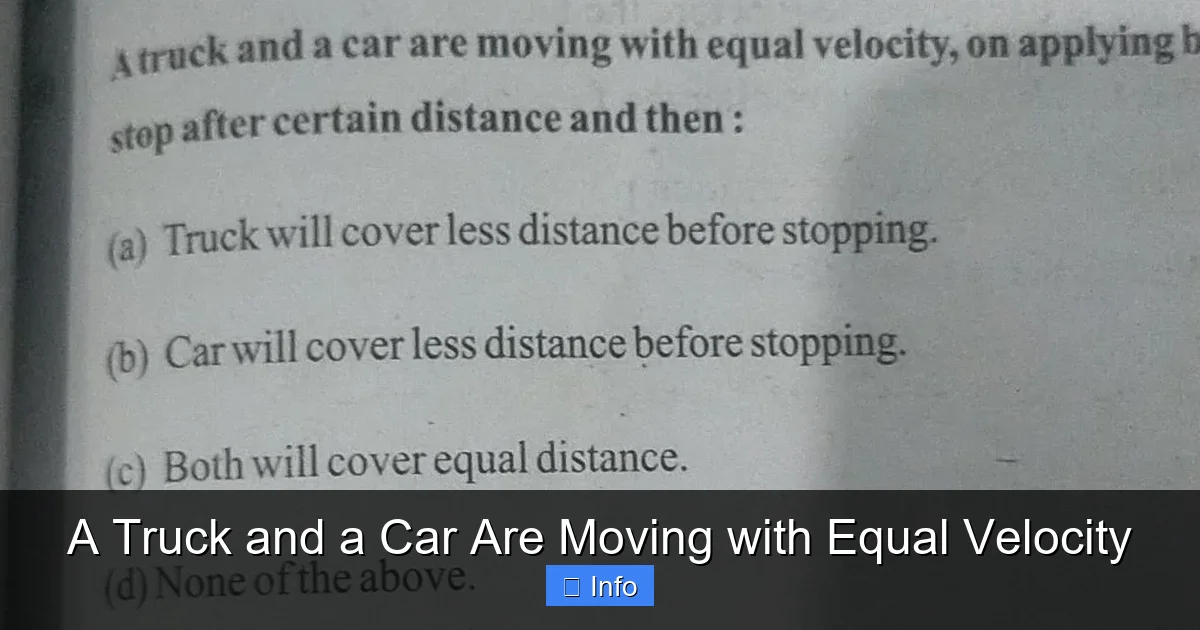
Visual guide about A Truck and a Car Are Moving with Equal Velocity
Image source: media.studyxapp.com
Practical Tips for Drivers
If you find yourself in a situation where a truck and a car are moving with equal velocity, and the car needs to brake suddenly, the truck behind it will not be able to stop in time. As a car driver, avoid sudden braking in front of a truck. Always signal early and give trucks ample room to slow down. If you are driving the truck, ensure your brakes are well-maintained and that you are actively scanning the road ahead to anticipate stops. For those looking to optimize their vehicle’s stopping power, choosing the right components is key. You might want to check out resources on best car shocks and struts for a smooth ride to ensure your vehicle handles braking forces effectively, or explore best car tire brands for performance and safety to get the best grip on the road.
Kinetic Energy and Collision Impact: The Force of Difference
The Formula of Force
Kinetic energy is the energy an object possesses due to its motion. The formula is KE = 0.5 * mass * velocity squared. When a truck and a car are moving with equal velocity, the velocity term is the same for both. However, because the truck’s mass is so much larger, its kinetic energy is exponentially higher. In a collision, this energy must go somewhere. If a truck and a car collide while moving at the same speed, the car will absorb the vast majority of the kinetic energy. The structural integrity of the car is often overwhelmed, leading to severe damage and a high risk of injury.
Understanding the Data
To make this clearer, let’s look at a simple comparison table showing the relative impact of mass on kinetic energy when velocities are equal.
| Vehicle Type | Average Weight (lbs) | Velocity (mph) | Relative Kinetic Energy |
|---|---|---|---|
| Compact Car | 3,000 | 60 | 1x (Baseline) |
| Sedan | 4,000 | 60 | 1.33x |
| Light Truck/SUV | 6,000 | 60 | 2x |
| Large Semi-Truck | 80,000 | 60 | 26.7x |
As the table shows, the difference is staggering. A large semi-truck has over 26 times the kinetic energy of a compact car at the same speed. This explains why collisions with heavy trucks are so devastating. The physical force involved is not just a matter of speed, but of total mass and the energy it carries.
Practical Driving Tips: Sharing the Road Safely
What Car Drivers Should Do
When you are driving near a truck, especially when a truck and a car are moving with equal velocity, you must be extra cautious. Car drivers should avoid driving in blind spots (the “No-Zone”) where the truck driver cannot see you. Since the truck has a much longer stopping distance, do not cut in front of it closely. Always maintain a safe following distance when you are behind a truck. If you need to pass, do so quickly and safely, ensuring you have plenty of room to merge back. Remember, the truck’s momentum means it cannot stop quickly, so your actions must be predictable.
What Truck Drivers Should Do
Truck drivers face the challenge of managing a massive vehicle. When a truck and a car are moving with equal velocity, the truck driver must be hyper-aware of the car’s limitations. Car drivers can stop much faster, so truck drivers should anticipate sudden stops from cars ahead. Regular maintenance of truck systems, especially the brakes and tires, is vital. If you are looking for the best gear for your truck, consider checking out best truck tires for performance and durability or best truck tire sizes for performance and safety to ensure maximum traction and stopping power. Proper equipment is your first line of defense when sharing the road with faster-stopping vehicles.
Conclusion: Respecting the Physics of the Road
In conclusion, when a truck and a car are moving with equal velocity, they are not equal in any other physical aspect. The truck’s greater mass translates to more momentum, longer stopping distances, and vastly higher kinetic energy. This physical reality dictates how we must drive. By understanding these principles, we can all be safer drivers. Car drivers must give trucks plenty of space, and truck drivers must remain vigilant of surrounding traffic. Respecting the physics of the road is the key to preventing accidents and ensuring everyone gets to their destination safely. Drive smart, stay aware, and keep safety first.
Frequently Asked Questions
What does it mean when a truck and a car are moving with equal velocity?
It means both vehicles are traveling at the same speed and direction at any given moment. Even though their sizes and masses differ, their instantaneous velocity vectors are identical.
How does the momentum compare between a truck and a car if they have the same velocity?
Momentum is mass times velocity, so the truck’s momentum will be much larger because of its greater mass. While the car’s momentum is smaller, both share the same velocity component.
Why does a truck have more kinetic energy than a car even when both travel at the same speed?
Kinetic energy depends on mass and the square of velocity (½mv²). Since the truck’s mass is far greater, its kinetic energy is higher even though the velocity is the same.
Can a truck and a car have the same velocity but different accelerations?
Yes, they can have equal velocity but different accelerations if one is speeding up or braking more sharply. Velocity describes current speed and direction, while acceleration describes how quickly that velocity changes.
Does the fuel consumption differ for a truck and a car traveling at the same speed?
Generally, a truck consumes more fuel at the same speed because its engine must overcome greater aerodynamic drag and rolling resistance. However, modern diesel engines are optimized for highway cruising, so the difference can vary.
How does the stopping distance differ for a truck and a car moving with equal velocity?
The truck requires a longer stopping distance because its greater mass and kinetic energy need more braking force. Even with identical speeds, the vehicle’s mass and brake efficiency significantly affect how quickly it can come to a halt.