Personal Car Introduced in the Business Journal Entry

Introducing a personal car into business use requires careful journal entry recording for tax and accounting purposes. This guide explains the proper way to document vehicle usage changes, calculate depreciation, and maintain compliance with IRS regulations.
Key Takeaways
- Point 1: When a personal car is introduced for business use, you must establish its business purpose percentage for tax deductions.
- Point 2: The initial journal entry records the vehicle’s fair market value and converts it from personal to business asset.
- Point 3: Depreciation is calculated based on the business use percentage and applicable IRS guidelines.
- Point 4: Maintaining detailed mileage logs is crucial for substantiating business versus personal use.
- Point 5: Tax implications vary depending on whether the vehicle is used by the owner or employees.
- Point 6: Proper documentation prevents audit issues and maximizes legitimate business deductions.
📑 Table of Contents
Understanding the Basics of Personal Car Business Introduction
Let’s talk about something that happens more often than you might think: introducing a personal car into business use. Maybe you’ve started a side hustle, launched a consulting practice, or your small business just needs an extra set of wheels for client visits. Whatever the reason, when you start using your personal vehicle for business purposes, there are important accounting steps you need to take.
Think of it like this: your car was once purely personal – maybe you drove it to the grocery store, took weekend road trips, or used it for your daily commute. But now it’s wearing two hats. It’s still your car for personal stuff, but it’s also helping generate income for your business. This dual-purpose situation requires proper documentation and accounting treatment.
The process isn’t as complicated as it might sound, but it does require attention to detail. We’re going to walk through everything you need to know about recording this transition properly, from the initial journal entry to ongoing maintenance of your records.
What Constitutes Business Use of a Personal Vehicle?
Before we dive into the journal entries, let’s clarify what actually counts as business use. The IRS has specific guidelines here, and understanding them is crucial for proper accounting.
Business use typically includes trips made for client meetings, deliveries, site visits, or other work-related activities. However, your daily commute from home to your regular workplace generally doesn’t qualify. The key is that the primary purpose of the trip must be business-related.
Here’s a practical example: if you’re a freelance photographer and you drive to a client’s house to take pictures, that’s clearly business use. But if you drive to your home office (which is your regular workplace) and then take your camera gear to a nearby park for a personal shoot, that portion might not qualify as business use.
The Initial Journal Entry Process
Now let’s get into the nitty-gritty: how to actually record this in your business books. The initial journal entry is the foundation for all future accounting related to your vehicle’s business use.
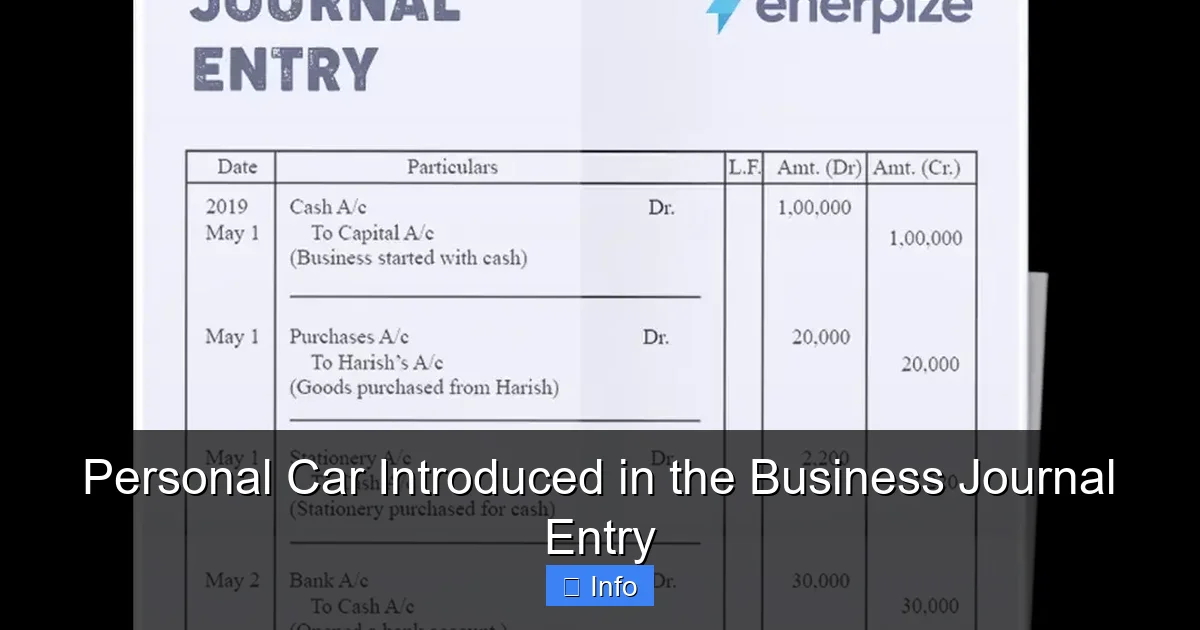
Visual guide about Personal Car Introduced in the Business Journal Entry
Image source: enerpize.com
When you introduce a personal car into business use, you’re essentially converting part of a personal asset into a business asset. The value you use for this conversion is typically the car’s current fair market value, not what you originally paid for it.
Here’s how the basic journal entry looks:
- Debit: Vehicle (Asset) – for the business-use portion of fair market value
- Credit: Owner’s Equity/Capital Contribution – for the same amount
Let’s say your car is worth $20,000 and you estimate it will be used 60% for business. Your journal entry would look like this:
- Debit: Vehicle (Asset) $12,000
- Credit: Owner’s Equity $12,000
This simple entry establishes your business’s claim on the vehicle and sets the stage for depreciation calculations going forward.
Determining Fair Market Value
figuring out your car’s fair market value is one of those areas where people often get tripped up. You can’t just guess or use what you think it’s worth. You need a reasonable, defensible number.
The easiest approach is to check resources like Kelley Blue Book or Edmunds to get an estimate of your vehicle’s current market value. You can also look at comparable sales in your area – what similar cars with the same year, make, model, and condition are actually selling for.
Another option is to get a professional appraisal, though this is usually overkill unless you’re dealing with a particularly valuable vehicle. For most people, using KBB or Edmunds values will be perfectly acceptable.
Remember: you want the value at the time you introduce the vehicle to business use, not its original purchase price. Cars depreciate quickly, and using an inflated value could raise red flags during an audit.
Depreciation and Ongoing Accounting
Once you’ve made that initial journal entry, the real work begins – and by “work,” I mean the ongoing accounting that keeps everything compliant and accurate. This is where depreciation comes into play.
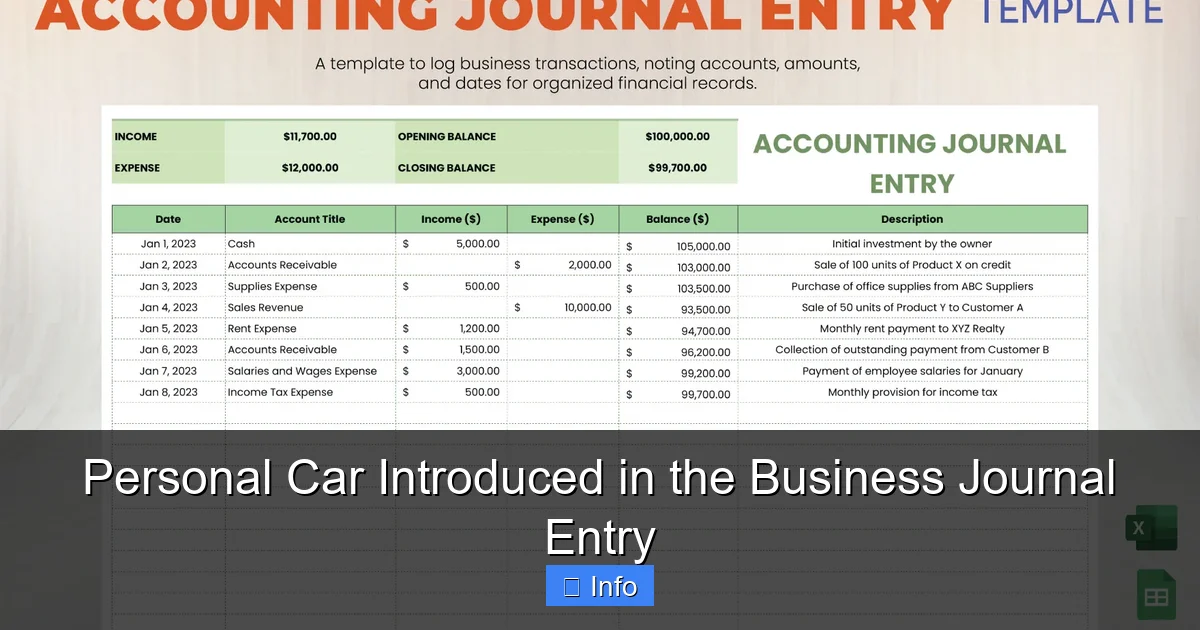
Visual guide about Personal Car Introduced in the Business Journal Entry
Image source: images.template.net
Depreciation is how businesses spread the cost of a vehicle over its useful life. Instead of deducting the entire value in year one, you deduct a portion each year. This makes sense because your car doesn’t suddenly lose all its value after one year of business use.
The IRS provides specific depreciation methods and rates for vehicles. For passenger cars placed in service after 2017, the limits are $10,000 for the first year, $16,000 for the second year, $9,600 for the third year, and $5,760 for each subsequent year.
Here’s a practical example: if you have a $12,000 business-use vehicle (based on our earlier example), your first-year depreciation would be limited to $10,000. In the second year, you’d depreciate the remaining $2,000 (or the annual limit, whichever is less).
Calculating Business Use Percentage
The business use percentage is probably the most critical number in this whole process. Get it wrong, and your depreciation and expense deductions will be off. Too high, and you risk an audit. Too low, and you’re leaving money on the table.
The standard approach is to track your actual mileage and determine what percentage was for business versus personal use. This means keeping a detailed log throughout the year.
For example, if you drove 12,000 miles total in a year and 7,200 of those were for business, your business use percentage would be 60%. This percentage applies to both depreciation and operating expenses.
Some people try to estimate their business use, but the IRS prefers actual records. You’ll want to document the date, destination, purpose, and starting/ending odometer readings for each business trip.
Tax Implications and Considerations
Tax season is when all these accounting decisions really matter. The way you handle your personal car’s introduction into business use can significantly impact your tax bill – both positively and negatively.
On the positive side, you can deduct business-related vehicle expenses. This includes not just depreciation, but also things like gas, insurance, maintenance, and even parking fees or tolls. But remember, you can only deduct the business-use percentage of these expenses.
There’s an important decision to make: actual expenses versus standard mileage rate. The IRS offers a standard mileage rate that changes each year. For 2023, it’s 65.5 cents per mile for business use. You can choose to use this rate instead of tracking actual expenses, which can simplify things considerably.
However, if you choose the standard mileage rate in the first year you use the vehicle for business, you’re locked into that method for the vehicle’s entire business life. If you want to deduct actual expenses, you need to make that choice from the start.
Employee vs. Owner Use
Another consideration is whether the vehicle will be used by the business owner or by employees. The tax treatment can differ significantly between these scenarios.
If you’re using your personal car for your own business, the rules we’ve discussed apply directly. But if employees are using company vehicles or their personal cars for business, different rules come into play.
For employees using their personal vehicles, they can typically only deduct unreimbursed employee expenses if they itemize deductions. However, many businesses choose to reimburse employees for business use of personal vehicles, which creates a different set of accounting entries and tax implications.
Record-Keeping Best Practices
You know that saying about the devil being in the details? Well, when it comes to using a personal car for business, the IRS is definitely the devil, and the details are your records. Without proper documentation, even the most legitimate business expenses can be disallowed.
The cornerstone of good record-keeping is maintaining a contemporaneous mileage log. This means logging your trips as they happen, not trying to remember them at year-end. Your log should include the date, destination, business purpose, and miles driven.
Modern technology makes this easier than ever. There are apps that automatically track your mileage using your phone’s GPS. These can be a lifesaver for staying organized, but make sure you categorize trips properly.
Beyond mileage logs, keep all receipts for vehicle-related expenses. Gas station receipts, oil change invoices, insurance bills, and repair orders should all be saved. Even if you use the standard mileage rate, having these records can help if you decide to switch methods later.
Common Mistakes to Avoid
Let’s be honest: nobody sets out to make accounting mistakes. But when it comes to recording a personal car’s introduction into business use, there are some common pitfalls that catch people off guard.
One of the biggest mistakes is failing to establish a consistent business use percentage. Some people try to adjust their percentage mid-year, which complicates depreciation calculations. It’s better to stick with one percentage throughout the year.
Another common error is mixing personal and business expenses without proper allocation. If you fill up your tank and some of that gas is for personal driving, you need to account for that split.
Some people also forget to update their insurance policies when they start using their personal vehicle for business. Most personal auto policies have restrictions on business use, so you may need to add a business use endorsement or switch to a commercial policy.
Practical Examples and Scenarios
Let’s bring this all together with some real-world scenarios to show how this works in practice.
Scenario 1: Sarah, a freelance graphic designer, starts using her 2020 Honda Civic (worth $18,000) for client meetings and design consultations. She estimates 70% business use. Her initial journal entry would debit Vehicle for $12,600 (70% of $18,000) and credit Owner’s Equity for the same amount. Throughout the year, she tracks 8,400 business miles out of 12,000 total miles, confirming her 70% estimate.
Scenario 2: Mike, a small construction business owner, purchases a new pickup truck for $30,000 and uses it exclusively for business. Since it’s 100% business use, he would debit Vehicle for $30,000 and credit Cash or Loans Payable, depending on how he purchased it. His depreciation would be calculated on the full amount.
These examples illustrate how the principles we’ve discussed apply to different situations. Whether you’re transitioning a personal vehicle or purchasing a new one for business, the fundamental accounting treatment remains the same.
Working with Professionals
While you can certainly handle the accounting for your personal car’s business use yourself, there are times when bringing in a professional makes sense. Accountants and bookkeepers can help ensure you’re taking advantage of all available deductions while staying within IRS guidelines.
If you’re starting a new business or significantly expanding your vehicle usage, a consultation with a tax professional can pay dividends. They can help you choose between actual expenses and the standard mileage rate, set up your depreciation schedule, and ensure your record-keeping meets audit standards.
Even if you handle your own books, consider having a professional review your approach at least once a year. They might spot opportunities you missed or flag potential issues before they become problems.
Moving Forward Successfully
Bringing a personal car into business use is one of those transitions that seems simple but has important implications. By understanding the proper journal entry process, maintaining accurate records, and staying compliant with tax regulations, you can maximize your legitimate business deductions while minimizing audit risk.
Remember that this isn’t a one-time event but an ongoing process. Each year, you’ll need to reassess your business use percentage, continue tracking expenses, and update your depreciation calculations. The good news is that once you establish good habits and systems, it becomes routine.
The investment you make in proper accounting today will pay off in peace of mind and potentially significant tax savings. Whether you’re driving for a side hustle or running a full-fledged business, treating your vehicle properly in your books is just good business practice.
So go ahead – take that personal car and put it to work for your business. Just make sure you’re doing it the right way, with proper documentation and accounting treatment. Your future self (and your accountant) will thank you.
Wrapping Up: Your Path to Success
Introducing a personal car into business use doesn’t have to be overwhelming. With the right approach, proper documentation, and attention to detail, you can navigate this process successfully while maximizing your business benefits. The key is starting with accurate records, making informed decisions about expense tracking methods, and maintaining consistency throughout the year.
Whether you’re just starting out or looking to improve your existing processes, remember that good accounting practices are an investment in your business’s success. They provide valuable insights into your operations, help you make better financial decisions, and ensure compliance with tax regulations. Take the time to do it right, and you’ll build a solid foundation for your business’s financial health.
Frequently Asked Questions
How do I determine the fair market value of my personal car for business use?
Use resources like Kelley Blue Book or Edmunds to get a current market value estimate. You can also research comparable sales in your area to verify the value. The key is using the vehicle’s value at the time you introduce it to business use, not its original purchase price.
Can I switch between actual expenses and the standard mileage rate?
If you use the standard mileage rate in your first year of business use, you’re generally locked into that method for the vehicle’s entire business life. If you want to deduct actual expenses, you must make that choice from the beginning. However, you can switch between methods for different vehicles.
What records do I need to keep for business vehicle use?
Maintain a detailed mileage log showing date, destination, business purpose, and miles for each trip. Keep all receipts for gas, maintenance, insurance, and other vehicle expenses. For the standard mileage rate, you’ll still want supporting documentation in case of an audit.
Do I need to adjust my insurance when using my personal car for business?
Most personal auto policies restrict business use, so you should contact your insurance company. You may need to add a business use endorsement or switch to a commercial policy. Operating without proper coverage could void your policy in the event of an accident.
How is depreciation calculated for a personal car used in business?
Depreciation is based on the business-use percentage of the vehicle’s fair market value at the time of introduction. The IRS provides specific depreciation limits for passenger vehicles, which change periodically. You’ll typically use either the straight-line or modified accelerated cost recovery system method.
What happens if I change the business use percentage mid-year?
You should try to maintain a consistent business use percentage throughout the year. If your usage changes significantly, consult with a tax professional about the proper accounting treatment. Changing percentages mid-year can complicate depreciation calculations and may raise questions during an audit.