Is Pollution Certificate Required for Bs6 New Car
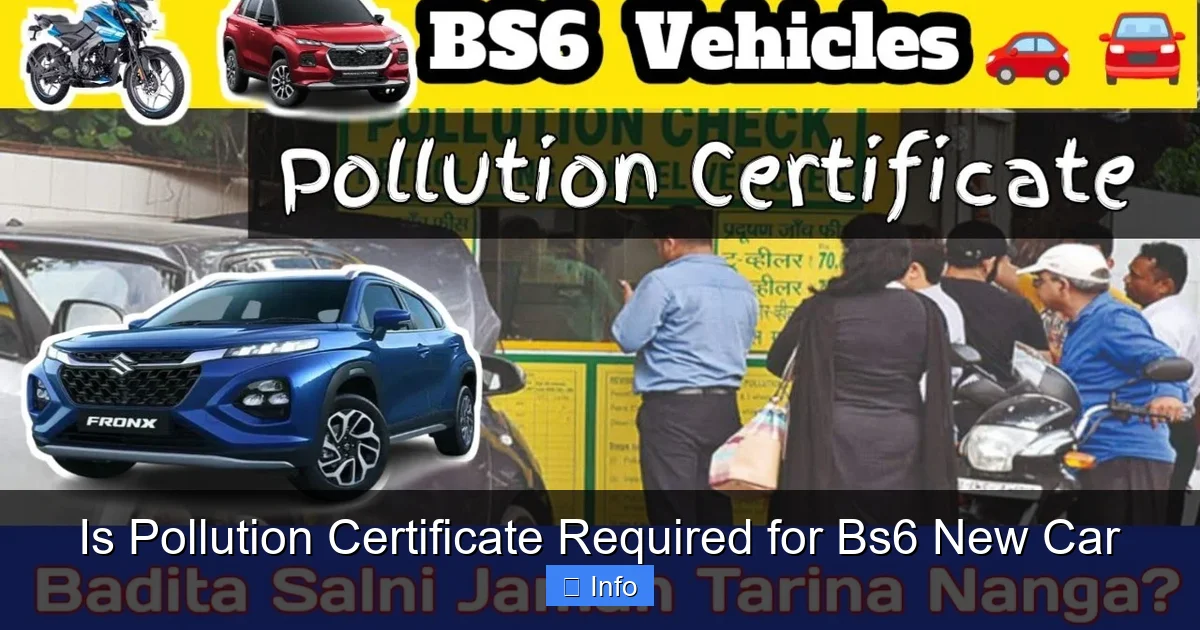
Yes, a pollution certificate (PUC) is required for BS6 new cars, but not immediately. New vehicles come with a manufacturer’s compliance certificate valid for one year. After that, you must get a PUC test every six months to stay legal on Indian roads.
Buying a brand-new car is exciting. You get that fresh interior smell, the latest tech, and the peace of mind that comes with a factory warranty. But amidst the celebrations, a practical question often pops up: is pollution certificate required for bs6 new car owners right away? The short answer is no, not on day one. However, the rules kick in faster than many people realize. Let’s break down exactly what the law says, how long your factory coverage lasts, and what you need to do to stay on the right side of the Motor Vehicles Act.
India transitioned to Bharat Stage 6 (BS6) emission norms in April 2020. These standards are equivalent to Euro 6 and represent a massive leap in cleaning up tailpipe emissions. Because BS6 engines are engineered to run much cleaner than their BS4 predecessors, the government grants a grace period for new vehicles. But that grace period has a hard deadline. Understanding the timeline saves you from fines and ensures your insurance claims remain valid.
Key Takeaways
- New BS6 cars have a one-year exemption: The manufacturer provides a compliance certificate valid for 12 months from registration.
- PUC becomes mandatory after one year: Once the initial validity expires, you must get a Pollution Under Control certificate every six months.
- BS6 norms are stricter: These engines emit significantly lower pollutants, making the PUC test easier to pass but still legally required.
- Digital PUC is now standard: Certificates are issued online and linked to the VAHAN database; carry a digital or printed copy.
- Penalties for non-compliance are steep: Fines can reach ₹10,000 or more for driving without a valid PUC after the exemption period.
- Testing is quick and affordable: Authorized centers charge a nominal fee (typically ₹60–₹100) and the test takes only a few minutes.
- Keep records handy: Store the digital copy on your phone and a printout in the glovebox for traffic checks.
📑 Table of Contents
- Understanding the Initial Exemption Period
- When Does the PUC Requirement Actually Start?
- Why BS6 Makes the PUC Test Easier (But Not Optional)
- Digital PUC: How the Modern System Works
- Penalties, Insurance, and Other Consequences
- Practical Tips to Stay Compliant Effortlessly
- Common Myths Busted
- Conclusion
Understanding the Initial Exemption Period
Every new car sold in India leaves the factory with a Type Approval Certificate (TAC) and a Form 22 (Road Worthiness Certificate). These documents certify that the vehicle meets BS6 emission standards right out of the box. Based on this, the Central Motor Vehicles Rules (CMVR) grant a one-year exemption from carrying a separate Pollution Under Control (PUC) certificate.
How the One-Year Clock Works
The exemption period starts from the date of registration, not the date of manufacture or invoice. If your car was registered on 15th July 2024, your factory compliance covers you until 14th July 2025. During this window, traffic police cannot challan you for not having a PUC certificate. However, you must carry the registration certificate (RC) and a valid insurance policy at all times.
What Documents Prove Exemption?
If stopped, show the registering authority’s stamp on your RC. The RC itself serves as proof that the vehicle is within its first year. Some owners also keep a copy of Form 22 provided by the dealer. While not legally mandatory to carry Form 22, it can smooth things over if an officer is unfamiliar with the rule.
When Does the PUC Requirement Actually Start?
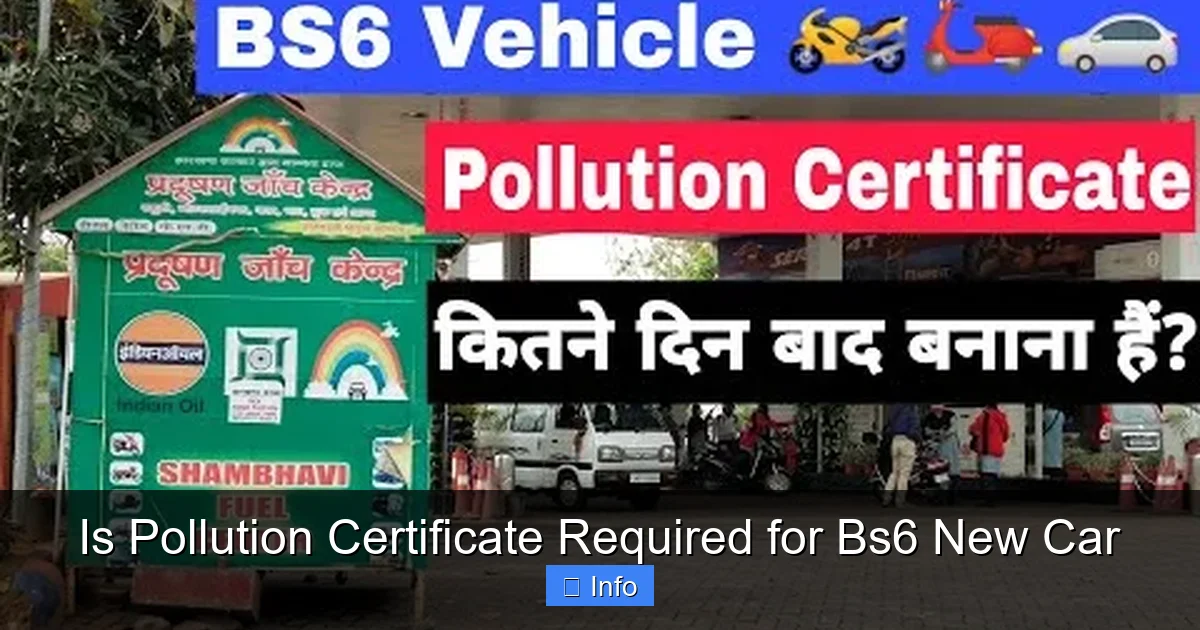
The moment your car completes one year from its registration date, the exemption evaporates. From that day forward, you are legally required to possess a valid PUC certificate. The first test must be done before the first anniversary of registration. Many owners schedule it a week or two early to avoid any last-minute rush.
Visual guide about Is Pollution Certificate Required for Bs6 New Car
Image source: i.ytimg.com
First PUC Test: What to Expect
Your first PUC test is straightforward. Drive to any authorized emission testing center—usually found at petrol pumps or standalone workshops. The technician will insert a probe into the exhaust pipe, rev the engine to specified RPMs, and measure pollutants like carbon monoxide (CO), hydrocarbons (HC), and nitrogen oxides (NOx). For BS6 petrol cars, the limits are extremely tight: CO ≤ 0.3% and HC ≤ 200 ppm. Diesel BS6 cars have separate opacity limits. Because the engine is new and calibrated to BS6 norms, passing is almost guaranteed unless there’s a mechanical fault.
Validity of the First and Subsequent Certificates
The very first PUC certificate you obtain after the one-year exemption is valid for six months. Every subsequent certificate is also valid for six months. This means you will visit the testing center twice a year, every year, for the life of the vehicle. Mark your calendar or set a phone reminder a month before expiry.
Why BS6 Makes the PUC Test Easier (But Not Optional)
BS6 technology includes advanced after-treatment systems: gasoline particulate filters (GPF) for petrol engines and selective catalytic reduction (SCR) with AdBlue for diesels. These systems slash particulate matter and NOx by 70-80% compared to BS4. Consequently, a well-maintained BS6 car will sail through the PUC test with readings far below the permissible limits.
Visual guide about Is Pollution Certificate Required for Bs6 New Car
Image source: i.ytimg.com
Don’t Let Cleanliness Breed Complacency
Just because your car runs clean doesn’t mean you can skip the test. The law is absolute: no valid PUC = violation. Traffic police now use handheld devices linked to the VAHAN database. They can instantly check your PUC status by entering your registration number. If the database shows an expired or missing certificate, a challan is issued on the spot—even if your actual emissions are near zero.
Real-World Scenario: The Forgotten Renewal
Imagine Rahul buys a BS6 sedan in March 2023. He enjoys the exemption until March 2024. Life gets busy, and he forgets to get the PUC done in April. In June, he’s stopped at a checkpoint. The officer checks VAHAN, sees no PUC record, and issues a ₹10,000 challan under Section 190(2) of the Motor Vehicles Act. Rahul’s clean engine doesn’t matter; the missing certificate does. This scenario plays out daily across metros.
Digital PUC: How the Modern System Works
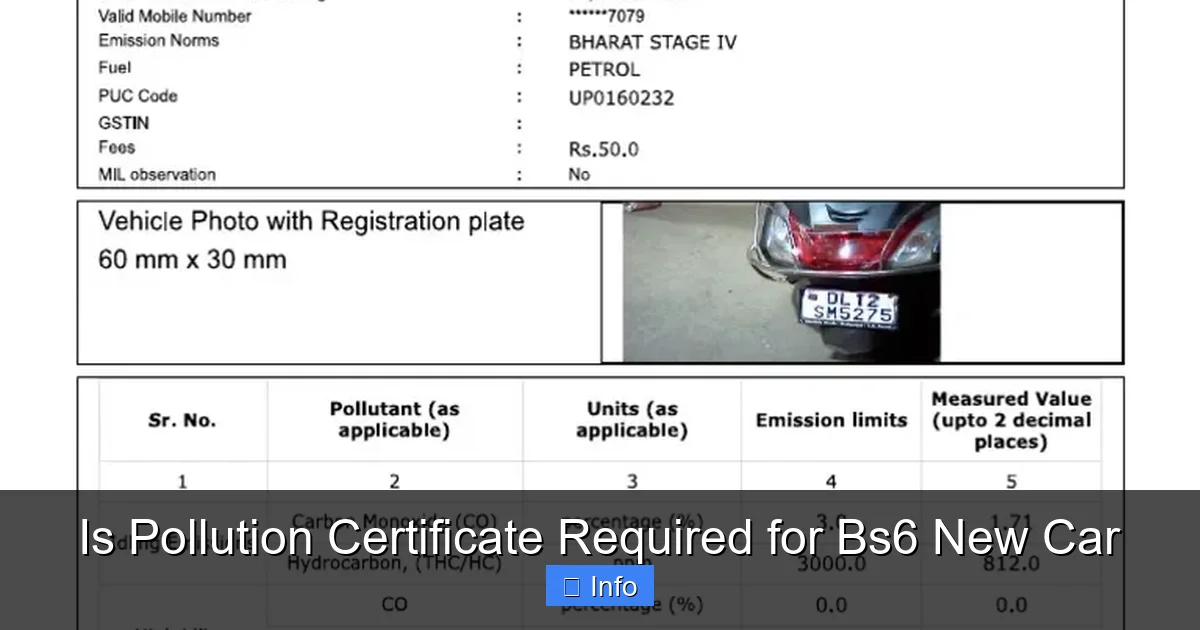
Gone are the days of laminated paper cards that fade in the sun. Since 2020, PUC certificates are issued digitally. The testing center uploads the result to the central VAHAN portal. You receive an SMS with a link to download the PDF. This digital certificate is legally valid across India.
Visual guide about Is Pollution Certificate Required for Bs6 New Car
Image source: imgv2-1-f.scribdassets.com
Carrying Proof: Digital vs. Physical
The Ministry of Road Transport and Highways (MoRTH) has clarified that a digital copy on your smartphone (via mParivahan or DigiLocker app) is equally valid as a printout. However, network connectivity can be spotty inside buildings or tunnels. Savvy drivers keep both: a PDF saved offline on the phone and a printed copy in the glovebox. It takes two minutes to print and saves potential hassle.
Checking Your PUC Status Online
You can verify your PUC status anytime at the VAHAN portal or the mParivahan app. Enter your registration number and chassis number (last five digits). This is useful if you misplace the SMS or want to confirm the testing center uploaded the data correctly.
Penalties, Insurance, and Other Consequences
The fine for driving without a valid PUC certificate is ₹10,000 for the first offence and can go higher for repeat violations. But the financial hit doesn’t stop there.
Impact on Motor Insurance Claims
If you meet with an accident and your PUC was expired at the time, your insurer can reject the claim. The Insurance Regulatory and Development Authority of India (IRDAI) has mandated that a valid PUC is a prerequisite for claim settlement. This applies to both own-damage and third-party claims. A ₹100 test saves you from losing lakhs in coverage.
Renewal of Registration (RC)
When your car turns 15 years old (10 years in Delhi-NCR for diesel), you need to renew the Registration Certificate. The RTO will ask for a valid PUC certificate as part of the renewal paperwork. A gap in PUC history can delay the process.
Practical Tips to Stay Compliant Effortlessly
Compliance doesn’t have to be a chore. Build a tiny habit loop and you’ll never miss a deadline.
Set Automated Reminders
Use Google Calendar, your phone’s reminder app, or the mParivahan app’s built-in alert feature. Set two alerts: one 30 days before expiry, another 7 days before. When the first alert fires, book a slot at your nearest center.
Choose a Convenient Testing Center
Identify a center on your daily commute—maybe the petrol pump where you refuel weekly. Many centers now offer online booking via WhatsApp or their website. Book a 10-minute slot; the actual test takes 3 minutes. If you’re getting the car serviced, ask the workshop to do the PUC test simultaneously. Most authorized service centers are also authorized PUC centers.
Keep a “Car Docs” Folder
Create a physical folder (or a dedicated digital folder on your phone) for: RC, Insurance, PUC, Driver’s License, and FASTag receipt. Update it every six months. When the new PUC PDF arrives, replace the old one immediately. This folder lives in the glovebox or your daily bag.
Watch for AdBlue Warnings (Diesel Owners)
If you drive a BS6 diesel, the AdBlue (DEF) level directly affects emissions. A low AdBlue warning will eventually limit engine starts. Top up promptly—not just for PUC, but to avoid being stranded. A full AdBlue tank ensures the SCR system works optimally during the test.
Common Myths Busted
Myth 1: “My Car Is Electric, So No PUC Needed.”
Fact: Electric vehicles (EVs) are exempt from PUC requirements because they have zero tailpipe emissions. This is one of the few genuine exemptions. However, you still need valid insurance and RC.
Myth 2: “I Got a PUC Last Year, So I’m Good for Another Year.”
Fact: PUC validity is strictly six months for all vehicles older than one year. There is no annual certificate.
Myth 3: “Dealer Said I Don’t Need PUC for Three Years.”
Fact: Some dealers mistakenly confuse the warranty period (often 3 years) with PUC exemption. The exemption is only 1 year. Always verify with the RTO or VAHAN portal.
Myth 4: “If I Don’t Drive Much, I Don’t Need PUC.”
Fact: The requirement is based on calendar time, not mileage. Even a garage-kept car needs a valid PUC if it’s on the road.
Conclusion
So, is pollution certificate required for bs6 new car buyers? Not for the first 12 months. The manufacturer’s compliance certificate covers you. But the day that first anniversary arrives, the rule changes completely. You must have a valid PUC certificate renewed every six months thereafter. The process is cheap, fast, and now fully digital. Set a reminder, keep a copy handy, and you’ll never face a challan or an insurance headache. Your BS6 engine is built to run clean—prove it on paper twice a year and enjoy the drive worry-free.
While you’re taking care of compliance, don’t forget the fun parts of new car ownership. If you’re looking to keep that showroom shine, check out our guide on the best car wash soaps for a professional shine. And if you’re gifting the car to a new driver in the family, our list of car gifts for new drivers has some great ideas. Finally, understanding the total cost of ownership includes knowing how much is title for a car in your state.
Frequently Asked Questions
Is a pollution certificate required for a brand-new BS6 car immediately after purchase?
No. New BS6 cars enjoy a one-year exemption from the date of registration. The manufacturer’s compliance certificate (Form 22) serves as proof during this period.
When should I get the first PUC test done for my new BS6 car?
Schedule the first PUC test before the first anniversary of your vehicle’s registration date. The certificate you receive will be valid for six months.
What happens if I drive without a PUC after the one-year exemption ends?
You risk a ₹10,000 challan under the Motor Vehicles Act. Additionally, your motor insurance claim can be rejected if an accident occurs while the PUC is expired.
Can I show a digital PUC certificate on my phone during a traffic stop?
Yes. A digital copy saved on your phone (via mParivahan, DigiLocker, or the PDF from the testing center) is legally valid. Carry a printed backup for areas with poor connectivity.
Are electric vehicles (EVs) required to have a pollution certificate?
No. EVs have zero tailpipe emissions and are fully exempt from PUC requirements. You only need valid insurance and registration documents.
How much does a PUC test cost for a BS6 car?
The fee is nominal, typically ranging from ₹60 to ₹100 depending on the state and fuel type (petrol/diesel). The test takes only a few minutes at any authorized center.