Find the Maximum Velocity for Skidding for a Car
Finding the maximum velocity for skidding for a car tells you the fastest speed you can take a curve before your tires lose grip. This limit depends on tire friction, road conditions, and how tight the turn is. Knowing these factors helps you drive more safely in everyday situations.
Key Takeaways
- Maximum velocity for skidding: The top speed a car can maintain on a curve before the tires lose traction and the vehicle starts to slide.
- Friction is key: The coefficient of friction between tires and road determines how much grip you have during a turn.
- Road conditions matter: Wet, icy, or gravel roads lower the maximum velocity for skidding significantly compared to dry pavement.
- Curve radius affects speed: Tighter turns require lower speeds to avoid skidding, while wider curves allow a higher maximum velocity.
- Vehicle weight plays a role: Heavier cars need more force to change direction, which impacts skidding thresholds and weight transfer.
- Tire condition is critical: Worn or underinflated tires reduce grip and lower the safe maximum velocity for skidding.
- Stay below the limit: Always drive slower than the calculated maximum to leave a safety margin for unexpected hazards.
📑 Table of Contents
What Is the Maximum Velocity for Skidding?
Picture yourself driving down a quiet road on a clear afternoon. You see a curve ahead and gently turn the steering wheel. The car responds, and you glide through the bend without any drama. Now imagine entering that same curve just a little faster. The tires might squeal, the vehicle could start to slide, and suddenly you are fighting to stay on the road. The fastest speed at which you can take that turn without losing grip is known as the maximum velocity for skidding.
This is not just a concept for physics textbooks or professional racers. It matters for every driver who wants to stay safe. When you understand how to find the maximum velocity for skidding for a car, you gain a clearer sense of how fast is too fast when the road bends. It helps you respect the limits of your tires and the pavement beneath them.
Skidding occurs when the force needed to keep the car moving in a circular path exceeds the friction available between the tires and the road. At that exact moment, the tires can no longer hold the vehicle to the curve, and the car slides outward. Finding the maximum velocity for skidding means identifying the speed where grip and turning force are balanced on a knife’s edge.
The Simple Idea Behind Skidding
Think of your tires like the soles of your favorite shoes. If you try to change direction quickly on dry concrete, your shoes grip and you turn safely. If that same concrete is covered in ice, your feet slide out from under you. Car tires behave the same way. The maximum velocity for skidding is the point where your tires stop gripping the pavement and begin to slide across it.
Why This Number Matters for Every Driver
You do not need to carry a calculator in your glove compartment, but understanding this limit can save your life. Posted speed limits are usually set for ideal conditions. They do not always account for a sudden rainstorm, a patch of black ice, or tires that are worn down past their prime. When you know what drives the maximum velocity for skidding, you can adjust your speed to match the real world instead of relying on a sign that assumes perfect conditions.
The Physics Behind the Formula
You do not need an engineering degree to understand the basics. The maximum velocity for skidding depends on a few key ingredients: the friction between your tires and the road, gravity, and the radius of the curve. On a flat road, the most common formula looks like this:
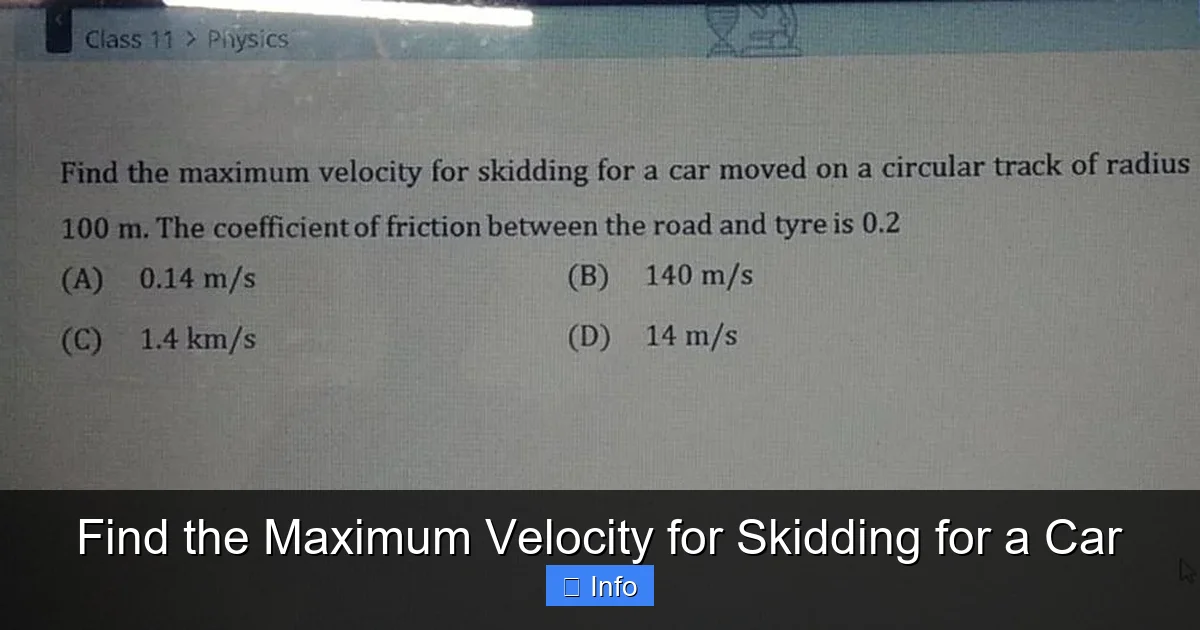
Visual guide about Find the Maximum Velocity for Skidding for a Car
Image source: classroom-images.cdn.askfilo.com
v = √(μ × g × r)
In plain language, velocity equals the square root of the friction coefficient multiplied by gravity multiplied by the turn radius.
Centripetal Force and Friction
Whenever a car turns, it needs a force pulling it toward the center of the circle. Physicists call this centripetal force. On a flat surface, that force comes entirely from the friction between the tires and the pavement. If the required centripetal force is greater than the friction your tires can generate, the car skids. The maximum velocity for skidding happens right at the boundary. Just below that speed, friction holds. Just above it, the tires break loose.
Breaking Down the Variables
- μ (mu): This is the coefficient of friction. It represents how sticky or grippy the road surface is for your tires.
- g: This is the acceleration due to gravity, roughly 9.8 meters per second squared.
- r: This is the radius of the curve measured in meters.
Each variable affects the outcome. If any one of them drops, the maximum velocity for skidding drops as well.
A Simple Example Calculation
Imagine you are driving on dry asphalt with a friction coefficient of 0.7. You approach a curve with a radius of 30 meters. Plugging the numbers into the formula:
v = √(0.7 × 9.8 × 30)
v = √(205.8)
v ≈ 14.3 meters per second
That is about 52 kilometers per hour, or roughly 32 miles per hour. If you take the turn faster than that, you are likely to skid.
Now picture the same curve after a heavy rain. The friction coefficient might fall to 0.4 because water sits between the tires and the road.
v = √(0.4 × 9.8 × 30)
v = √(117.6)
v ≈ 10.8 meters per second
That is only about 39 kilometers per hour, or 24 miles per hour. Rain alone can reduce your safe turning speed by nearly a third.
How Road Conditions Change the Limit
The condition of the road surface is one of the most important factors in the maximum velocity for skidding. A clean, dry road gives your tires the best possible grip. Anything that comes between the tire and the pavement reduces that grip and lowers the safe speed.
Dry Pavement vs. Wet Roads
On dry pavement, rubber meets road with very little interference. Water acts like a lubricant. When it rains, a thin film can form between your tires and the road surface. If your tires cannot push that water away quickly enough, you may hydroplane or skid at speeds that would be perfectly safe in dry weather.
Ice, Snow, and Loose Gravel
Ice is the most dangerous surface for skidding. The friction coefficient on ice can be as low as 0.1 or 0.2. A curve that might feel safe at 50 kilometers per hour when dry could drop the maximum velocity for skidding to under 20 kilometers per hour on ice. Snow and loose gravel are unpredictable too. Loose gravel acts like thousands of tiny ball bearings under your tires, making it easy to slide even at modest speeds.
Why Tire Tread Matters
Worn tires cannot channel water away effectively, and they have less rubber in contact with the road. That lowers the effective friction coefficient and brings down the maximum velocity for skidding. Keeping your tires in good condition is one of the simplest ways to maintain a larger safety margin.
Caring for your tires goes beyond pressure checks. Using quality products can help you spot problems early and keep rubber in top shape. If you want to keep your sidewalls conditioned, exploring the best car tire shine products is a smart step. Regularly removing brake dust and road grime with the best tire cleaners also makes it easier to inspect tread depth and sidewall damage.
The Role of Curve Radius and Vehicle Weight
Not every turn is the same. A wide, sweeping curve feels completely different from a tight hairpin turn. The shape of the bend and the mass of your vehicle both influence the maximum velocity for skidding.
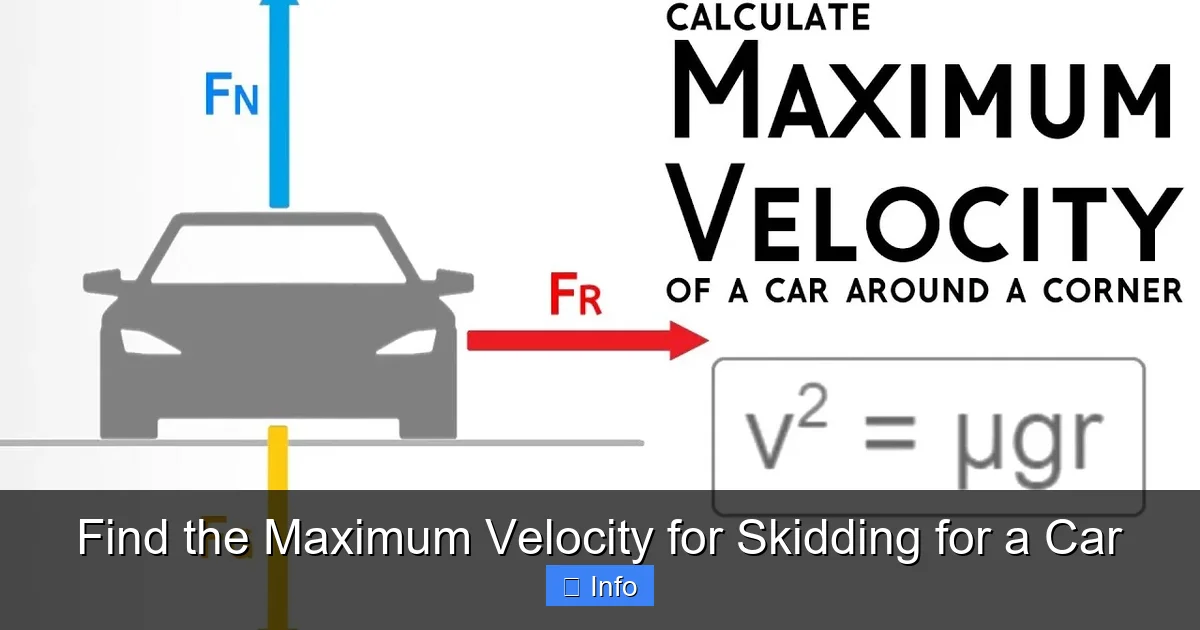
Visual guide about Find the Maximum Velocity for Skidding for a Car
Image source: i.ytimg.com
Tight Turns vs. Wide Curves
The curve radius appears directly under the square root in the formula. That means a smaller radius significantly reduces the maximum velocity. If you cut the radius in half, you do not just cut the safe speed in half. You reduce it by the square root of two, which is still a major difference. This is why highway exit ramps often carry advisory speed limits well below the main highway speed. The curve is tighter, and the maximum velocity for skidding is lower.
How Weight Shifts the Balance
It might seem logical that a heavier car would grip better because it presses down harder on the road. That is partly true, but a heavier vehicle also needs more force to change direction. In the basic flat-road formula, those two effects often cancel out, which is why mass does not appear as a separate variable. Still, weight transfer during a turn can unload the inside tires and reduce total grip, especially in tall vehicles like SUVs or trucks.
Real-World Tips to Avoid Skidding
Understanding the theory is useful, but applying it behind the wheel is what keeps you and your passengers safe. Here are practical ways to stay below the maximum velocity for skidding.
Check Your Tires Regularly
Inspect your tread depth at least once a month. Look for uneven wear, cracks, bulges, or objects stuck in the rubber. Make sure your tire pressure matches the vehicle manufacturer’s recommendation. Underinflated tires flex too much, generate excess heat, and can lose grip more easily during a turn.
Slow Down Before the Turn
The best time to brake is before you enter the curve, not while you are in the middle of it. Braking while turning asks your tires to do two jobs at once: slow the car and change its direction. That splits the available friction and lowers the maximum velocity for skidding. Enter the turn at a safe speed, then gently accelerate as you straighten out and exit.
What to Do If You Start to Skid
If you feel the car begin to slide, try not to panic. Take your foot off the accelerator. Do not slam on the brakes, because locking the wheels can make the skid worse. Steer gently in the direction you want the front of the car to go. Once you feel the tires regain traction, you can straighten the wheel and continue driving.
Building good braking habits is part of staying in control. If you want to review the fundamentals, our overview of proper braking technique offers useful context for everyday driving and emergency moments alike.
Conclusion
Finding the maximum velocity for skidding for a car is really about respecting the relationship between your tires, the road, and the laws of physics. There is no single number that fits every vehicle, every road, and every weather condition. The limit changes with the friction coefficient, the radius of the turn, and the surface beneath your wheels.
You do not need to calculate square roots every time you approach a bend. But keeping these principles in mind can make you a more cautious and confident driver. Slow down for turns, especially when it is raining or the road looks slick. Keep your tires well maintained and properly inflated. Give yourself a cushion of speed below the theoretical limit so you have room to react if something unexpected happens.
Driving is not about testing the edge of grip. It is about arriving safely. When you understand the maximum velocity for skidding, you know exactly why slowing down is the smartest choice you can make behind the wheel.
Frequently Asked Questions
What is the maximum velocity for skidding for a car?
It is the fastest speed a vehicle can travel through a curve before the tires lose grip and the car begins to slide. This speed depends on tire friction, road conditions, and the sharpness of the turn.
How do you calculate the maximum velocity for skidding?
On a flat road, you can use the formula v = √(μ × g × r), where μ is the friction coefficient, g is gravity, and r is the curve radius. Plug in your values and take the square root to find the speed in meters per second.
Does road condition affect the maximum velocity for skidding?
Yes, road conditions have a major impact. Wet, icy, or gravel surfaces reduce tire grip and lower the maximum velocity for skidding compared to dry pavement.
Do heavier cars have a higher maximum velocity for skidding?
Not necessarily. While heavier cars press harder on the road, they also need more force to change direction. In basic calculations, these effects often cancel out, so weight does not directly raise the skidding limit.
What should I do if my car starts to skid?
Take your foot off the accelerator and avoid slamming the brakes. Steer gently in the direction you want the front of the car to go until you regain traction.
How can I improve my tires to avoid skidding?
Keep your tires properly inflated, check tread depth regularly, and replace worn rubber. Clean tires and well-maintained sidewalls also help you spot issues before they reduce grip.