Which Sound Has a Higher Pitch Guitar or Car Horn

When comparing a guitar and a car horn, the guitar typically produces a higher pitch due to its string vibrations and design. Car horns generate lower frequencies to cut through traffic noise effectively. Understanding pitch helps us appreciate how different sounds serve unique purposes in our daily lives.
Key Takeaways
- Pitch Basics: Pitch refers to how high or low a sound is, determined by the frequency of sound waves.
- Guitar Characteristics: Guitars produce a wide range of pitches, with higher strings creating notably high-frequency sounds.
- Car Horn Purpose: Car horns are designed to produce attention-grabbing sounds, typically at lower frequencies for better penetration through noise.
- Frequency Comparison: Standard guitar notes can reach higher frequencies than typical car horn sounds, making them higher in pitch.
- Practical Applications: Understanding pitch differences helps in audio engineering, safety considerations, and musical instrument selection.
- Safety Implications: Car horn frequencies are optimized for road safety, while guitar pitches are crafted for musical expression.
📑 Table of Contents
Which Sound Has a Higher Pitch Guitar or Car Horn
Have you ever wondered why a guitar sounds so different from a car horn? Both create sound, but they do it in very different ways. When we talk about pitch, we’re really talking about how high or low a sound seems to our ears. This isn’t just a fun fact – it’s something that affects how we experience music, how drivers communicate on busy streets, and even how we design audio equipment.
The answer to whether a guitar or car horn has a higher pitch depends on several factors. Let’s dive into the science behind sound and explore what makes these everyday sounds so distinct from each other.
Understanding Pitch and Frequency
Before we compare guitars and car horns, let’s understand what pitch actually means. Pitch is our perception of how high or low a sound is. When a guitar plays a high note, it sounds “higher” than when it plays a low note. This difference comes down to frequency – the number of sound wave cycles that occur per second, measured in Hertz (Hz).
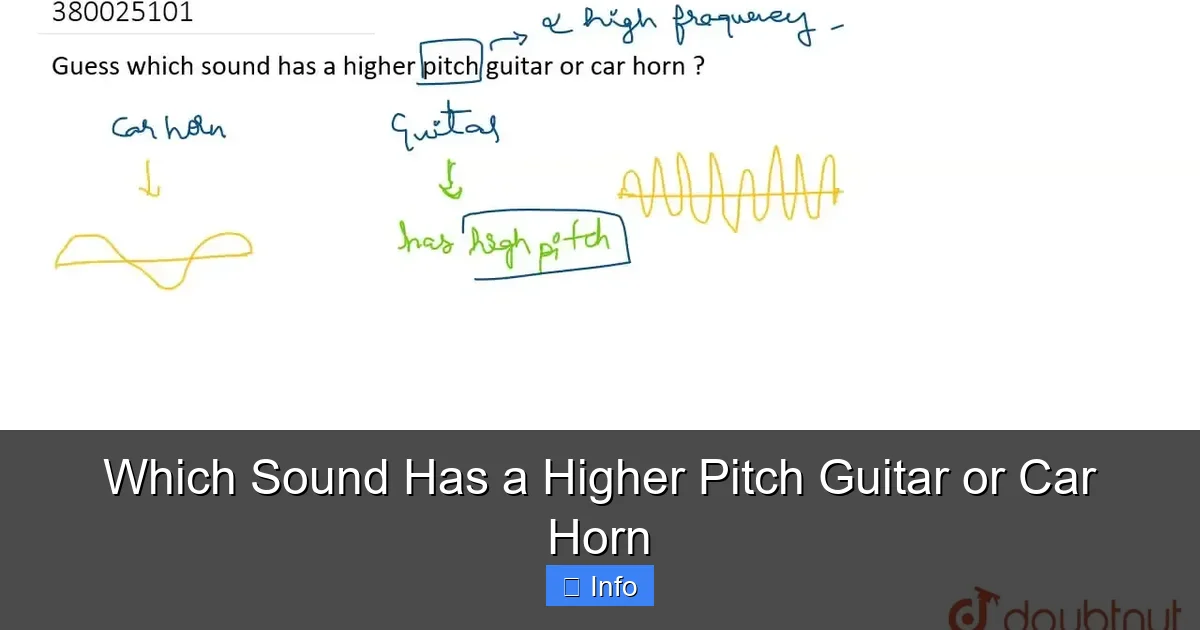
Visual guide about Which Sound Has a Higher Pitch Guitar or Car Horn
Image source: static.doubtnut.com
What Determines Frequency
Several factors influence the frequency of a sound:
- Vibrating Object: Whether it’s guitar strings or a car horn diaphragm
- Size and Tension: Thinner, tighter strings vibrate faster than thick, loose ones
- Material Properties: Different materials respond differently to vibration
- Enclosure Design: The shape and size of the housing affects sound projection
Higher frequencies mean higher pitches, and lower frequencies mean lower pitches. A typical human can hear sounds ranging from about 20 Hz to 20,000 Hz, though this range decreases with age.
Guitar Sound Characteristics
Guitars are incredibly versatile instruments capable of producing a wide range of pitches. A standard six-string guitar is tuned to E-A-D-G-B-E, with the thinnest string (high E) vibrating at about 330 Hz and the thickest string (low E) vibrating at around 82 Hz. However, when you play higher up the neck, those frequencies can go much higher.

Visual guide about Which Sound Has a Higher Pitch Guitar or Car Horn
Image source: i.ytimg.com
String Gauge and Pitch
The thickness of guitar strings plays a crucial role in determining pitch. Thinner strings vibrate more easily and at higher frequencies. That’s why the high E string is so thin compared to the low E string. When you press down on the fretboard to play higher notes, you’re effectively shortening the vibrating length of the string, which increases its frequency and raises the pitch.
Electric guitars, in particular, can produce very high pitches, especially when using effects like distortion or playing with techniques like bending strings. Some electric guitar solos reach frequencies well above 1,000 Hz, creating those soaring, expressive sounds we associate with rock and blues music.
Guitar Body and Sound Projection
The body of an acoustic guitar acts as a resonator, amplifying the string vibrations. The sound hole and internal chamber are designed to project sound efficiently. Electric guitars rely on electronic amplification, which can reproduce a broader range of frequencies than acoustic instruments alone.
Car Horn Sound Characteristics
Car horns serve a completely different purpose than musical instruments. They’re designed to grab attention and warn other drivers of potential danger. Because of this safety function, car horns are engineered to produce sounds that cut through traffic noise and can be heard clearly in various conditions.

Visual guide about Which Sound Has a Higher Pitch Guitar or Car Horn
Image source: i.ytimg.com
Typical Car Horn Frequencies
Most car horns operate in the range of 300 to 600 Hz. This relatively low frequency range is intentional – lower frequencies travel farther and penetrate through other sounds more effectively than high frequencies. That’s why you can often hear a car horn from much greater distances than you can hear a guitar, even though the guitar might be playing at a higher pitch.
Some modern cars have dual-tone horns that combine two different frequencies, typically around 300-400 Hz and 500-600 Hz. This creates a richer, more attention-grabbing sound while still staying in the lower frequency range.
Horn Design and Functionality
Car horns use electromagnetic or pneumatic systems to create sound. In electromagnetic horns, an electrical current passes through a coil, creating a magnetic field that causes a diaphragm to vibrate. The design of this diaphragm and its housing determines the resulting frequency and volume of the sound.
The goal is maximum audibility and clarity, not musical beauty. That’s why car horns don’t produce the wide range of pitches that guitars do – they’re optimized for a specific function.
Direct Pitch Comparison
Now let’s directly compare the two. When we look at the numbers, guitars clearly produce higher pitches than car horns. The highest notes on a guitar can reach frequencies of 1,000 Hz or more, while car horns typically stay below 600 Hz.
Real-World Examples
Consider these scenarios:
- Guitar Solo: A high-pitched guitar solo might feature notes at 800-1,200 Hz
- Car Horn: A typical car horn operates around 400-500 Hz
- Result: The guitar note is clearly higher in pitch
Even when comparing the lowest guitar notes to car horns, the guitar’s range extends much higher. A guitar can produce pitches both above and below what a car horn generates, giving it the advantage in terms of maximum pitch potential.
Perception Differences
However, perception isn’t just about raw numbers. Car horns are designed to be loud and penetrating, while guitar sounds are often softer and more nuanced. In some situations, a car horn might seem more “obtrusive” or noticeable than a guitar, even if the guitar is technically producing a higher pitch.
Why This Matters in Real Life
Understanding the pitch differences between guitars and car horns isn’t just academic – it has practical implications in several areas:
Audio Engineering and Sound Design
In audio engineering, knowing which frequencies different sounds occupy helps professionals mix music properly. For example, when recording a song that includes both guitar and car horn sound effects, engineers need to ensure both elements are clearly audible without clashing.
Traffic Safety Considerations
The design of car horns reflects their safety function. Engineers intentionally keep frequencies in a range that travels well and penetrates through ambient noise. This is why car horns sound so different from musical instruments – they prioritize effectiveness over musicality.
Practical Tips for Musicians and Drivers
Whether you’re a musician trying to understand sound better or just curious about the world around you, here are some practical tips:
For Musicians
If you play guitar, experiment with different strings and playing positions to explore the full range of pitches available to you. The highest fret positions on your guitar can produce surprisingly high frequencies that contrast beautifully with lower notes. Understanding how pitch works can help you make better choices about:
- String gauge selection
- Fretboard positioning
- Effects pedal usage
- Playing technique
For Drivers
While you can’t change your car horn’s fundamental frequency, understanding how sound travels can make you a more effective communicator on the road. Use short, clear bursts rather than prolonged honking, and remember that your horn’s lower frequency is designed to cut through traffic noise effectively.
Conclusion
In conclusion, when comparing a guitar and a car horn, the guitar generally produces a higher pitch. Guitars can generate frequencies well above 1,000 Hz, while car horns typically operate in the 300-600 Hz range. However, the car horn’s design serves a completely different purpose – maximum audibility and safety communication rather than musical expression.
This comparison highlights how different sounds are engineered for their specific functions. Guitars are crafted to produce beautiful, varied musical tones across a wide frequency spectrum. Car horns are designed to be heard clearly in noisy traffic environments. Both achieve their goals brilliantly through thoughtful engineering and design.
Curious about other sound comparisons or want to learn more about how frequency affects our daily lives? There’s a whole world of acoustic science waiting to be discovered. From the low rumble of thunder to the high chirp of birds, every sound tells a story about the physics of our world and the amazing human ability to perceive and appreciate the incredible variety of sounds around us.
Frequently Asked Questions
Which produces a higher frequency guitar or car horn?
A guitar produces higher frequencies than a car horn. Guitars can reach frequencies above 1,000 Hz, especially in higher registers, while car horns typically operate between 300-600 Hz for optimal traffic penetration.
Can a car horn ever produce a higher pitch than a guitar?
Generally no, but some specialty vehicle horns or air horns might produce higher frequencies than the lowest guitar notes. However, standard car horns are designed to stay in the lower frequency range for maximum effectiveness.
Why are car horns designed with lower frequencies?
Lower frequencies travel farther and penetrate through ambient noise like traffic more effectively. This makes car horns ideal for their safety function of alerting other drivers to potential dangers on busy roads.
Do electric guitars produce higher pitches than acoustic guitars?
Both can produce similar high pitches, but electric guitars often seem higher due to amplification and effects. The fundamental frequency range is comparable, though effects like distortion can emphasize higher harmonics.
How does string thickness affect guitar pitch?
Thinner strings vibrate at higher frequencies, producing higher pitches. Thicker strings vibrate more slowly, creating lower pitches. This is why the thinnest guitar string produces the highest standard note in the guitar’s tuning.
What role does pitch play in vehicle safety?
Pitch affects how well sounds carry through noise. Car horns use lower pitches that cut through traffic noise effectively. Understanding pitch helps drivers communicate better and helps engineers design more effective warning systems.