How Many Miles Can a Toyota Sienna Go on Empty?
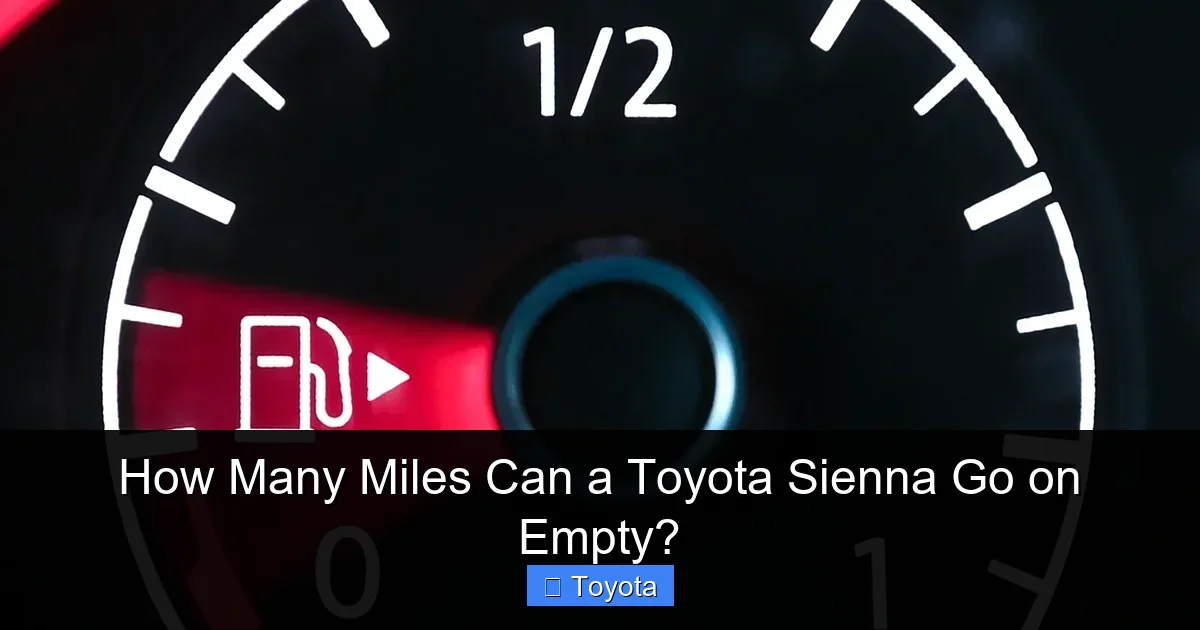
If you are wondering how many miles a Toyota Sienna can go on empty, the answer depends on your specific model year and driving conditions. Generally, you can expect a small buffer of 1 to 3 miles, but relying on it is risky for your vehicle.
We have all been there. You are cruising down the highway, perhaps with the kids in the back and a playlist playing loudly. Suddenly, a small, glowing orange light appears on your dashboard. The fuel light is on. Your heart sinks just a little bit. You start doing the mental math: “How many miles can a Toyota Sienna go on empty?”
It is a stressful moment. You don’t want to be stranded on a busy highway or stuck in a dark parking lot. You want to know exactly how much time you have left before the engine sputters and stops. Understanding the limits of your vehicle is one of the best ways to keep your family safe and your van running smoothly for years.
In this guide, we will dive deep into the mechanics of fuel reserves. We will look at why it is dangerous to run your tank low and how you can maximize your mileage when you are cutting it close. Whether you drive an older Sienna or a brand-new hybrid model, this information is vital for every Toyota owner.
Key Takeaways
- Fuel Reserve: Most Toyota Siennas have a small amount of fuel left when the light comes on.
- Driving Style: Smooth driving can extend your range, while heavy acceleration uses gas faster.
- Vehicle Health: Regularly checking your fuel system helps prevent damage to the fuel pump.
- Model Variations: Hybrid models may offer different efficiency and range than standard gasoline models.
- Safety First: Never wait until the light comes on to find a gas station.
📑 Table of Contents
Understanding the Fuel Reserve in a Toyota Sienna
When your Toyota Sienna tells you that you are low on gas, it is not actually telling you that the tank is empty. Modern cars are designed with a “reserve” amount of fuel. This is a small amount of gasoline that stays in the tank even after the gauge reaches the red line or the light turns on.
What is the “Buffer” Amount?
Typically, a Toyota Sienna has a buffer of roughly 1 to 3 gallons of fuel left when the light illuminates. Depending on your driving efficiency, this might translate to anywhere from 10 to 40 miles of driving. However, this is a very loose estimate. It is not a guarantee.
Why do manufacturers include a reserve?
The reserve serves two purposes. First, it gives you a warning so you can find a gas station. Second, it protects the fuel pump. Most fuel pumps are located inside the gas tank and are cooled by the gasoline surrounding them. If you run the tank too low, the pump can overheat, leading to expensive repairs.
Factors That Affect Your Remaining Range
You might notice that sometimes you can drive 20 miles after the light comes on, but other times, you barely make it 5 miles. This is because your range is not a fixed number. It changes based on how you drive and what you are carrying.
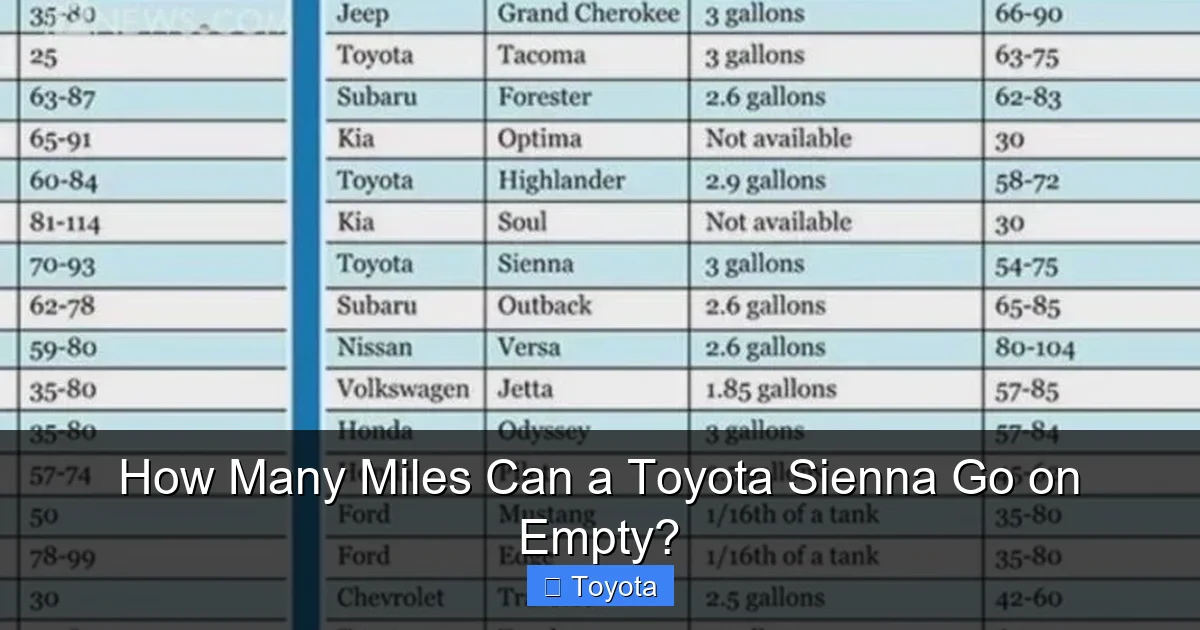
Visual guide about How Many Miles Can a Toyota Sienna Go on Empty?
Image source: automotivian.com
Driving Speed and Style
Speed is a huge factor. If you are driving at a steady 65 mph on a flat highway, you will get much better mileage than if you are stop-and-go driving in a city. Aggressive driving—like flooring the accelerator to merge—uses up that precious reserve fuel much faster than gentle, steady movements.
Weight and Load
The Toyota Sienna is a heavy vehicle designed to carry people and cargo. The more weight you have in the van, the more energy the engine needs to move it. If you are traveling with a full load of passengers and luggage, your “miles on empty” will decrease significantly compared to driving alone.
Terrain and Weather
Driving uphill is hard work for an engine. If you are driving through mountainous regions, you will burn fuel much faster. Additionally, using the air conditioning or running the heater can impact your overall fuel efficiency, though the impact of the AC is often more noticeable in smaller cars than in large minivans.
The Risks of Running Your Tank Too Low
While it might seem like a good way to save a few dollars by waiting until the last minute, running your Sienna on empty is a bad habit. There are real mechanical consequences to running out of gas frequently.

Visual guide about How Many Miles Can a Toyota Sienna Go on Empty?
Image source: topgear.com
Damage to the Fuel Pump
As mentioned earlier, the fuel pump relies on the gasoline to stay cool. When you run the tank very low, the pump is exposed to air. This can cause it to run hotter than it was designed to. Over time, this heat can wear out the pump, leading to a sudden failure. Replacing a fuel pump can cost hundreds, if not thousands, of dollars.
Debris in the Fuel System
Over time, small particles and sediment can settle at the bottom of your gas tank. When you run the tank nearly dry, the pump is more likely to suck up that sediment. This debris can clog your fuel injectors or your fuel filter. If you are worried about your vehicle’s long-term health, you should learn how to break in a new car Toyota to ensure you are treating the engine with care from day one.
The Inconvenience of Stranding
Beyond the mechanical issues, there is the simple matter of being stranded. If you run out of gas, you are stuck. You will have to call a tow truck or wait for a roadside assistance vehicle to bring you fuel. This wastes time and adds unnecessary stress to your trip.
How to Maximize Mileage When the Light is On
If you find yourself in a situation where the fuel light is on and the nearest gas station seems far away, do not panic. You can take specific steps to make that remaining fuel last as long as possible.

Visual guide about How Many Miles Can a Toyota Sienna Go on Empty?
Image source: di-sitebuilder-assets.dealerinspire.com
1. Maintain a Steady Speed
Avoid rapid acceleration and heavy braking. The more you fluctuate your speed, the more fuel the engine consumes. Try to find a steady rhythm and stick to it. Using cruise control on flat highways can help maintain a consistent speed, which is much more efficient.
2. Turn Off Non-Essential Electronics
Every electrical component in your Sienna uses a tiny bit of energy. While the impact of the radio is small, turning off the air conditioning and unnecessary electronics can help reduce the load on the engine, allowing every drop of fuel to go toward moving the van forward.
3. Reduce the Load
If you have extra heavy items in the back that you don’t need for your immediate destination, consider moving them or removing them. Less weight equals better efficiency. Similarly, if you have extra passengers who can ride in a different vehicle, doing so will save gas.
Fuel Efficiency Tips for Toyota Sienna Owners
The best way to deal with the “miles on empty” question is to never let it become an emergency. You can improve your overall fuel economy by adopting better driving habits and maintaining your vehicle properly.
Regular Maintenance is Key
A well-maintained engine is an efficient engine. Make sure you are following your Toyota’s maintenance schedule. This includes regular oil changes and checking your tire pressure. Under-inflated tires create more rolling resistance, which forces the engine to work harder and burn more gas.
Plan Your Trips
Use technology to your advantage. Apps like Google Maps or Waze can show you the most efficient routes and, more importantly, the locations of gas stations along your path. Knowing where the fuel is before you need it takes the stress out of driving.
Understand Your Vehicle’s Specs
It helps to know what you are driving. For example, if you are comparing the efficiency of different models, you might wonder how much is a Toyota RAV in terms of cost and efficiency compared to a Sienna. While they are different classes of vehicles, understanding how different Toyota models handle fuel can help you become a more mindful driver.
Conclusion
In summary, while a Toyota Sienna can technically travel a short distance after the fuel light comes on, you should never rely on that reserve. The “miles on empty” vary depending on your speed, the weight of your passengers, and the terrain you are driving on. To protect your fuel pump and avoid the headache of being stranded, make it a habit to refuel when your tank hits a quarter full.
By driving smoothly, maintaining your vehicle, and planning your trips, you can ensure that your Sienna remains a reliable companion for all your family adventures. Drive safe, stay fueled, and enjoy the journey!
Frequently Asked Questions
How many miles can a Toyota Sienna go on empty?
Most Toyota Siennas can go between 10 and 40 miles on the reserve fuel after the light comes on. However, this is highly dependent on your driving style and the weight of the vehicle.
Is it bad for my engine to run out of gas?
Yes, running out of gas can be very harmful. It can cause the fuel pump to overheat and may pull sediment from the bottom of the tank into your engine’s fuel system.
Does the Toyota Sienna hybrid get better mileage?
Yes, the hybrid models of the Toyota Sienna are designed for much higher fuel efficiency than the standard gasoline models, especially in city driving conditions.
Why does my fuel light come on even though I have gas?
The fuel light is designed to turn on when you reach a certain low threshold, not when the tank is truly empty. This is a safety measure to prevent you from running out of fuel.
How can I improve my Sienna’s gas mileage?
You can improve mileage by driving at steady speeds, maintaining proper tire pressure, and avoiding unnecessary weight or heavy acceleration.
Can I tow my Sienna if I run out of gas?
If you are stranded due to lack of fuel, you may need to have it towed. If you are curious about towing safety, you should research can you tow a car with emergency brake on to ensure you follow proper procedures.