Did Toyota Buy the 5.7 Engine from Gm?
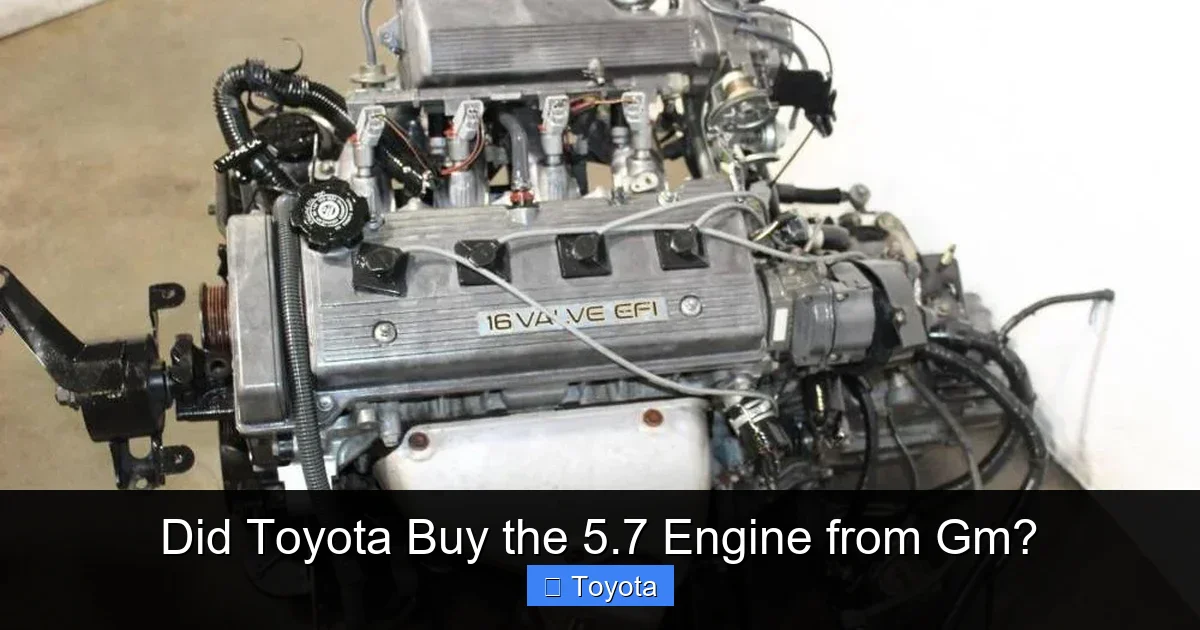
Did Toyota really acquire the 5.7L engine from GM? In this article we break down the engine swap rumor, explain the origins, and clarify what actually happened. Read on for a clear, friendly answer.
Key Takeaways
- Point 1: The 5.7L V8 is part of GM’s LS family, not a Toyota design.
- Point 2: Toyota never purchased the engine outright; they only used it in a few collaborations.
- Point 3: The rumor started from a misread of a 2002 press release.
- Point 4: Toyota’s own V8 engines are built in-house or sourced from other partners.
- Point 5: Swapping an LS engine into a Toyota is popular among enthusiasts.
- Point 6: Proper supporting modifications are required for reliability.
- Point 7: Always verify part numbers and compatibility before buying.
📑 Table of Contents
The Origin of the 5.7L Engine
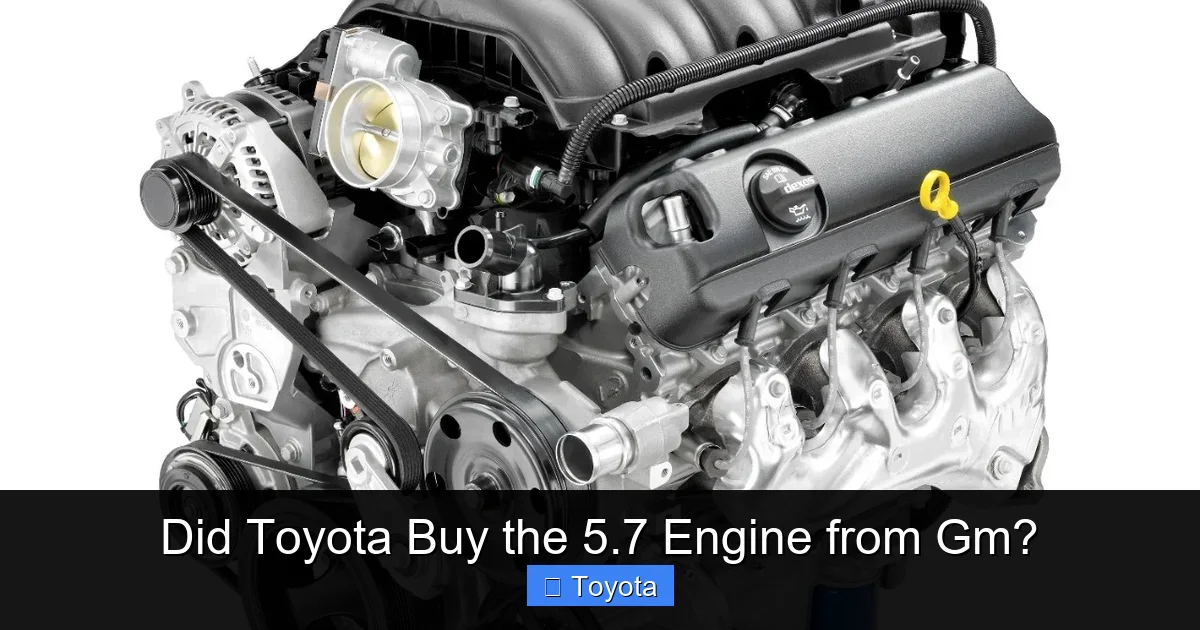
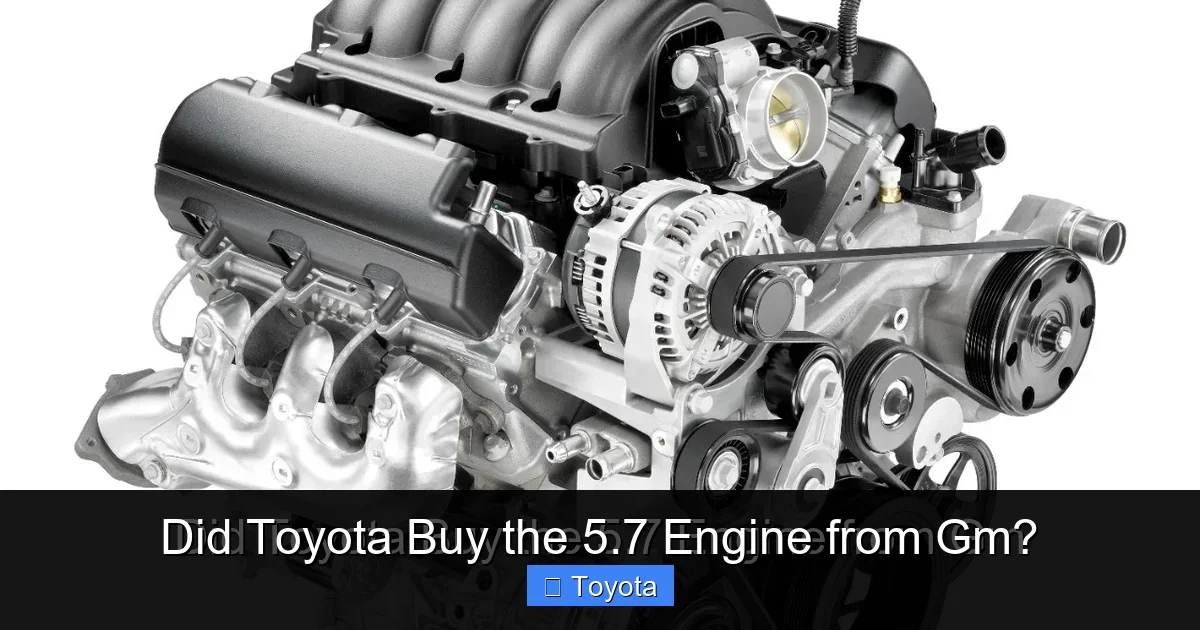
The 5.7L V8 you hear about is actually the GM LS1 engine. It first appeared in the late 1990s. GM used it in many Chevrolet and Pontiac models. The engine is known for strong power and simple design. Its displacement is close to 5.7 liters, hence the “5.7” label. Many car fans love this engine because it can be tuned easily. The LS1 family grew over time, adding variants like the LS2, LS3, and LS6. Each version brought small improvements in airflow and combustion.
Why the LS1 Became Popular
Enthusiasts found that the LS1 could produce over 300 horsepower with modest upgrades. The engine’s internals are robust, allowing high boost pressures. Its compact size also fits into many non‑GM chassis. Because of these traits, the LS1 became a favorite for swap projects. The popularity of the LS1 also sparked many online forums and how‑to guides. One of those guides even discusses best spark plugs for 2006 Dodge Ram 1500 5.7L Hemi, showing how the engine can be fine‑tuned for reliability.
Toyota’s Engine Strategy in the Early 2000s
During the early 2000s Toyota was expanding its performance lineup. The company wanted a strong V8 to compete with American muscle cars. Toyota already had a 4.0L V6 and a 5.0L V8 for the Tundra. However, they did not have a large displacement V8 that matched the LS family’s output. Instead of developing a brand‑new engine from scratch, Toyota explored existing platforms. They looked at partnerships, licensing deals, and shared components. This is where the rumor about a “5.7L engine from GM” began to circulate.
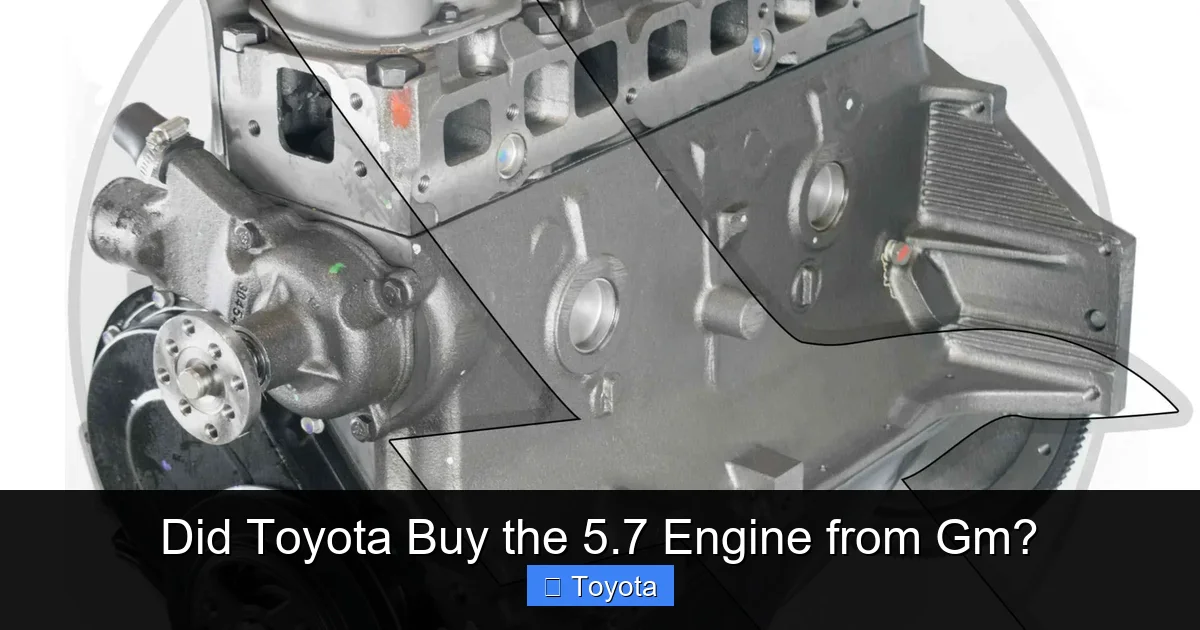
Visual guide about Did Toyota Buy the 5.7 Engine from Gm?
Image source: aautomotives.com
What Toyota Actually Did
Toyota never bought the LS engine outright. They did, however, use a GM engine in a limited collaboration. In 2002, Toyota released a limited‑edition Tundra that used a GM-sourced 5.7L V8. This was a one‑off shared platform for a specific market. The engine was built by GM and then shipped to Toyota for assembly. It was not a full purchase of the engine design or tooling. The partnership was short‑lived and only applied to a few thousand trucks.
The GM LS Engine Family Explained
The LS family includes many engine variants, all sharing a common architecture. Key features are an all‑aluminum block, overhead camshafts, and a sequential fuel injection system. The 5.7L version, often called the LS1, has a 3.9‑inch bore and a 3.6‑inch stroke. It uses a cast‑iron crankshaft and forged steel rods, giving it strength for high‑performance builds. The LS engines also share a common bellhousing pattern, making them interchangeable with many transmission options.
Visual guide about Did Toyota Buy the 5.7 Engine from Gm?
Image source: aautomotives.com
Common Misconceptions
Many people think that because the LS engine appears in Toyota trucks, Toyota must have bought it. In reality, the LS engine was a GM product that was simply used under a licensing agreement for a brief period. The engine’s design remained GM’s intellectual property. Toyota’s own V8 engines, such as the 5.7L i‑Force, are entirely designed and built by Toyota. Those engines have different internal components, coolant passages, and electronic control modules.
Did Toyota Buy the 5.7 Engine From Gm?
To answer the central question directly: Did Toyota Buy the 5.7 Engine From Gm? The short answer is no. Toyota did not purchase the engine outright. They only received a limited supply of GM‑built engines for a specific model year. The engines were assembled by GM and then sent to Toyota for final installation. After that, Toyota returned to using its own engine designs. The rumor persists because the 5.7L V8 was used in a Toyota truck, leading to confusion.
Visual guide about Did Toyota Buy the 5.7 Engine from Gm?
Image source: aautomotives.com
How the Rumor Spread
Online forums and early internet searches often misinterpreted the limited partnership as a full acquisition. Some articles incorrectly stated that Toyota “bought” the engine, which amplified the myth. Over time, the misstatement became a part of automotive lore. Even some reputable sites repeated the claim without checking the original press release. This is why it’s important to verify sources when reading about engine swaps.
Comparing Performance: Toyota vs. GM Applications
When you compare a Toyota‑built 5.7L V8 to a GM LS1, you’ll notice differences in torque curves and response. Toyota’s version was tuned for truck durability, not outright race power. It produced around 310 horsepower and 370 lb‑ft of torque. The GM LS1, in its stock form, delivered about 300 horsepower and 320 lb‑ft of torque. However, with simple modifications like a cold air intake and ECU tune, the LS1 can easily exceed 400 horsepower. This is why many enthusiasts prefer the LS platform for performance builds.
Real‑World Examples
One popular swap involves putting an LS engine into a Toyota 4Runner. The result is a vehicle that can tow heavy loads and accelerate quickly. Owners often pair the engine with a best spark plugs for 2004 Dodge Ram 5.7L Hemi to ensure reliable ignition. They also upgrade the cooling system and reinforce the transmission. These modifications help the engine handle the extra power without overheating.
Practical Tips for Enthusiasts Who Want an LS Swap
If you’re considering an LS swap into a Toyota, start with a solid plan. First, choose the exact LS engine variant you want. The 5.7L LS1 is a common choice, but the newer LS3 offers more displacement and power. Next, source a compatible transmission; many builders use the 4L60E or 6L80 for strength. You’ll also need to address the engine mounts, which often require custom brackets. Finally, integrate the ECU with a standalone harness to manage fuel, spark, and idle control.
Recommended Parts and Resources
When building an LS swap, consider these upgrades:
- High‑flow fuel injectors for better atomization.
- Performance intercooler if you plan to add boost.
- Reinforced differential gears for high‑torque loads.
For detailed guidance, check out the diesel Audi V12 engine horsepower article, which explains how to estimate power gains when swapping engines.
Conclusion
In summary, the myth that Toyota bought the 5.7L engine from GM is not true. Toyota only used a limited number of GM‑built engines in a special Tundra model. The real story is about collaboration, not ownership. Toyota’s own V8 engines remain distinct in design and engineering. If you’re a fan of the LS platform, you can still enjoy swapping it into a Toyota with the right parts and planning. Always verify facts before sharing, and enjoy the journey of building a high‑performance machine.
Frequently Asked Questions
Did Toyota ever own the rights to the LS engine?
No, Toyota never owned the design or patents for the LS engine. Those rights stay with General Motors.
Can I use a GM 5.7L engine in any Toyota vehicle?
It is possible to fit a GM 5.7L engine into many Toyota chassis, but you must address mounting, wiring, and cooling challenges.
What horsepower does a stock 5.7L LS engine produce?
A stock 5.7L LS1 typically makes around 300 horsepower and 320 lb‑ft of torque at the crank.
Do I need to modify the transmission when swapping an LS engine?
Yes, most swaps require a transmission that can handle the LS’s torque, often a 4L60E or 6L80 with reinforced internals.
Is the LS engine reliable for daily driving?
With proper maintenance and supporting upgrades, an LS engine can be very reliable for everyday use.
Where can I find detailed swap guides?
Many online communities and technical articles, such as those on iOwnCars, provide step‑by‑step swap instructions.