A Car Makes a Displacement of 100m Towards East
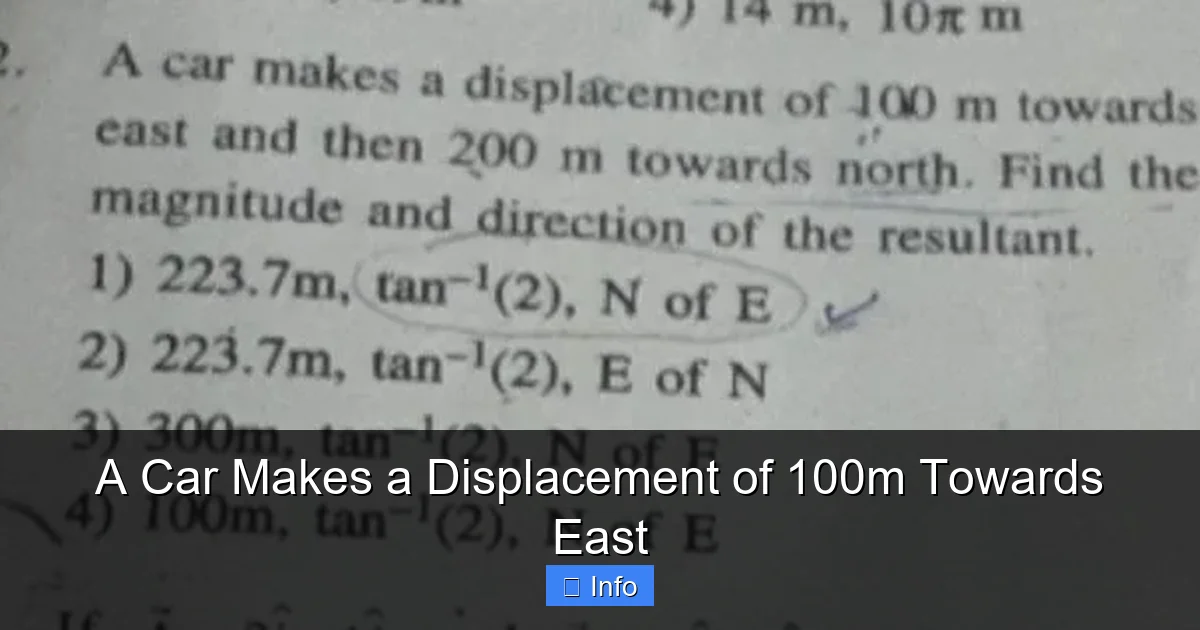
A car making a displacement of 100m towards east simply means it has moved 100 meters in the eastward direction from its starting point. This concept is a basic vector quantity in physics, distinguishing displacement from distance traveled. Understanding it helps grasp motion, navigation, and real‑world driving scenarios.
Key Takeaways
- Displacement vs. Distance: Displacement is a vector that shows change in position, while distance is a scalar that only measures how much ground was covered.
- Vector Components: A displacement of 100m towards east can be expressed as (+100 m, 0 m) in a coordinate system where east is the positive x‑axis.
- Real‑World Relevance: Drivers use displacement concepts when calculating how far they’ve deviated from a route or when using GPS to find the shortest path.
- Adding Displacements: Multiple movements can be summed vectorially; for example, going 100m east then 50m north yields a resultant displacement of about 111.8m northeast.
- Negative Displacement: Moving west after an eastward trip reduces the net eastward displacement, possibly resulting in zero or even a westward net displacement.
- Practical Tips: Sketching a simple diagram with arrows helps visualize and solve displacement problems quickly.
📑 Table of Contents
- Introduction: What Does “A Car Makes a Displacement of 100m Towards East” Mean?
- Understanding Vectors: Magnitude and Direction
- Adding and Subtracting Displacements
- Applications in Navigation and Driving
- Common Misconceptions About Displacement
- Practical Tips for Visualizing Displacement
- Conclusion: Why Mastering Displacement Matters
Introduction: What Does “A Car Makes a Displacement of 100m Towards East” Mean?
When you hear the phrase a car makes a displacement of 100m towards east, picture a vehicle that starts at a certain point, drives straight east for exactly 100 meters, and then stops. The car’s displacement is not the same as the distance it might have traveled if it took a winding path; displacement only cares about the straight line from start to finish, together with the direction.
This idea is a cornerstone of kinematics, the branch of physics that describes motion. By treating movement as a vector—having both magnitude (100 m) and direction (east)—we can predict where objects will end up, combine multiple movements, and even understand navigation systems in modern cars.
In everyday driving, you might not think about vectors, but your GPS does exactly that: it calculates the displacement from your current location to your destination and gives you turn‑by‑turn directions. Understanding the basics helps you appreciate why a straight‑line shortcut can save time and fuel.
Understanding Vectors: Magnitude and Direction
Why Displacement Is a Vector
A vector needs two pieces of information: how far (magnitude) and which way (direction). When we say a car makes a displacement of 100m towards east, the magnitude is 100 meters and the direction is east. If the car instead moved 100 meters west, the vector would be −100 m in the east‑west axis.
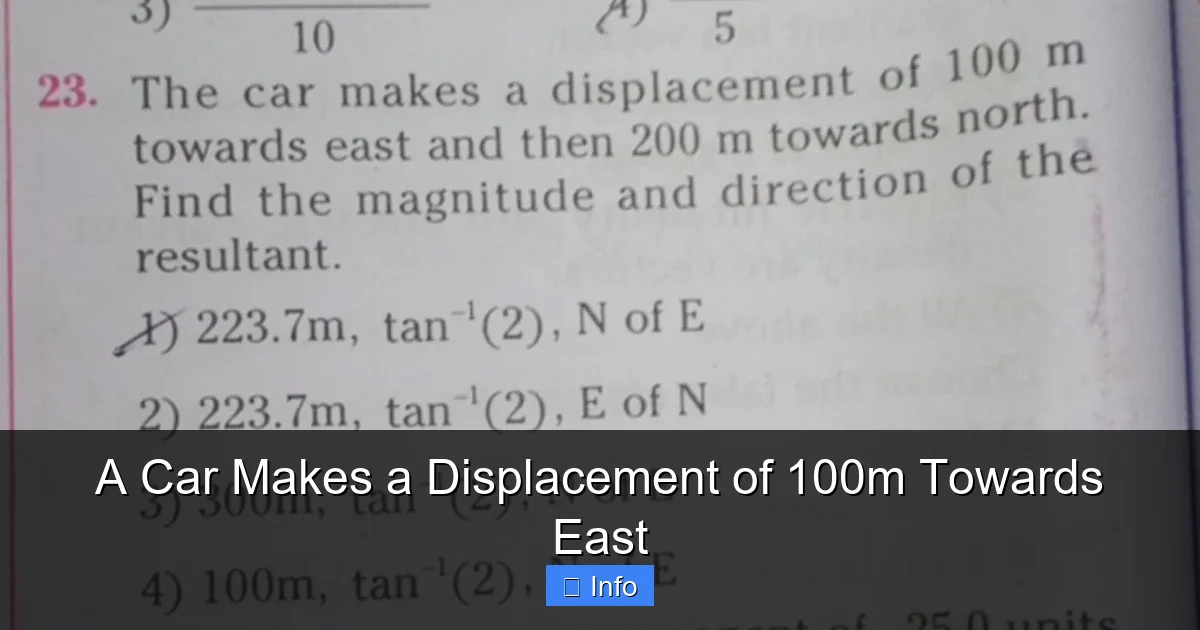
Visual guide about A Car Makes a Displacement of 100m Towards East
Image source: storage.googleapis.com
Representing Displacement on a Graph
On a simple x‑y graph, east is usually the positive x‑axis and north the positive y‑axis. The displacement a car makes a displacement of 100m towards east appears as an arrow starting at the origin (0,0) and ending at the point (100,0). This visual makes it easy to add or subtract multiple displacements.
Scalar vs. Vector Quantities
Distance traveled is a scalar; it only has magnitude. If the car drove 100 m east, then 50 m west, and then 30 m east again, the total distance is 180 m. The net displacement, however, is (100 − 50 + 30) = 80 m east. Recognizing this difference prevents confusion when solving physics problems.
Adding and Subtracting Displacements
Head‑to‑Tail Method
To combine two movements, place the tail of the second vector at the head of the first. The resultant vector runs from the tail of the first to the head of the second. For example, if after a car makes a displacement of 100m towards east it then goes 50 m north, the resultant displacement points to (100, 50) and has a magnitude of √(100² + 50²) ≈ 111.8 m at about 26.6° north of east.
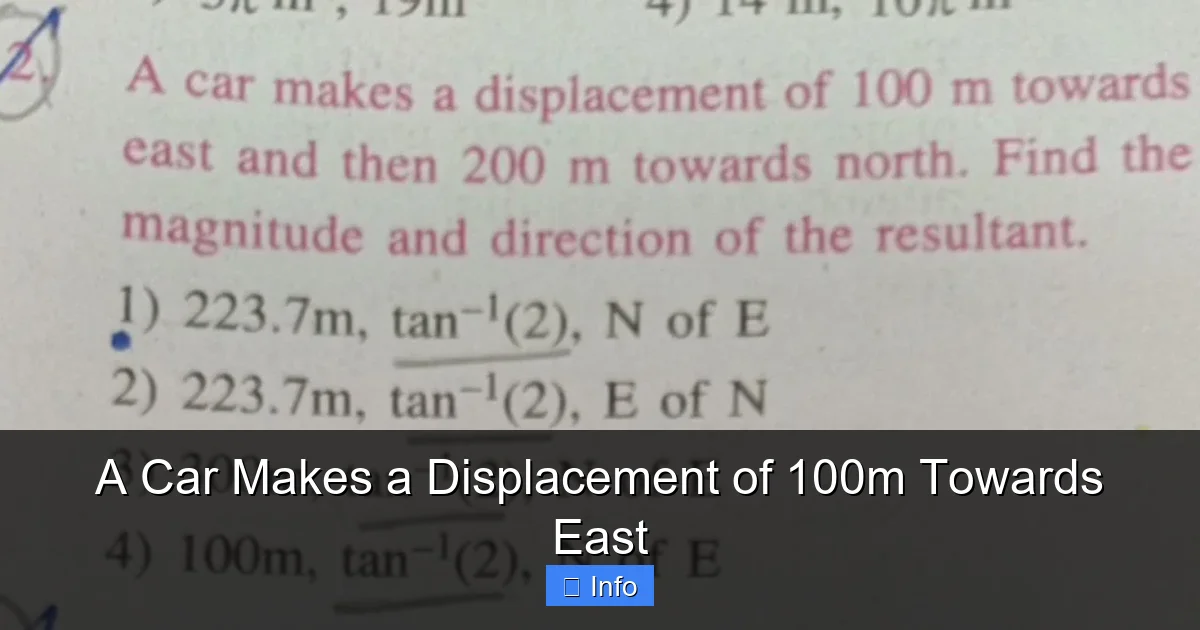
Visual guide about A Car Makes a Displacement of 100m Towards East
Image source: storage.googleapis.com
Using Components
Breaking each displacement into east‑west (x) and north‑south (y) components simplifies math. The eastward movement contributes +100 m to x and 0 to y. A northward movement of 30 m adds 0 to x and +30 m to y. Summing components gives the final x and y, from which magnitude and direction are derived.
Real‑World Example: Road Trip Detour
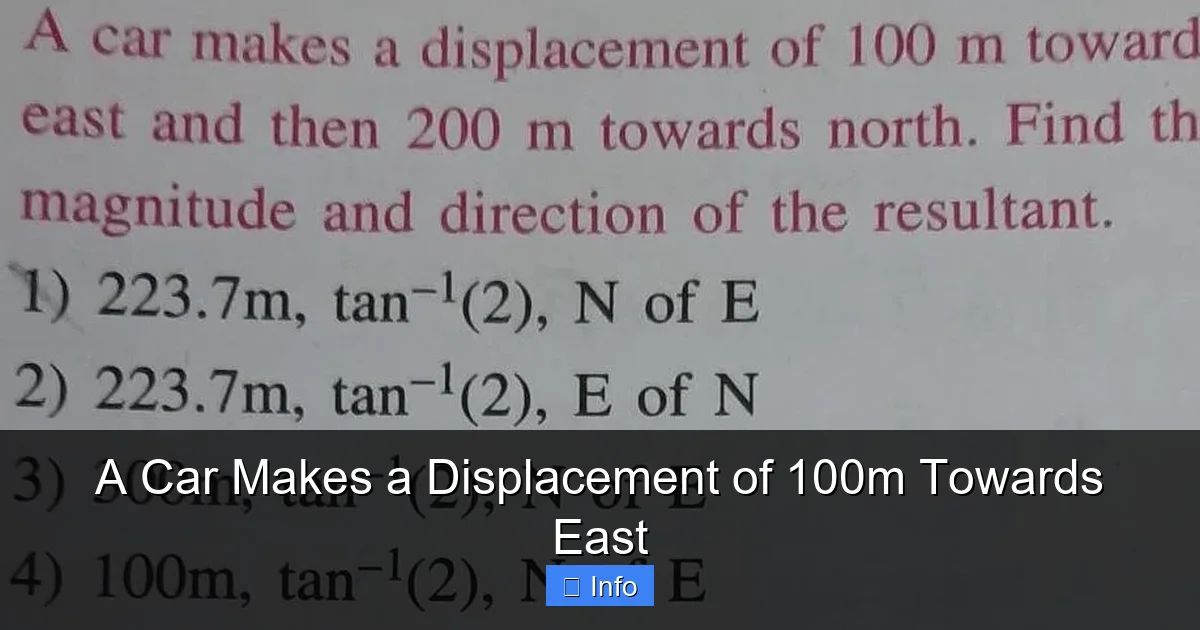
Imagine you leave home, drive 100 m east to a store (so a car makes a displacement of 100m towards east), then realize you need to go north to a friend’s house 200 m away. Your total displacement from home is the vector sum of those two legs, which you can compute quickly with components or a scale drawing.
GPS and Vector Calculations
Modern GPS receivers constantly compute your displacement from satellites. When you enter a destination, the device calculates the vector that points from your current location to the target, then breaks it down into turn instructions. Knowing that a car makes a displacement of 100m towards east helps you understand why the system sometimes tells you to “keep left” even if you’re not turning.
Visual guide about A Car Makes a Displacement of 100m Towards East
Image source: media.kunduz.com
Estimating Fuel Efficiency
If you take a winding route that adds extra distance but little net displacement, you burn more fuel without getting much closer to your goal. By aiming to minimize unnecessary displacement changes—like avoiding frequent back‑and‑forth—you can improve mileage.
Using a Simple Diagram for Quick Checks
Before a long drive, sketch a quick map: draw an arrow for each leg of your trip. The final arrow’s tip shows your net displacement. If the tip is far from where you want to be, you know you need to adjust your route.
Common Misconceptions About Displacement
“More Distance Means More Displacement”
Many learners think that if a car travels a longer path, its displacement must be larger. As shown earlier, a car could drive 1 km in a circle and end up exactly where it started, giving zero displacement despite covering a large distance.
“Displacement Can’t Be Negative”
Displacement can be negative relative to a chosen direction. If east is positive, then a movement of 30 m west is −30 m east. The sign simply indicates the opposite direction.
“Displacement Is Always the Shortest Path”
By definition, displacement is the straight line from start to finish, which is indeed the shortest possible path between those two points. However, the actual road you drive may be longer due to obstacles, traffic rules, or terrain.
Practical Tips for Visualizing Displacement
Draw a Simple Arrow Diagram
Take a piece of paper, mark your starting point, and draw an arrow 10 cm long to the right if you’re using a scale where 1 cm = 10 m. Label it “100 m east.” This instantly shows the vector a car makes a displacement of 100m towards east.
Use Smartphone Apps
Several free physics apps let you input vectors and see the resultant. Try entering “100 m east” and then “50 m north” to watch the arrow change. It’s a fun way to reinforce the concept.
Relate to Everyday Landmarks
If you know that a city block is roughly 80 m long, then a car makes a displacement of 100m towards east is a little more than one block east. Associating the number with familiar distances makes it easier to grasp.
Conclusion: Why Mastering Displacement Matters
Understanding that a car makes a displacement of 100m towards east is more than an academic exercise; it’s a practical tool for navigation, efficient driving, and basic physics problem‑solving. By recognizing displacement as a vector, you can separate the true change in position from the total ground covered, make smarter route choices, and appreciate the invisible math behind your GPS.
Next time you’re on the road, picture that eastward arrow. Whether you’re calculating a detour, checking your fuel usage, or simply curious about how far you’ve actually moved from your starting point, the concept of displacement will give you a clear, directional answer.
Frequently Asked Questions
What is the difference between displacement and distance?
Distance is a scalar that measures the total length of the path traveled, regardless of direction. Displacement is a vector that shows the change in position from the starting point to the ending point, including both magnitude and direction.
Can a car have a displacement of zero even if it moved?
Yes. If the car returns to its starting point after moving, the net change in position is zero, so the displacement is zero while the distance traveled is greater than zero.
How do you calculate the resultant displacement of two movements?
Break each movement into its east‑west and north‑south components, add the corresponding components together, then use the Pythagorean theorem to find the magnitude and trigonometry to find the direction of the resultant vector.
Why is displacement important for GPS navigation?
GPS devices compute the displacement vector from your current location to your destination and then translate that vector into turn‑by‑turn directions, ensuring you follow the most efficient path.
Does taking a curved road affect displacement?
The shape of the road influences the distance you travel, but displacement depends only on your start and end points. A curved path can increase distance without changing the net displacement.
How can I visualize displacement in my daily driving?
Sketch a simple arrow diagram on paper or use a free physics app to draw each leg of your trip as a vector. The final arrow shows your net displacement, helping you see how much you’ve actually shifted from where you began.