How Far Can Half a Tank Get You
Half a tank of gas can typically get you between 150-350 miles, depending on your vehicle’s fuel efficiency and tank size. Most cars average 25-35 miles per gallon, and a typical tank holds 12-15 gallons. This guide breaks down the real-world range you can expect, the key factors that affect your distance, and simple strategies to maximize every drop of fuel in your tank.
## Understanding How Far Half a Tank Can Get You
Picture this. You’re heading out on a road trip, and you just filled up your tank. Halfway through your journey, you start wondering if you have enough fuel to reach your destination. This is a question almost every driver asks at some point. **How far can half a tank actually get you?**
The answer isn’t as simple as picking a number. It depends on several factors working together. Your vehicle’s fuel efficiency, the size of your gas tank, how you drive, and even the weather all play important roles. Let’s break down everything you need to know to estimate your range accurately.
Understanding your fuel range helps you avoid those nervous moments at the gas station. It also saves you money by preventing unnecessary fill-ups. Plus, knowing your vehicle’s range means you can plan your trips with confidence.
## The Mathematics Behind Your Fuel Range
### Calculating Your Half-Tank Distance
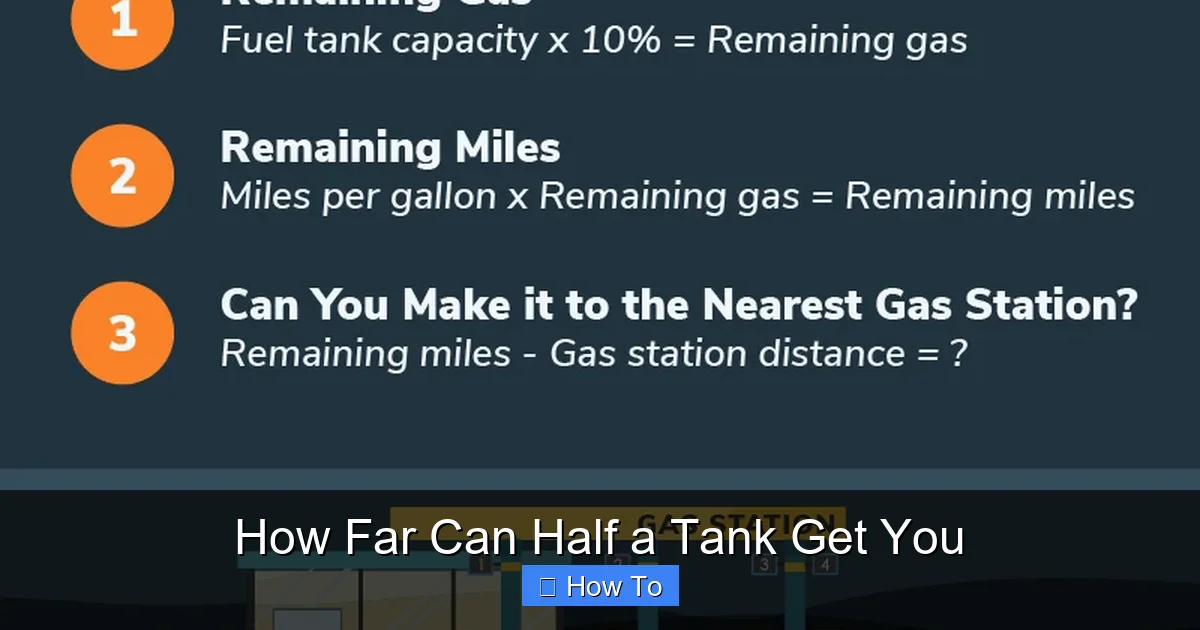
Getting a rough estimate of your range is actually pretty straightforward. You need just two pieces of information. First, find out your average fuel economy. Second, know your tank’s total capacity.
For most passenger vehicles, the math works like this. A typical car gets around 28 miles per gallon combined (city and highway). Most sedans have tanks holding 12-15 gallons. Half of that is 6-7.5 gallons. Multiply by your MPG, and you get roughly 168-210 miles of range from half a tank.
If you drive a Toyota Camry, you might be interested to know that the Camry’s gas tank holds around 15.4 gallons in most models. That means half a tank is roughly 7.7 gallons. At its 28-32 MPG average, you’re looking at approximately 215-245 miles on half a tank.
Trucks and SUVs typically have larger tanks but lower fuel efficiency. A full-size truck with a 26-gallon tank might get 18 MPG combined. Half a tank (13 gallons) would only take you about 234 miles. The larger tank doesn’t always mean better range.
### Real-World Numbers for Common Vehicles
Different vehicles give you different results. Here are some practical examples you might recognize.
Compact cars like the Honda Civic typically have 12-gallon tanks. At 32 MPG combined, half a tank gets you about 192 miles. The Toyota Corolla follows similar numbers with its 13-gallon tank and 31 MPG average, giving you around 200 miles from half a tank.
Crossover SUVs like the Toyota RAV4 sit in the middle. With a 14.5-gallon tank and 27 MPG combined, half a tank takes you roughly 196 miles. Larger SUVs like the Toyota Sequoia have 22.5-gallon tanks but only manage about 18 MPG. That puts half a tank at around 202 miles, surprisingly similar to smaller vehicles.
Minivans like the Toyota Sienna actually perform well. The Sienna’s hybrid system can achieve 36 MPG combined despite its size. With an 18-gallon tank, half a tank gives you an impressive 324 miles of range.
## Factors That Affect Your Actual Range
### Driving Conditions Make a Huge Difference
The numbers above assume ideal conditions, but real life rarely cooperates. Your actual range can vary dramatically based on how and where you drive.
City driving kills your fuel economy. Every stop and start burns extra fuel. Expect 20-30% less range in urban driving compared to highway cruising. If you do a lot of stop-and-go traffic, plan for closer to 150 miles on half a tank rather than 200.
Highway driving is where your engine operates most efficiently. Steady speeds around 65-70 MPH give you the best mileage. This is when you can expect numbers closest to your vehicle’s rated fuel economy.
Extreme temperatures affect both your engine and your driving habits. Cold weather makes your engine run richer and uses more fuel to heat the cabin. Hot weather means your air conditioning works overtime, which also draws power from your engine.
### Vehicle Condition and Maintenance
A well-maintained vehicle runs more efficiently. Several maintenance items directly impact your fuel economy and range.
Under-inflated tires create more rolling resistance. This can reduce your fuel efficiency by 3-5% according to most estimates. Check your tire pressure monthly and keep it at the manufacturer’s recommended PSI. Properly inflated tires can add miles to your range.
A dirty air filter restricts airflow to your engine. This makes your engine work harder and burn more fuel. Replacing a clogged air filter can improve fuel economy by up to 10% in some cases.
Engine problems like bad oxygen sensors, faulty spark plugs, or dirty fuel injectors all hurt your efficiency. If you notice your fuel economy dropping suddenly, have these components checked.
### Your Driving Style Matters
Aggressive driving wastes fuel. Rapid acceleration, hard braking, and speeding all increase fuel consumption. Gentle acceleration and anticipating traffic flow can improve your MPG by 10-20%.
Speed also plays a major role. Going 75 MPH instead of 65 MPH can reduce your fuel economy by 10-15%. The faster you drive, the more wind resistance your vehicle faces, and wind resistance grows exponentially with speed.
Idling is pure waste. If you’re waiting in a parking lot or sitting through a long drive-thru, turn off your engine. Modern engines start easily and don’t suffer from frequent stop-start cycles.
## Smart Strategies to Maximize Your Half Tank
### Planning and Preparation Tips
A little planning goes a long way toward stretching your fuel. Start with knowing your vehicle’s actual range. Don’t rely on estimates—track your own fuel economy over several fill-ups.
Before a longer trip, check your route for gas stations. Apps like GasBuddy can help you find the cheapest fuel along your route. It’s better to top off at a cheaper station than to run low and pay premium prices.
Remove unnecessary weight from your vehicle. That pile of sports equipment, tools, or other items adds weight that your engine must move. Every 100 pounds of unnecessary weight reduces fuel economy by about 1%.
### Driving Techniques for Better Efficiency
Use cruise control on highways when traffic allows. It maintains a constant speed more efficiently than your right foot can. This simple habit can improve fuel economy by 5-7%.
Minimize air conditioning use when possible. At highway speeds, the impact is small, but in city driving, AC can reduce fuel economy by 10-15%. Use the recirculate mode and park in shade when possible to keep your car cooler.
Engine braking saves fuel compared to constant braking. When approaching a stop or downhill, take your foot off the gas early and let the engine slow you down naturally. This technique reuses the car’s momentum instead of wasting it as heat.
### Understanding Your Low Fuel Warning
Most vehicles illuminate the low fuel light when you have about 10-15% of your tank remaining. This is your cue to find a gas station soon. But how much range do you really have at this point?
The answer varies by vehicle, but you typically have 1-3 gallons in reserve after the light comes on. That’s another 30-90 miles depending on your vehicle. However, you shouldn’t rely on this reserve for regular planning.
Running your tank extremely low can cause problems. Sediment at the bottom of your tank can clog your fuel filter. Additionally, your fuel pump uses gasoline for cooling and lubrication. Running it dry repeatedly can shorten its lifespan.
## Seasonal and Environmental Considerations
### Winter Driving Challenges
Cold weather presents unique challenges for fuel range. Your engine takes longer to reach operating temperature, which means richer fuel mixtures and more fuel consumption.
Winter gasoline blends also contain more energy per gallon than summer blends, but this doesn’t fully offset the cold weather penalties. Expect 10-15% less range during winter months compared to summer.
To maximize winter range, warm up your engine gently by driving, not idling. Clear snow and ice efficiently rather than letting your car warm up for extended periods. Park in garages when possible to keep your engine warmer.
### Summer Heat Impacts
Hot weather creates its own set of problems. Air conditioning is the biggest fuel drain during summer months. Heavy AC use can reduce fuel economy by 10-25% depending on conditions.
Hot asphalt also increases rolling resistance. Your tires work harder on warm pavement, slightly reducing efficiency. Park in shaded areas when possible to keep your vehicle cooler and reduce AC needs.
Consider using reflective sun shades and cracked windows (in safe situations) to reduce heat buildup. A cooler car at startup means less AC needed immediately.
## Emergency Preparedness and Safety
### What to Do When You’re Running Low
If you find yourself with limited fuel, prioritize safety. Get off the highway as soon as possible. Driving on fumes is risky and can leave you stranded in dangerous locations.
If you must continue driving, reduce your speed to maximize efficiency. 55-60 MPH is often more efficient than 70 MPH. Turn off non-essential electrical loads like the radio and AC.
Never drive to empty just to find the exact fuel capacity of your tank. This practice can damage your fuel system and leave you stranded. It’s better to refuel early and often.
### Building a Simple Emergency Kit
Keep a small emergency kit in your vehicle for unexpected situations. Include a basic tool kit, flashlight, and first aid supplies. A reflective warning triangle can help if you break down.
Consider keeping a small portable fuel container with a few gallons of reserve fuel. Store it properly in a well-ventilated area away from heat sources. This emergency reserve can save you if you miscalculate your range.
Know the location of gas stations along your regular routes. This knowledge helps you make smart decisions about when and where to refuel.
## Conclusion
Understanding how far half a tank can get you puts you in control of your driving decisions. Most vehicles will travel 150-350 miles on half a tank, but your actual range depends on factors you can influence.
Your driving habits matter more than you might think. Smooth acceleration, steady speeds, and minimal idling can significantly extend your range. Regular maintenance keeps your vehicle running efficiently and maximizes every gallon.
Plan ahead for longer trips. Know your vehicle’s actual fuel economy, check your route for gas stations, and keep your tires properly inflated. These small steps add up to big savings over time.
Whether you’re commuting to work or planning a cross-country adventure, understanding your fuel range helps you drive with confidence. You’ll spend less time worrying about the gas gauge and more time enjoying the road ahead. Stay prepared, drive smart, and make every gallon count.
## Frequently Asked Questions
How many miles can you typically drive on half a tank of gas?
Most vehicles will travel between 150-350 miles on half a tank, depending on fuel tank size (typically 12-15 gallons) and your vehicle’s fuel economy (usually 25-35 MPG combined). Smaller cars with good efficiency may achieve 250+ miles, while larger trucks or SUVs might only get 150-200 miles.
Does driving faster use more fuel?
Yes, significantly. Highway speeds of 70 MPH use roughly 15-20% more fuel than driving at 60 MPH. The increase in wind resistance at higher speeds forces your engine to work harder. Maintaining a steady speed in the 55-65 MPH range gives you the best fuel efficiency.
What reduces fuel economy the most?
Aggressive driving (rapid acceleration and hard braking) can reduce fuel economy by up to 40% in some situations. Other major factors include cold weather (10-20% reduction), heavy loads (5-10% per 100 pounds), and AC use (10-25% depending on conditions).
Is it bad to run your tank to half empty?
No, running to half a tank is perfectly fine and actually recommended for fuel system health. Running extremely low repeatedly can allow sediment to enter your fuel system and may overheat your fuel pump. It’s best to refuel when you reach a quarter tank remaining.
How accurate is the low fuel warning light’s range estimate?
After the low fuel light activates, most vehicles have approximately 1-3 gallons remaining, providing roughly 30-90 miles of additional range depending on your MPG. This reserve varies by vehicle and driving conditions, so you shouldn’t rely on it for precise planning.
What driving habits save the most fuel?
Driving smoothly with gentle acceleration and anticipating traffic flow saves the most fuel. Using cruise control on highways, maintaining proper tire pressure, and reducing unnecessary weight also help significantly. Combining these habits can improve fuel economy by 20-30% compared to aggressive driving.
Key Takeaways
- Average Range: Half a tank usually provides 150-350 miles of driving range for most passenger vehicles.
- Fuel Economy Matters: Your vehicle’s MPG rating is the biggest factor in determining how far half a tank will take you.
- Tank Size Varies: Small cars may have 10-gallon tanks while trucks can hold 20-30 gallons, affecting total range.
- Driving Conditions Count: City driving reduces efficiency by 20-30% compared to steady highway cruising.
- Reserve Fuel Exists: Most vehicles have 1-3 gallons in reserve after the low fuel light activates.
- Weight Impacts Range: Heavier loads and additional cargo decrease your fuel efficiency noticeably.
- Maintenance Matters: Under-inflated tires and poor maintenance can cut your range by 10-15% or more.
Frequently Asked Questions
What is How Far Can Half A Tank Get You?
How Far Can Half A Tank Get You is an important topic with many practical applications.