If a Car Accelerates Uniformly to a Speed of 144
If a car accelerates uniformly to a speed of 144, it gains velocity at a steady rate until it reaches that mark. This guide explains the physics, the math, and what it means for real-world driving. Learn how to calculate time, distance, and acceleration while staying safe on the road.
Key Takeaways
- Uniform acceleration means steady speed gain: The car’s velocity increases by the same amount every second.
- 144 needs units: Whether it’s km/h, mph, or m/s, always convert units before using physics formulas.
- Core formula: Final velocity equals initial velocity plus acceleration times time (v = u + at).
- Distance matters: You can find how far the car travels using v² = u² + 2as.
- Real cars aren’t perfect: Traffic, hills, and engine limits make true uniform acceleration rare on public roads.
- Safety first: Rapid acceleration to high speeds requires full attention and a clear road ahead.
📑 Table of Contents
Introduction
Imagine you are sitting in a car at a stoplight. The light turns green, you press the gas pedal, and the speedometer needle climbs smoothly. If a car accelerates uniformly to a speed of 144, it means the vehicle picks up speed at the exact same rate every second until it reaches that number. It sounds simple, but there is a lot of physics hiding behind that smooth climb.
Most drivers never think about acceleration in terms of equations. They just feel the push back into the seat. However, understanding what happens if a car accelerates uniformly to a speed of 144 can help you estimate how long a merge will take, how much distance you need, and whether your car is performing the way it should.
In this guide, we will walk through the meaning of uniform acceleration, the math used to describe it, and real-world examples you can relate to. We will keep the language simple, the examples practical, and the focus on safety.
Understanding Uniform Acceleration
Uniform acceleration is a fancy way of saying steady acceleration. When a car accelerates uniformly, its velocity changes by the same amount in each equal time interval. If the car gains 5 kilometers per hour every second, it will keep gaining 5 kilometers per hour every second until something changes.
Visual guide about If a Car Accelerates Uniformly to a Speed of 144
Image source: i.ytimg.com
Steady Gains, Not Sudden Jumps
In real life, few things are perfectly uniform. A driver might press harder or lighter on the pedal. The road might slope. The wind might push against the car. But in physics problems, we assume ideal conditions to make the math clear. So if a car accelerates uniformly to a speed of 144, we pretend nothing interferes with that steady increase.
Why the Word “Uniform” Matters
The word uniform allows us to use simple formulas. If acceleration were changing every second, we would need calculus or complex computer models. With uniform acceleration, basic algebra is enough to find time, distance, and final speed.
Converting 144 to Usable Units
Before doing any calculations, you must know what “144” refers to. Is it 144 kilometers per hour? 144 miles per hour? 144 meters per second? Each unit leads to very different results.
Visual guide about If a Car Accelerates Uniformly to a Speed of 144
Image source: i.ytimg.com
Picking the Right Unit: km/h, mph, or m/s
Most physics textbooks use meters per second because it fits neatly with the metric system. Road signs in many countries use kilometers per hour. In the United States, miles per hour is common. If a car accelerates uniformly to a speed of 144 km/h, that is about 89.5 miles per hour. If it accelerates uniformly to a speed of 144 m/s, that is over 320 miles per hour, which is faster than almost any street-legal car.
Converting 144 to Meters per Second
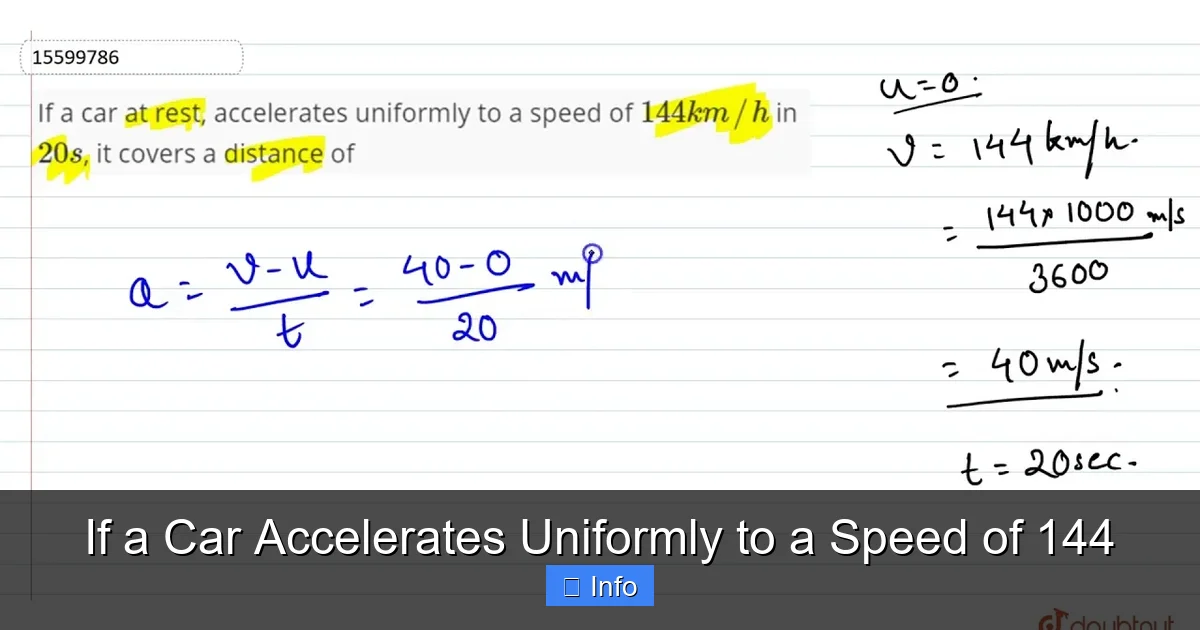
To convert kilometers per hour to meters per second, divide by 3.6. So 144 km/h divided by 3.6 equals exactly 40 m/s. That is a clean number, which is why many physics problems choose 144 km/h. It makes the math easier to follow without a calculator.
Key Equations and Sample Calculations
There are three main equations that describe uniform acceleration. They connect initial velocity, final velocity, acceleration, time, and distance.
Visual guide about If a Car Accelerates Uniformly to a Speed of 144
Image source: storage.googleapis.com
The Core Formulas of Motion
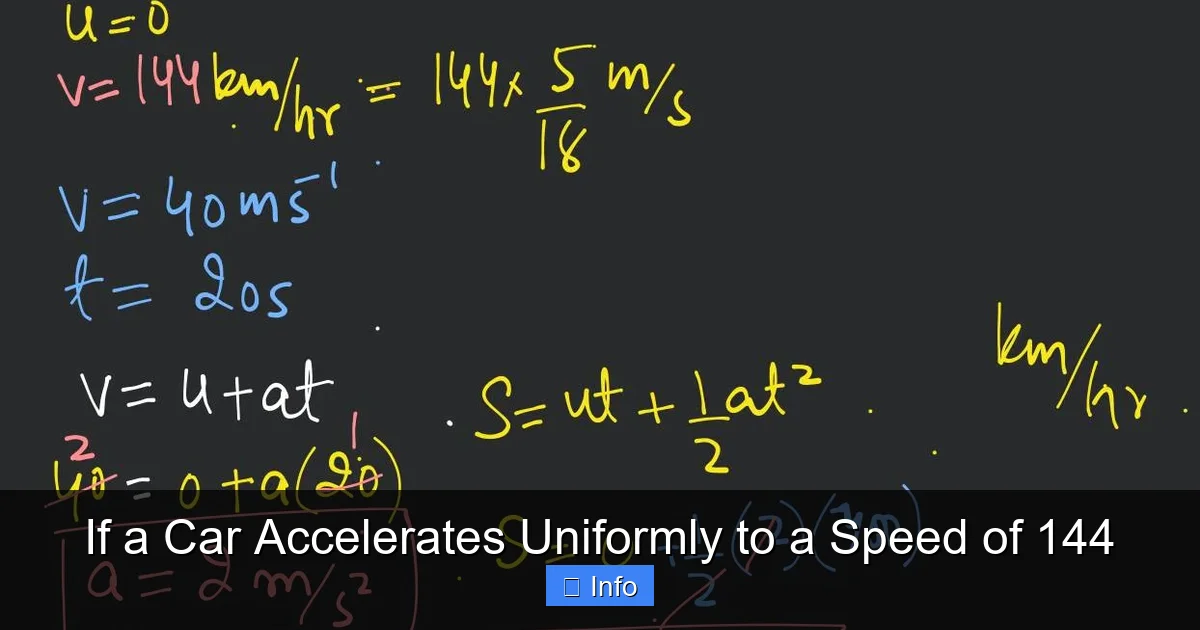
The most common formula is v = u + at. Here, v is final velocity, u is initial velocity, a is acceleration, and t is time. If a car accelerates uniformly to a speed of 144 km/h starting from rest, u is zero. You can rearrange the formula to solve for acceleration or time, depending on what you know.
Another useful formula is s = ut + ½at². This tells you how far the car travels while accelerating. If you know how long it takes to reach 144, you can figure out how much road you need.
The third formula, v² = u² + 2as, lets you find final velocity based on distance and acceleration, or find acceleration based on how far the car traveled. It is handy when time is not given.
Example: Starting from a Stop
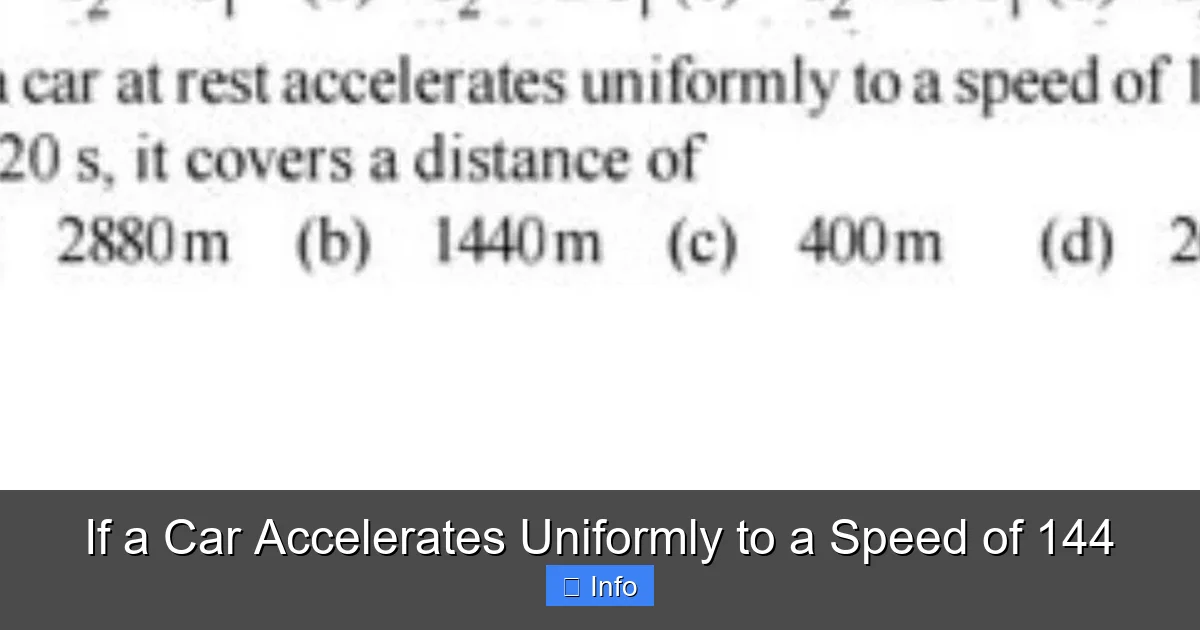
Suppose a car accelerates uniformly to a speed of 144 km/h, which is 40 m/s. It starts from a complete stop, so u = 0. Let us say it takes 20 seconds to reach that speed. We can find acceleration using a = (v – u) / t. That gives us a = (40 – 0) / 20, which equals 2 m/s². That means the car gains 2 meters per second of speed every second.
Example: Already Moving When You Start
Now imagine the car is already moving at 36 km/h, or 10 m/s, when it begins accelerating uniformly to a speed of 144 km/h. If the acceleration is still 2 m/s², we use v = u + at to find time. Rearranging gives t = (v – u) / a, so t = (40 – 10) / 2, which equals 15 seconds. Starting from a roll saves time compared to starting from a standstill.
How Far Does the Car Travel?
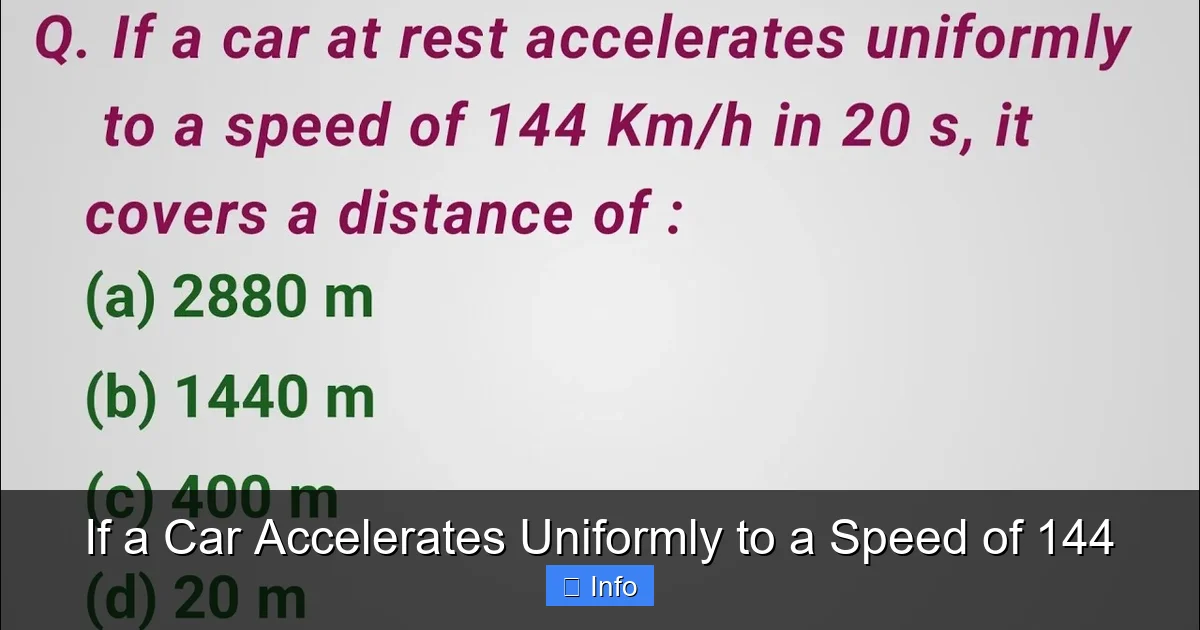
Using the distance formula from the first example, s = 0 × 20 + ½ × 2 × 20². That simplifies to ½ × 2 × 400, which is 400 meters. So the car needs about 400 meters of clear road to accelerate uniformly to a speed of 144 km/h under those conditions. That is roughly the length of four football fields.
Real-World Driving and Safety
Textbook problems assume perfect conditions. Real driving is messier, but the same principles apply.
Merging onto a Highway
When you enter a highway, you often need to accelerate quickly to match traffic. If traffic is moving near 100 km/h and you accelerate uniformly to a speed of 144 km/h, you must make sure you have enough ramp length and visibility. Always check your mirrors and blind spots before committing to the merge.
Passing a Slower Vehicle
Passing on a two-lane road requires quick acceleration and clear sightlines. If you accelerate uniformly to a speed of 144 to pass, remember that you also need distance to slow back down afterward. Never attempt this maneuver near curves, hills, or intersections.
Track Days and Controlled Environments
The safest place to explore hard acceleration is a closed track. There, you can study how your car behaves if it accelerates uniformly to a speed of 144 without worrying about other drivers. If you want to improve your vehicle’s acceleration potential, you might look into how to get more power out of a Toyota engine, but always do so within legal and safe limits.
Engine Power and Torque
An engine must produce enough force to keep acceleration constant. As speed increases, air resistance grows, and the engine has to work harder. If the engine cannot keep up, acceleration will drop off. This is why a car might accelerate uniformly at first but then taper off as it nears 144 km/h.
Road Conditions and Traction
Wet, icy, or gravel roads reduce tire grip. If the wheels spin, the car is not accelerating uniformly no matter how steady your foot is. Traction control systems try to help, but physics still wins when the surface is slippery.
Vehicle Weight and Load
A car carrying four passengers and luggage weighs more than an empty car. More weight means the engine must generate more force to achieve the same acceleration. If you are loading up for a trip, expect acceleration to feel slower than usual.
New vehicles also need care early in their life. Before you test how quickly a car accelerates uniformly to a speed of 144, it is wise to follow the manufacturer’s guidance. You can read about how to break in a new car Toyota to protect the engine during those first few thousand miles.
Common Mistakes and Final Thoughts
Even experienced drivers and students make errors when thinking about acceleration.
Mixing Up Units
The most common mistake is using kilometers per hour in a formula that expects meters per second. Always convert before you calculate. If a car accelerates uniformly to a speed of 144 km/h, convert that to 40 m/s before plugging it into physics equations.
Forgetting Initial Speed
Many people assume u = 0 every time. But if the car is already rolling, the initial velocity is not zero. Ignoring it will give you the wrong time and distance.
Ignoring Maintenance
A poorly maintained engine cannot deliver steady performance. Spark plugs, filters, and fluid levels all matter. Keeping your engine bay tidy helps you spot leaks and issues early. If you want tips on upkeep, check out how to clean a car engine bay as part of your regular routine.
If a car accelerates uniformly to a speed of 144, the journey from a standstill to that speed follows predictable rules. By knowing the basic equations, converting units correctly, and respecting real-world limits, you can better understand your vehicle’s capabilities.
Remember that uniform acceleration is a model, not a guarantee. Traffic, weather, and mechanical condition all influence what actually happens on the road. Use this knowledge to plan merges, passes, and highway driving with more confidence and caution.
Drive safely, keep your vehicle maintained, and enjoy the ride.
Frequently Asked Questions
What does it mean if a car accelerates uniformly to a speed of 144?
It means the car increases its velocity by the same amount every second until it reaches 144, regardless of the unit used. The acceleration remains constant throughout the process.
Is 144 km/h fast for uniform acceleration?
Yes, 144 km/h is about 89.5 mph, which is a highway speed in many regions. Reaching it uniformly requires a decent amount of power and a long stretch of clear road.
How long does it take to accelerate uniformly to 144 km/h?
The time depends on the car’s acceleration rate. For example, at 2 m/s² starting from rest, it takes 20 seconds to reach 40 m/s, which equals 144 km/h.
Can every car accelerate uniformly to 144?
No. Many factors like engine power, weight, tire grip, and road conditions affect whether a car can maintain uniform acceleration up to that speed.
What formula should I use to calculate acceleration?
Use v = u + at, where v is final velocity, u is initial velocity, a is acceleration, and t is time. Rearrange the formula depending on which value you need to find.
Why is unit conversion important in these problems?
Physics formulas typically require meters per second, while speedometers show kilometers per hour or miles per hour. Converting 144 km/h to 40 m/s ensures your calculations are accurate.