Guess Which Sound Has Higher Pitch Guitar or Car Horn

Guess which sound has higher pitch guitar or car horn? This article breaks down the science of pitch, compares typical guitar notes with car horn blasts, and helps you understand why one often sounds sharper than the other. You’ll also get practical tips for musicians and drivers who want to optimize sound quality.
Key Takeaways
- Pitch is measured in hertz (Hz): Higher frequencies produce higher‑pitched sounds.
- Standard guitar strings range from about 82 Hz (low E) to 1 047 Hz (high E) when played open, with fretted notes reaching even higher.
- Most car horns emit sound between 400 Hz and 500 Hz, though some aftermarket models can reach up to 600 Hz.
- Human ears perceive sounds around 2 kHz–5 kHz as especially bright, which is why a tweeter‑enhanced horn can feel sharper.
- Upgrading guitar strings or pickups can push the instrument’s pitch perception higher without changing the fundamental frequency.
- Adding quality car audio tweeters, batteries, or RCA cables can improve horn clarity and perceived pitch (see our guides on tweeters, batteries, and RCA cables).
📑 Table of Contents
Introduction
Have you ever stood beside a revving car and wondered whether its horn sounds higher or lower than a guitar string plucked nearby? The question “guess which sound has higher pitch guitar or car horn” pops up in music classes, driver‑ed discussions, and casual debates among friends. At first glance, a blasting horn seems loud and aggressive, while a guitar can sing sweet, soaring melodies. Yet loudness does not always equal pitch.
In this guide we’ll unpack the physics of pitch, look at how guitars and car horns create sound, compare their typical frequency ranges, and reveal why our ears sometimes judge one as higher‑pitched than the other. By the end you’ll be able to answer the question confidently and even tweak your own gear for better sound.
What Is Pitch?
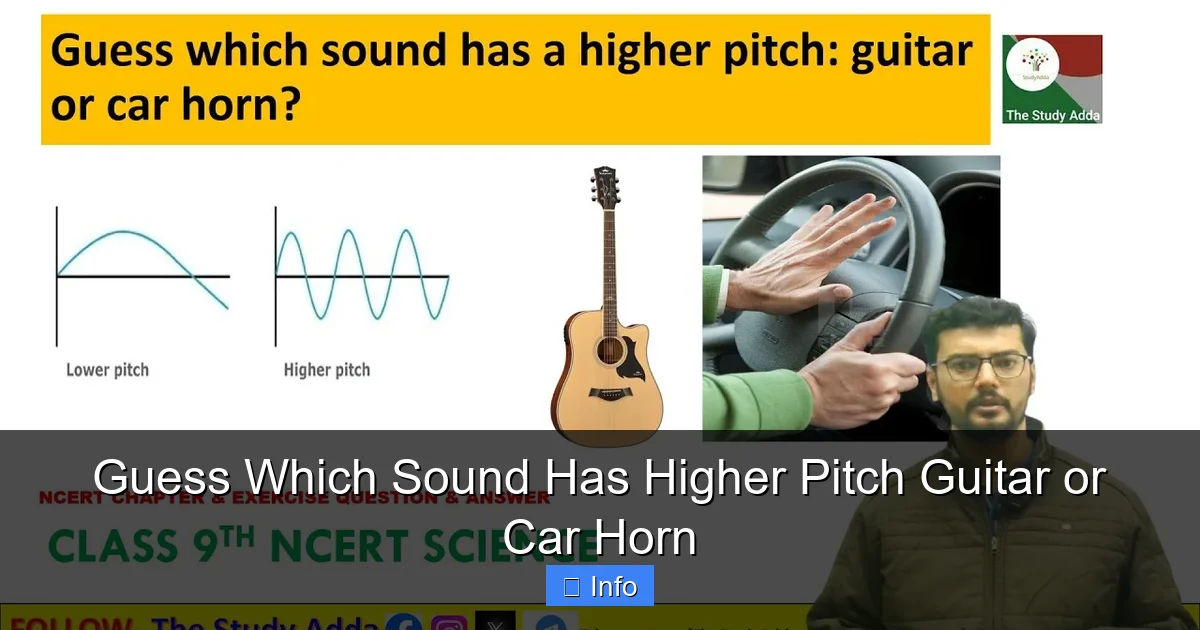
Pitch is how high or low a sound feels to our ears. It is directly tied to the frequency of the sound wave, measured in cycles per second, or hertz (Hz). A higher frequency means a higher pitch.
Visual guide about Guess Which Sound Has Higher Pitch Guitar or Car Horn
Image source: i.ytimg.com
Humans typically hear frequencies from about 20 Hz to 20 000 Hz. Sounds below 500 Hz feel deep and bass‑heavy, while those above 2 000 Hz start to sound bright and piercing. The ear is especially sensitive around 2 kHz–5 kHz, which is why a small boost in that range can make a sound feel noticeably higher.
When we ask “guess which sound has higher pitch guitar or car horn,” we are really asking which source produces sound waves with a higher frequency on average.
How Guitars Produce Sound
A guitar creates sound when its strings vibrate. The vibration transfers energy to the guitar body, which amplifies the sound and sends it into the air.
Strings and Their Frequencies
Standard tuning for a six‑string guitar gives the following open‑string frequencies:
- Low E (6th string): ~82 Hz
- A (5th string): ~110 Hz
- D (4th string): ~147 Hz
- G (3rd string): ~196 Hz
- B (2nd string): ~247 Hz
- High E (1st string): ~330 Hz
When you press a string against a fret, you shorten its vibrating length, which raises the frequency. For example, pressing the high E string at the 12th fret doubles its frequency to about 660 Hz. Playing near the 24th fret can push the note past 1 300 Hz.
Body, Pickups, and Amplification
The guitar’s hollow body (or solid body with pickups) shapes the timbre but does not change the fundamental frequency much. However, pickups and amplifiers can emphasize certain harmonics. Adding a bright pickup or boosting the treble on an amp can make the guitar sound higher‑pitched, even if the fundamental stays the same.
If you want to experiment, try swapping to lighter gauge strings or using a capo higher on the neck. Both actions raise the pitch of the notes you play.
How Car Horns Work
Car horns are designed to be loud and attention‑grabbing. They rely on a vibrating diaphragm or a disc that is set into motion by compressed air or an electromagnet.

Visual guide about Guess Which Sound Has Higher Pitch Guitar or Car Horn
Image source: i.ytimg.com
Types of Horns
Most factory horns are either:
- Electromagnetic (disc) horns: A coil moves a metal disc back and forth, creating sound.
- Air‑powered (trumpet) horns: Compressed air flows through a reed or diaphragm, similar to a saxophone.
Aftermarket options often include multiple horns tuned to different notes to create a chord that is more noticeable.
Typical Frequency Range
A standard car horn usually peaks between 400 Hz and 500 Hz. Some larger trucks or trains use horns that go lower, around 250 Hz, for a deep blast. High‑performance aftermarket horns can be tweaked to reach 600 Hz or slightly more, but they rarely exceed the 1 kHz mark.
Because the horn’s sound is concentrated in a narrow band, it feels loud and urgent, but its pitch is generally lower than many guitar notes played above the first few frets.
Comparing Pitch: Guitar vs Car Horn
Now let’s put the numbers side by side to answer “guess which sound has higher pitch guitar or car horn.”
Typical Frequencies
Guitar: Open strings range from 82 Hz to 330 Hz. Fretted notes can easily exceed 1 000 Hz, especially on the high E string.
Car Horn: Most factory horns sit between 400 Hz and 500 Hz, with some aftermarket models reaching up to 600 Hz.
What Our Ears Hear
Because human hearing is most sensitive around 2 kHz–5 kHz, a guitar note that contains strong harmonics in that region will sound brighter and higher‑pitched than a horn whose energy is concentrated below 1 kHz. Even if the fundamental frequency of a horn is higher than a low guitar string, the horn’s lack of upper harmonics often makes it perceive as lower‑pitched.
For example, plucking the high E string at the 12th fret yields a fundamental of 660 Hz with strong harmonics near 2 kHz. A typical car horn at 450 Hz has far less energy in the 2 kHz region, so the guitar note will feel higher‑pitched despite the horn’s fundamental being lower.
Real‑World Listening Test
Try this simple experiment:
- Play a recording of a clean electric guitar playing the high E string at the 12th fret.
- Immediately after, play a recording of a standard car horn.
- Ask a friend which sound seems higher. Most listeners will pick the guitar.
The result shows that pitch perception depends not just on the fundamental frequency but also on the harmonic content and our ear’s sensitivity.
Practical Tips for Musicians and Drivers
Understanding pitch helps you make better choices, whether you’re shaping a guitar tone or upgrading a car’s warning system.
For Guitarists
- Use lighter gauge strings to raise the pitch of open notes without changing tuning.
- Place a capo on higher frets to instantly shift everything upward.
- Choose pickups with a bright treble response or boost the treble on your amp to emphasize harmonics that ears perceive as higher.
- Consider a guitar with a shorter scale length (like a 24.75‑inch neck) if you want higher fretted notes to feel tighter.
For Drivers Wanting a Sharper Horn
If you feel your car horn sounds too low‑pitched and want it to cut through traffic more effectively, you can:
- Add a tweeter: Pairing a small high‑frequency tweeter with your horn creates a brighter sound that feels higher‑pitched. Check out our guide on the best car audio tweeters for superior sound quality for options that fit most vehicles.
- Upgrade the power supply: A stable, high‑current battery ensures the horn diaphragm moves quickly, preserving clarity. See our recommendations in the best car audio batteries for superior sound performance article.
- Use quality RCA cables: If you run an amplified horn system, low‑loss cables prevent signal degradation. Browse the best rated car audio RCA cables for superior sound quality for reliable choices.
- Consider a dual‑tone horn: Combining a low‑tone trumpet horn with a high‑tone disc horn creates a chord that feels more urgent and perceptibly higher.
These tweaks don’t change the fundamental frequency dramatically, but they boost the harmonic content in the 2 kHz–5 kHz range, making the horn sound sharper and more attention‑grabbing.
Conclusion
So, which sound has higher pitch—guitar or car horn? The answer depends on the note you play and the horn you hear. A guitar’s open strings sit mostly below the typical horn range, but once you start fretting higher notes or adding bright harmonics, the guitar easily surpasses the horn in perceived pitch. Car horns, while loud, usually occupy a narrower band around 400 Hz–500 Hz, which our ears interpret as a moderate pitch.
By understanding the physics of frequency, harmonics, and human hearing, you can make informed choices—whether you’re selecting guitar strings, setting up an amp, or picking a car horn upgrade. The next time someone asks you to “guess which sound has higher pitch guitar or car horn,” you’ll have the facts (and a few fun experiments) to back up your answer.
Frequently Asked Questions
Does a louder car horn mean a higher pitch?
No. Loudness (amplitude) and pitch (frequency) are independent. A horn can be very loud but still produce a low‑frequency tone, just as a soft whistle can be high‑pitched.
Can I make my guitar sound higher‑pitched without changing tuning?
Yes. Using lighter gauge strings, placing a capo higher on the neck, or boosting treble on your amp will emphasize higher frequencies and make the instrument feel higher‑pitched.
What frequency range do most car horns use?
The majority of factory car horns emit sound between 400 Hz and 500 Hz. Some aftermarket models can reach up to 600 Hz, but they rarely go above 1 kHz.
Will adding a tweeter to my car horn make it louder?
A tweeter adds high‑frequency content, which can make the horn sound sharper and more noticeable, but it does not significantly increase overall sound pressure level. For more volume, you’d need a higher‑powered horn or better air supply.
Are there guitar strings that produce frequencies higher than a car horn?
Absolutely. Pressing the high E string at the 12th fret yields about 660 Hz, and notes above the 20th fret can exceed 1 kHz—well above the typical horn range.
How do harmonics affect our perception of pitch?
Our ears are especially sensitive to frequencies between 2 kHz and 5 kHz. When a sound contains strong harmonics in that range, we perceive it as higher‑pitched, even if its fundamental frequency is lower than another sound’s fundamental.