Does Toyota Negotiate Vehicle Prices?
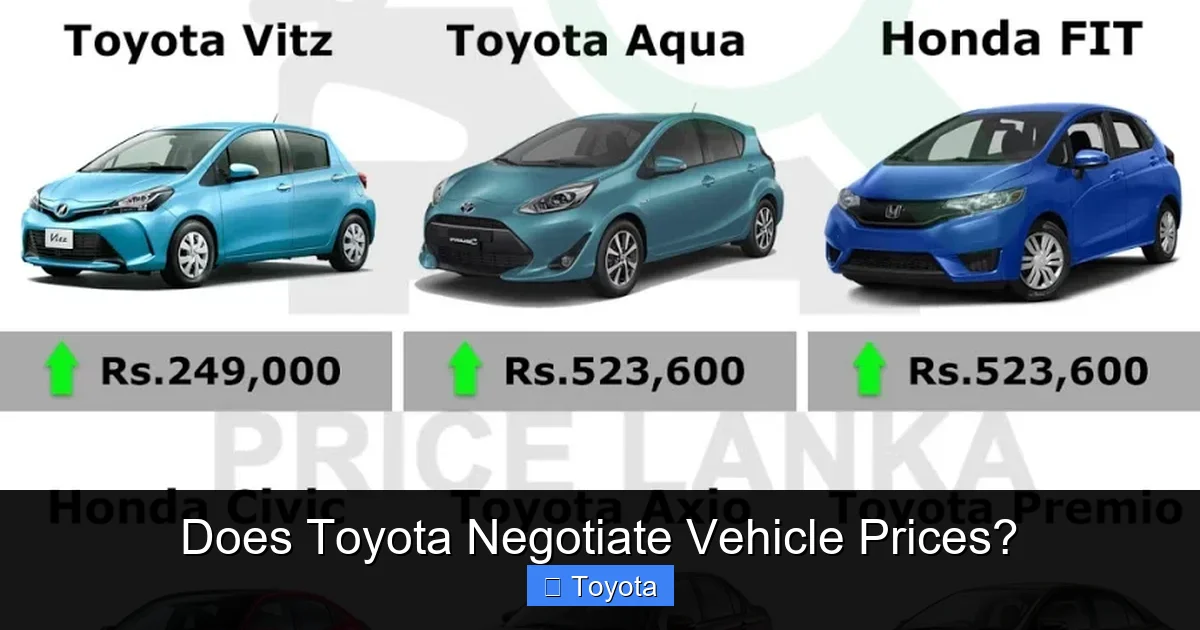
Toyota dealerships do negotiate vehicle prices, but the process varies by model, demand, and location. While some popular models may have less flexibility, understanding market value and dealer incentives can help you secure a fair deal.
So you’re walking onto a Toyota lot, eyeing that shiny new Camry or rugged Tacoma, and the big question hits you: does Toyota negotiate vehicle prices? The short answer is yes, absolutely. But like anything in car buying, the real answer lives in the details. It’s not a simple yes or no; it’s a “yes, but…” situation. Understanding how the game works at a Toyota dealership can save you thousands and a whole lot of stress.
I’ve been through this dance a few times myself. You see the sticker price on the window (that’s the MSRP), and you wonder if that’s real or just a suggestion. Spoiler alert: it’s almost always a suggestion. But how far down can you go? That depends on a mix of market forces, the specific model you want, and how well you do your homework. Let’s break it all down so you walk in prepared and walk out happy.
Key Takeaways
- Negotiation is standard: Most Toyota dealers expect some haggling on new and used vehicles.
- High-demand models have less wiggle room: Vehicles like the RAV4 Hybrid or Tacoma often sell at or above MSRP.
- Dealer invoice price is your baseline: Knowing the dealer’s cost gives you a strong starting point for negotiations.
- Timing matters: End-of-month, end-of-year, or model changeover periods offer better leverage.
- Focus on the “out-the-door” price: Negotiate the total cost including fees, taxes, and add-ons, not just the monthly payment.
- Pre-approved financing strengthens your position: Arranging your own loan lets you negotiate as a cash buyer.
- Used Toyotas offer more flexibility: Pre-owned inventory typically has higher profit margins for dealers to work with.
📑 Table of Contents
Understanding Toyota’s Pricing Structure
Before you can negotiate, you need to speak the language. Toyota, like all manufacturers, sets a Manufacturer’s Suggested Retail Price (MSRP). That’s the number on the window sticker. But the dealer didn’t pay that much for the car. They paid the invoice price (sometimes called dealer cost). The difference between invoice and MSRP is the dealer’s gross profit margin before overhead.
The Role of Holdback and Incentives
Here’s a secret: the invoice price isn’t even the dealer’s true bottom line. Toyota pays dealers a “holdback” — usually 2-3% of the MSRP — after the car is sold. This reimburses the dealer for financing costs. So even if you buy at “invoice,” the dealer still makes money. On top of that, there are factory-to-dealer incentives (hidden rebates) that vary by region and time of year. These are the golden nuggets that allow prices to dip below invoice.
Market Adjustments: The Wild Card
You’ve probably heard of “Market Adjustment” or “Additional Dealer Markup” (ADM). This is an extra fee slapped on top of MSRP for hot models. During supply shortages (like the recent chip crisis), this was rampant on RAV4 Hybrids, Tacomas, and Supras. If a car has a market adjustment, negotiation gets harder. You’re no longer negotiating down from MSRP; you’re negotiating down from MSRP + $5,000. In these cases, your best bet is often to wait, expand your search radius, or consider a less constrained model.
Which Toyota Models Are Negotiable?
Not all Toyotas are created equal in the negotiation room. Supply and demand rule the day.
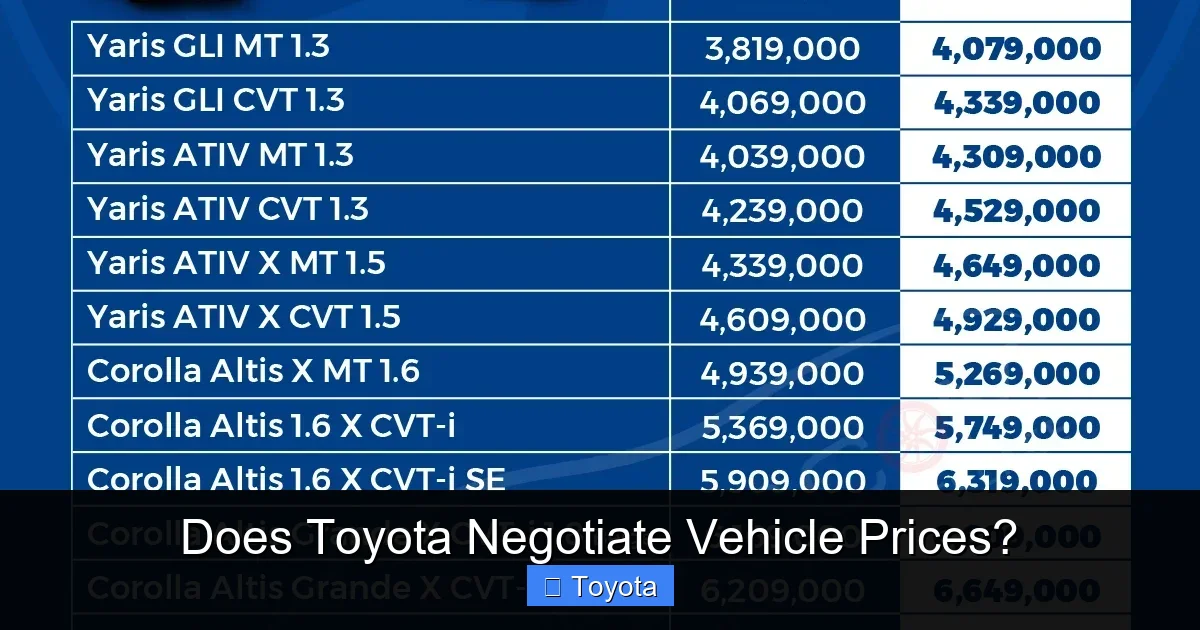
Visual guide about Does Toyota Negotiate Vehicle Prices?
Image source: aautomotives.com
High-Demand Models (Tougher Negotiation)
- RAV4 Hybrid / Prime: Perennially short supply. Often sell at MSRP or above.
- Tacoma (especially TRD trims): Cult following means dealers don’t budge much.
- Sienna Hybrid: The only hybrid minivan game in town = pricing power.
- GR Corolla / GR Yaris: Limited allocation, enthusiast demand = ADM city.
- Land Cruiser (new model): High demand, low volume.
Models With More Wiggle Room
- Camry / Corolla (gas models): High volume, lots of competition (Honda Accord, Hyundai Sonata). Dealers discount to move metal.
- Highlander (gas V6): Faces stiff competition from Kia Telluride, Hyundai Palisade.
- Tundra (non-hybrid, lower trims): Fighting Ford F-150, Ram 1500, Chevy Silverado. Rebates are common.
- Sequoia: Niche segment, slower turnover.
- Mirai (FCEV): Massive incentives due to limited hydrogen infrastructure.
If you’re flexible on model, you hold the cards. If your heart is set on a Tacoma TRD Pro, prepare to pay sticker or walk away. For a broader look at pricing across the lineup, check out how much does a Toyota cost to get a baseline for your budget.
The Best Times to Negotiate a Toyota
Timing isn’t everything, but it’s a lot. Dealers have monthly, quarterly, and annual sales targets tied to bonus money from Toyota corporate. Hitting these targets unlocks “stair-step” incentives — big checks that make it worth selling a few cars at a loss.
Visual guide about Does Toyota Negotiate Vehicle Prices?
Image source: aautomotives.com
End of the Month / Quarter / Year
The last few days of any month are classic. The last few days of March, June, September, December (quarter ends) are better. The last few days of December? That’s the Super Bowl. Dealers are chasing year-end volume bonuses hard.
Model Changeover Periods
When the 2025s arrive, the 2024s become “aged inventory.” Toyota charges dealers floorplan interest (financing cost) for every day a car sits. After 90-120 days, dealers get desperate. This is your window for below-invoice deals on outgoing model years.
Holiday Weekends
Memorial Day, Fourth of July, Labor Day, Black Friday. Manufacturers run special lease/finance programs. Dealers staff up and advertise heavily. They need volume. Just expect crowds and tired salespeople.
Slow Seasons
January and February are often slow (post-holiday, tax refunds not yet spent, cold weather in north). A dealer with a snowy lot and zero foot traffic on a Tuesday in January might take a skinny deal just to have a win.
How to Negotiate Like a Pro
Okay, you’re at the dealership. Now what? Follow this process.
Visual guide about Does Toyota Negotiate Vehicle Prices?
Image source: automotivian.com
1. Do Your Homework Before You Leave Home
Know the exact trim, options, and color you want. Look up the MSRP, invoice price, and current incentives on sites like Edmunds, KBB, or CarsDirect. Print it out or have it on your phone. Knowledge is your only leverage.
2. Get Pre-Approved Financing
Walk in with a loan approval from your credit union or bank. This lets you say, “I’m a cash buyer.” You can still take the dealer’s financing if they beat your rate (they often can via captive lenders like Toyota Financial Services), but you need the baseline. It also prevents the “monthly payment” shell game.
3. Negotiate the “Out-the-Door” Price Only
Don’t talk monthly payment. Don’t talk trade-in yet. Don’t talk accessories. Negotiate one number: the total cash price including all taxes, title, registration, and dealer fees (doc fee, etc.). Say: “What’s the out-the-door price for this specific VIN?”
4. Start Low, But Be Realistic
On a negotiable model, start at invoice minus any public rebates. On a tight model, start at MSRP minus rebates. Expect counteroffers. Move in small increments ($100-$200). Stay calm. Be willing to walk out. The “I need to think about it / talk to my spouse” walk to the door is the most powerful move in your arsenal.
5. Handle the Trade-In Separately
Only discuss your trade after the new car price is locked. Get offers from CarMax, Carvana, and a local used car dealer first. That’s your floor. If the Toyota dealer beats it, great. If not, sell it yourself or to the high bidder. Mixing trade-in clouds the new car negotiation.
6. Watch the F&I Office (Finance & Insurance)
After price agreement, you go to the “box” with the Finance Manager. They sell extended warranties, gap insurance, paint protection, tire/wheel plans, etc. Just say no. Or say “I’ll think about it.” You can buy Toyota’s factory extended warranty (Toyota Extra Care) later online for less. Gap insurance is cheaper from your auto insurer. Dealer add-ons are high-profit, low-value for most buyers.
New vs. Used Toyota Negotiation
The dynamics shift significantly between new and used.
New Toyota Negotiation
- Prices are tethered to MSRP/Invoice.
- Factory incentives (rebates, special APR) are public and non-negotiable — they come off the top.
- Dealer profit is the only moving part.
- You can order exactly what you want (if allocation allows).
Used Toyota Negotiation
- No MSRP anchor. Price is based on market data (KBB, Black Book, MMR auction values).
- Dealer acquired it via trade-in or auction. Their cost varies wildly.
- Reconditioning costs (tires, brakes, detailing) are baked in but opaque.
- Much more room to negotiate. Used cars are where dealers make their highest margins.
- Certified Pre-Owned (CPO) Toyotas have less wiggle room (they cost more to certify, come with warranty), but you can still push.
If you’re looking at a specific popular used model like a RAV4, knowing the market value is key. You can see current pricing trends for the RAV4 at how much is a Toyota RAV. For trucks, check how much is a Toyota Tundra. And if a Corolla is on your list, how much is a new Toyota Corolla gives you the new-car baseline to compare against used.
Special Scenarios: Leasing, Ordering, and Online Buying
Leasing a Toyota
You negotiate the capitalized cost (cap cost) — the selling price of the car — just like a purchase. The money factor (interest rate) and residual value are set by Toyota Financial Services (TFS) and generally non-negotiable. But the cap cost? Fair game. Lower cap cost = lower payment. Don’t let them only show you the payment. Demand the cap cost number.
Factory Ordering
If you order a 2025 Tacoma exactly how you want, you’re negotiating a future purchase. Get the agreed price in writing (a buyer’s order or purchase agreement). Specify that price is locked regardless of incentives at delivery (or that you get the better of current vs. future incentives). Put a refundable deposit down. This avoids market adjustments on lot stock.
Toyota’s “SmartPath” / Online Retail
Some dealers use Toyota’s SmartPath system or third-party tools (like Cars.com, TrueCar) for “no-haggle” pricing. These prices are usually fair (invoice + small margin) but not the absolute bottom. You can still try to negotiate, but the dealer may say “price is fixed.” It saves time and stress. Decide what you value more: lowest possible dollar or ease of transaction.
Common Negotiation Mistakes to Avoid
- Focusing on Monthly Payment: This hides the total price and allows dealers to stretch terms (84-96 months) or pack in products.
- Not Knowing Your Credit Score: Your rate depends on it. Know your tier before you go.
- Falling for “Protection Packages”: Pinstriping, fabric guard, VIN etching, nitrogen tires — often $1,000+ for $50 of product. Decline firmly.
- Trading In Upside Down: Owing more than your car is worth rolls negative equity into the new loan. You’re instantly underwater. Pay off the old car first or pay the difference in cash.
- Buying on First Visit: Sleep on it. The deal will still be there tomorrow (mostly). Pressure tactics (“another buyer interested,” “incentive expires today”) are often bluffs.
- Ignoring the Doc Fee: Documentation fees vary by state (some capped, some not). In uncapped states, dealers charge $500-$900. It’s negotiable or at least you can ask for a price reduction to offset it.
Conclusion
So, does Toyota negotiate vehicle prices? Yes, they do. Every single day. But the amount of negotiation depends entirely on the model, the market, the timing, and your preparation. A Camry LE in January? You’ll likely get a discount. A RAV4 Prime in June? You’ll be lucky to pay MSRP.
The power is in the prep. Know the numbers. Secure your financing. Separate the transactions (price, trade, financing). Be polite but firm. And never, ever be afraid to walk out. There’s always another Toyota dealer — and another day. Your perfect Toyota at a fair price is out there. Go get it.
Frequently Asked Questions
Can you negotiate the price of a new Toyota at the dealership?
Yes, you can negotiate the price of a new Toyota. The MSRP is a starting point, and dealers have flexibility between the invoice price and MSRP, plus potential holdback and incentives. However, high-demand models may have limited or no discount.
Do Toyota dealers charge over MSRP?
Some dealers add “Market Adjustments” or “Additional Dealer Markup” on popular models like the RAV4 Hybrid, Tacoma, or GR Corolla. This is legal but not required by Toyota. You can refuse to pay it, shop other dealers, or wait for supply to improve.
Is it better to negotiate via email or in person?
Email (or text) is often better for initial negotiations. It creates a paper trail, removes pressure, lets you compare multiple dealers easily, and forces the dealer to put numbers in writing. Visit in person only for the test drive and final signing.
What is a fair profit for a Toyota dealer on a new car?
A fair deal is often considered $500-$1,500 over true dealer cost (invoice minus holdback and incentives) on a standard volume model. This covers the dealer’s overhead and salesperson commission. On slow movers, you might buy at or below invoice.
Can you negotiate the price of a Toyota Certified Pre-Owned (CPO) car?
Yes, CPO prices are negotiable. They are priced higher than non-CPO used cars due to the inspection, warranty, and reconditioning costs. However, dealers still have margin built in. Use market comparables (KBB, CarGurus) to support your offer.
Does Toyota offer employee pricing or friends and family discounts?
Toyota does not have a national, permanent “employee pricing for everyone” program like some domestic brands. They occasionally run “Toyota Employee Purchase Program” events for eligible employees/retirees of partner companies. Friends/family discounts are at the dealer’s discretion.