A Car of Mass M Starts from Rest and Accelerates
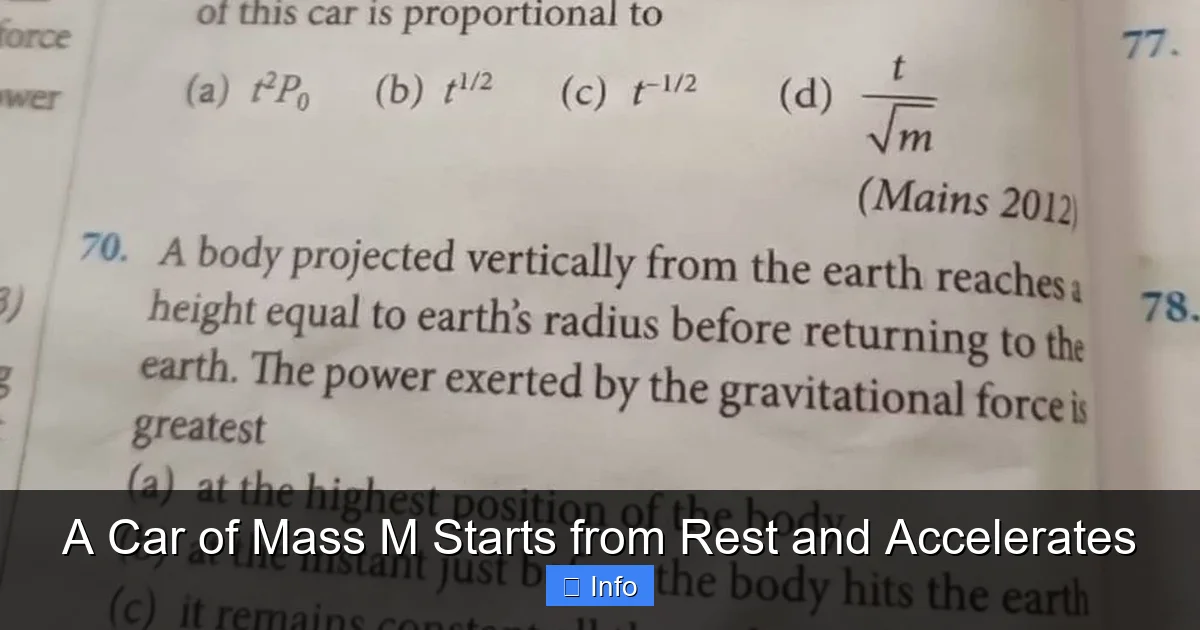
When a car of mass m starts from rest and accelerates, it follows Newton’s second law, turning fuel into motion. Understanding force, mass, and acceleration helps you drive smarter and safer. Practical tips and real‑world examples make the science easy to grasp.
When we talk about a car of mass m starts from rest and accelerates, we are really diving into the basics of motion. This concept is the foundation of everything from everyday commuting to high‑performance driving. By breaking down the physics, we can see why some cars feel zippy while others feel more sluggish. In this guide, we’ll explore the science, share real‑world examples, and give you practical tips to make the most of every start.
Key Takeaways
- Force and Mass Relationship: The equation F = m × a shows how force, mass, and acceleration are linked.
- Starting From Rest: A car at rest has zero initial velocity, so all applied force creates acceleration.
- Real‑World Examples: Light sports cars accelerate faster because they have less mass.
- Driver Tips: Smooth throttle, proper tire pressure, and good maintenance improve acceleration.
- Safety First: Controlling acceleration prevents loss of traction and keeps you safe.
- Performance Upgrades: Upgrading engine power or suspension can boost how quickly a car of mass m starts from rest and accelerates.
- Physics in Everyday Driving: Every start, stop, and merge uses the same basic physics principles.
📑 Table of Contents
Understanding the Basics of Motion
What Does “A Car of Mass M Starts From Rest and Accelerates” Really Mean?
When a car of mass m starts from rest and accelerates, it means the vehicle begins with zero velocity and then increases its speed over time.
Think of the car as a block on a track. At the start line, the block isn’t moving. Once you push, the force you apply creates motion. The same idea works for any vehicle, whether it’s a tiny city car or a powerful truck.
The phrase “a car of mass m starts from rest and accelerates” is a classic physics problem. It helps us calculate how much force is needed to change the car’s speed in a given time.
Force, Mass, and Acceleration: The Core Equation
The Math Behind F = m × a
Newton’s second law states: Force equals mass times acceleration (F = m × a). This simple formula tells us three things:
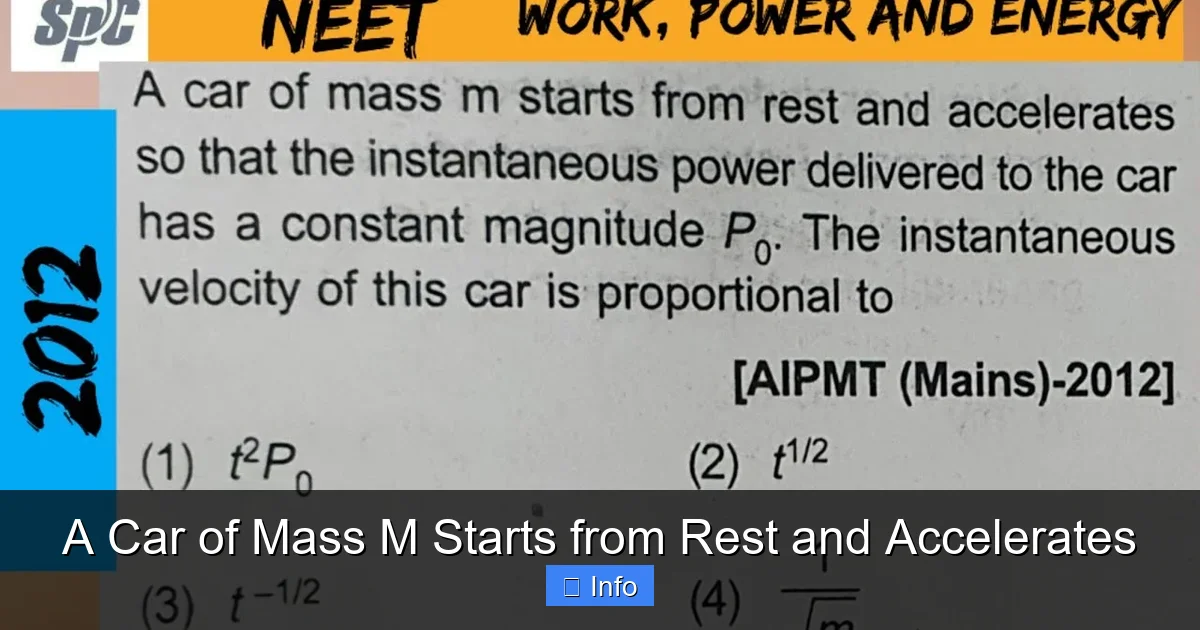
Visual guide about A Car of Mass M Starts from Rest and Accelerates
Image source: i.ytimg.com
- Force (F): The push or pull on the car.
- Mass (m): The car’s weight, measured in kilograms.
- Acceleration (a): How quickly speed changes, measured in meters per second squared.
When a car of mass m starts from rest and accelerates, we plug in the numbers. For example, a 1,500‑kg car that reaches 10 m/s in 5 seconds has an acceleration of 2 m/s². The required force is 1,500 × 2 = 3,000 N.
Understanding this helps you see why heavier cars need more power to accelerate. It also explains why electric cars can feel instantly responsive—they deliver high force right away.
Real‑World Car Examples
How Different Vehicles Behave When a Car of Mass M Starts From Rest and Accelerates
Not all cars behave the same way. A sports car with a small mass m will accelerate faster than a large SUV with the same engine.
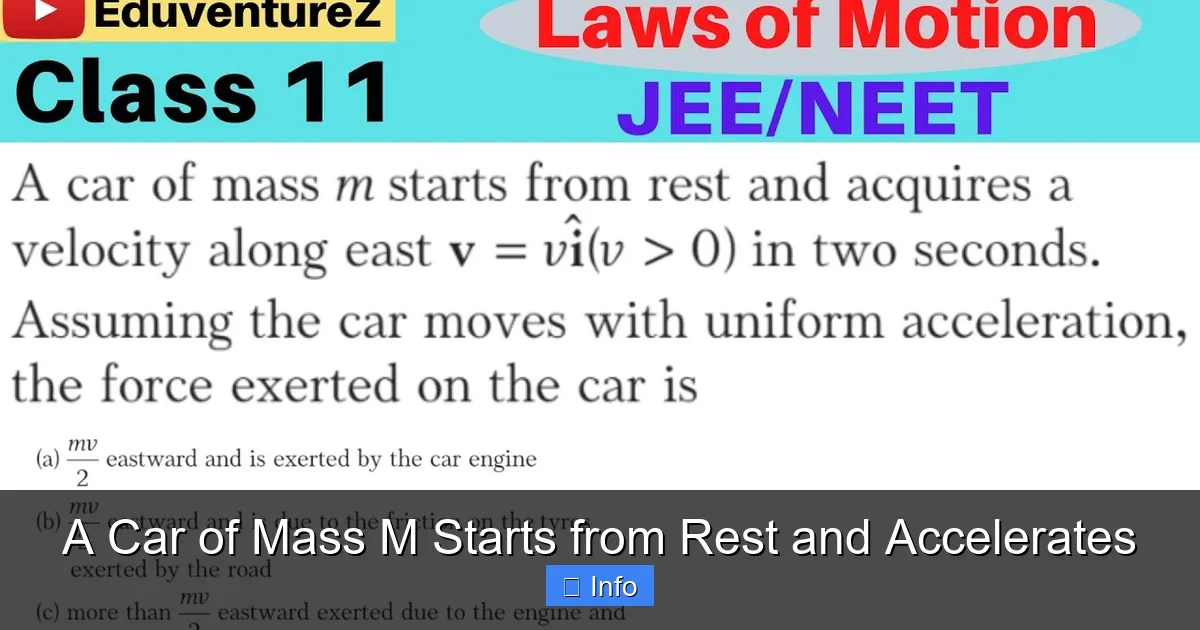
Visual guide about A Car of Mass M Starts from Rest and Accelerates
Image source: i.ytimg.com
Consider the Toyota Ae86. Its lightweight chassis and modest engine make it a favorite for learning how a car of mass m starts from rest and accelerates. You can read more about its performance here.
If you want to squeeze more power from a larger engine, many drivers look at the 4.7‑liter Toyota V8. Upgrading intake, exhaust, and tuning can significantly increase the force a car of mass m starts from rest and accelerates with. Check out a guide on boosting that engine here.
Suspension also plays a role. Better shocks and struts keep the tires planted, allowing more of the engine’s force to turn into forward motion. For recommendations on upgrades, see this article.
Tips for Better Acceleration
Optimize Your Driving Style
When a car of mass m starts from rest and accelerates, smooth throttle use is key. Jerking the wheel can waste force and reduce traction.
Visual guide about A Car of Mass M Starts from Rest and Accelerates
Image source: i.ytimg.com
Use the “slow and steady” approach:
- Press the gas gently until you feel the car move.
- Shift gears at the right RPM for smooth power delivery.
- Keep revs in the optimal range for your transmission.
This method maximizes the force that actually moves the car forward.
Maintenance for Peak Performance
A well‑maintained car of mass m starts from rest and accelerates more efficiently. Here are three quick checks:
- Tire pressure: Under‑inflated tires increase rolling resistance, requiring more force.
- Engine health: Clean oil and tuned components ensure the engine can produce maximum force.
- Transmission fluid: Proper fluid keeps gear shifts smooth, preserving acceleration.
Regular service appointments keep your vehicle ready to deliver that perfect start.
Safety and Control When Accelerating
Traction and Grip
When a car of mass m starts from rest and accelerates, the tires must grip the road. Wet or icy surfaces reduce grip, making it harder to convert force into motion.
Tips for better traction:
- Reduce speed before entering slippery areas.
- Use appropriate driving modes (e.g., snow, eco).
- Avoid sudden acceleration; gradually increase throttle.
Braking and Stability
Even the best acceleration needs good braking. A car of mass m starts from rest and accelerates, but also must stop safely.
Key points:
- Keep brake pads clean and correctly sized.
- Balance brake bias for front‑rear stability.
- Practice smooth braking to maintain control.
Conclusion
Understanding how a car of mass m starts from rest and accelerates opens the door to smarter driving and better vehicle care. By grasping the simple equation F = m × a, you can see why lighter cars feel quicker and why maintenance matters.
Real‑world examples, like the Toyota Ae86 and a tuned 4.7‑liter engine, show how physics plays out on the road. Applying smooth throttle, checking tire pressure, and upgrading suspension all help a car of mass m start from rest and accelerate more efficiently.
Remember, safety is the ultimate goal. Proper traction, smooth braking, and mindful acceleration keep you and others safe. Use the tips above, and you’ll enjoy every start with confidence.
Frequently Asked Questions
What does it mean when a car of mass m starts from rest and accelerates?
It means the vehicle begins with zero speed and then increases its velocity. This is governed by Newton’s second law, where the force applied to the car’s mass determines its acceleration.
How do I calculate the force needed for acceleration?
Use F = m × a. Determine the car’s mass (in kg) and the desired acceleration (in m/s²). Multiply them to get the force in Newtons.
Why do lighter cars accelerate faster?
Because acceleration = force ÷ mass. With the same engine force, a smaller mass results in a larger acceleration, making the car feel quicker.
Can I improve my car’s acceleration with simple maintenance?
Yes. Proper tire pressure, clean oil, and healthy brakes reduce resistance and help the engine convert fuel into motion more effectively.
What role does traction play in acceleration?
Traction is the grip between tires and road. Good grip lets the engine’s force translate into forward motion without wheel spin, especially important when a car of mass m starts from rest and accelerates.
Are performance upgrades worth it for better acceleration?
Upgrades like intake systems, exhausts, and improved suspension can increase force output and grip, giving a noticeable boost in how quickly a car of mass m starts from rest and accelerates.