Purchased Car for Personal Use Journal Entry
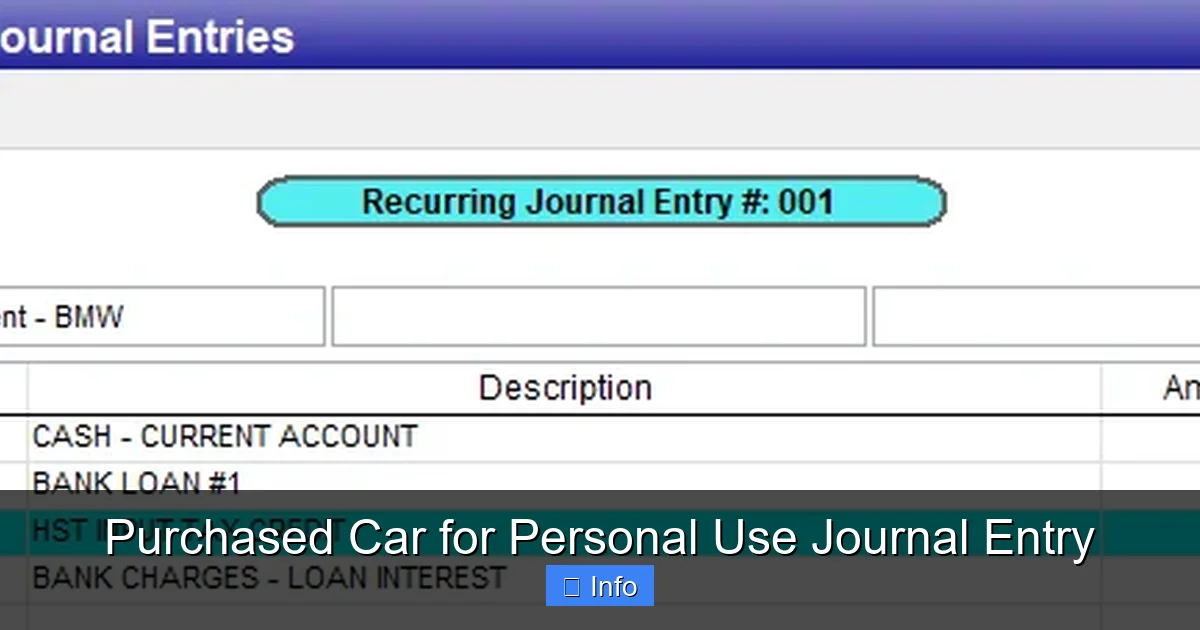
Recording a purchased car for personal use journal entry is straightforward: debit your vehicle asset account and credit cash or a loan liability. This guide covers the exact entries, handling loans, trade-ins, and ongoing costs so your personal books stay accurate and tax-ready.
Buying a car is exciting. The new-car smell, the freedom of the open road, and the pride of ownership all hit at once. But once the celebration settles, a practical question pops up: how do you record this in your personal accounting records? If you keep a ledger, use software like QuickBooks, or just maintain a spreadsheet, you need a clean purchased car for personal use journal entry. Getting it right keeps your net worth statement accurate and makes tax time easier if you ever claim mileage or sell the vehicle.
Many people think a car purchase is just a big expense. In accounting terms, it’s not. A car is a fixed asset that provides value over several years. That means the purchase goes on your balance sheet, not your income statement. The cash leaves your pocket, but you gain an asset of equal value. Over time, that asset loses value through depreciation, and you incur operating costs like gas, insurance, and repairs. Each of those has its own entry. This article walks you through every scenario, from a simple cash purchase to a financed deal with a trade-in, so you can post entries with confidence.
Key Takeaways
- Asset Classification: A personal vehicle is a fixed asset, not an expense, so it goes on your balance sheet.
- Basic Entry: Debit Vehicle Asset, credit Cash (or Loan Payable if financed).
- Loan Payments: Split each payment between principal (reduces liability) and interest (expense).
- Trade-Ins: Record the new car at full cost, remove the old car’s book value, and recognize any gain or loss.
- Ongoing Costs: Fuel, insurance, and repairs are expenses; major improvements get capitalized.
- Depreciation Optional: Personal books don’t require depreciation, but tracking value helps with net worth.
- Documentation: Keep the purchase agreement, loan papers, and receipts for at least seven years.
📑 Table of Contents
Understanding the Basics of a Personal Car Purchase Journal Entry
Why It’s an Asset, Not an Expense
When you buy groceries, you expense them immediately because they’re consumed right away. A car is different. You expect to use it for years. Accounting standards call this a capital expenditure. You capitalize the cost, meaning you put it on the balance sheet as an asset. Then, if you choose, you depreciate it over its useful life. For personal books, depreciation is optional but helpful for tracking true net worth.
The Accounting Equation in Action
Remember the fundamental equation: Assets = Liabilities + Equity. When you buy a car for cash, one asset (Cash) goes down and another asset (Vehicle) goes up. Total assets stay the same. When you finance, Cash doesn’t move; instead, a liability (Loan Payable) goes up. Equity is untouched at the moment of purchase. This keeps your books in balance.
What Costs to Include in the Asset Value
The asset value isn’t just the sticker price. Include sales tax, dealer documentation fees, title and registration fees, and any delivery charges. Do not include ongoing costs like insurance premiums or fuel. If you pay for a warranty or service contract at purchase, you can either capitalize it as part of the vehicle or expense it over the coverage period. Most people capitalize it for simplicity.
The Accounting Equation and Your Personal Vehicle
Cash Purchase Example
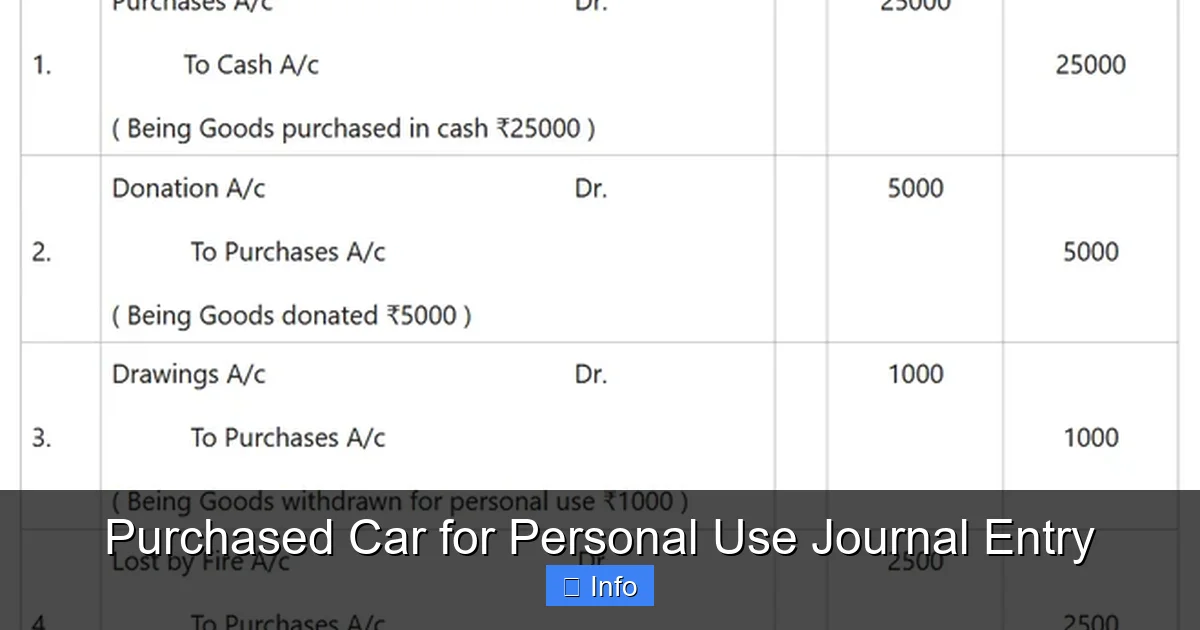
Imagine you pay $25,000 cash for a used sedan. The entry is:
Visual guide about Purchased Car for Personal Use Journal Entry
Image source: media.geeksforgeeks.org
- Debit: Vehicle Asset – $25,000
- Credit: Cash – $25,000
Your Vehicle asset account now shows $25,000. Your Cash account drops by $25,000. Net worth is unchanged. If you use accounting software, you’ll create a fixed asset account named “Vehicle” or “Personal Auto” and post the transaction there.
Financed Purchase Example
Now suppose you put $5,000 down and finance $20,000. The entry:
- Debit: Vehicle Asset – $25,000
- Credit: Cash – $5,000
- Credit: Loan Payable – $20,000
You still record the full $25,000 as the asset. The liability side shows the loan. Each monthly payment will reduce the loan and record interest expense. We’ll cover that in the next section.
Trade-In Scenario
Trading in an old car adds a step. Say your old car has a book value of $8,000 (original cost $15,000 minus $7,000 accumulated depreciation). The dealer gives you $9,000 trade-in allowance. You buy a new car for $30,000. The entry:
- Debit: Vehicle Asset (new) – $30,000
- Debit: Accumulated Depreciation (old) – $7,000
- Credit: Vehicle Asset (old) – $15,000
- Credit: Gain on Trade-In – $1,000 (the $9,000 allowance minus $8,000 book value)
- Credit: Cash or Loan Payable – $21,000 (the net amount you pay after trade)
If the allowance were less than book value, you’d debit a loss instead of crediting a gain. Many personal bookkeepers skip depreciation, so the old car’s book value is just its original cost. In that case, the gain or loss is the trade allowance minus original cost.
Step-by-Step Guide to Recording the Journal Entry
Gather Your Documents
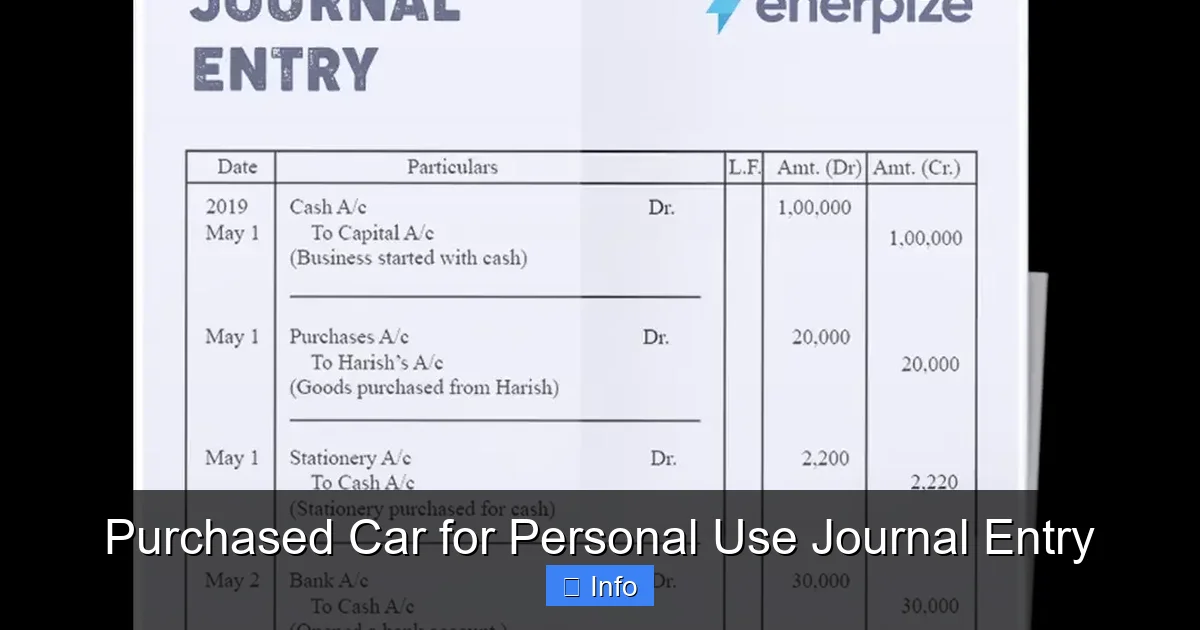
Before you post anything, collect the purchase agreement, loan contract, title paperwork, and receipt for any down payment. These documents have the exact numbers you need: total price, taxes, fees, down payment, loan amount, interest rate, and payment schedule.
Visual guide about Purchased Car for Personal Use Journal Entry
Image source: enerpize.com
Set Up Your Accounts
In your chart of accounts, ensure you have:
- Vehicle Asset (fixed asset)
- Loan Payable (long-term liability)
- Interest Expense (expense)
- Cash/Bank (asset)
- Optional: Accumulated Depreciation (contra-asset) and Depreciation Expense
Post the Initial Entry
On the purchase date, create a journal entry with the date, description (“Purchased 2024 Honda Accord for personal use”), and the debits and credits from the examples above. Attach a digital copy of the contract to the entry if your software allows.
Record the First Loan Payment
When the first payment is due, split it. Suppose the payment is $400, with $300 principal and $100 interest. The entry:
- Debit: Loan Payable – $300
- Debit: Interest Expense – $100
- Credit: Cash – $400
Repeat this each month using the amortization schedule from your lender. The principal portion reduces the liability; the interest portion hits your income statement.
Handle Additional Costs at Purchase
If you paid for a extended warranty, gap insurance, or accessories at the dealership, decide whether to capitalize. For a warranty, you might debit Vehicle Asset and credit Cash for the warranty cost, then amortize it over the warranty period. For floor mats or a cargo liner, just expense them as “Auto Accessories” unless they’re substantial.
Common Scenarios and Examples
Buying from a Private Party
You hand over a cashier’s check for $12,000. No loan, no trade. Simple entry:

Visual guide about Purchased Car for Personal Use Journal Entry
Image source: carunway.com
- Debit: Vehicle Asset – $12,000
- Credit: Cash – $12,000
Keep the bill of sale and title transfer receipt as support.
Leasing a Vehicle
A lease is not a purchase. You don’t record an asset or liability (unless it’s a finance lease under ASC 842, which is rare for personal use). Instead, each lease payment is an expense:
- Debit: Lease Expense – $X
- Credit: Cash – $X
If you later buy the car at lease end, that’s a purchase entry at the buyout price.
Receiving a Car as a Gift
If a family member gives you a car, you record it at fair market value:
- Debit: Vehicle Asset – FMV
- Credit: Gift Income (or Equity Contribution) – FMV
This increases your net worth. Get a written statement of the car’s value at the gift date for your records.
Using the Car for Business Part-Time
If you drive the car for both personal and business miles, you still record the purchase once as a personal asset. For business use, you track mileage and deduct either the standard mileage rate or actual expenses allocated to business. The journal entry for the purchase doesn’t change; the deduction happens on your tax return, not in your personal books.
Tax Implications and Considerations
Sales Tax Deduction
You may deduct state and local sales tax on a vehicle purchase if you itemize and choose the sales tax deduction instead of state income tax. Keep the purchase contract showing tax paid. The journal entry doesn’t change; the deduction is a tax-return item.
Personal Property Tax
Some states charge annual personal property tax on vehicles. When you pay it, record:
- Debit: Property Tax Expense
- Credit: Cash
This is deductible if you itemize.
Depreciation for Tax vs. Books
Tax depreciation (MACRS) differs from book depreciation. For personal books, you can skip depreciation entirely or use straight-line for a realistic net worth. If you ever use the car for business, you’ll need a depreciation schedule for the business portion. Starting with a clean book value makes that easier.
Selling the Car Later
When you sell, you remove the asset and any accumulated depreciation, record cash received, and recognize a gain or loss. Example: Sold car with $25,000 cost and $10,000 accumulated depreciation for $18,000 cash.
- Debit: Cash – $18,000
- Debit: Accumulated Depreciation – $10,000
- Credit: Vehicle Asset – $25,000
- Credit: Gain on Sale – $3,000
If you sold for $12,000, you’d debit a $3,000 loss instead.
Tips for Accurate Record Keeping
Use a Dedicated Asset Account
Create a separate fixed asset account for each vehicle. Name it “2024 Honda Accord” or “Personal Vehicle – Accord.” This makes it easy to track cost, depreciation, and eventual sale for each car.
Attach Digital Copies
Scan or photograph the purchase agreement, loan documents, title, and registration. Attach them to the journal entry in your software. If you use a spreadsheet, keep a folder with the files named by date and description.
Reconcile Loan Balances
At least once a year, compare your Loan Payable balance to the lender’s statement. Adjust for any discrepancies. This catches missed payments or posting errors early.
Track Mileage Separately
Even if you don’t use the car for business, tracking total miles helps you calculate actual cost per mile. Use a simple log or an app. This data is invaluable if you ever need to substantiate business use or calculate reimbursement.
Consider a Maintenance Sub-Account
If you want to track total cost of ownership, create expense sub-accounts: Fuel, Insurance, Repairs, Maintenance, Registration, Tires. At year-end, you can see exactly what the car cost to run. This helps with budgeting and future purchase decisions.
Don’t Forget Accessories and Upgrades
After purchase, you might add a roof rack, upgrade the stereo, or install a hidden GPS tracking device for security. If the cost is significant and extends the car’s useful life or value, capitalize it by debiting Vehicle Asset. Otherwise, expense it as Repairs or Accessories. For example, a quality floor jack for your garage is a tool, not part of the car, so expense it. But a premium tire shine is a supply, not an asset.
Conclusion
Recording a purchased car for personal use journal entry doesn’t have to be intimidating. The core principle is simple: you’re swapping one asset for another, or taking on a liability to acquire an asset. By capturing the full cost—including taxes and fees—you set up an accurate starting point for your vehicle asset. From there, loan payments, operating expenses, and eventual sale each have clear, repeatable entries.
Consistency is the secret. Use the same account structure for every vehicle. Attach documentation to every entry. Reconcile loan balances annually. And if you ever use the car for business, you’ll have a clean history to allocate costs. Whether you’re a spreadsheet enthusiast or a software user, these habits keep your personal financial picture sharp and ready for any decision—like upgrading to that dream car down the road.
Now that you know the entries, open your ledger and post that first transaction. Your future self will thank you when tax season arrives or when you’re negotiating a trade-in. Safe driving and happy bookkeeping!
Frequently Asked Questions
Do I need to depreciate a car for personal use in my books?
No, depreciation is not required for personal financial statements. However, recording depreciation gives you a more realistic net worth by showing the car’s declining value over time.
How do I record a car loan payment each month?
Split the payment into principal and interest using your amortization schedule. Debit Loan Payable for the principal portion, debit Interest Expense for the interest portion, and credit Cash for the total payment.
What if I trade in my old car when buying a new one?
Record the new car at its full purchase price. Remove the old car’s cost and accumulated depreciation from your books. The difference between the trade-in allowance and the old car’s book value is a gain or loss.
Can I deduct the sales tax on my car purchase?
You may deduct state and local sales tax on a vehicle purchase if you itemize deductions and choose the sales tax deduction instead of deducting state income tax. Keep the purchase contract as proof.
How do I handle a car received as a gift?
Record the vehicle at its fair market value on the date of the gift. Debit Vehicle Asset and credit Gift Income or Equity Contribution for the same amount.
What costs should I capitalize vs. expense after purchase?
Capitalize costs that add value or extend the car’s life, like a major engine rebuild or a permanent accessory. Expense routine items like oil changes, tires, fuel, insurance, and minor accessories.