A Car Accelerates from Rest at a Constant Rate Alpha
Understanding constant acceleration is key to grasping how your car speeds up smoothly from a standstill. This guide breaks down the math behind acceleration at a steady rate alpha, shows real-world automotive examples, and clarifies common misconceptions for better driving awareness.
Picture yourself sitting in the driver’s seat, hands firmly on the wheel, and hitting the gas pedal with confidence. The moment your foot presses down, the car begins to move forward, building speed gradually until it reaches its desired pace. This smooth, predictable increase in velocity is one of the most fundamental concepts in physics, and it applies directly to everything we experience when we drive. In the world of automobiles, engineers spend years perfecting every component so that a vehicle can accelerate from a complete stop with consistency and reliability. The secret sauce behind this process is a mathematical quantity called alpha, which represents the constant rate at which a car gains speed. Understanding how alpha works isn’t just academic—it gives you insight into why some cars feel responsive while others drag, and how modern technology helps bring us closer to true, uninterrupted acceleration.
At its core, constant acceleration describes a situation where an object’s velocity increases by the same amount each second. There is no speeding up faster than before and then slowing down; instead, the change becomes perfectly predictable. If we call this steady rate alpha (α), we can describe the entire motion using a very simple relationship between time, acceleration, and speed. This straightforward model forms the basis of many engineering principles and helps drivers make smarter choices on the road. By exploring the mechanics of this phenomenon, we can demystify the feeling of acceleration, learn how to spot problems early, and appreciate the cleverness of automotive design.
Key Takeaways
- Alpha defines uniform acceleration when velocity increases steadily over time from zero speed.
- The formula v = αt relates final velocity directly to acceleration and travel time.
- Initial conditions matter because starting from rest sets the foundation for smooth acceleration.
- Real cars approximate constant acceleration through engine design and traction control systems.
- Math helps diagnose performance issues by comparing expected vs actual speed profiles.
- Practical observation aids learning as drivers track speed changes during acceleration phases.
📑 Table of Contents
Understanding Acceleration Physics
The Value of Alpha in Moving Vehicles
When we talk about acceleration in a car, alpha is the star of the show. It tells us exactly how quickly the vehicle is gaining velocity after we release the brake and push the throttle. Think of alpha as the engine’s heartbeat—when it beats faster, the car picks up speed faster. This value depends on several factors including the engine’s power output, the weight of the vehicle, and the friction between tires and road. In theory, a high alpha means rapid, powerful acceleration, while a low alpha results in a gentle crawl that takes longer to reach cruising speed. Most modern cars operate somewhere in the middle, providing enough punch to get moving quickly without sacrificing fuel efficiency or safety. Knowing that alpha can vary based on conditions helps drivers anticipate how their car will behave in different scenarios, from city traffic to open highways.
Breaking Down Uniform Acceleration
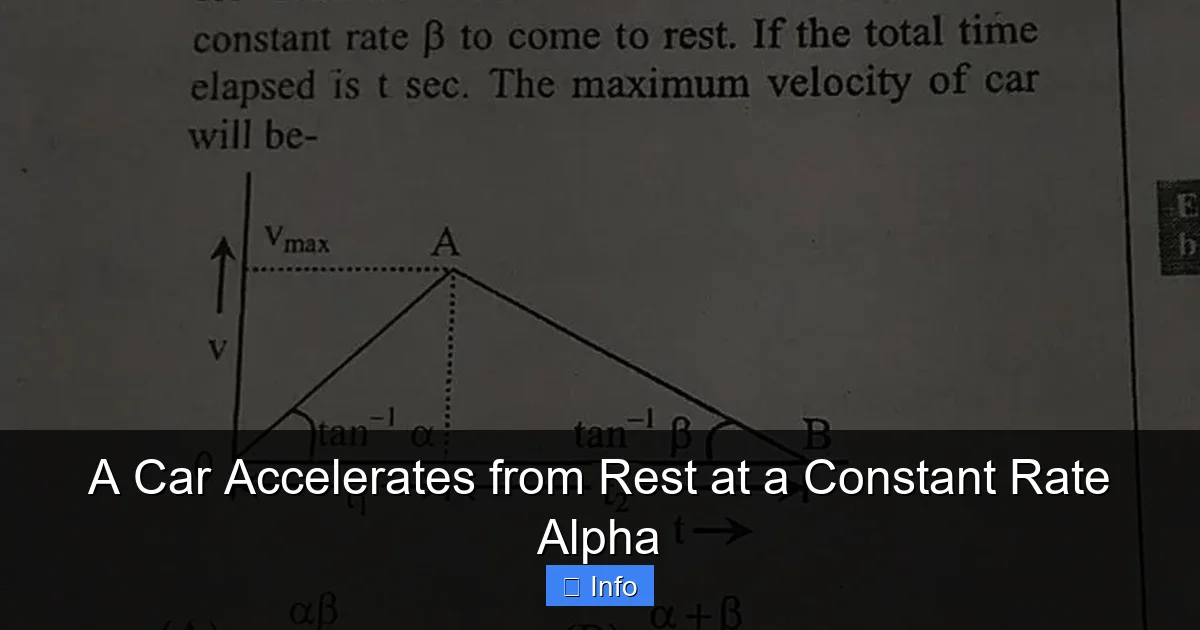
Uniformly accelerating motion might sound technical, but it’s something you experience every day. Every time you step onto a highway and floor the gas pedal, your car undergoes uniform acceleration for a brief period before other forces like drag and rolling resistance take over. During this initial phase, the speedometer climbs at a consistent rate determined by alpha. This creates a straight-line graph where time on the horizontal axis and speed on the vertical axis form a diagonal line whose slope equals alpha. The beauty of this linear relationship lies in simplicity—once you know alpha, predicting future speed becomes effortless. Whether you’re calculating how far ahead of you a car will travel before overtaking you or estimating braking distances, understanding uniform acceleration saves time and reduces uncertainty.
Real-World Automotive Applications
How Engineers Design for Smooth Acceleration
Car manufacturers invest millions of dollars into making sure their vehicles accelerate predictably and reliably. When designers set out to build a new model, they consider how alpha will influence the overall driving experience. A sports sedan might have a higher alpha for sportier handling, allowing riders to go from idle to highway speed with noticeable enthusiasm. Conversely, a family minivan prioritizes comfort over speed, favoring a gentler acceleration profile that minimizes jostling for passengers. These design decisions happen at multiple levels, from the size and type of the engine to the placement and pressure distribution of tires. Each element contributes to the final alpha value, creating a harmonious flow that feels natural to both the driver and the people inside. The goal is always the same: transform raw energy into usable motion in a controlled and enjoyable manner.
Visual guide about A Car Accelerates from Rest at a Constant Rate Alpha
Image source: classroom-images.cdn.askfilo.com
Racing Cars and Constant Rate Performance
In the racing world, engineers push the boundaries of what alpha can achieve. Formula 1 teams seek maximum acceleration by optimizing every aspect of the powertrain, aerodynamics, and suspension setup. Their engines produce immense force precisely timed to maintain a near-constant acceleration rate throughout corners and straights. While real race tracks introduce variables like air resistance and track banking, the underlying principle remains the same—engineers manipulate alpha to extract peak performance. Even in everyday driving, this concept translates to familiar situations such as merging onto a busy freeway. When you commit fully to the throttle, you’re essentially trying to maximize alpha right now, converting pedal force into steady velocity growth. Understanding this connection between driver input and machine output deepens appreciation for the sophisticated systems hidden beneath the hood.
Mathematical Insight
Deriving Velocity from Alpha and Time
The mathematics behind constant acceleration is surprisingly elegant. If we define alpha as the constant rate of increase in speed, then after t seconds of pushing the accelerator, the car’s velocity follows a clean formula: final velocity equals alpha multiplied by time. Written as v = αt, this equation captures the essence of uniform acceleration in one compact statement. Imagine your car starts at zero speed and you maintain a steady pressing of the gas pedal—the math predicts exactly how fast you’ll be going after any given interval. For example, if alpha measures two meters per second squared and you accelerate for seven seconds, your final speed will be fourteen meters per second, which translates to about fifty kilometers per hour. This direct proportionality makes prediction straightforward and valuable for both theorists and drivers alike.
Visual guide about A Car Accelerates from Rest at a Constant Rate Alpha
Image source: storage.googleapis.com
Position as a Function of Acceleration
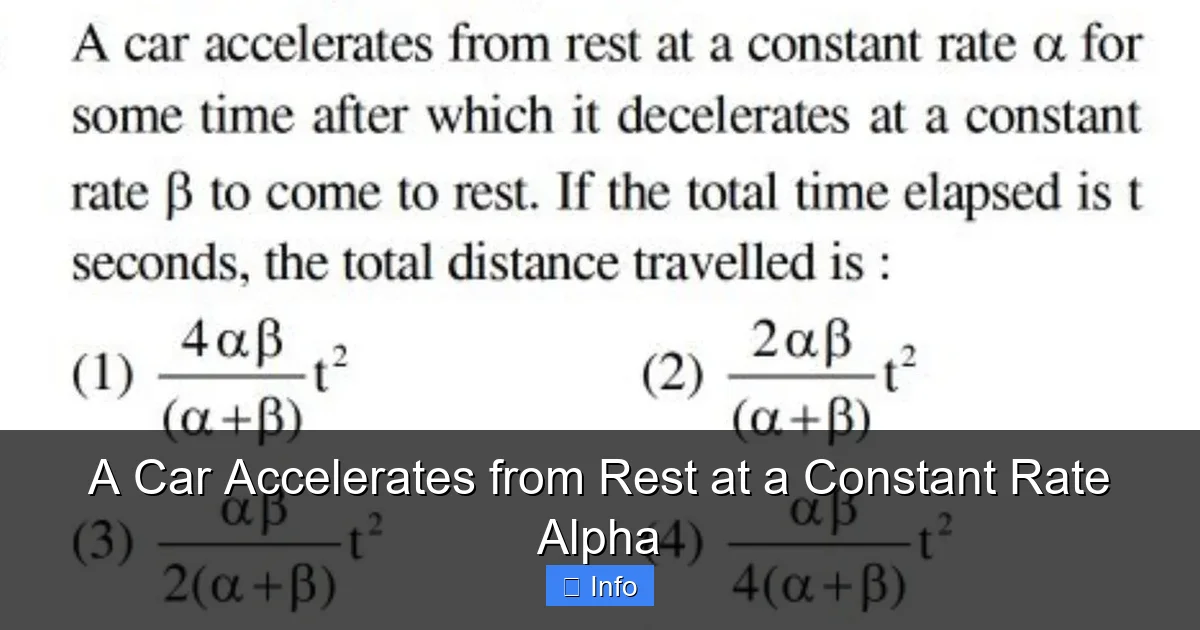
Velocity alone doesn’t tell the whole story about where a car is located during its acceleration. To understand the complete picture, we must also consider position, which grows according to another simple rule involving alpha. Since acceleration affects speed, and speed affects distance traveled, combining these ideas yields position equal to half alpha times t squared plus any initial displacement. In practical terms, this formula helps explain why cars feel lighter off the line compared to later stages of acceleration. Early on, small values of t result in minimal positional change, but as time extends, the quadratic term dominates and position rises rapidly. Drivers intuitively sense this effect when they notice that the initial burst of speed builds momentum, setting them up for smoother progress toward top speeds.
Common Misconceptions
Steady State vs Steady Acceleration
One of the most frequent misunderstandings involves confusing steady state with steady acceleration. A car cruising at a constant speed has reached equilibrium where net forces cancel out, resulting in zero acceleration. This is not the same as accelerating at a constant rate; rather, acceleration is actually decreasing toward zero as speed approaches the limit set by friction and other resistances. Many beginners incorrectly assume that holding the throttle fully produces constant acceleration indefinitely, forgetting that real-world limits eventually take hold. Recognizing the difference prevents frustration when a car suddenly loses its ability to accelerate smoothly, especially as weather conditions change or worn components reduce effective torque. Proper understanding of when alpha holds true versus when it fades away is essential for maintaining optimal vehicle performance.

Visual guide about A Car Accelerates from Rest at a Constant Rate Alpha
Image source: storage.googleapis.com
Variables That Break Perfect Alpha Assumption
While the ideal scenario assumes alpha stays unchanged forever, real cars rarely conform perfectly to this model. Multiple factors can cause alpha to fluctuate unexpectedly: tire grip varies with temperature, road surface changes due to moisture or debris, and engine load shifts as the vehicle moves from idle to full throttle. Additionally, electronic stability systems may modulate acceleration dynamically to enhance safety, introducing subtle variations that deviate from pure uniform motion. Understanding these deviations equips owners to interpret speedometer readings accurately and troubleshoot unusual behavior. Rather than viewing imperfections as failures, recognizing them as normal parts of the system helps in diagnosing issues like hesitation, slipping, or inconsistent throttle response.
Practical Observation Techniques
If you want to observe acceleration in action, there are several accessible methods to gather data during your next trip. One approach is the manual timing test, where you mark a fixed point on a barrier like a parking line or curb and note your speed at multiple intervals using a smartphone app that records acceleration. Another technique involves using built-in telematics features found in most modern vehicles, which can log hard acceleration events and report average alpha values during driving sessions. For those who prefer hands-on measurement, placing a timer and a known distance marker allows you to compute average acceleration manually: divide the change in velocity by the elapsed time. Recording these observations provides concrete evidence of whether your car behaves as predicted by the theoretical model, making abstract concepts tangible in the real world.
Modern technology further enhances our ability to study acceleration. Many cars come equipped with sensors that monitor vehicle dynamics in real time, feeding continuous streams of data to dashboards and mobile apps. By analyzing patterns such as sudden spikes in acceleration or prolonged periods of zero acceleration, drivers can identify potential problems before they become serious. This capability transforms passive driving into active monitoring, turning what was once invisible information into actionable feedback. As autonomous driving systems evolve, understanding the fundamentals of constant acceleration will remain crucial for interpreting sensor outputs and developing robust decision-making algorithms.
Frequently Asked Questions
What does alpha mean in car acceleration?
Alpha (α) represents the constant rate of acceleration—a unitless coefficient that quantifies how quickly a vehicle’s speed increases over time. In simple terms, it tells you exactly how many meters per second squared the car gains in velocity each second once the driver commits to the throttle. Higher alpha values indicate brisk, rapid acceleration typical of sports cars, while lower values correspond to gradual crawls suited for comfort-focused vehicles.
How do you calculate acceleration if you know distance and time?
While the standard definition uses time directly, you can derive acceleration from distance and time using the kinematic equation d = (1/2)αt². Solving for alpha gives you alpha equals twice the distance divided by the square of the time taken to cover that distance. For instance, if a car travels 60 meters in 8 seconds, alpha equals one hundred twentieth meters per second squared, meaning it gained roughly six tenths of a meter per second each second.
Is constant acceleration realistic for real cars?
Perfect constant acceleration is rare in practice because real vehicles face changing friction, varying traction, and environmental factors. However, manufacturers engineer systems to closely approximate this condition within defined operating ranges. Modern cameras, sensors, and adaptive control systems help maintain stable acceleration rates even as conditions shift, making the ideal model increasingly achievable in everyday driving.
How can I measure my car’s acceleration at home?
You can perform a simple manual test by marking a visible reference point on a flat surface, recording your starting speed, and noting your speed after a predetermined number of seconds using a phone speedometer app. Divide the change in velocity by the elapsed time to estimate alpha. Alternatively, many newer vehicles include driver-assistance features that display acceleration metrics directly on the instrument cluster, offering immediate feedback without additional equipment.
Does engine power affect the value of alpha?
Yes, engine power profoundly influences alpha. More powerful engines generate greater force, enabling higher acceleration rates when properly matched to tire grip and available traction. However, alpha is not solely determined by raw power; transmission gearing, weight distribution, and aerodynamic drag all play critical roles. A high-performance engine paired with efficient drivetrain and lightweight construction will typically deliver higher alpha than a modest engine struggling against heavy load or road imperfections.
How does weight impact constant acceleration?
Weight acts inversely on acceleration because heavier vehicles require more force to achieve the same increase in speed. According to Newton’s second law, acceleration equals force divided by mass, so doubling the mass halves the achievable acceleration for identical driving inputs. This is why luxury sedans sometimes feel sluggish compared to compact models despite similar horsepower ratings. Modern engineering addresses this challenge through advanced materials, optimized chassis designs, and strategic power-to-weight ratios to keep acceleration competitive across vehicle classes.