To Simulate Car Accidents Auto Manufacturers
Auto manufacturers simulate car accidents through a combination of physical crash tests, advanced computer simulations, and virtual reality systems. These methods allow engineers to evaluate vehicle safety performance, optimize structural designs, and meet stringent regulatory standards before a single production vehicle hits the road.
When you buckle your seatbelt and pull away from the curb, you probably don’t think about the thousands of violent collisions your vehicle has already survived, virtually and physically, before it ever reached the showroom floor. The process to simulate car accidents auto manufacturers rely on today represents one of the most sophisticated engineering undertakings in modern industry. It blends raw destructive power with delicate measurement, brute force with artificial intelligence, all in service of a single goal: keeping you alive when physics turns against you.
The journey from concept to crashworthy vehicle spans years and involves hundreds of engineers, massive computing clusters, and facilities that look more like movie sets than factories. Every new model undergoes a gauntlet of impacts: frontal, side, rear, rollover, pedestrian, and increasingly, scenarios specific to electric vehicle architectures. Understanding how auto manufacturers simulate car accidents reveals not just the complexity of modern vehicle development, but the extraordinary lengths the industry goes to protect occupants.
Key Takeaways
- Physical crash testing remains essential: Real-world barrier and vehicle-to-vehicle tests provide irreplaceable validation data for safety systems.
- Computer simulation reduces costs: Finite element analysis and computational fluid dynamics allow thousands of virtual crashes for the price of one physical test.
- Human body models improve injury prediction: Advanced anthropomorphic test devices and virtual human models measure forces on organs, bones, and soft tissues.
- Regulatory standards drive testing protocols: NCAP, FMVSS, and Euro NCAP requirements dictate minimum test scenarios manufacturers must pass.
- Digital twins accelerate development: Virtual replicas of vehicles enable real-time simulation updates as designs evolve during the engineering process.
- Electric vehicles require new test approaches: Battery integrity, high-voltage safety, and unique weight distributions demand specialized crash simulation methods.
- AI and machine learning enhance accuracy: Predictive algorithms optimize test parameters and correlate virtual results with physical test outcomes.
📑 Table of Contents
- The Evolution of Crash Simulation: From Sled Tests to Supercomputers
- Physical Crash Testing: The Irreplaceable Reality Check
- Virtual Crash Simulation: The Digital Proving Ground
- Specialized Simulation Challenges: Electric Vehicles and New Architectures
- Regulatory Landscape: The Rules That Shape Testing
- Advanced Technologies Reshaping Crash Simulation
- The Human Element: Engineering Judgment in a Digital Age
- Future Directions: Where Crash Simulation Is Heading
- Conclusion: The Never-Ending Pursuit of Safety
The Evolution of Crash Simulation: From Sled Tests to Supercomputers
Early Days: Brute Force and Dummies
In the 1950s and 1960s, the approach to simulate car accidents auto manufacturers used was remarkably primitive by today’s standards. Engineers would accelerate vehicles down tracks into solid barriers or use rocket sleds to decelerate test bucks violently. The data came from mechanical instruments, high-speed film cameras running at thousands of frames per second, and the first anthropomorphic test devices, what we now call crash test dummies.
These early dummies were essentially articulated steel frames with vinyl skin and basic accelerometers in the head and chest. They could tell engineers if a steering column would impale a driver or if a dashboard would crush a passenger’s legs, but they couldn’t measure subtle injury mechanisms like aortic rupture, brain shear, or spinal compression. The tests were expensive, destructive, and each one provided only a single data point for a specific impact configuration.
The Computer Revolution: Finite Element Analysis Enters the Chat
The 1980s brought a paradigm shift. As computing power grew exponentially, engineers began using finite element analysis (FEA) to simulate car accidents auto manufacturers could model mathematically rather than physically. Instead of crashing a car, they could crash a mathematical representation of a car, millions of tiny elements connected by equations describing material properties, contact mechanics, and structural behavior.
The first production vehicle developed extensively using computer simulation was arguably the 1994 Ford Windstar, though the technique had been percolating in aerospace and defense for decades. Early models were crude by modern standards, perhaps 50,000 elements representing major structural components. Today, a full-vehicle crash model routinely exceeds 10 million elements, with individual spot welds, adhesive beads, and bolt pretension forces explicitly represented.
Modern Integration: The Virtual-Physical Loop
Contemporary development doesn’t choose between physical and virtual testing. It demands both in a continuous feedback loop. Engineers use physical tests to validate and calibrate their simulation models, then use those validated models to explore hundreds of design variations that would be prohibitively expensive to test physically. When a physical test reveals an unexpected result, the model gets updated. When a simulation suggests a promising design change, a physical test confirms it.
This integration has compressed development timelines dramatically. A vehicle program that once required 100+ physical crash tests might now need 30-40, with the remaining validation performed virtually. The cost savings are staggering: a single full-vehicle crash test can cost $500,000 to $1,000,000 when you account for prototype vehicles, instrumentation, facility time, and engineering analysis. A virtual crash costs perhaps $500 in computing time.
Physical Crash Testing: The Irreplaceable Reality Check
Barrier Tests: The Standard Benchmarks
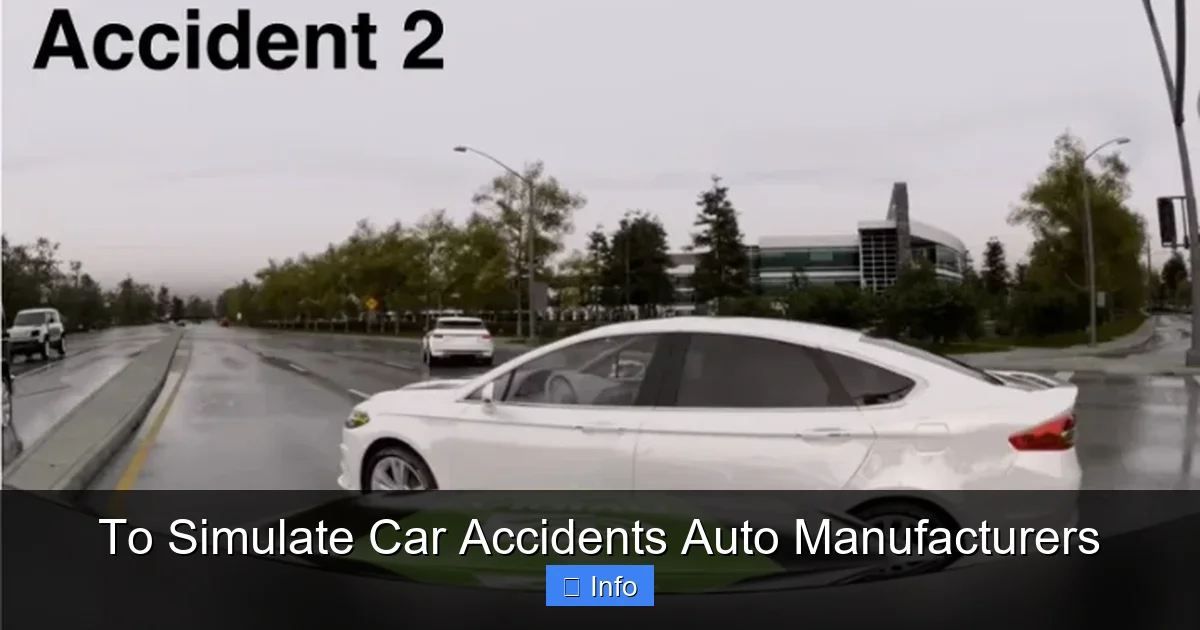
Despite advances in simulation, regulatory bodies worldwide still mandate physical barrier tests. The most common include the full-frontal rigid barrier test at 30-35 mph (FMVSS 208), the offset deformable barrier test at 40 mph (Euro NCAP, IIHS), the side impact moving deformable barrier test (FMVSS 214), and the side pole test at 20 mph (FMVSS 214, Euro NCAP). Each test targets specific injury mechanisms and structural load paths.
Visual guide about To Simulate Car Accidents Auto Manufacturers
Image source: developer-blogs.nvidia.com
When auto manufacturers simulate car accidents physically, they’re not just checking a box. These tests validate the entire safety system: structure, restraints, airbags, seat belts, and their complex interactions. A 40 mph offset barrier test, for instance, loads the vehicle’s front structure asymmetrically, forcing the engine cradle, frame rails, and occupant compartment to manage energy in ways a centered impact doesn’t. The results determine star ratings that consumers rely on.
Vehicle-to-Vehicle Compatibility Testing
Real-world crashes rarely involve a vehicle hitting an immovable barrier. They involve two vehicles of different masses, geometries, and structural stiffnesses. To address this, manufacturers conduct car-to-car tests, often a midsize sedan striking a smaller car or an SUV striking a sedan. These tests evaluate geometric compatibility: do the front structures align to engage each other’s crash management systems, or does one vehicle override the other?
The Insurance Institute for Highway Safety (IIHS) runs a moderate overlap front test where a vehicle strikes a deformable barrier representing another vehicle. More recently, they’ve added a updated moderate overlap test that emphasizes rear-seat occupant protection, reflecting the reality that ride-sharing and autonomous vehicles will carry more rear passengers. These tests force manufacturers to optimize not just for driver protection, but for every seating position.
Rollover and Roof Crush Evaluation
Rollover crashes account for a disproportionate share of fatalities relative to their frequency. To simulate car accidents auto manufacturers test for rollover scenarios using both dynamic tests (the fishhook maneuver that can tip a vehicle) and static roof crush tests (FMVSS 216a). The static test applies a force equal to 3x the vehicle’s weight to the roof, measuring intrusion.
Modern vehicles increasingly employ advanced high-strength steels, aluminum, and even carbon fiber in roof structures to meet these requirements while minimizing weight. The A-pillars, B-pillars, and roof rails form a survival cage that must maintain integrity during multiple rollover events. Physical testing validates that the production welding, adhesive bonding, and fastener strategies achieve the design intent.
Pedestrian and Cyclist Impact Testing
Regulations in Europe, Japan, and increasingly elsewhere require testing vehicle front ends against pedestrian and cyclist impactors. These tests use flexible legform, upper legform, and headform impactors fired at the hood, fenders, bumper, and windshield areas. The goal is to minimize head injury criterion (HIC) and leg injury measures.
This has driven innovations like pop-up hoods that create clearance between the hood surface and hard engine components, energy-absorbing bumper systems, and windshield designs that reduce head trauma. Active systems that detect imminent pedestrian impacts and raise the hood or deploy external airbags are also being validated through these physical tests.
Virtual Crash Simulation: The Digital Proving Ground
Finite Element Modeling: Building the Virtual Vehicle
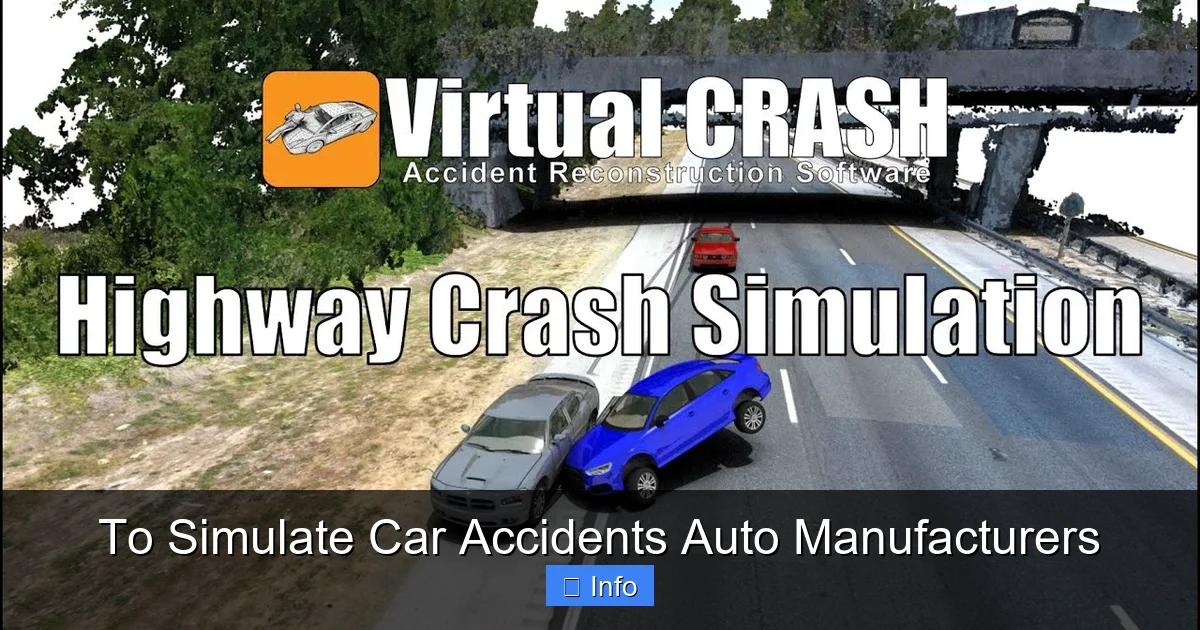
Creating a simulation model that accurately represents a vehicle’s crash behavior is an enormous undertaking. Engineers start with CAD data, but CAD models aren’t simulation-ready. They contain cosmetic features, non-structural components, and geometric details that would choke a solver. The modeling team must defeaturing, simplify, and idealize the geometry while preserving structural load paths.
Visual guide about To Simulate Car Accidents Auto Manufacturers
Image source: i.ytimg.com
Each component receives a material model: elastic-plastic for metals, hyperelastic for rubber, viscoelastic for foams, orthotropic for composites. Spot welds become constrained node sets or beam elements with failure criteria. Adhesives get cohesive zone models. Bolts get pretension and contact definitions. The contact definitions between parts, self-contact within folding structures, and contact with barriers or other vehicles must be meticulously defined.
A typical explicit dynamics solver like LS-DYNA, RADIOSS, or PAM-CRASH solves the equations of motion for millions of elements at time steps measured in microseconds. A 100-millisecond crash event might require 10 million time steps. On a modern HPC cluster with thousands of cores, a full-vehicle frontal impact simulation might complete in 8-12 hours. This allows engineers to run dozens of simulations per week.
Occupant Simulation: Dummies and Human Body Models
Simulating the vehicle structure is only half the equation. The other half is simulating the occupant. Traditional crash test dummies (Hybrid III, WorldSID, THOR) have virtual counterparts with identical geometry, mass properties, and joint characteristics. These finite element dummy models allow engineers to run the same virtual test with different dummy sizes (5th percentile female, 50th percentile male, 95th percentile male) and positions.
But dummies have limitations. They measure forces and accelerations at discrete points, not continuous tissue-level stresses. Enter human body models (HBMs) like THUMS (Total Human Model for Safety), GHBMC (Global Human Body Models Consortium), and VIVA+. These models represent bones, organs, muscles, ligaments, and blood vessels with anatomical fidelity. They can predict injury risk for specific organs: aortic rupture, liver laceration, brain contusion, tibial fracture.
When auto manufacturers simulate car accidents using HBMs, they can evaluate safety systems for populations dummies don’t represent well: elderly occupants with fragile bones, obese occupants with different kinematics, children in various restraint systems. This capability is becoming essential as the driving population ages and diversifies.
Parameter Optimization and Design of Experiments
One of the most powerful applications of virtual simulation is design optimization. Engineers define design variables (material grades, thicknesses, section geometries, reinforcement patterns) and objectives (minimize mass, maximize energy absorption, limit intrusion, reduce peak deceleration). They then run Design of Experiments (DOE) studies, automatically generating hundreds of design variants and simulating each one.
Response surface methodology, genetic algorithms, and more recently, machine learning surrogates, navigate this high-dimensional design space. The result is a Pareto frontier of optimal designs, trade-off curves showing the best achievable performance for each weight target. This approach has enabled the widespread adoption of tailored blanks, variable-thickness stampings, and complex multi-material structures that would be impossible to optimize through intuition alone.
Virtual Prototyping for Advanced Driver Assistance Systems
As vehicles gain automatic emergency braking (AEB), lane keeping, and evasive steering, the simulation challenge expands. Engineers must now simulate car accidents auto manufacturers hope will never happen, because the vehicle intervened. This requires coupling vehicle dynamics models, sensor models (radar, lidar, camera), perception algorithms, and decision-making logic with crash simulation.
Scenario-based testing generates thousands of virtual traffic situations: a child running from between parked cars, a truck crossing an intersection, a sudden stop on the highway. The ADAS system must detect, classify, decide, and actuate braking or steering within milliseconds. The crash simulator then evaluates the outcome: did the intervention prevent the crash? Mitigate severity? Cause a different collision? This closed-loop simulation is essential for validating Level 2+ and Level 3 autonomy.
Specialized Simulation Challenges: Electric Vehicles and New Architectures
Battery Integrity and Thermal Runaway Prevention
Electric vehicles introduce a new crash hazard: high-energy battery packs that can short-circuit, overheat, and enter thermal runaway. When auto manufacturers simulate car accidents for EVs, they must model the battery pack structure, cell-level mechanical behavior, electrical isolation systems, and thermal propagation. A pack that survives mechanical deformation but develops an internal short 30 minutes later is a failure.
Visual guide about To Simulate Car Accidents Auto Manufacturers
Image source: m.media-amazon.com
Simulation models now include representative cells with jellyroll structures, separator layers, and electrode coatings. Crush simulations predict internal short circuit initiation. Coupled electro-thermal models predict whether a local short will propagate. Physical validation involves crushing modules and packs in specialized fixtures while monitoring voltage, temperature, and gas generation. The goal: ensure the pack remains electrically isolated and thermally stable in survivable crashes.
High-Voltage Safety Systems
EVs operate at 400V, 800V, or even higher voltages. A crash must trigger immediate high-voltage isolation: contactors opening, capacitors discharging, ground fault detection activating. Simulation validates the timing and reliability of these systems under crash-induced deformation, connector separation, and wire harness damage. Physical tests verify that no accessible conductive parts exceed safe voltage thresholds after impact.
Unique Weight Distribution and Structural Load Paths
Battery packs concentrate mass low and central, fundamentally changing vehicle inertia properties and crash pulse characteristics. The floor structure must protect the pack from intrusion while managing energy in frontal, side, and rear impacts. Skateboard architectures lack traditional engine compartments, so the front crash structure must be entirely reimagined. Simulation explores these new load paths extensively before any physical prototype exists.
Over-the-Air Update Validation
Modern EVs receive over-the-air updates that can modify braking, stability control, and even structural control strategies (like active hood deployment or seat belt pretensioner firing thresholds). When auto manufacturers simulate car accidents for these vehicles, they must re-validate safety performance for each software release that affects crash-relevant systems. Automated regression simulation pipelines run hundreds of crash scenarios against new software builds to ensure no regression in safety performance.
Regulatory Landscape: The Rules That Shape Testing
North American Standards: FMVSS and NCAP
In the United States, the Federal Motor Vehicle Safety Standards (FMVSS) establish minimum performance requirements. FMVSS 208 (occupant crash protection), 214 (side impact), 216a (roof crush), 226 (ejection mitigation), and 301 (fuel system integrity) all require physical testing or validated simulation. The New Car Assessment Program (NCAP) adds consumer-facing star ratings that drive competitive improvement beyond minimums.
Recent NCAP updates include forward collision warning, automatic emergency braking, lane departure warning, and pedestrian AEB evaluation. The proposed NCAP overhaul adds more stringent frontal and side tests, rear seat occupant protection, and advanced crash avoidance technology assessments. Manufacturers must simulate car accidents auto manufacturers design for both current and anticipated future standards.
European and Global Standards: Euro NCAP and GTRs
Euro NCAP is widely considered the world’s most demanding consumer safety program. Its 2025 roadmap includes far-side occupant protection, driver monitoring evaluation, automated driving assessment, and post-crash safety (egress, fuel/electrical isolation). Global Technical Regulations (GTRs) under the UNECE harmonize standards across Europe, Japan, Korea, Australia, and others.
China’s C-NCAP and C-IASI programs add market-specific requirements. Korea’s KNCAP, Japan’s JNCAP, and Australia’s ANCAP each have unique test protocols. A global vehicle platform must pass all relevant regimes, often requiring 50+ distinct physical test configurations and hundreds of simulation load cases. The simulation workload for a global program is immense.
Emerging Regulations: Cybersecurity, Software Updates, and Autonomy
UN R155 (cybersecurity) and UN R156 (software updates) now require manufacturers to demonstrate that safety-critical systems remain secure and that over-the-air updates don’t degrade crash protection. For automated vehicles, new frameworks like UN R157 (ALKS) and proposed ADS regulations demand evidence of safe behavior across infinite scenario variations, evidence that can only be provided through massive-scale simulation.
Advanced Technologies Reshaping Crash Simulation
Digital Twins and Model-Based Systems Engineering
The concept of a digital twin, a virtual replica that evolves alongside its physical counterpart, is transforming how auto manufacturers simulate car accidents. Instead of building a simulation model from scratch for each program, manufacturers maintain living vehicle models that update with every design change, material substitution, and manufacturing process adjustment. These models integrate CAD, CAE, manufacturing data, and even in-service field data.
Model-Based Systems Engineering (MBSE) connects requirements, architecture, behavior, and verification in a single digital thread. A change to a side impact requirement propagates through the system architecture to the B-pillar design, the door beam geometry, the seat structure, the airbag deployment logic, and the validation test matrix automatically. This traceability reduces errors and accelerates compliance demonstration.
Artificial Intelligence and Machine Learning Acceleration
AI is entering crash simulation at multiple levels. Surrogate models trained on thousands of simulation results can predict crash outcomes in seconds rather than hours, enabling real-time optimization during design reviews. Computer vision algorithms analyze high-speed crash videos to extract deformation measurements automatically, replacing manual digitization. Generative design algorithms propose structural topologies that human engineers might never conceive.
Perhaps most promising, machine learning models are learning to correlate simulation results with physical test results, identifying systematic biases in material models, contact algorithms, or modeling assumptions. This “simulation calibration” reduces the gap between virtual and physical results, increasing confidence in untested designs.
Cloud Computing and Democratized Simulation
Cloud-based HPC platforms (AWS, Azure, Google Cloud, Rescale, OnScale) allow manufacturers to burst to thousands of cores for parametric studies without maintaining massive on-premise clusters. This democratizes simulation access: design engineers can run crash simulations directly from their CAD environment, getting feedback in hours rather than waiting weeks for CAE specialist availability.
Collaborative simulation environments let geographically distributed teams work on the same model simultaneously, with version control, change tracking, and automated reporting. This proved invaluable during the pandemic and remains a competitive advantage for global engineering organizations.
Extended Reality for Visualization and Training
Virtual and augmented reality tools let engineers walk through a crash event at 1:1 scale, observing deformation, occupant kinematics, and airbag deployment from any viewpoint. This spatial understanding reveals issues that 2D plots miss: a steering column that rotates into the driver’s thighs, a door trim panel that contacts the dummy’s head, a battery pack that intrudes into the footwell.
VR also trains technicians and first responders. Virtual vehicle extrication training lets firefighters practice cutting points, high-voltage disablement, and occupant access on new models before physical training vehicles are available. This accelerates the dissemination of critical safety information to the people who save lives at crash scenes.
The Human Element: Engineering Judgment in a Digital Age
Experience Still Matters
For all the computational power and algorithmic sophistication, the most critical component in crash simulation remains the engineer’s judgment. Knowing which simplification is acceptable and which will invalidate results. Recognizing when a material model extrapolates beyond its validated range. Understanding that a simulation showing “passing” results might mask a failure mode the model doesn’t capture.
Senior crash engineers develop intuition through years of correlating simulations with physical tests. They know that spot weld failure models are notoriously sensitive to mesh density. That adhesive models often overpredict energy absorption. That dummy chest deflection correlates poorly with rib fracture risk for elderly occupants. This knowledge isn’t in the software manuals. It’s in the people.
Cross-Functional Collaboration
Crash simulation doesn’t happen in isolation. It requires constant dialogue with design (packaging constraints), body engineering (manufacturing feasibility), materials (supply chain availability), restraints (airbag and seat belt development), and CAE (modeling methodology). A structural change that improves frontal crash performance might degrade side impact, roof crush, or NVH performance.
The best organizations embed crash engineers in vehicle development teams from day one, not as a validation checkpoint at the end. This “shift left” approach catches issues when they’re cheap to fix. A B-pillar reinforcement added in CAD costs pennies. The same reinforcement added after tooling is cut costs millions.
Ethical Responsibility and Public Trust
Every engineer who works on crash simulation carries a profound responsibility. Their decisions affect real people in real crashes. The industry’s shift toward transparency, sharing crash test videos, publishing safety reports, and participating in independent assessment programs, reflects this responsibility. When auto manufacturers simulate car accidents, they’re not just meeting regulations. They’re making a promise to every person who will ever ride in their vehicles.
Future Directions: Where Crash Simulation Is Heading
Virtual Certification: The Holy Grail
Regulators are exploring virtual certification pathways where validated simulation models could replace certain physical tests. The EU’s VIRTUAL project and NHTSA’s simulation validation initiatives aim to establish credibility frameworks: model validation metrics, uncertainty quantification, and audit trails that would allow regulators to accept simulation evidence for specific test modes.
This won’t eliminate physical testing. But it could reduce the number of physical tests required for certification, especially for minor design changes, carryover models, and regional variants. The key challenge: ensuring that simulation credibility is maintained across the entire vehicle lifecycle, not just at the certification milestone.
In-Crash Sensing and Adaptive Restraints
Future vehicles will sense crash severity and type within the first few milliseconds and adapt restraint deployment accordingly. This requires simulation of the entire sensing-to-deployment chain: crash sensor signals, restraint control unit algorithms, airbag inflator characteristics, and occupant interaction. The simulation must capture the stochastic nature of real crashes: varying impact angles, overlap, closing speeds, and occupant positions.
Post-Crash Safety and Autonomous Vehicle Challenges
Autonomous vehicles introduce new post-crash scenarios: vehicles that must move themselves out of traffic after a minor collision, unlock doors for egress without electrical power, communicate with emergency services, and manage high-voltage systems without human intervention. Simulating these scenarios requires coupling crash dynamics with vehicle dynamics, electrical systems, communication protocols, and human factors.
Personalized Protection: The Ultimate Frontier
Imagine a vehicle that knows its occupant’s age, stature, medical conditions, and seating posture, and configures its restraint systems accordingly. A 75-year-old driver with osteoporosis gets lower-force airbag deployment and optimized seat belt load limiting. A child in a booster seat gets precisely tuned side curtain timing. This level of personalization demands simulation at a scale and fidelity we’re only beginning to approach.
Conclusion: The Never-Ending Pursuit of Safety
The effort to simulate car accidents auto manufacturers undertake today represents one of humanity’s most ambitious applications of science and engineering to save lives. From the violent clarity of a 40 mph barrier test to the subtle physics of a finite element model with 20 million elements, from the calibrated ribs of a THOR dummy to the virtual aorta of a human body model, every tool serves the same purpose: understanding what happens when metal meets physics, so that flesh and bone don’t have to.
The progress is measurable and remarkable. A driver in a 2024 model is roughly 70% less likely to die in a crash than a driver in a 1990 model, per mile driven. That improvement didn’t happen by accident. It happened because thousands of engineers spent millions of hours crashing cars, real and virtual, learning from each impact, and applying those lessons to the next generation.
As vehicles electrify, automate, and connect, the simulation challenge grows more complex. But so do the tools. Exascale computing, AI-accelerated solvers, anatomically complete human models, and digital thread integration are converging to make the virtual proving ground more predictive than ever. The day when every crash scenario is simulated before a single prototype is built isn’t just a vision. It’s an engineering trajectory we’re already on.
Next time you hear the reassuring thunk of a car door closing, remember: that sound represents the culmination of countless simulated collisions, each one a lesson learned without a life lost. The work to simulate car accidents auto manufacturers perform every day is invisible to most drivers. But its impact is written in the statistics of lives saved, injuries prevented, and families kept whole. That’s not just engineering. That’s a moral imperative made measurable.
Frequently Asked Questions
How do auto manufacturers simulate car accidents using computers?
Auto manufacturers use finite element analysis (FEA) software like LS-DYNA, RADIOSS, and PAM-CRASH to create detailed mathematical models of vehicles with millions of elements. These models simulate crash physics by solving equations of motion at microsecond time steps, predicting structural deformation, occupant kinematics, and injury metrics without physical prototypes.
Why do manufacturers still conduct physical crash tests if simulation is so advanced?
Physical crash tests remain essential for validating simulation models, meeting regulatory certification requirements, and capturing complex real-world phenomena like manufacturing variability, material behavior at extreme strain rates, and system-level interactions that models may not fully represent.
What are human body models and how do they differ from crash test dummies?
Human body models (HBMs) like THUMS and GHBMC are anatomically detailed finite element representations of human anatomy including bones, organs, muscles, and vasculature. Unlike physical dummies that measure forces at discrete points, HBMs predict tissue-level injury risk for specific organs and can represent diverse populations (elderly, obese, children) that physical dummies cannot.
How has electric vehicle design changed crash simulation requirements?
EVs require specialized simulation for battery pack integrity, thermal runaway prevention, high-voltage isolation systems, and unique structural load paths from skateboard architectures. The concentrated low mass of battery packs changes vehicle inertia and crash pulse characteristics, demanding new front structure designs and validation methods.
What role does AI play in modern crash simulation?
AI accelerates crash simulation through surrogate models that predict results in seconds, computer vision for automated high-speed video analysis, generative design for novel structural topologies, and machine learning calibration that correlates simulation predictions with physical test results to improve model fidelity.
How many crash simulations does a typical vehicle program run?
A modern global vehicle program typically runs 5,000-15,000 full-vehicle crash simulations across all load cases (frontal, side, rear, rollover, pedestrian, battery, etc.), design variants, occupant sizes, and regulatory regimes. This compares to 30-50 physical crash tests for the same program.