How Many Passengers Allowed in Private Car in Unlock 3
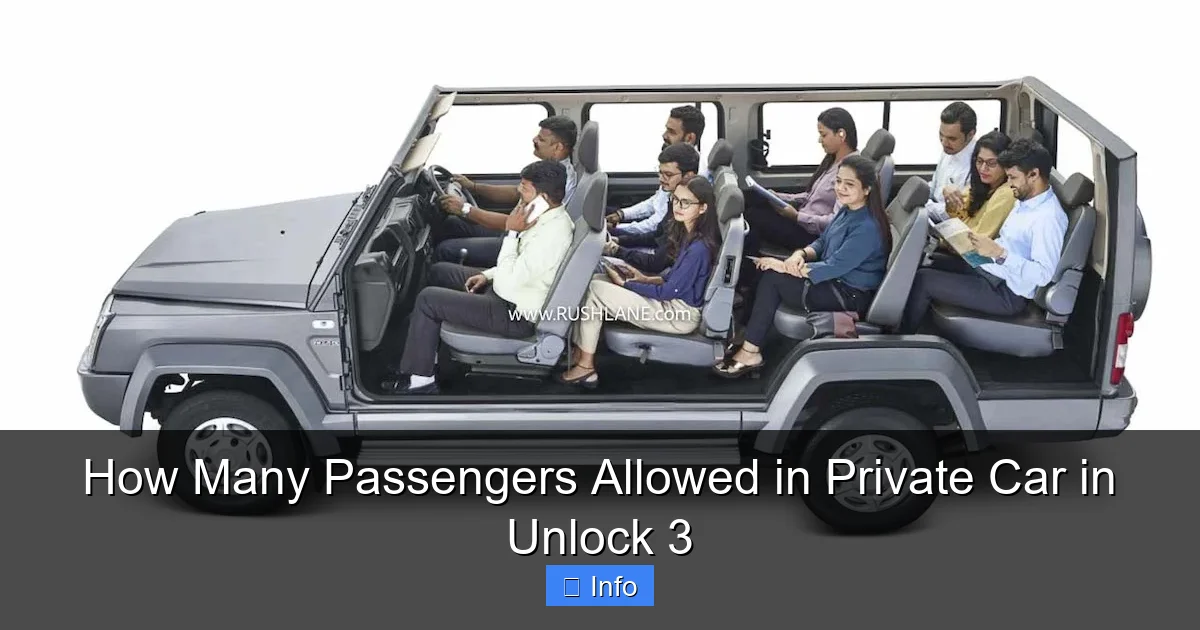
During Unlock 3, private cars were allowed to carry a maximum of four occupants, including the driver. This guide explains the rule, offers practical safety advice, and provides a vehicle‑preparation checklist to help you travel confidently with passengers.
How Many Passengers Allowed in Private Car in Unlock 3
The COVID‑19 pandemic brought a series of unlocking phases across India, each with its own set of rules for private vehicle usage. Unlock 3, which began in September 2020, marked a noticeable relaxation compared with the earlier phases. Understanding the exact passenger limit for private cars during this period is essential for anyone who needed to travel for work, family visits, or essential services. This article breaks down the rule, explains why it was set, and gives you practical tips to stay safe and compliant while sharing your car with others.
Key Takeaways
- Passenger limit: Unlock 3 permitted up to four people in a private car (driver + three passengers).
- Documentation: Carry a valid driver’s license, vehicle registration, and any required e‑pass or travel authorization.
- Health precautions: Wear masks, sanitize hands, and ensure vehicle ventilation when traveling with others.
- Vehicle check: Inspect tires, brakes, lights, and fluid levels before each trip with passengers.
- Luggage planning: Know your car’s cargo capacity (e.g., how many suitcases fit in a Toyota Camry) to avoid overloading.
- Emergency readiness: Keep a first‑aid kit, spare tire, and emergency contacts accessible.
📑 Table of Contents
Understanding Unlock 3 Guidelines
Unlock 3 was part of a staggered approach to revive economic activity while controlling the virus spread. The government issued detailed orders that covered everything from office openings to public transport. For private cars, the focus was on limiting the number of occupants to reduce close contact inside the vehicle.
What the Official Order Said
The Ministry of Home Affairs (MHA) guidelines stated that private vehicles could operate with a maximum of four occupants. This count included the driver. Any vehicle exceeding this limit was considered a violation and could attract fines or be denied passage at checkpoints.
Why Four Occupants?
Health experts determined that four people in a standard sedan still allowed enough space for basic ventilation and mask usage, especially when windows were partially opened. The number balanced the need for mobility with the goal of minimizing droplet transmission. Larger groups would have increased the risk of airborne spread, particularly in cars with limited air exchange.
How the Rule Was Enforced
Police and transport authorities set up checkpoints at state borders and major city entrances. Officers would visually inspect the number of people inside a car. If a vehicle appeared overloaded, they could ask the occupants to exit and verify identities. Repeat offenders faced higher penalties, including possible vehicle impoundment.
Passenger Limits Explained in Detail
Knowing the exact number helps you plan trips without guesswork. Below we dissect what “four occupants” means in real‑world scenarios.
Visual guide about How Many Passengers Allowed in Private Car in Unlock 3
Image source: topcarliftdubai.com
Driver Plus Three Passengers
The most common configuration was the driver and three passengers. This could be a family of four, three coworkers, or a mix of adults and children. As long as the total did not exceed four, the vehicle complied with Unlock 3 rules.
Special Cases: Children and Infants
Children and infants counted toward the occupant total. A car with two adults, two toddlers, and a baby would already be five people and thus not allowed. Parents needed to either leave one child with a caregiver or use two vehicles if both parents needed to travel.
Impact on Ride‑Sharing and Carpools
Ride‑sharing apps had to adjust their algorithms to match no more than three passengers per driver during Unlock 3. Many services temporarily disabled the “pool” option for larger groups. Carpool colleagues had to stagger shifts or use separate vehicles to stay within the limit.
What Happened If You Exceeded the Limit?
If caught with five or more occupants, you could face a fine ranging from ₹500 to ₹2000, depending on the state. In some regions, authorities also required the driver to attend a brief awareness session on COVID‑appropriate behavior. The vehicle itself was not usually seized unless the violation was repeated.
Safety Tips for Traveling with Passengers in Unlock 3
Even though the rule allowed four people, safety remained paramount. Below are practical steps to reduce risk while sharing your car.
Visual guide about How Many Passengers Allowed in Private Car in Unlock 3
Image source: legaltranslationinuae.ae
Mask Usage and Hand Hygiene
All occupants should wear a well‑fitted mask that covers the nose and mouth. Keep a small bottle of hand sanitizer in the glove compartment and use it before entering and after exiting the vehicle. Encourage passengers to sanitize their hands after touching shared surfaces like door handles or seat belts.
Ventilation Strategies
Set the car’s ventilation system to fresh air mode rather than recirculation. Open windows slightly, especially on opposite sides, to create cross‑flow. This helps disperse any respiratory droplets and lowers the concentration of airborne particles.
Seating Arrangement for Minimum Contact
If possible, have the driver sit alone in the front, and place passengers diagonally across the rear seat. This maximizes physical distance. Avoid having three passengers in the back seat side‑by‑side, as that reduces the space between them.
Cleaning High‑Touch Areas
Before each trip, wipe down the steering wheel, gear shift, door handles, seat belts, and dashboard with a disinfectant wipe. Pay special attention to the rear seat headrests and armrests if passengers will be resting their heads there.
Managing Symptoms
If any passenger shows signs of fever, cough, or shortness of breath, advise them to stay home. Keep a digital thermometer in the car for quick checks. It is better to cancel a trip than risk spreading the virus.
Vehicle Preparation Checklist for Passenger Trips
A well‑prepared car not only keeps you compliant but also ensures a smooth journey. Use this checklist before heading out with passengers.

Visual guide about How Many Passengers Allowed in Private Car in Unlock 3
Image source: dubaikhaleej.com
Documentation Essentials
- Valid driver’s license
- Vehicle registration certificate (RC)
- Insurance policy document
- Any required e‑pass or travel authorization (if crossing state borders)
- Pollution Under Control (PUC) certificate
Mechanical Inspection
- Check tire pressure and tread depth
- Test brakes for responsiveness
- Ensure all lights (headlamps, tail lights, turn signals) work
- Verify fluid levels: engine oil, coolant, brake fluid, windshield washer
- Look for any warning lights on the dashboard
Emergency Kit
- First‑aid box with bandages, antiseptic wipes, pain relievers
- Spare tire, jack, and lug wrench
- Flashlight with extra batteries
- Basic tool set (screwdrivers, pliers)
- List of emergency contacts and roadside assistance numbers
Luggage and Cargo Planning
Knowing how much you can carry prevents overloading, which can affect braking and stability. For example, if you drive a Toyota Camry, you might wonder how many suitcases fit in a Toyota Camry to plan your packing efficiently. Overloading not only risks a fine but also increases wear on suspension components.
Fuel and Energy Considerations
Long trips with extra passengers consume more fuel. Keep the tank at least half full to avoid unexpected stops. If you drive a hybrid or electric vehicle, check the charge level and locate charging stations along your route.
Real‑World Examples and Scenarios
To illustrate how the Unlock 3 passenger rule played out in everyday life, here are a few common situations.
Family Visit to a Hometown
Rajesh needed to drive from Mumbai to Pune to see his parents. He took his wife, his teenage son, and his mother‑in‑law—four people total. He packed light luggage, checked his tire pressure, and kept the windows slightly open for airflow. At the state border, officials glanced at the car, confirmed four occupants, and let him pass without delay.
Colleagues Sharing a Ride to the Office
Three office mates from Bangalore decided to carpool to reduce parking costs. They coordinated shifts so that only three of them rode together each day, with the driver rotating. This kept the occupant count at three (driver + two passengers), well within the limit, and they saved on fuel while maintaining social distance as much as possible.
Tourist Group Exploring a Hill Station
A group of five friends wanted to visit Ooty. Since the car could only hold four, they split into two vehicles: one car carried the driver and three friends, the second car carried the remaining driver and two friends. Each vehicle stayed compliant, and they regrouped at the destination for their activities.
Emergency Medical Transport
When a neighbor needed urgent dialysis, a local volunteer offered his car. He drove alone with the patient in the back seat, making two occupants. He sanitized the seat belts before and after the trip and kept the windows open. The trip was swift, and the volunteer faced no issues at checkpoints.
Frequently Asked Questions (Unlock 3 Passenger Rule)
Below are answers to common questions that arose during Unlock 3. These clarify doubts and help you stay informed.
Did the passenger limit apply to commercial vehicles like taxis?
Yes, the four‑occupant rule applied to all private and contract carriages, including taxis and ride‑sharing cars. Commercial goods vehicles were exempt from the passenger limit but still had to follow driver‑only or driver‑plus‑helper rules depending on the state.
Were there any exemptions for medical emergencies?
Many states allowed an additional passenger if the vehicle was being used for a medical emergency, provided the driver could show proof (such as a hospital referral or ambulance‑like signage). However, it was always advisable to call an official ambulance when possible.
Did the rule change if the car had a sunroof or panoramic roof?
The vehicle’s design did not affect the occupant count. Whether the car had a sunroof, moonroof, or fixed roof, the limit remained four people. The guidance focused on the number of individuals, not the car’s features.
How did the rule interact with night‑time curfews?
Unlock 3 often included night curfews (e.g., 10 pm to 5 am). Even if you were within the passenger limit, you could not be on the road during curfew hours unless you had an essential‑services e‑pass. Plan trips accordingly to avoid penalties.
Was there a difference in the limit for SUVs versus sedans?
No, the limit was uniform across vehicle types. An SUV, sedan, hatchback, or minivan could carry no more than four occupants. Larger vehicles did not receive a higher allowance because the risk of transmission was considered similar regardless of cabin size.
What should I do if I see a vehicle overloaded with passengers?
If you notice a car clearly exceeding the four‑person limit, you can report it to the local traffic police via their helpline or mobile app. Provide the vehicle’s license plate, location, and time. Authorities will then take appropriate action.
Conclusion
Unlock 3 brought a welcome relaxation of movement restrictions, allowing private cars to carry up to four occupants. Understanding this rule helped families, coworkers, and essential workers plan trips without running afoul of the law. By following the safety tips—wearing masks, ensuring ventilation, cleaning high‑touch surfaces, and keeping documentation ready—you could travel with confidence while minimizing health risks.
Remember that the passenger limit applied to everyone inside the car, regardless of age or vehicle type. Planning your luggage, checking mechanical fitness, and preparing an emergency kit were just as important as respecting the occupant cap. If you ever wondered about specific car details—like how many spark plugs are in a Toyota Corolla or how many catalytic converters are in a Toyota Tacoma—keeping that knowledge handy ensured your vehicle stayed reliable for those passenger‑filled journeys.
As pandemic guidelines continue to evolve, staying informed and adaptable remains the best way to drive safely and responsibly. Keep this guide bookmarked for future reference, and enjoy the road with peace of mind.
Frequently Asked Questions
What was the exact passenger limit for private cars during Unlock 3?
The official guidelines allowed a maximum of four occupants in a private car, which included the driver and up to three passengers.
Did children count toward the passenger limit during Unlock 3?
Yes, every individual, regardless of age, counted as an occupant. A car with two adults and two children already reached the four‑person limit.
Was the four‑person rule applicable to all types of private vehicles?
The limit applied uniformly to sedans, hatchbacks, SUVs, and minivans. Vehicle size or body style did not change the allowed number of occupants.
What penalties could I face if I exceeded the passenger limit in Unlock 3?
Violators could be fined between ₹500 and ₹2000, depending on the state, and might be asked to reduce the number of passengers immediately. Repeated offenses could lead to higher fines or vehicle impoundment.
How could I ensure proper ventilation while traveling with passengers?
Set the climate system to fresh air mode, open windows slightly on opposite sides to create cross‑flow, and avoid using recirculation for extended periods.