Did Toyota Buy the 5.7 Engine from Gm
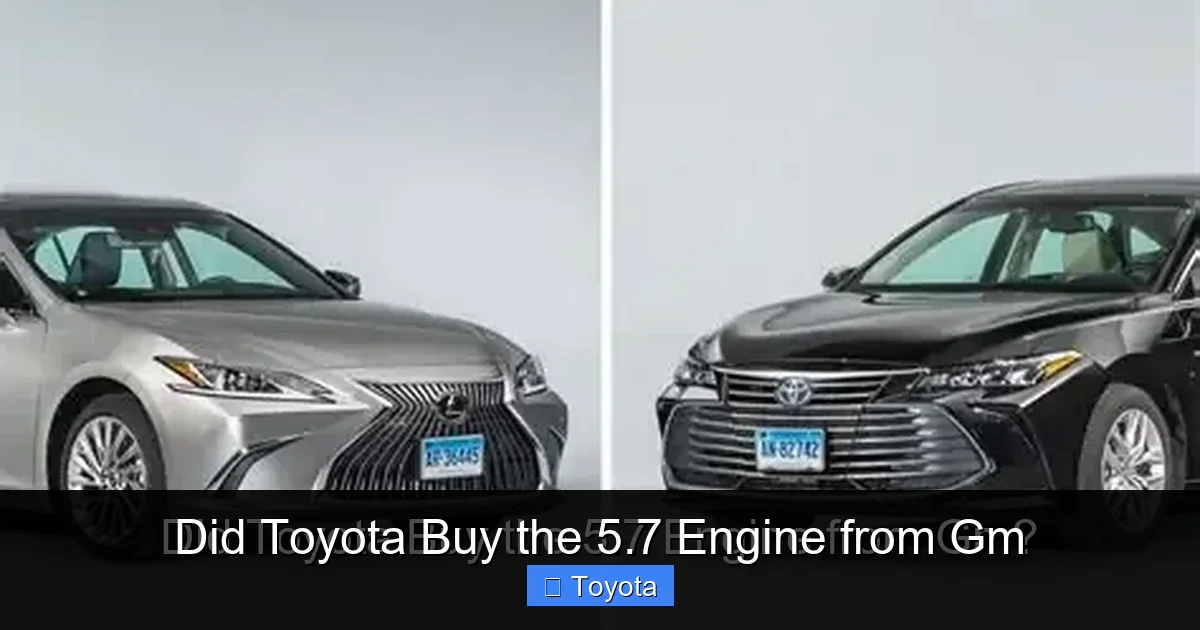
Toyota’s 5.7L V8 engine was designed and built by Toyota engineers, not purchased from General Motors. The 3UR-FE engine debuted in 2007 for the Tundra and Sequoia, featuring Toyota’s own architecture with dual VVT-i technology. While GM produced their famous LS-series 5.7L engines, Toyota’s powerplant is a completely separate design with different block architecture, head design, and manufacturing processes.
If you spend time around trucks, you have probably heard the rumor. Someone at a car meet or in an online forum will swear up and down that Toyota just bought the 5.7 liter V8 from General Motors. It sounds plausible on the surface. Both companies built 5.7 liter V8s. Both engines went into full-size trucks. But the truth is much simpler. Toyota did not buy the 5.7 engine from GM. Not even close.
The Toyota 3UR-FE 5.7L V8 is a homegrown design. It came from Toyota engineers in Japan. It was built for one reason. Toyota needed a proper V8 for the new Tundra. They wanted to compete with the Detroit Three. So they sat down and designed an engine from a clean sheet of paper. Let us walk through the whole story. We will look at the engine itself. We will compare it to the GM LS. And we will put this rumor to bed once and for all.
Key Takeaways
- Toyota developed the 5.7L V8 in-house: The 3UR-FE engine was created by Toyota engineers specifically for truck applications.
- No GM connection exists: Despite similar displacement, Toyota’s engine shares no architecture with GM’s LS-series V8s.
- Debuted in 2007: The engine first appeared in the Toyota Tundra and Sequoia for the 2007 model year.
- Advanced technology: Features dual VVT-i, acoustic control induction, and a deep-skirt block design unique to Toyota.
- Built in Alabama: Production occurs at Toyota’s Huntsville, Alabama engine plant alongside other Toyota V8s.
- Proven reliability: The engine has earned a reputation for durability with many examples exceeding 300,000 miles.
- Distinct from GM’s 5.7L: GM’s LS1/LS6 used a different bore spacing, deck height, and valve train architecture entirely.
📑 Table of Contents
The Origin Of The Toyota 5.7L V8
Back in the early 2000s, Toyota had a problem. The first generation Tundra sold okay. But it used a 4.7L V8. That engine was the 2UZ-FE. It was a good motor. But it was not enough for the heavy duty segment. Ford had the 5.4L Triton. Dodge had the 5.7L Hemi. Chevy had the 6.0L Vortec. Toyota needed more displacement. They needed more torque. And they needed it fast.
A Clean Sheet Design
Toyota did not go shopping for an engine. They started from zero. The project began around 2003. The goal was a 90-degree V8. It needed an aluminum block with cast iron liners. It needed aluminum heads. It had to meet strict emissions standards. And it had to be bulletproof. Toyota engineers looked at what made the 2UZ-FE reliable. Then they scaled everything up. They increased the bore. They increased the stroke. They redesigned the cooling passages. They optimized the combustion chamber shape.
The 3UR-FE Debut
The engine launched in the 2007 Tundra. It also went into the Sequoia. Later it found its way into the Land Cruiser and Lexus LX 570. From day one, it made 381 horsepower and 401 lb-ft of torque. Those numbers were competitive. But the real story was the torque curve. Peak torque arrived at just 3,600 rpm. That is low for a naturally aspirated V8. It meant real world pulling power. Exactly what truck buyers wanted.
Breaking Down The 3UR-FE Architecture
Let us look at what makes this engine uniquely Toyota. The details tell the story. No GM parts bin here.
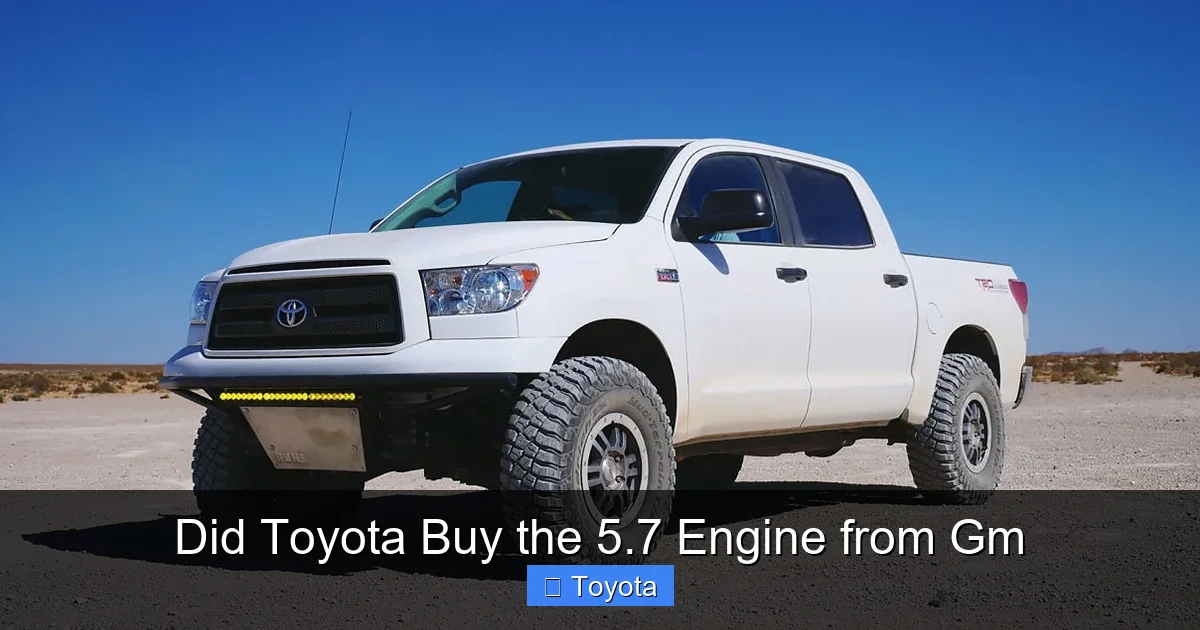
Visual guide about Did Toyota Buy the 5.7 Engine from Gm
Image source: low-offset.com
Block Design
The block uses a deep skirt design. The main bearing caps are cross-bolted. That means they bolt from the side as well as the bottom. This creates incredible bottom end rigidity. The block is die-cast aluminum. The cylinder liners are cast iron. They are inserted during the casting process. This is Toyota’s standard practice. GM LS blocks use a different approach. Many LS blocks are sand cast. Some are aluminum. Some are iron. The bolt patterns are different. The deck height is different. The bore spacing is different. Nothing interchanges.
Crankshaft And Rods
The crankshaft is forged steel. It uses a 180-degree flat plane crank pin arrangement. Wait. That is wrong. It uses a 90-degree cross-plane crank. Just like every other American style V8. The rods are forged steel. They are cracked cap design. This means the big end is fractured to create a perfect match. GM uses this too. But the dimensions are all Toyota specific. The rod length. The journal diameters. The stroke. All unique.
Cylinder Heads
The heads are aluminum. Four valves per cylinder. Dual overhead cams. This is a big difference. The GM LS uses a single cam in the block. Pushrods. Rocker arms. Toyota went with dual overhead cams. This allows variable valve timing on both intake and exhaust. Toyota calls this Dual VVT-i. It adjusts cam timing continuously. The LS did not get variable valve timing until much later. And even then, it works differently. The combustion chambers are pent-roof shaped. The spark plug sits in the center. This promotes fast, complete combustion.
Intake System
Toyota developed the Acoustic Control Induction System. This is a two-stage intake manifold. It has a valve that changes the runner length. At low rpm, it uses long runners for torque. At high rpm, it switches to short runners for power. You can hear it switch over around 4,200 rpm. It sounds like a second throttle body opening. GM used a similar concept on some LS engines. But the execution is completely different. Toyota’s system is electronically controlled. It is integrated with the ECU logic.
Comparing Toyota 5.7L To GM 5.7L
This is where the rumor falls apart. Let us compare the actual specs side by side.
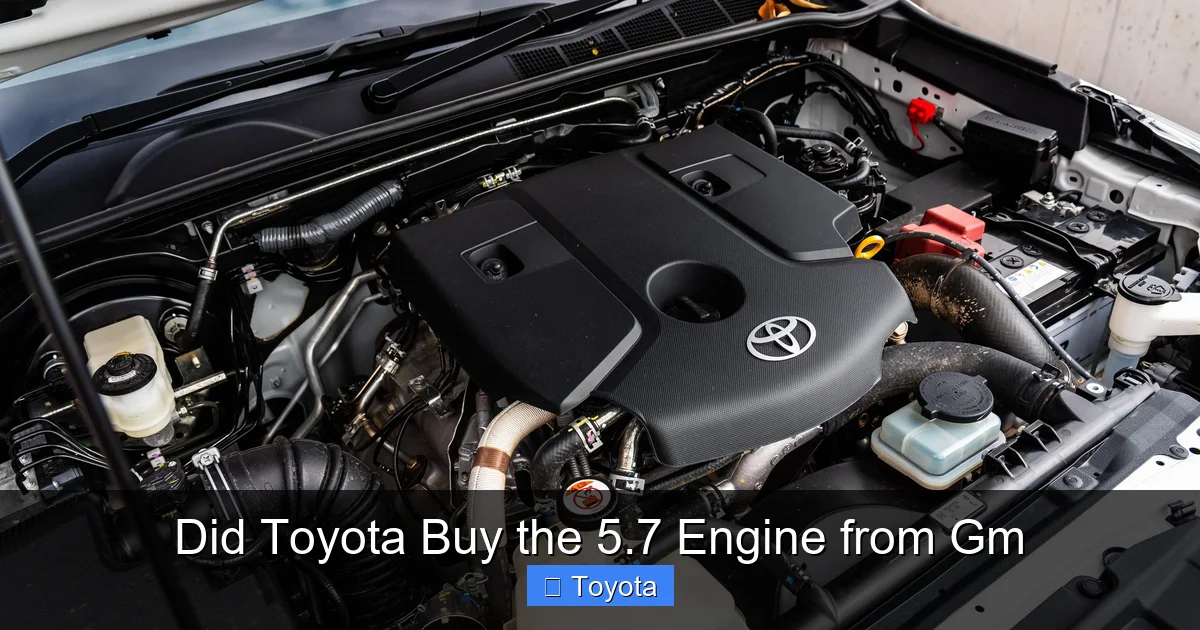
Visual guide about Did Toyota Buy the 5.7 Engine from Gm
Image source: images.carexpert.com.au
GM LS1 And LS6 5.7L
GM’s 5.7L LS1 debuted in 1997 in the Corvette. It used a 3.900 inch bore. A 3.622 inch stroke. That gives 346 cubic inches. Which is 5.7 liters. The block has 4.400 inch bore spacing. The deck height is 9.240 inches. It uses a single cam in the valley. Pushrods actuate two valves per cylinder. The heads are aluminum. Cathedral port design. The intake manifold is composite plastic. It is a brilliant design. But it is pure GM.
Toyota 3UR-FE 5.7L
Toyota’s 5.7L uses a 3.700 inch bore. A 4.016 inch stroke. That gives 345 cubic inches. Also 5.7 liters. But the bore spacing is 4.330 inches. The deck height is different. The block architecture shares zero dimensions with the LS. Dual overhead cams. Four valves per cylinder. The heads flow differently. The combustion chambers are different. The intake ports are different. The exhaust ports are different. The only thing they share is displacement. And even that is slightly different if you measure precisely.
Why The Confusion Exists
So why do people think they are related? A few reasons. First, the displacement is the same. 5.7 liters. Second, both are 90-degree V8s. Third, both use aluminum blocks with iron liners. Fourth, both went into trucks. Fifth, the internet loves a good conspiracy. But if you put the blocks side by side, they look nothing alike. The motor mounts are in different places. The bell housing pattern is different. The Toyota uses a Toyota bolt pattern. The LS uses the classic GM pattern. You cannot bolt a Toyota transmission to an LS. You cannot bolt an LS transmission to a Toyota 3UR-FE. Not without a very expensive adapter plate.
Manufacturing And Production
Another nail in the coffin. Where are these engines built?
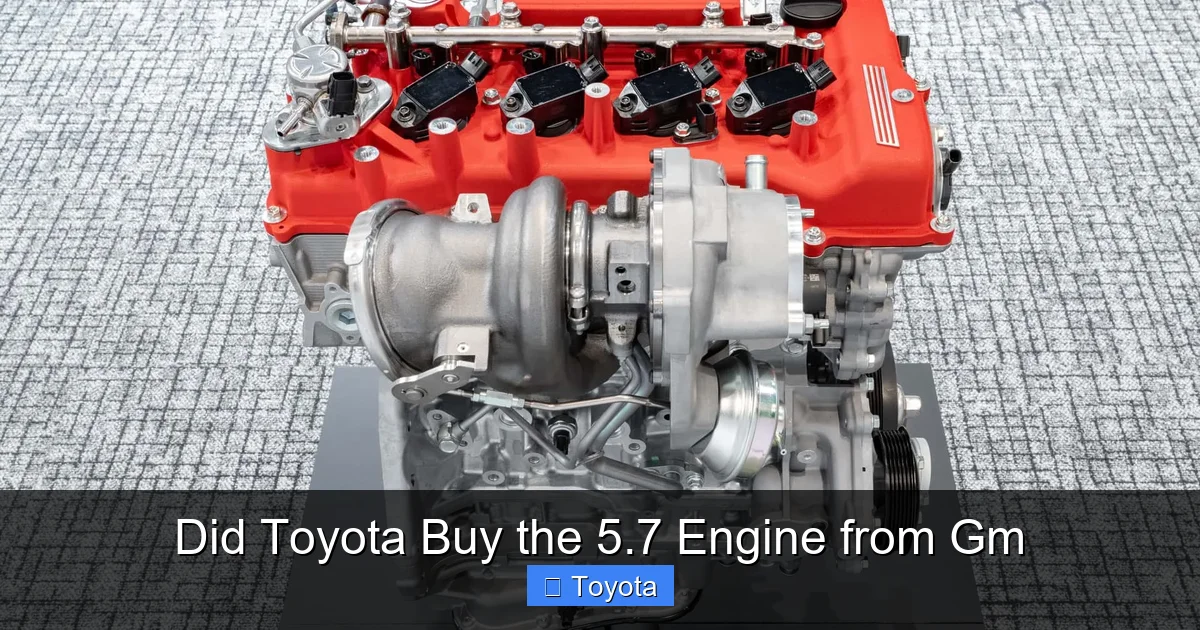
Visual guide about Did Toyota Buy the 5.7 Engine from Gm
Image source: cdn.motor1.com
Toyota Production In Alabama
The 3UR-FE is built at Toyota Motor Manufacturing Alabama. This plant is in Huntsville. It opened in 2003. It builds V6 and V8 engines. The 3UR-FE line started in 2006 for the 2007 model year. The plant is 100% Toyota owned. The machining lines are Toyota designed. The assembly process is Toyota Production System. The quality controls are Toyota standards. No GM involvement. None. Zero.
GM Production
GM LS engines came from multiple plants. Romulus, Michigan. Silao, Mexico. St. Catharines, Ontario. Tonawanda, New York. These are GM plants. They use GM tooling. GM processes. The two supply chains do not cross. Toyota does not buy blocks from GM. Toyota does not buy heads from GM. Toyota does not buy cranks from GM. Every major component is Toyota sourced. Many from Toyota suppliers like Aisin, Denso, and Toyota Boshoku.
Real World Performance And Reliability
The proof is in the pudding. Or in this case, the odometer.
Towing Capability
The 3UR-FE Tundra can tow over 10,000 pounds when properly equipped. That puts it right in the mix with domestic trucks. The torque curve is the secret. 401 lb-ft at 3,600 rpm. But more importantly, 90% of peak torque is available from 2,000 rpm to 5,000 rpm. That wide plateau means you do not need to downshift constantly. The engine just pulls. If you are shopping for a used Tundra, check out how much a Toyota Tundra weighs to understand the payload capacity for your specific configuration.
Longevity Stories
There are countless 3UR-FE engines with 300,000 miles. Some with 400,000. A few documented over 500,000. The design priorities show. The deep skirt block resists flex. The cross-bolted mains keep the crank aligned. The forged crank handles stress. The dual VVT-i reduces cold start wear. The timing chain is a massive single row chain. It is designed for the life of the engine. Most owners never touch it. Compare that to the LS timing chain which can stretch. Different philosophies. Both work. But they are different.
Common Issues
No engine is perfect. The 3UR-FE has a few known issues. The exhaust manifolds can crack. This usually happens around 100,000 miles. The fix is updated manifolds or headers. The secondary air injection pump can fail. This is an emissions device. It pumps air into the exhaust on cold starts. When it fails, you get a check engine light. Some owners delete it. Others replace it. The water pump is driven by the timing chain. When it fails, it is a bigger job. But it usually lasts 150,000 miles or more. These are minor issues. Not design flaws shared with GM.
The UR Engine Family
The 3UR-FE is part of a family. This proves it is a Toyota design.
1UR-FE 4.6L V8
This is the little brother. Same architecture. Smaller bore. 3.661 inches. Same stroke. 4.016 inches. It debuted at the same time. It went into the Tundra, Sequoia, Land Cruiser, and Lexus models. It makes 310 horsepower and 327 lb-ft. Same dual VVT-i. Same acoustic intake. Same everything. Just smaller cylinders. GM never made a 4.6L LS. Ford made a 4.6L modular. But that is a completely different engine. The 1UR-FE proves Toyota designed a scalable V8 family.
2UR-FE 5.0L V8
This one is interesting. Same bore as the 5.7L. 3.700 inches. But shorter stroke. 3.524 inches. It uses a different crank. Different rods. Different pistons. It was built for the Lexus IS F. And the Lexus GS F. And the RC F. It revs to 7,300 rpm. It makes over 400 horsepower naturally aspirated. It uses forged pistons. Titanium valves. Special cams. This is a high performance variant of the same architecture. GM never made a 5.0L LS. The LS3 is 6.2L. The LS7 is 7.0L. The 5.0L displacement is pure Toyota.
3UR-FBE Flex Fuel
There is even a flex fuel version. The 3UR-FBE. It runs on E85. It has different injectors. Different fuel lines. Different ECU calibration. Same block. Same heads. Same everything else. Toyota engineered this variant in-house. For the Tundra FFV model. GM has flex fuel LS engines. But they use different hardware. Different software. Different everything.
Why This Rumor Persists
Let us be honest about why people believe this.
Similarities Are Superficial
Both are 90-degree V8s. Both are aluminum block. Both have pushrods. Wait. Toyota does not have pushrods. That is a difference. Both have overhead cams. Wait. GM LS does not have overhead cams. That is a difference. Both have variable valve timing. GM got it later. Both have electronic throttle. Everyone has that now. Both have coil on plug ignition. Standard now. The similarities are just “modern V8 things.” The differences are fundamental architecture.
Benchmarking Is Not Buying
Toyota absolutely benchmarked the LS engine. Every manufacturer benchmarks competitors. They bought LS engines. They tore them down. They measured everything. They analyzed the manufacturing. They studied the performance. Then they designed their own engine to beat it in the areas that mattered to Toyota customers. That is not buying. That is competing. Ford did the same thing with the Coyote 5.0L. They benchmarked the LS. They benchmarked the Hemi. They built their own DOHC V8. Nobody says Ford bought the Coyote from GM.
The “Toyota Uses GM Parts” Myth
There is a broader myth that Toyota uses GM parts. Some people point to the NUMMI joint venture. That was a plant in California. Toyota and GM built cars together there. The Toyota Matrix and Pontiac Vibe. The Toyota Corolla and Chevrolet Prizm. But those were badge engineered cars. Not engines. And that venture ended in 2010. The 3UR-FE was never built at NUMMI. It was never a GM design. The plant in Alabama is 100% Toyota.
Maintenance And Ownership
If you own a 3UR-FE, here is what you need to know.
Oil Changes
Use 0W-20 synthetic. The capacity is 7.9 quarts with filter. Change it every 5,000 miles if you tow. Every 10,000 miles if you do not. The engine holds a lot of oil. That helps with cooling. It also means the oil stays cleaner longer. But do not push it. This engine works hard. For the best protection, consider reviewing the best 5W-30 engine oils as many owners prefer slightly heavier weight for towing applications.
Spark Plugs
The 3UR-FE uses iridium plugs. They are good for 120,000 miles. But check them at 60,000. The rear bank is tight. You need a swivel socket. And patience. Or pay a shop. It is a three hour job for a pro. Six hours for a DIYer. Use OEM Denso or NGK. Do not use cheap plugs. The dual VVT-i is sensitive to misfires. For other 5.7L applications, you might find spark plug recommendations for the 5.7 Hemi useful for comparison.
Coolant
Toyota Super Long Life Coolant. Pink stuff. It is good for 100,000 miles or 10 years. Then change it every 50,000 miles. Do not mix with green coolant. Do not use universal coolant. The aluminum block and heads need the specific additive package. A flush and fill is cheap insurance.
Transmission Fluid
The 6-speed automatic (AB60F) behind the 3UR-FE uses Toyota WS fluid. It is not “lifetime.” Change it every 60,000 miles if you tow. Every 100,000 if you do not. Use a fluid exchange machine. Or do a drain and fill three times. The transmission holds about 12 quarts. But only 4-5 drain out. So you need to cycle it.
The Future Of The 3UR-FE
Toyota is moving on. The new Tundra uses a twin-turbo V6. The 3UR-FE is being phased out. But it will live on for decades in the used market. And it will keep working. Because it was designed right. By Toyota. For Toyota.
Legacy Status
The 3UR-FE will go down as one of Toyota’s best engines. It proved Toyota could build a big American style V8. It proved they could do it without help. It set the standard for reliability in the segment. And it did it all with a Toyota badge on the valve cover. Not a GM badge. Not a shared badge. Just Toyota.
Collector Potential
Clean, low mile 2007-2021 Tundras with the 5.7L are already appreciating. The double cab 4×4 models. The TRD packages. The Platinum trims. People want the last of the naturally aspirated V8 trucks. The 3UR-FE is the heart of that desire. It is an engine that defines an era. Toyota’s era of taking the fight to Detroit. And winning on their own terms.
Conclusion
The rumor is false. Toyota did not buy the 5.7 engine from GM. The 3UR-FE is a Toyota design. Built in Alabama. Engineered in Japan. Proven on the road. It shares displacement with the GM LS1. That is it. The architecture is different. The valve train is different. The block is different. The heads are different. The manufacturing is different. The company is different.
Next time someone tells you Toyota bought the 5.7 from GM, you can set them straight. You know the facts. You know the specs. You know the history. And you know that sometimes, the simplest answer is the right one. Toyota built it. Toyota owns it. Toyota deserves the credit.
Frequently Asked Questions
Did Toyota purchase the 5.7L engine design from General Motors?
No, Toyota did not purchase the 5.7L engine from GM. The 3UR-FE V8 was developed entirely in-house by Toyota engineers as a clean-sheet design for the 2007 Tundra and Sequoia.
What are the main differences between Toyota’s 5.7L and GM’s 5.7L LS engine?
The Toyota 3UR-FE uses dual overhead cams with four valves per cylinder and Dual VVT-i, while the GM LS uses a single in-block cam with pushrods and two valves per cylinder. The block architecture, bore spacing, deck height, and head design are completely different.
Where is the Toyota 5.7L V8 manufactured?
The 3UR-FE is manufactured at Toyota Motor Manufacturing Alabama in Huntsville, a 100% Toyota-owned facility that has produced the engine since 2006.
Is the Toyota 5.7L V8 reliable for high mileage use?
Yes, the 3UR-FE has proven extremely reliable with many examples exceeding 300,000 miles. Its deep-skirt block, cross-bolted mains, and forged crankshaft contribute to exceptional durability.
What vehicles use the Toyota 5.7L V8 engine?
The 3UR-FE was used in the 2007-2021 Toyota Tundra, 2008-2022 Sequoia, 2008-2021 Land Cruiser, and Lexus LX 570. Variants also powered the Lexus IS F, GS F, and RC F.
Why do people think Toyota bought the 5.7L from GM?
The confusion stems from both engines sharing 5.7L displacement, being 90-degree V8s with aluminum blocks, and targeting the same truck market. However, these are superficial similarities – the fundamental architectures are entirely different.