Cost of Converting Petrol Car to Electric in India
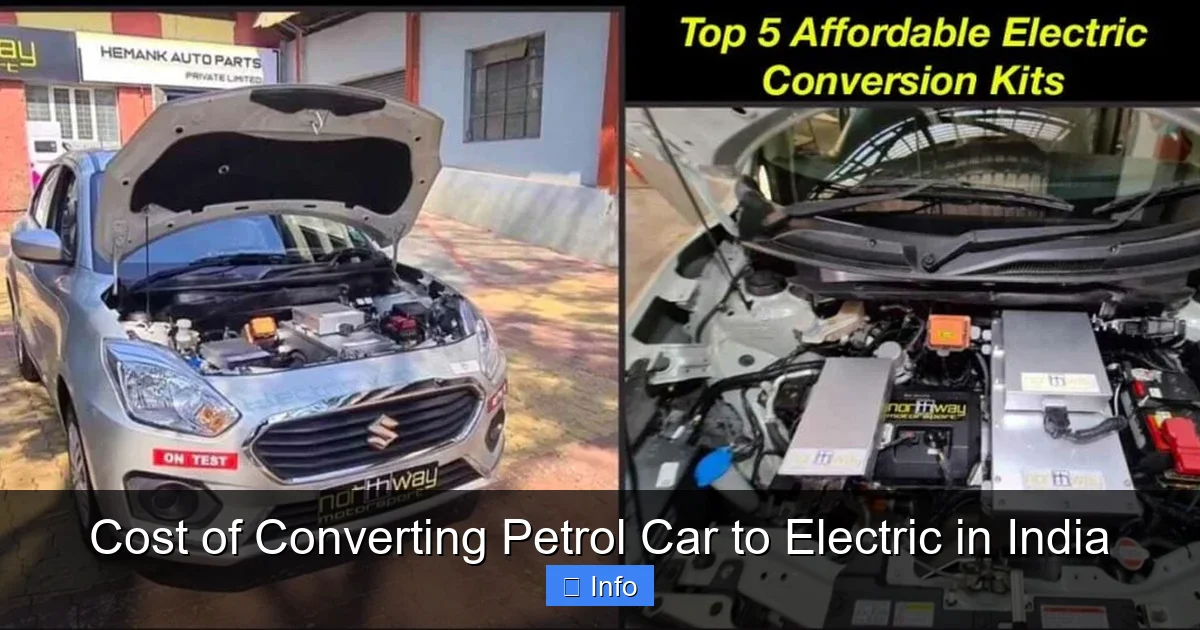
Converting a petrol car to electric in India typically costs between ₹3 lakh to ₹8 lakh depending on the vehicle model, battery capacity, and motor specifications. The process involves replacing the engine with an electric motor, installing a battery pack, and updating the transmission system. While conversion offers lower running costs and environmental benefits, it requires ARAI certification and RTO approval before the vehicle can legally ply on Indian roads.
Have you ever looked at your ageing petrol car and wondered if there’s a way to give it a new lease on life? With fuel prices climbing steadily and electric vehicles gaining momentum across India, many car owners are exploring the possibility of converting their existing petrol vehicles to electric. The idea sounds appealing on paper — keep your beloved car, ditch the fuel bills, and join the green revolution. But before you dive in, you need to understand the real costs, the regulatory maze, and whether this decision makes financial sense for your specific situation.
The concept of petrol to electric conversion isn’t new globally, but in India, it’s still finding its feet. A handful of specialized workshops and startups have emerged in major cities like Delhi, Mumbai, Bangalore, and Pune, offering conversion services for popular models. However, this isn’t a simple bolt-on job. It involves fundamental changes to your vehicle’s powertrain, electrical architecture, and safety systems. The cost of converting petrol car to electric in India can vary dramatically based on multiple factors, and understanding these variables will help you make an informed decision.
Key Takeaways
- Total conversion cost ranges from ₹3 lakh to ₹8 lakh: Price varies based on car model, battery size, motor power, and labor charges across different Indian cities.
- Battery pack is the biggest expense: Lithium-ion batteries account for 40-50% of the total conversion cost, with prices ranging from ₹15,000 to ₹25,000 per kWh.
- ARAI certification is mandatory: Every converted vehicle must pass Automotive Research Association of India testing for safety and performance compliance.
- RTO re-registration changes the fuel type: After conversion, the RC book must be updated from petrol to electric, which involves inspection and paperwork.
- Running costs drop significantly: Electric conversions reduce per-kilometer expenses by 70-80% compared to petrol, with minimal maintenance needs.
- Not all cars are suitable candidates: Lightweight hatchbacks and sedans with simple mechanical systems convert more easily than heavy SUVs or complex modern vehicles.
- Resale value remains uncertain: The market for converted EVs is still developing, making future valuation unpredictable compared to factory-built electric cars.
📑 Table of Contents
Understanding Petrol to Electric Conversion in India
What Does Conversion Actually Involve?
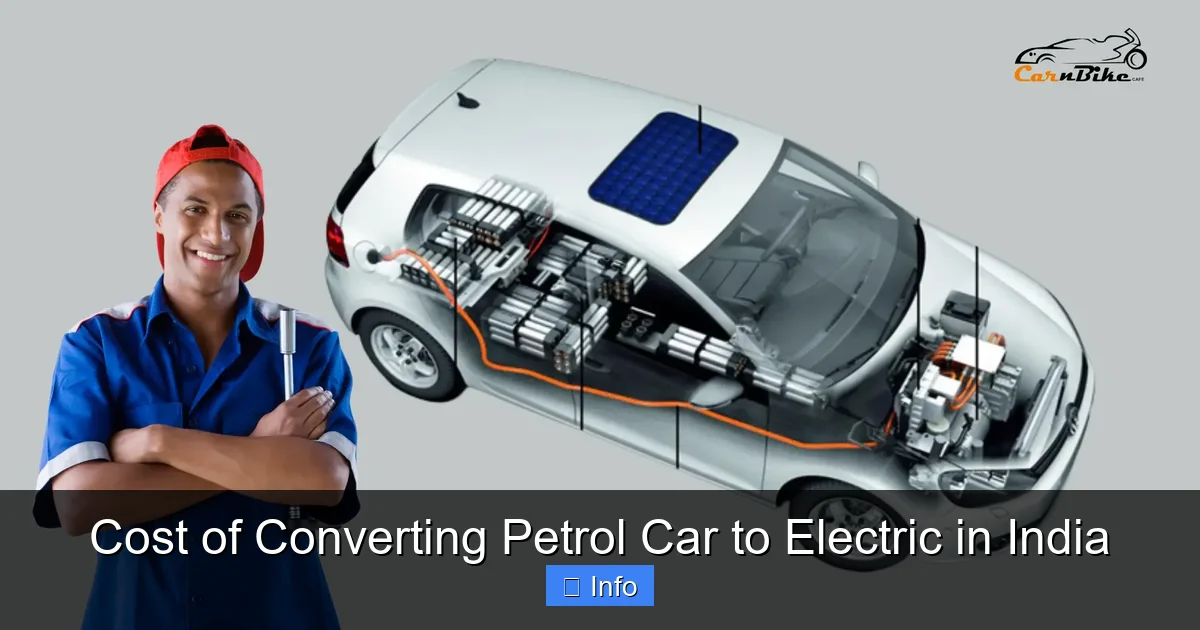
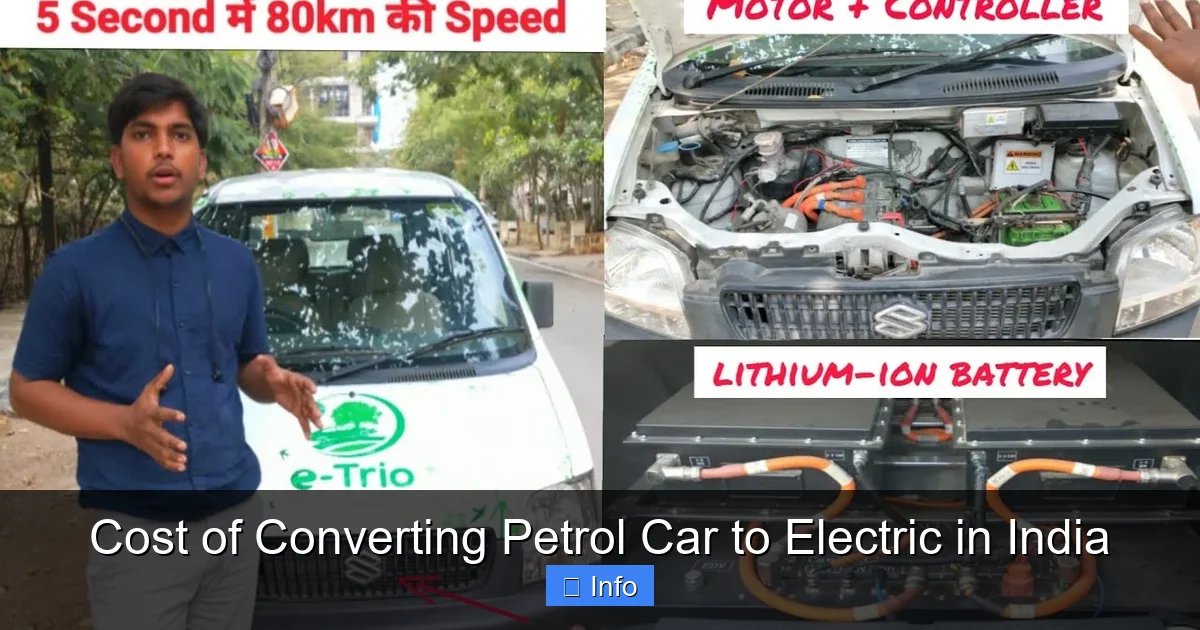
When we talk about converting a petrol car to electric, we’re describing a complete powertrain transplant. The internal combustion engine, fuel tank, exhaust system, radiator, and transmission (in most cases) are removed. In their place, an electric motor, controller, battery pack, charger, and associated wiring harness are installed. The vehicle’s instrument cluster often needs reprogramming or replacement to show battery status, range, and motor temperature instead of RPM and fuel level.
The complexity varies significantly between vehicles. Older cars with simple mechanical systems — think Maruti 800, Zen, Esteem, or the first-generation Honda City — are relatively straightforward. Modern cars with extensive electronic control units, CAN bus networks, and integrated safety systems present far greater challenges. Power steering, air conditioning, and brake boosters that originally ran off the engine need alternative solutions, usually electric pumps or vacuum systems.
The Current Landscape in India
India’s EV conversion ecosystem is still in its early stages. Unlike Europe or the US, where conversion kits for classic cars are well-established industries, India has only a few authorized retrofitters. The Ministry of Road Transport and Highways (MoRTH) has issued guidelines for retro fitment, but the process remains stringent. As of 2024, only a handful of companies have ARAI-approved conversion kits for specific vehicle models. This limited availability affects both cost and choice.
Breaking Down the Cost Components
Electric Motor and Controller
The heart of any conversion is the electric motor. For typical Indian hatchbacks and sedans, motors in the 30-60 kW range are common. A decent AC induction motor or permanent magnet synchronous motor with controller costs between ₹1.5 lakh to ₹3 lakh. Higher performance motors for larger vehicles or better acceleration can push this to ₹4-5 lakh. The controller manages power delivery, regenerative braking, and motor protection — it’s essentially the brain of the electric drivetrain.
Visual guide about Cost of Converting Petrol Car to Electric in India
Image source: carnbikecafe.com
Battery Pack — The Biggest Expense
If the motor is the heart, the battery is the fuel tank, and it’s where most of your money goes. Lithium-ion battery packs for conversion typically range from 15 kWh to 30 kWh for city cars. At current Indian market rates of ₹15,000 to ₹25,000 per kWh, the battery alone costs ₹2.25 lakh to ₹7.5 lakh. A 20 kWh pack giving roughly 150-180 km range would cost around ₹3.5-4 lakh. Battery chemistry matters too — LFP (lithium iron phosphate) batteries are safer and longer-lasting but heavier than NMC (nickel manganese cobalt) variants.
Charging System and Ancillaries
You’ll need an onboard charger (₹30,000-60,000), DC-DC converter for 12V systems (₹15,000-25,000), high-voltage wiring, connectors, contactors, and safety systems like battery management system (BMS) — another ₹50,000-80,000. Don’t forget the charging port installation, instrumentation changes, and thermal management for the battery pack. These “small” items add up to ₹1.5-2 lakh quickly.
Labor and Workshop Charges
Professional conversion isn’t a weekend DIY project. Expect 15-25 days of workshop time. Labor charges in major metros range from ₹80,000 to ₹1.5 lakh depending on complexity. This includes fabrication of motor mounts, battery enclosures, wiring harness routing, and integration with existing vehicle systems. Reputable workshops also handle the certification paperwork, which saves you enormous hassle.
Certification and Registration Costs
ARAI testing and certification for a converted vehicle costs ₹2-3 lakh. This covers safety tests, electromagnetic compatibility, range verification, and performance validation. RTO re-registration fees vary by state but typically run ₹15,000-30,000 including the new RC book, green number plate, and hypothecation removal if applicable. Some states offer road tax exemptions for converted EVs, which can offset this cost partially.
Factors That Influence the Final Price
Vehicle Model and Condition
A well-maintained Maruti Swift or Hyundai i10 converts more cleanly than a neglected Mahindra Scorpio. The donor vehicle’s structural integrity matters — rusted chassis points, worn suspension, or damaged wiring add unexpected repair costs. Lighter vehicles need smaller batteries and motors, directly reducing cost. A 900 kg hatchback might need a 15 kWh pack, while a 1600 kg SUV requires 30+ kWh for similar range.
Visual guide about Cost of Converting Petrol Car to Electric in India
Image source: i.ytimg.com
Desired Range and Performance
This is where costs scale non-linearly. A 100 km city runabout costs significantly less than a 250 km highway-capable conversion. Each additional 10 kWh of battery adds ₹1.5-2.5 lakh. Similarly, a 40 kW motor adequate for city driving costs half of an 80 kW unit needed for highway overtaking. Define your actual needs honestly — most urban drivers rarely exceed 50 km daily.
Choice of Components
Imported components from established brands (Netgain, HPEVS, Curtis, Kelly) cost 2-3x more than Chinese or Indian alternatives. However, they come with better documentation, support, and reliability track records. Some Indian startups now offer indigenous motor-controller-battery packages optimized for local conditions at competitive prices. The warranty and service network should factor into your decision, not just the upfront price.
Geographic Location
Workshops in Delhi NCR, Bangalore, and Pune have more competition and experience, often translating to better pricing. Tier-2 cities might have fewer options, meaning higher costs or shipping your car to a major hub. State-level EV policies also differ — some offer subsidies for retro fitment, others don’t. Check your state’s current EV policy before committing.
Popular Cars Suitable for Conversion
Hatchbacks — The Sweet Spot
Maruti Suzuki models dominate the conversion scene for good reason. The Alto, WagonR, Swift, and Baleno offer lightweight platforms, simple mechanics, and abundant spare parts. A Swift conversion with 20 kWh battery and 40 kW motor typically costs ₹4.5-5.5 lakh all-inclusive. The Hyundai i10, Grand i10, and Santro are equally viable candidates. These cars retain decent resale value post-conversion due to their popularity.
Sedans — More Space for Batteries
Honda City (first and second gen), Hyundai Verna, Maruti Ciaz, and Toyota Etios provide larger engine bays and trunk space for battery installation. The City is a favorite among conversion shops — its robust chassis handles the battery weight well. Expect ₹5.5-7 lakh for a quality sedan conversion with 200+ km range. The boot space reduction is minimal since batteries can be distributed between engine bay and trunk.
Compact SUVs — Possible But Pricey
Vehicles like the Ford EcoSport, Renault Duster, or Hyundai Creta can be converted, but costs escalate to ₹7-9 lakh. Their heavier weight demands larger batteries and more powerful motors. The higher center of gravity also requires careful battery placement for stability. Unless you have a specific attachment to the vehicle, buying a factory EV like the Nexon EV or XUV400 often makes more financial sense in this segment.
Classic and Vintage Cars
This niche is growing among enthusiasts. Converting a Contessa, Premier Padmini, or Ambassador to electric preserves the classic aesthetics while delivering modern reliability. These conversions are highly customized, often costing ₹8-12 lakh, but the result is a unique vehicle with zero emissions and instant torque. ARAI certification for one-off conversions follows a different, more complex pathway.
Legal and Regulatory Requirements
Central Motor Vehicles Rules Amendment
In 2022, MoRTH notified Rule 115D under the Central Motor Vehicles Rules, 1989, specifically addressing retro fitment of electric kits. The rule mandates that conversion kits must be type-approved by ARAI or other designated agencies. The kit manufacturer, not the workshop, obtains this approval for specific vehicle models. This means you can only legally convert models for which an approved kit exists.
ARAI Certification Process
The certification involves submitting the converted vehicle to ARAI (or ICAT, GARC) for a battery of tests: electrical safety (high voltage protection, isolation resistance), electromagnetic compatibility, brake performance, acceleration, gradeability, and range verification. The process takes 2-3 months and costs ₹2-3 lakh. Only after receiving the type approval certificate can you approach the RTO for re-registration.
RTO Re-registration Steps
With the ARAI certificate in hand, you submit Form 20 (application for registration), the original RC book, insurance certificate, pollution under control certificate, address proof, and the conversion invoice to your RTO. The vehicle undergoes physical inspection. Upon approval, a new RC book is issued with fuel type changed to “Electric,” and a green number plate with white lettering is assigned. The vehicle’s age for scrappage policy purposes remains linked to the original registration date.
Insurance Considerations
Insuring a converted EV requires a specialist insurer. Standard policies may not cover the converted powertrain adequately. You’ll need a comprehensive policy that explicitly covers the battery pack, motor, and controller. Premiums are typically 15-20% higher than equivalent petrol variants initially, but some insurers now offer EV-specific products with better terms. Ensure the declared value reflects the conversion cost.
Is Conversion Worth It? Pros and Cons
The Financial Case
Let’s run the numbers. A petrol Swift running 15,000 km annually at 18 kmpl and ₹100/litre fuel costs ₹83,000 yearly in fuel alone. Add oil changes, filters, spark plugs, and engine maintenance — another ₹15,000-20,000. Total: ~₹1 lakh/year. An electric conversion costing ₹5 lakh saves ₹1 lakh annually. Simple payback: 5 years. But batteries degrade — expect 10-15% capacity loss over 8 years. Factor in battery replacement at year 8-10 (₹3-4 lakh then), and the economics get tighter.
However, if you have solar panels at home, your charging cost drops to near zero. Then the payback improves dramatically. Commercial users — taxi operators, delivery fleets — see faster ROI due to higher annual mileage. For a private owner doing 8,000 km/year, the math rarely works purely on savings. The value proposition shifts to convenience, environmental impact, and future-proofing.
Environmental Impact
Converting an existing car avoids the carbon footprint of manufacturing a new vehicle — estimated at 6-8 tonnes CO2e for a small car. The conversion itself has embodied energy (battery production, motor manufacturing), but studies show net carbon payback within 15,000-25,000 km depending on your grid’s electricity mix. In India, with coal-heavy grids, the payback is longer than in hydro/nuclear-heavy countries, but still positive over the vehicle’s life.
Practical Challenges
Range anxiety is real with conversions. Factory EVs have sophisticated thermal management, predictive range algorithms, and nationwide charging networks. Conversions often lack these refinements. Public charging infrastructure, while growing, remains unreliable for long-distance travel. You’re also dependent on a single workshop for specialized repairs — no dealer network to fall back on. Spare parts for the conversion kit may become unavailable if the kit manufacturer exits the market.
Resale Value Uncertainty
This is the biggest unknown. Factory EVs from Tata, MG, Mahindra have established (though depreciating) resale markets. Converted cars have virtually no comparable sales data. Banks may not finance them. Buyers will worry about certification validity, battery health, and workshop support. If you plan to sell within 3-5 years, conversion is risky. If you’ll keep the car 10+ years, the resale question matters less.
Choosing the Right Conversion Partner
Questions to Ask Before Committing
Before handing over your car and a substantial cheque, ask the workshop: Which specific ARAI-approved kit are you using for my car model? Can you show the type approval certificate? How many conversions of this exact model have you completed? What warranty do you offer on motor, controller, and battery (separately)? Will you handle the entire RTO process? Can I speak to 2-3 previous customers? What’s the estimated real-world range in summer and winter?
Red Flags to Watch For
Workshops offering “ARAI certification included” at suspiciously low prices — certification alone costs ₹2+ lakh. Claims of “universal kit fits any car” — every model needs specific homologation. Pressure to pay full amount upfront — stage payments tied to milestones (kit delivery, mechanical fitment, electrical integration, certification, registration) protect you. Vague answers about battery warranty terms or thermal management. No physical workshop address or only a residential address.
Recommended Due Diligence
Visit the workshop. Check their current projects. Verify the kit manufacturer’s credentials on the ARAI website. Read the fine print on battery warranty — cycle life, calendar life, capacity retention guarantees. Understand what happens if the kit manufacturer goes out of business. Get everything in writing: total cost breakdown, timeline with penalty clauses, warranty terms, and post-conversion support commitments.
Conclusion
Converting your petrol car to electric in India is technically feasible, legally permissible, and environmentally meaningful — but it’s not a decision to take lightly. The cost of converting petrol car to electric in India ranges from ₹3 lakh for a basic city runabout to ₹8+ lakh for a capable highway cruiser, with certification and registration adding another ₹2-3 lakh. For the right person — someone with a suitable donor car, primarily urban driving patterns, access to home charging, and a long ownership horizon — conversion can deliver years of low-cost, emission-free motoring with a unique story.
For most others, the rapidly improving factory EV market, falling battery prices, and expanding charging infrastructure make waiting or buying a purpose-built electric car the more rational choice. The conversion route shines brightest for classic car enthusiasts, fleet operators with predictable routes, and early adopters willing to navigate the pioneering challenges. Whatever you decide, go in with eyes open, budgets padded for contingencies, and a workshop partner who demonstrates competence, transparency, and staying power. The electric future is coming — whether you retrofit your way there or buy your ticket on a factory-built vehicle is your call.
Frequently Asked Questions
What is the minimum cost to convert a petrol car to electric in India?
The absolute minimum cost for a basic conversion of a small hatchback like a Maruti Alto with a 10-12 kWh battery pack and 25 kW motor starts around ₹3 lakh including labor, but excludes ARAI certification and RTO fees which add another ₹2-3 lakh.
Is ARAI certification mandatory for electric car conversion in India?
Yes, ARAI certification is mandatory under Rule 115D of the Central Motor Vehicles Rules. Without a valid type approval certificate for the specific conversion kit on your vehicle model, you cannot legally re-register the car as an electric vehicle or get a green number plate.
How long does the petrol to electric conversion process take?
The physical conversion typically takes 15-25 working days at a professional workshop. However, the complete process including ARAI testing (2-3 months) and RTO re-registration (2-4 weeks) can take 4-6 months from start to finish.
Can any petrol car be converted to electric in India?
Legally, only vehicles for which an ARAI-approved conversion kit exists can be converted. Practically, lighter vehicles with simple mechanical systems (older hatchbacks, sedans) are most suitable. Modern cars with complex electronics, heavy SUVs, and vehicles with structural rust are poor candidates.
What is the expected range after converting a petrol car to electric?
Range depends on battery capacity. A typical 15-20 kWh conversion on a hatchback delivers 120-180 km real-world range. Larger 30 kWh packs on sedans can achieve 220-280 km. Highway driving, AC usage, and battery age reduce these figures by 15-25%.
Does converting a petrol car to electric affect insurance premiums?
Yes, insurance premiums for converted EVs are typically 15-20% higher than equivalent petrol variants initially. You need a comprehensive policy explicitly covering the battery pack, motor, and controller. Some insurers now offer specialized EV conversion policies with better terms.