A Car Starts from Rest and Moves with Uniform Acceleration
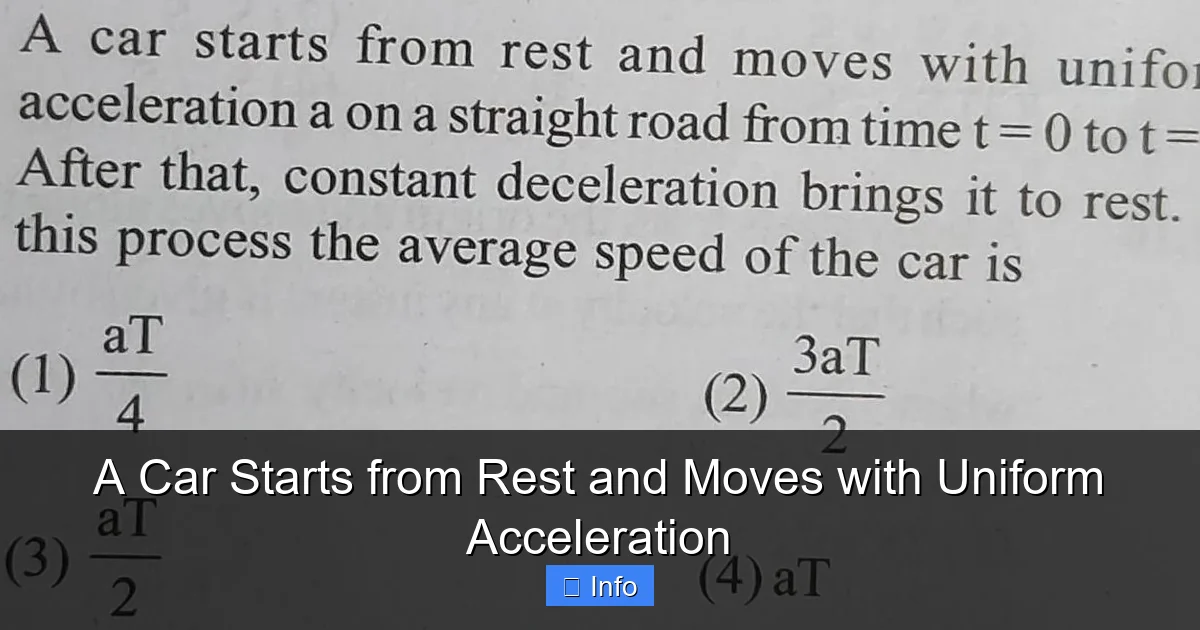
A car starts from rest and moves with uniform acceleration, making it easy to predict speed, distance, and time. This article breaks down the physics and offers practical driving tips.
Key Takeaways
- Uniform acceleration means speed changes by the same amount each second. It’s the simplest motion to analyze and predict.
- The three core kinematic equations are all you need. They let you solve for time, distance, speed, or acceleration.
- Real‑world calculations are straightforward. Plug in the numbers and you’ll see how far a car travels in a given time.
- Spot uniform acceleration on the road. A steady rise in speed on the speedometer is the tell‑tale sign.
- Smooth throttle and proper gear shifts keep acceleration even. This prevents jerky movements and improves fuel efficiency.
- Regular maintenance of tires, suspension, and drivetrain supports consistent acceleration.
📑 Table of Contents
- What Uniform Acceleration Means for a Car Starting from Rest
- Core Kinematic Equations You Need to Know
- Real‑World Example: Calculating Distance and Time
- How to Spot Uniform Acceleration While Driving
- Practical Tips to Keep Acceleration Uniform
- Conclusion: Why Mastering This Concept Helps You Drive Smarter
- FAQs
What Uniform Acceleration Means for a Car Starting from Rest
Understanding the phrase a car starts from rest and moves with uniform acceleration helps you grasp the basics of motion. Let’s see why a car starts from rest and moves with uniform acceleration is a great starting point for learning physics.
Uniform acceleration means the speed changes by the same amount each second. When a car starts from rest, the initial speed is zero. From that moment, the engine provides a constant push, so the speed climbs steadily. This steady climb is what we call uniform acceleration. It’s simple, predictable, and easy to measure.
Why does this matter? Because once you understand the pattern, you can predict how far the car will travel, how long it will take to reach a certain speed, and even how to drive more efficiently. In everyday driving, recognizing uniform acceleration can help you save fuel and avoid unnecessary wear on the brakes.
Core Kinematic Equations You Need to Know
The three core equations that describe a car starts from rest and moves with uniform acceleration are easy to remember. They come from the definition of constant change in speed.
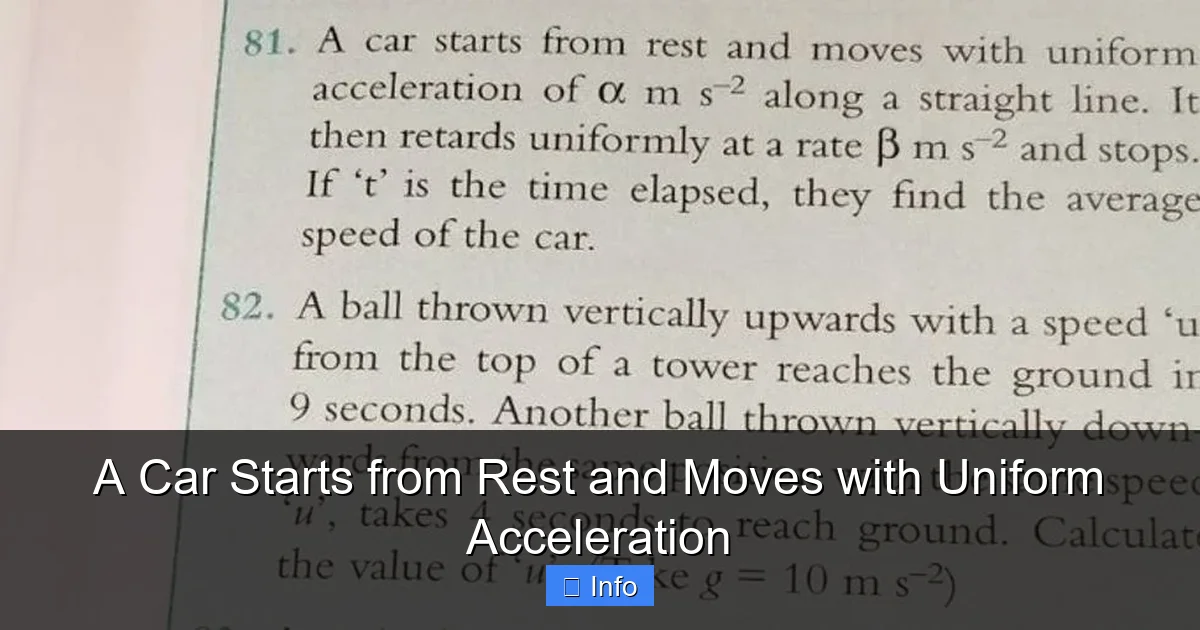
Visual guide about A Car Starts from Rest and Moves with Uniform Acceleration
Image source: static-images.findfilo.com
The Three Core Kinematic Equations
First, the distance formula: distance equals initial speed times time plus half the acceleration times time squared. Since the car starts from rest, the initial speed term drops out, leaving distance = ½ a t².
Second, the speed formula: final speed equals initial speed plus acceleration times time. With zero initial speed, final speed = a t.
Third, the relationship between speed, distance, and acceleration: final speed squared equals initial speed squared plus twice acceleration times distance. Again, with zero initial speed, it simplifies to final speed squared = 2 a distance.
These equations let you solve for any missing variable — time, speed, distance, or acceleration — when you know the others. That’s why a car starts from rest and moves with uniform acceleration is a perfect classroom example.
Real‑World Example: Calculating Distance and Time
Imagine a car starts from rest and moves with uniform acceleration for 10 seconds; we can find the distance covered. Let’s assume the acceleration is 2 meters per second squared.
Using the distance formula, distance = ½ × 2 × 10² = 100 meters. So after ten seconds, the car has traveled one hundred meters. That’s a clear illustration of how a car starts from rest and moves with uniform acceleration behaves predictably.
If you double the time to 20 seconds, the distance becomes ½ × 2 × 20² = 400 meters. The distance grows quickly because the car keeps speeding up each second. Even a small increase in acceleration, say to 3 m/s², would make the car cover 600 meters in the same 20 seconds. This shows how a car starts from rest and moves with uniform acceleration can be very dynamic.
How to Spot Uniform Acceleration While Driving
When you watch the speedometer, a car starts from rest and moves with uniform acceleration shows a steady increase in speed. The needle climbs evenly, without sudden jumps.
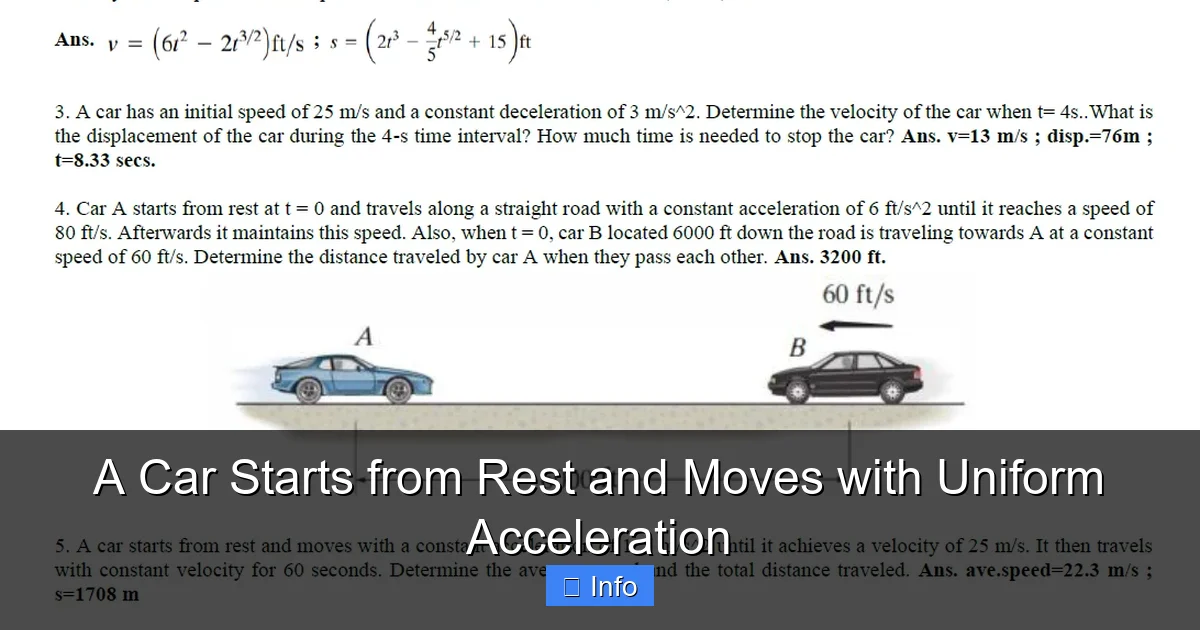
Visual guide about A Car Starts from Rest and Moves with Uniform Acceleration
Image source: media.cheggcdn.com
Recognizing Constant Throttle vs. Variable Throttle
If you keep the gas pedal pressed at the same position, the car’s speed rises uniformly. A variable throttle — pressing harder then easing off — creates uneven acceleration, which feels jerky.
Using Speedometer and Tachometer Readings
That steady climb is the hallmark of a car starts from rest and moves with uniform acceleration. You can also watch the tachometer; the RPMs rise at a constant rate when acceleration is uniform. This consistency helps you drive smoother and more safely.
If the speed rises evenly, you can confirm a car starts from rest and moves with uniform acceleration by checking the time intervals. For example, note how many seconds it takes to go from 20 km/h to 40 km/h. A constant interval means uniform acceleration.
Practical Tips to Keep Acceleration Uniform
Keeping a smooth throttle lets a car starts from rest and moves with uniform acceleration without jerky bursts. Think of the gas pedal as a gentle hand, not a hammer.
Smooth Throttle Control
Apply the pedal gradually. Avoid sudden full‑throttle hits, which cause the speed to jump. A steady press gives the engine time to deliver power evenly.
Proper Gear Shifting (if manual)
A steady gear change preserves the uniform acceleration, so a car starts from rest and moves with uniform acceleration stays smooth. Shift up before the engine revs get too high, and avoid riding the clutch.
Checking Tire Pressure and Load
Checking tire pressure ensures a car starts from rest and moves with uniform acceleration safely. Under‑inflated tires increase rolling resistance, making the engine work harder and breaking the uniform pattern.
Choosing the Right Suspension
Good shocks and struts help a car starts from rest and moves with uniform acceleration feel steady, not bouncy. This is why many drivers upgrade to the Best Car Shocks And Struts For Smooth Ride for better ride quality.
Regular Maintenance
Regular maintenance of the drivetrain also supports a car starts from rest and moves with uniform acceleration by preventing power loss. Clean fuel injectors and a healthy transmission keep the acceleration consistent.
Choosing the Right Tires
Choosing the right tires also helps a car starts from rest and moves with uniform acceleration maintain grip. Tires with proper tread depth and correct size give the best traction, which is essential for steady acceleration.
Conclusion: Why Mastering This Concept Helps You Drive Smarter
By mastering the concept of a car starts from rest and moves with uniform acceleration, you become a more confident driver. Understanding the steady speed rise lets you anticipate stops, merge safely, and enjoy a smoother ride.
Whether you’re buying a new Toyota or just polishing your current ride, the principles of a car starts from rest and moves with uniform acceleration stay the same. If you ever lease a Toyota, the same physics apply, so you’ll know what to expect when a car starts from rest and moves with uniform acceleration.
And just like you’d use the best car buffers and polishers for a flawless finish, consistent acceleration keeps your car looking and performing its best.
Even after many miles, a car starts from rest and moves with uniform acceleration remains a reliable way to gauge performance. So whether you’re on a highway or a city street, the idea of a car starts from rest and moves with uniform acceleration guides your driving decisions.
FAQs
Question? Can a car start from rest and move with uniform acceleration on a hill?
Yes, a car can start from rest on a hill and still move with uniform acceleration if the engine provides enough power to overcome gravity. The slope changes the effective acceleration, but the principle stays the same.
Question? Do I need special tires for uniform acceleration?
Not necessarily, but tires with good grip help maintain uniform acceleration. Proper tire pressure and tread depth are key to keeping the car stable as speed changes.
Question? How does uniform acceleration affect fuel consumption?
Uniform acceleration generally uses less fuel than repeated hard accelerations. When speed rises steadily, the engine operates more efficiently, saving you money at the pump.
Question? Can I feel uniform acceleration in a hybrid car?
Absolutely. Hybrid vehicles can deliver smooth, constant power, so you’ll notice the same steady speed increase when they move with uniform acceleration.
Question? What’s the difference between uniform acceleration and constant speed?
Uniform acceleration means speed is changing at a steady rate, while constant speed means the velocity stays the same. In a car starting from rest, the speed is never constant until it reaches a steady value.
Question? Is uniform acceleration important for safety?
Yes, because predictable acceleration helps you react appropriately. Drivers who understand how a car starts from rest and moves with uniform acceleration can avoid sudden braking and maintain safe following distances.
Frequently Asked Questions
What is a car starts from rest and moves with uniform acceleration?
a car starts from rest and moves with uniform acceleration is an important topic with many practical applications.