A Car Starts from Rest and Accelerates Uniformly
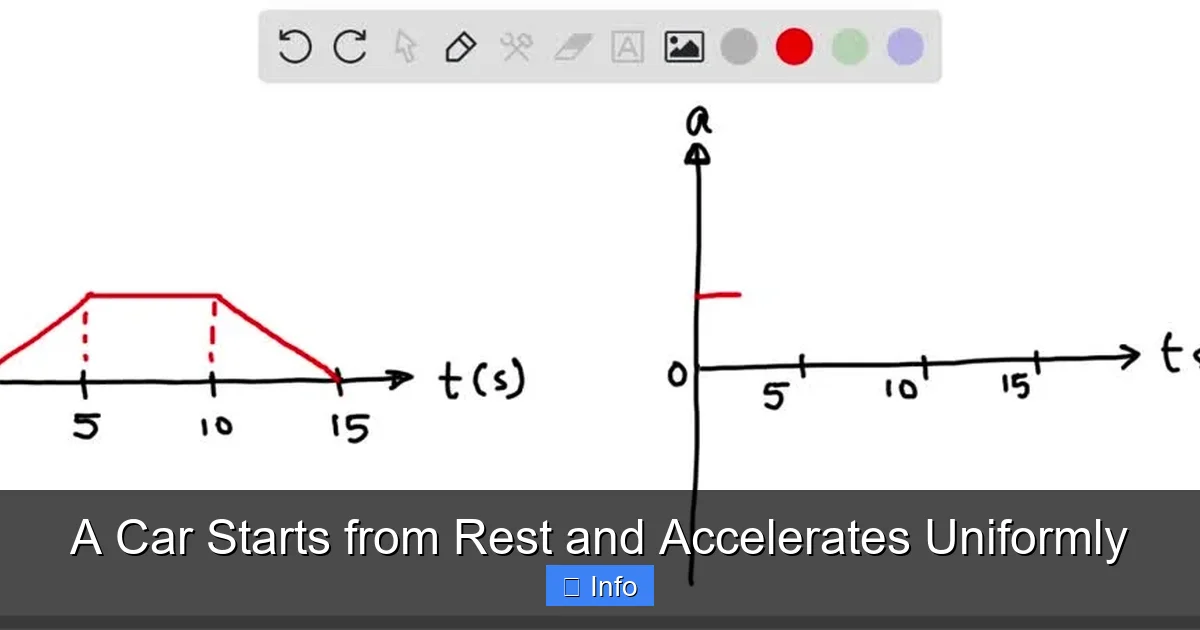
A car starting from rest and accelerates uniformly follows predictable rules. When one object begins motion while speeding up at the same rate every moment, we call this uniform acceleration. Everyone from elementary students to automotive engineers can benefit from knowing how this fundamental principle works in everyday driving.
Key Takeaways
- Uniform acceleration means the speed increases by a constant amount each second.
- The mathematical relationship is given by v = u + at, where v is final velocity.
- Newton’s second law (F = ma) connects the forces causing acceleration to the car’s mass.
- Real-world examples include toy cars in science classes and sports cars on track days.
- External forces like friction and air resistance constantly work against the car’s forward drive.
- Understanding uniform acceleration helps you troubleshoot poor performance or design better vehicles.
📑 Table of Contents
Introduction
Have you ever wondered why your car speeds up smoothly after you press the gas pedal? This happens because of something called uniform acceleration. When a car starts from rest—meaning it sits still at zero speed—and then speeds up at a perfectly steady rate every single second, we have a classic physics situation right in front of us. It sounds simple, but the principles behind this everyday phenomenon apply to everything from toy cars in school labs to full-sized race cars zooming around the track. Knowing how this works makes driving safer, because you can predict how quickly your ride will get going and adjust accordingly.
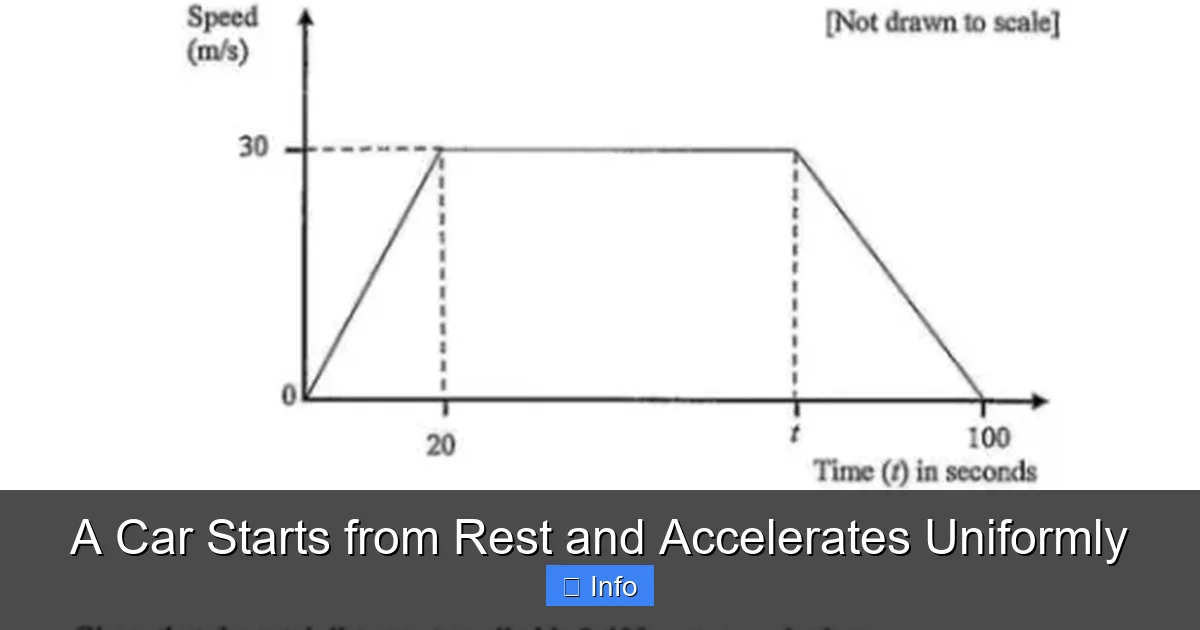
Uniform acceleration describes a very specific type of motion. Unlike a car that suddenly jumps from a stop sign into high speed, a uniformly accelerating car maintains its rate of increase in velocity throughout the entire movement. At the very beginning, when the car is parked at rest, its initial velocity is zero. As you press the accelerator, the car gains speed by tiny increments that never change size. After two seconds, it has gone faster by two units; after four seconds, four units more. This consistency is what gives us the term “uniform”—the same rate every moment without interruption.
Understanding Uniform Acceleration
At its heart, uniform acceleration is a straightforward concept. Imagine you have a car sitting quietly at a red light. The light turns green, and you gently press the accelerator. Instead of lurching forward instantly, the car creeps away slowly, picking up speed at a regular pace. Over time, the speedometer needle moves upward in equal steps. Each tick mark represents the same amount of acceleration—say, five miles per hour every second. This is the essence of uniform acceleration.

Visual guide about A Car Starts from Rest and Accelerates Uniformly
Image source: i.ytimg.com
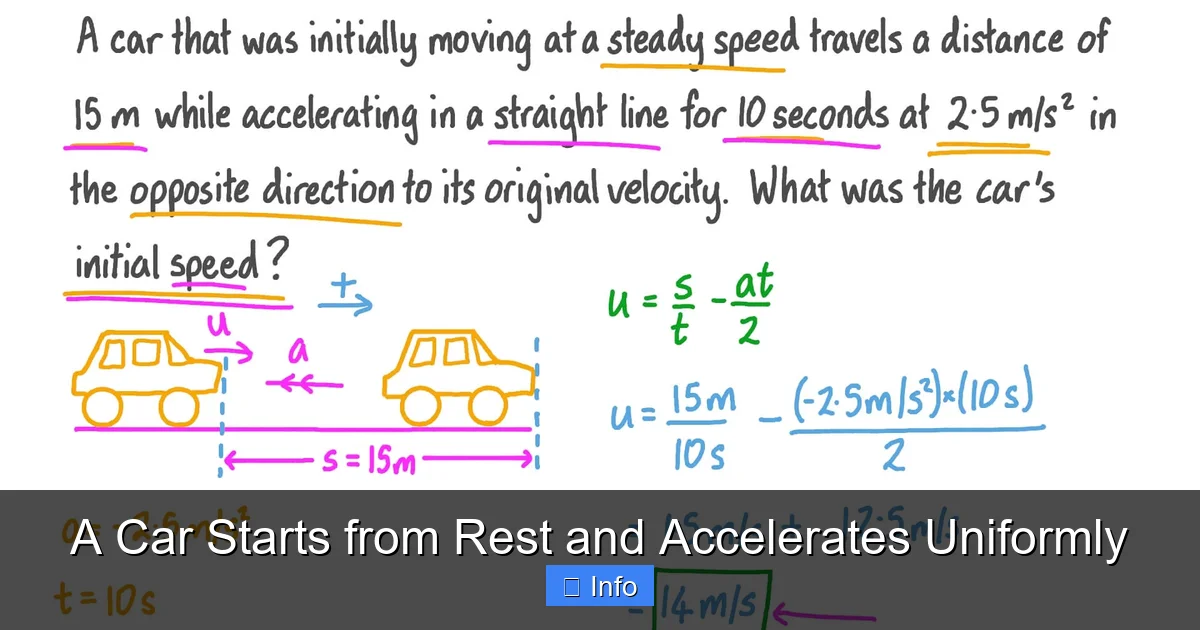
The mathematical foundation comes straight from kinematics, the branch of physics dealing with motion. The most important equation here is v equals u plus at. Here, v stands for final velocity—the speed you reach after the whole process. u is the initial velocity, which starts out at zero when a car first moves. a is the acceleration itself—the constant rate of speed gain. The letter t represents time, measured in seconds. By plugging in numbers, you can find out exactly how fast a car will be going after any given period of time.
A common mistake people make is confusing acceleration with velocity. Velocity tells you how fast something is moving in a particular direction. Acceleration, however, tells you how quickly that velocity changes. You can have high speed with low acceleration—like a rocket coasting at constant speed once engines shut off. Or you can have rapid acceleration even at low speeds, such as when you step on the gas hard from a standstill. Both scenarios involve different values for acceleration, but neither violates the idea of uniform acceleration unless other forces interfere.
The Physics Foundation
To truly grasp uniform acceleration, we need to return to Newton’s famous second law: F equals m times a. This famous formula states that the net force acting on an object determines how much it accelerates, and that effect depends directly on the object’s mass. In the case of a car, the “object” is the automobile, and the force comes primarily from the engine pushing against road grip.
Visual guide about A Car Starts from Rest and Accelerates Uniformly
Image source: p16-ehi-va.gauthmath.com
When you sit in your driver’s seat, the engine creates a backward reaction force inside the tires. This tire-road interaction pushes the car forward. If the car weighs ten thousand kilograms, applying the same push will produce less acceleration than applying that same push to a lightweight golf cart. Therefore, mass plays a critical role in determining how easily a vehicle can achieve uniform acceleration. A heavy truck needs far more power to maintain the same speed-up rate compared to a compact sedan.
Beyond pure force, several other factors subtly alter whether acceleration stays perfectly uniform. Rolling resistance—the friction between tires and pavement—always opposes motion. Even on flat ground, the engine must work harder to overcome this drag. There is also air resistance, or wind drag, which grows larger as speed increases. Near-zero clearance between your body and the seats keeps you seated tight, reducing aerodynamic drag. All these elements compete against the forward push, creating a dynamic tug-of-war that can turn a theoretically uniform acceleration into something irregular.
Real-World Applications
While textbooks often present uniform acceleration as a neat theory, the reality involves many variables. Still, the simplified model serves as an excellent approximation for normal driving conditions.
Visual guide about A Car Starts from Rest and Accelerates Uniformly
Image source: media.nagwa.com
Consider the classic classroom demonstration. Teachers give small toy cars wheels and let them roll across a smooth floor. By releasing the car from rest and timing how long it takes to travel a fixed distance, students discover approximately uniform acceleration. The data usually looks perfect until they add friction by placing the toy on carpet or incline. Suddenly, the car doesn’t speed up as steadily—it slows down more noticeably as speed rises. This demonstrates how real-world conditions break the perfect uniformity, yet the underlying principle remains clear.
In the world of racing, engineers obsess over achieving smooth acceleration. Formula One cars and NASCAR racers spend millions designing suspension systems and engine management software specifically to keep their acceleration curves flat. When a driver transitions from standing start to full throttle, the goal is to minimize any jerkiness. Any sudden drop in acceleration feels like a slip in control, potentially leading to accidents. Thus, manufacturers invest heavily in understanding and replicating uniform acceleration through careful material selection and precision tuning.
Everyday drivers experience uniform acceleration without thinking about it. When you merge onto a highway, you typically press the accelerator and watch the car creep up to the posted limit. The rate at which you catch up to traffic depends entirely on how well your engine produces torque and how efficiently your transmission transfers it to the wheels. A well-maintained vehicle with fresh oil and clean bearings responds predictably—exactly the behavior described by uniform acceleration.
Factors That Influence Acceleration
Several elements determine whether a car achieves true uniform acceleration in practice. First, the net force driving the car is crucial. A powerful exhaust system produces more thrust, allowing higher acceleration. However, stronger brakes can also assist during deceleration phases, changing the balance of forces during the entire motion cycle.
The mass of the car cannot be ignored. A heavier vehicle requires proportionally more energy to achieve the same surge in speed. This is why sports teams sometimes prefer smaller, lighter cars when optimizing for launch acceleration, while trucks can afford bulkier designs without sacrificing performance dramatically.
Environmental factors play hidden roles too. Temperature affects engine efficiency—hot engines may run leaner, producing less power. Humidity and dust can change the coefficient of friction between tires and road surface, subtly altering the effective force available for acceleration. Even minor variations in road surface roughness cause the car’s contact patch to behave differently, introducing microscopic fluctuations in force.
Finally, driver input introduces variability. If you gradually ease off the gas, acceleration decreases. If you snap the pedal to the floor, the engine’s response curve matters—if the car is already near its top speed, additional throttle yields diminishing returns due to air resistance and traction limits. Understanding these influences helps both hobbyists building scale models and professional teams chasing record times.
Practical Calculation Tips
Wondering how to put numbers to this concept? A few simple steps will take you from raw data to clear answers.
Step one: Measure your starting state. Record the initial velocity (u)—usually zero if the car was at rest. Then note the elapsed time (t) and the final velocity (v) after a certain interval.
Step two: Apply the master equation. Divide the final velocity by the time interval to find average acceleration, or rearrange the formula to solve for unknown quantities. For example, if a car reaches 50 mph in 10 seconds from a standstill, plug those values into v = u + at to verify the acceleration.
Step three: Check assumptions. Before trusting your result, confirm that external forces remain relatively constant. If you hit a bump or enter a gravel patch, the actual acceleration will deviate from the calculated value. Real-world experiments should account for these deviations by measuring multiple trials and calculating an experimental acceleration.
Here’s a quick example. Suppose a delivery van starts from rest and reaches 30 km/h after 8 seconds. Using v = 30 km/h (convert to m/s: ~8.33 m/s) and u = 0, we solve for a: a = (v – u)/t = 8.33/8 = 1.04 m/s². This tells you the van achieved uniform acceleration of roughly 1 meter per second squared.
Using these calculations daily sharpens intuition about vehicle dynamics. Next time you observe a car gaining speed smoothly, mentally rehearse the formula and picture the numbers flowing together. It transforms observation into understanding.
Common Pitfalls and Troubleshooting
It’s easy to get tripped up when interpreting acceleration data. One frequent error involves mistaking instantaneous acceleration for average acceleration. If you measure speed at just before and just after a brief period, you might think the car is constantly speeding up rapidly. In truth, acceleration is the *rate* of velocity change—that’s what the numbers describe continuously, not discrete jumps.
Another tricky issue arises with rounding errors. When using calculators or spreadsheets, intermediate results can accumulate slight inaccuracies. Always round appropriately at each stage, especially when teaching students who rely on digital tools for homework assignments.
Driver expectations can also lead to confusion. Passengers often assume that a car accelerating equally fast should cover distances in identical times, ignoring the increasing speed factor. Remember, covering the last meter of a journey always takes longer because you’re traveling faster. Uniform acceleration ensures that the “speed boost” is distributed evenly, keeping motion patterns predictable for everyone involved.
Lastly, distinguishing between linear and non-uniform acceleration is vital for diagnostic purposes. If a mechanic hears reports of jerky acceleration, they know the system isn’t providing constant force. Towing issues, broken transmissions, or worn brake pads can all introduce variable forces, resulting in non-linear acceleration profiles that differ from the textbook model.
Frequently Asked Questions
Question? What is uniform acceleration in simple terms?
Uniform acceleration simply means that a vehicle speeds up at the exact same rate every second. If you start from a standstill and press the gas pedal, the car doesn’t jump forward instantly—rather, it picks up speed gradually and consistently. Think of climbing stairs at a steady pace versus trying to rush up them all at once. The former shows uniform acceleration.
Question? How do you calculate uniform acceleration?
To calculate uniform acceleration, use the formula a equals v minus u divided by t. Here, a is acceleration, v is final velocity, u is initial velocity (often zero if starting from rest), and t is time. Plug your known values into the equation and you’ll have your answer—a number representing how many meters per second squared the car is speeding up each second.
Question? Why does a car’s acceleration eventually slow down despite being initially uniform?
While the theoretical model assumes perfect uniformity, real cars face decreasing acceleration due to various forces. Friction between tires and road, air resistance, and mechanical wear mean the net forward force diminishes over time. These opposing forces grow stronger relative to the car’s momentum, causing the acceleration to taper off from its initial steady rate.
Question? Does adding weight always reduce acceleration?
Generally yes, more weight means greater inertia. Since acceleration equals force divided by mass, doubling the mass halves the acceleration for the same applied force. However, some vehicles trade mass for technology—like hybrid cars with lightweight materials—which allow them to maintain robust acceleration despite carrying extra electronics and batteries.
Question? Are there situations where a car cannot accelerate uniformly?
Absolutely. Rapid braking, steep hills, or encountering loose gravel all disrupt the assumption of constant net force. In racing, drivers intentionally vary acceleration to manage grip limits—slowing down before corners to maintain stability. In these cases, the acceleration profile becomes non-uniform precisely because the conditions themselves are changing.
Question? How can drivers improve their own vehicle’s acceleration?
Regular maintenance goes a long way. Keeping tires properly inflated reduces rolling resistance. Changing oil and fluids ensures the engine runs efficiently. Removing unnecessary cargo lessens weight, while checking brake function prevents premature lock-up. These small adjustments help the car respond more predictably, bringing real-world driving closer to the ideal of uniform acceleration.