A Car Has Wheels Which Are 80 Cm in Diameter
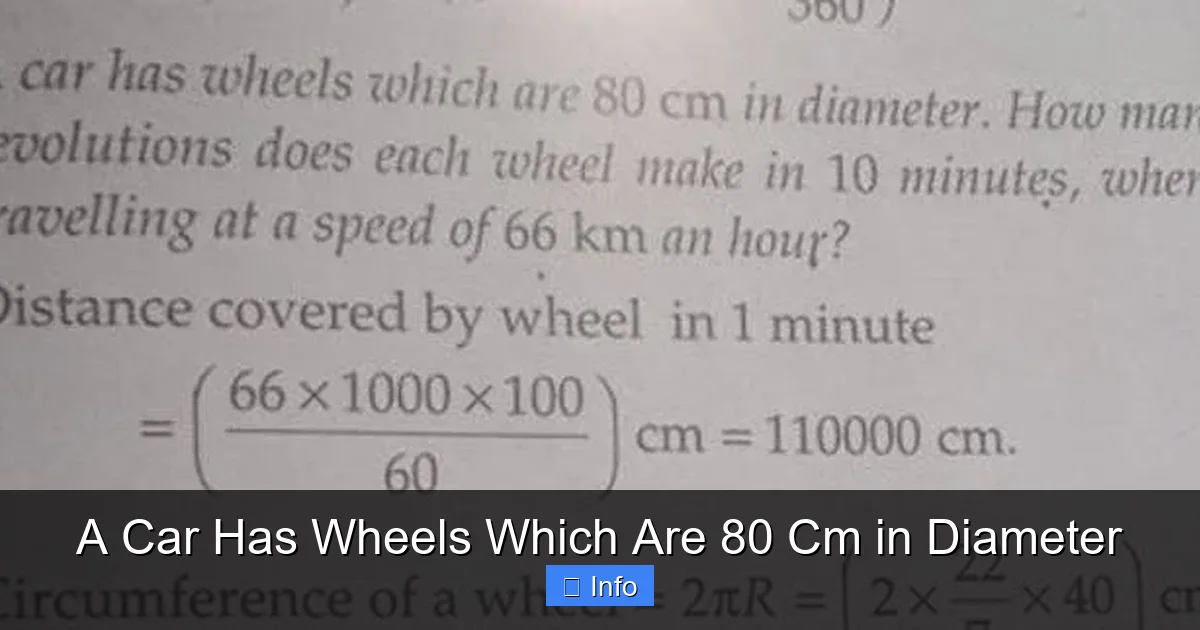
When a car has wheels that are 80 cm in diameter, this measurement plays a crucial role in determining everything from speedometer accuracy to tire wear patterns. Understanding this basic specification helps drivers make informed decisions about maintenance, performance, and safety. In this article, we’ll explore what this wheel size means, how to calculate related measurements, and why it matters for your driving experience.
Key Takeaways
- Wheel Diameter Basics: An 80 cm diameter wheel equals approximately 31.5 inches, which is a common size for many passenger vehicles and SUVs.
- Circumference Calculation: Using pi (3.14159), an 80 cm wheel has a circumference of roughly 251.3 cm or 2.513 meters per revolution.
- Speed and RPM Relationship: This wheel size directly affects how engine RPM translates to vehicle speed, impacting fuel economy and performance.
- Tire Size Compatibility: The 80 cm measurement typically refers to the rim alone; tire selection must account for sidewall height to maintain proper overall diameter.
- Maintenance Considerations: Regular inspection of 80 cm wheels includes checking for bends, proper torque specifications, and alignment issues.
- Replacement Planning: When replacing wheels or tires, maintaining the original 80 cm diameter ensures accurate speedometer readings and proper vehicle handling characteristics.
📑 Table of Contents
- Understanding Your Car’s 80 cm Wheels
- Calculating Wheel Circumference and Distance Traveled
- Tire Selection and Overall Diameter Considerations
- Maintenance Tips for 80 cm Wheels
- Performance Implications and Real-World Driving
- Troubleshooting Common Issues with 80 cm Wheels
- Making Informed Decisions About Your 80 cm Wheels
- Conclusion
Understanding Your Car’s 80 cm Wheels
Have you ever wondered what it actually means when someone says a car has wheels that are 80 cm in diameter? It sounds like a pretty specific measurement, but understanding this number can tell you a lot about your vehicle’s performance, handling, and even fuel efficiency. Whether you’re a new driver trying to learn more about your car or an experienced enthusiast looking to modify your setup, knowing your wheel specifications is fundamental knowledge.
The diameter of a wheel—the distance from one edge to the other passing through the center—is one of the most important measurements in automotive design. For wheels that measure 80 cm in diameter, this translates to about 31.5 inches, which is a size commonly found on everything from compact cars to larger SUVs. But here’s where it gets interesting: this simple measurement affects nearly every aspect of how your car performs on the road.
Think about it this way: every time your wheel makes one complete rotation, your car moves forward by exactly one wheel circumference. With an 80 cm diameter wheel, that circumference works out to approximately 251.3 centimeters, or about 2.5 meters. This means that for every 1,000 revolutions of your wheels, your car will have traveled roughly 2.5 kilometers. Pretty neat, right? But this measurement doesn’t just satisfy our curiosity—it has real-world implications that every driver should understand.
Why Wheel Diameter Matters More Than You Think
You might be thinking, “It’s just a number on a spec sheet,” but wheel diameter actually influences several critical aspects of your car’s behavior. First, it determines the final drive ratio between your engine and the road. Smaller diameter wheels generally provide better acceleration because they require less torque to turn, while larger wheels can improve top speed potential but may reduce fuel economy.
Additionally, the diameter affects your speedometer’s accuracy. Car manufacturers calibrate speedometers based on specific wheel and tire combinations. If you change to wheels with a different diameter without adjusting the tire size accordingly, your speedometer could read inaccurately—which means you might think you’re driving 60 mph when you’re actually going 65 mph. This isn’t just about getting speeding tickets; it affects fuel economy calculations, maintenance intervals, and even safety system calibrations.
Calculating Wheel Circumference and Distance Traveled
Now let’s dive into some practical math. To calculate the circumference of your 80 cm diameter wheels, you simply multiply the diameter by pi (π), which is approximately 3.14159. So 80 cm × 3.14159 = 251.33 cm. This means each complete revolution of your wheel covers about 2.513 meters of ground distance.

Visual guide about A Car Has Wheels Which Are 80 Cm in Diameter
Image source: i.ytimg.com
This calculation becomes incredibly useful when you want to understand how your car’s performance relates to real-world driving. For example, if you know your engine is turning at 3,000 RPM in a particular gear, and you know your differential ratio, you can calculate exactly how fast you’re traveling. Let’s say you have a typical differential ratio of 3.73:1. At 3,000 engine RPM, your wheels would be turning at 3,000 ÷ 3.73 = 804 RPM. Multiply that by the circumference (2.513 meters), and you get 2,020 meters per minute, or about 121 km/h (75 mph).
Practical Applications of These Calculations
These numbers aren’t just academic exercises—they have real applications for everyday driving. If you’re planning a long road trip and want to estimate fuel costs, knowing your wheel circumference helps you calculate exactly how many revolutions your engine will make over a given distance. This can help you choose the most fuel-efficient route or driving style.
Moreover, understanding these relationships helps when troubleshooting performance issues. If your car feels like it’s working harder than usual at highway speeds, checking whether your actual tire diameter matches the manufacturer’s specifications can reveal whether your speedometer is reading accurately. Many drivers don’t realize that worn tires can effectively reduce the wheel diameter, causing the engine to work harder and consume more fuel.
Tire Selection and Overall Diameter Considerations
Here’s where things get a bit more complex: the 80 cm measurement typically refers only to the wheel rim itself, not the complete wheel and tire assembly. When you add a tire, the overall diameter increases based on the tire’s sidewall height. This is why it’s crucial to select tires that maintain the correct overall diameter to preserve your car’s original performance characteristics.

Visual guide about A Car Has Wheels Which Are 80 Cm in Diameter
Image source: classroom-notes.cdn.askfilo.com
For example, if your 80 cm rim is fitted with a tire that has a sidewall height adding 5 cm on each side, your total wheel diameter becomes 90 cm. This represents more than just a cosmetic change—it significantly alters your car’s gearing, speedometer accuracy, and even suspension geometry. Most manufacturers specify both the rim diameter and the recommended tire size to ensure the final assembled diameter remains within acceptable tolerances.
Finding the Right Tire Size for Your 80 cm Wheels
When shopping for tires to fit your 80 cm wheels, look for sizes that are designed specifically for that rim width. The tire size notation tells you everything you need to know: for instance, a 225/60R16 tire means the tread is 225 mm wide, the sidewall height is 60% of that width, and it fits a 16-inch rim. Converting that to metric, a 16-inch rim is about 40.6 cm, so you’d need to find the equivalent for your 80 cm wheels.
Modern tire calculators make this process much easier. Many online tools allow you to input your rim diameter and desired tire width, then recommend appropriate aspect ratios to maintain your target overall diameter. Keeping within 3% of the original equipment manufacturer’s specifications is generally recommended to avoid speedometer inaccuracies and handling issues.
Maintenance Tips for 80 cm Wheels
Proper maintenance of your 80 cm wheels goes beyond just keeping them clean (though that’s important too). These larger wheels often require specific attention to torque specifications, balancing, and alignment. Because they’re typically found on heavier vehicles, the stresses on both wheels and tires are greater, making regular inspection essential.

Visual guide about A Car Has Wheels Which Are 80 Cm in Diameter
Image source: classroom-images.cdn.askfilo.com
When checking your wheels, look for signs of damage such as cracks, bends, or corrosion around the rim edges. Even small imperfections can cause vibration at highway speeds or lead to tire damage. Pay special attention to the valve stems and mounting surfaces, as these areas are prone to wear and can cause slow leaks if not properly maintained.
Torque Specifications and Installation Best Practices
One critical aspect of wheel maintenance that many drivers overlook is proper torque application. Your 80 cm wheels need to be tightened to the manufacturer’s specified torque values—typically between 80-120 lb-ft for most passenger vehicles. Under-tightening can cause the wheel to come loose while driving, while over-tightening can stretch or break wheel bolts and damage the wheel itself.
Always use a calibrated torque wrench when installing wheels, and follow the star pattern tightening sequence recommended by your vehicle’s manufacturer. This ensures even pressure distribution across the wheel hub. After the first 50-100 miles of driving with newly installed wheels, it’s wise to re-check the torque to ensure everything remains properly secured.
Performance Implications and Real-World Driving
The 80 cm wheel diameter has noticeable effects on your car’s day-to-day driving characteristics. Larger diameter wheels typically provide better steering response and cornering stability, but they can also transmit more road vibration into the cabin. This is partly because larger wheels usually mean lower profile tires, which offer less cushioning between the road and your vehicle.
Fuel economy is another consideration. While larger wheels can reduce rolling resistance in some cases, they also add rotational mass that the engine must work to turn. This trade-off means that switching to 80 cm wheels from a smaller size might improve highway stability but could slightly reduce acceleration and fuel efficiency in city driving.
Seasonal Considerations and All-Weather Performance
If you live in an area with significant seasonal changes, your 80 cm wheels present unique challenges and opportunities. Winter tires designed for larger wheels can dramatically improve traction in snow and ice, but they’re also more expensive to replace. Conversely, summer performance tires on 80 cm wheels can provide excellent grip on warm pavement but may become hazardous in cold weather conditions.
Many drivers with 80 cm wheels find it worthwhile to invest in a second set of wheels for seasonal tire changes. This approach protects your premium wheels from winter road salt and grime while allowing you to optimize tire selection for each season’s conditions.
Troubleshooting Common Issues with 80 cm Wheels
Even with proper maintenance, 80 cm wheels can develop issues that affect your driving experience. Vibration at certain speeds often indicates wheel imbalance or tire wear patterns that need addressing. If you notice pulling to one side, this could signal alignment problems or uneven tire pressure that becomes more pronounced with larger diameter wheels.
Unusual noises while driving might indicate bearing wear, which is particularly important with larger wheels due to the increased leverage forces involved. Don’t ignore these warning signs—larger wheels carry more momentum and energy, making component failures potentially more dangerous than with smaller wheel setups.
When to Seek Professional Help
While basic wheel maintenance can be done at home with the right tools, some issues require professional attention. If you suspect bent wheels, damaged bearings, or persistent vibration that isn’t resolved by balancing, visiting a qualified technician is essential. These professionals have specialized equipment to diagnose and repair issues that could be dangerous to ignore.
Additionally, if you’re considering upgrading to different wheel sizes or modifying your setup, consulting with experts can help you avoid costly mistakes. The interaction between wheel size, tire selection, suspension geometry, and drivetrain components is complex, and improper modifications can affect everything from handling to warranty coverage.
Making Informed Decisions About Your 80 cm Wheels
Understanding that your car has wheels which are 80 cm in diameter is just the beginning of making informed decisions about your vehicle’s maintenance and performance. This knowledge empowers you to communicate more effectively with mechanics, make better purchasing decisions about tires and accessories, and appreciate the engineering that went into your car’s design.
Whether you’re calculating how many revolutions your wheels make during your daily commute or planning a tire upgrade for better performance, the 80 cm measurement serves as a foundation for understanding your car’s behavior on the road. By staying informed about your wheel specifications and maintaining them properly, you’ll enjoy safer, more efficient driving for years to come.
Conclusion
So there you have it—a seemingly simple specification like “a car has wheels which are 80 cm in diameter” opens up a whole world of automotive knowledge and practical applications. From basic circumference calculations to complex performance considerations, this measurement touches nearly every aspect of your driving experience.
Remember that understanding your car’s specifications isn’t just for gearheads—it’s practical knowledge that helps you drive safer, maintain your vehicle more effectively, and make better decisions about upgrades and repairs. Whether you’re calculating speed based on RPM or choosing the right tire size, knowing your wheel diameter gives you the power to take control of your car’s performance.
The next time you’re out on the road, think about those 80 cm wheels turning beneath you, each revolution covering 2.5 meters of ground, working in harmony with your engine and transmission to deliver a smooth, controlled driving experience. With this knowledge, you’re not just a driver—you’re an informed participant in your car’s operation and maintenance.
Keep learning, keep maintaining, and most importantly, keep enjoying the journey. Your 80 cm wheels are ready to take you wherever you want to go, as long as you treat them right.
Frequently Asked Questions
What does 80 cm wheel diameter mean for my car’s speed?
An 80 cm wheel diameter means each revolution covers about 2.513 meters of distance. This directly affects how your engine RPM translates to road speed, with larger wheels generally requiring lower RPM at any given speed compared to smaller wheels.
Can I put different sized tires on my 80 cm wheels?
Yes, but you must maintain the correct overall diameter to preserve speedometer accuracy and handling characteristics. Use tire size calculators to ensure the combined wheel and tire diameter stays within 3% of the original specification.
How do I check if my 80 cm wheels are properly torqued?
Use a calibrated torque wrench set to your vehicle manufacturer’s specifications, typically 80-120 lb-ft. Always tighten in a star pattern and re-check torque after the first 50-100 miles of driving.
Are 80 cm wheels good for winter driving?
This depends on your tire choice rather than the wheel size itself. Properly sized winter tires on 80 cm wheels can provide excellent traction, though lower profile tires may transmit more road vibration in icy conditions.
What maintenance do 80 cm wheels require?
Regular cleaning, inspection for cracks or bends, proper torque checks, and seasonal tire rotation are essential. Pay special attention to valve stems and mounting surfaces where leaks commonly occur.
How does wheel diameter affect fuel economy?
Larger diameter wheels like 80 cm typically add rotational mass that can slightly reduce fuel economy, though modern designs often offset this with reduced rolling resistance. The impact varies based on tire selection and driving conditions.