A Car Is Moving on a Straight Road Due North
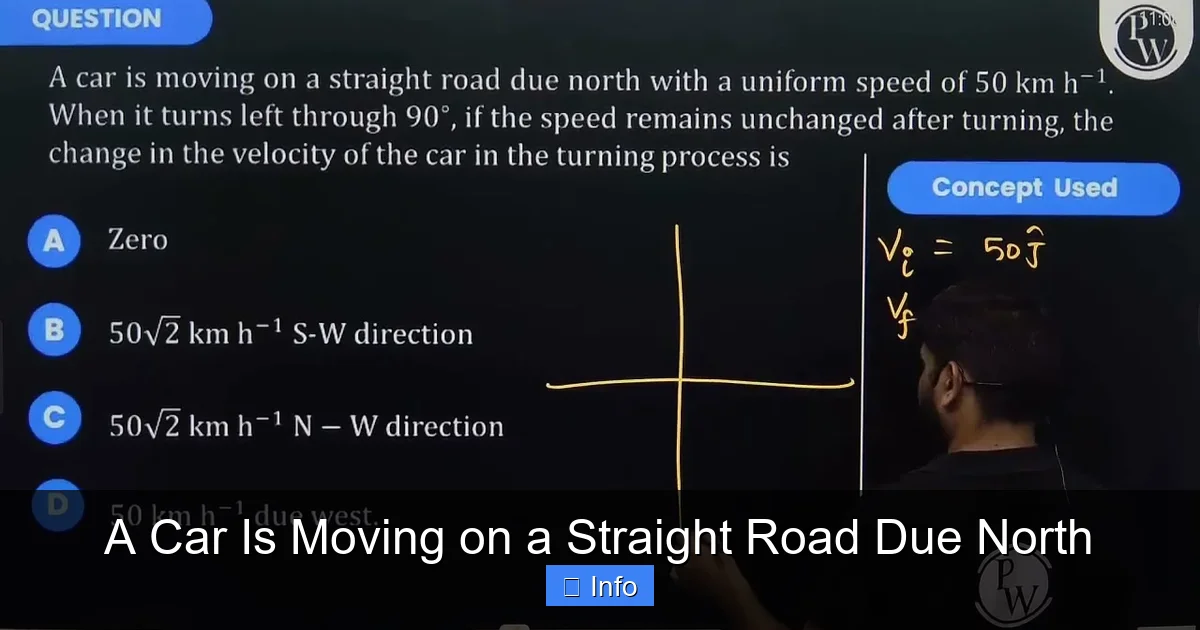
A car traveling due north on a straight road maintains constant velocity when no external forces act upon it, exemplifying uniform linear motion in physics. This fundamental concept helps explain displacement, speed, and how drivers perceive motion on open highways.
Imagine a car is moving on a straight road due north. It’s a simple image, yet behind it lies a foundation of physics that governs much of our driving experience. When we picture a vehicle cruising north without turning, we’re imagining uniform linear motion—a concept that feels intuitive but relies on specific conditions being met. In this article, we’ll break down what’s really happening when a car travels north on a straight road, explore the forces at play, and share practical tips you can use the next time you’re on a long, straight stretch of highway.
**Understanding uniform linear motion**
Uniform motion means the car covers equal distances in equal intervals of time, and its velocity remains constant. For a car moving due north on a straight road, this implies two things: the speedometer reads a steady number, and the compass heading stays at 0° (or 360°). In physics terms, velocity is a vector, so it has both magnitude (speed) and direction. If either changes, the motion is no longer uniform.
Many beginners confuse speed and velocity. Speed is how fast the car travels, measured in miles per hour or kilometers per hour. Velocity adds the “due north” component. If you’re driving at 60 mph due north, your speed is 60, and your velocity is 60 mph north. Should you wind up facing northeast, your northward component decreases even if your speedometer stays at 60. This distinction matters when navigating maps, planning routes, or simply understanding how your car’s GPS calculates estimated arrival time.
In the real world, perfect uniform motion is rare. Friction between tires and pavement, air resistance pushing against the car’s front, and even the Earth’s rotation introduce tiny variations. However, on a well-maintained highway with minimal crosswinds, a modern car can come remarkably close to the ideal. That’s why cruise control was invented—to automate speed maintenance and help the driver focus on steering and traffic rather than constant acceleration adjustments.
**Forces that constantly act on the car**
Even when the road looks perfectly straight and the driver’s foot is off the gas, forces are at work. Gravity pulls the car toward the Earth’s center, but the road’s normal force pushes up, resulting in no vertical motion. Horizontally, two main forces compete: rolling resistance from the tires deforming slightly as they turn, and aerodynamic drag from air molecules pushing back as the car slices through them.
Rolling resistance is often underestimated. Even at moderate speeds, tires aren’t perfectly rigid; they flatten a bit at the contact patch, converting some of the car’s kinetic energy into heat. That’s why a car coasting in neutral will gradually slow down even on a level surface. Air drag increases with the square of speed—double your speed, and you quadruple the drag force. At 70 mph, drag becomes a significant factor that the engine must constantly overcome to maintain velocity.
Driver inputs also create forces. Slight steering adjustments alter the tire’s direction, generating lateral forces that can nudge the car off a perfectly straight path. Pressing the accelerator increases engine torque, which fights resistance and speeds the car up. Braking introduces opposite force, reducing velocity. Each of these actions means the driver is constantly, often unconsciously, balancing forces to keep the car moving north as steadily as possible.
**Real-world driving scenarios and tips**
If you’ve ever driven across a flat desert highway or a long straight stretch of interstate, you know the experience can feel hypnotic. The monotony of the landscape, the hum of the engine, and the steady rhythm of tires on asphalt can lull even alert drivers into a relaxed state. That’s why staying engaged is crucial.
One practical tip: use lane markings as your north-reference guide. White dashed lines typically indicate the direction of travel; keeping your car centered between them helps maintain a straight course without constant compass checking. Another tip: engage cruise control when conditions allow. It automatically manages throttle input to maintain a set speed, reducing the micro-adjustments that can cause subtle swerving.
Pay attention to crosswinds, especially in open areas or near large vehicles. A strong gust from the east can push your car west, requiring a small steering correction to the east to compensate. Experienced drivers often make these corrections instinctively, but being aware of wind direction—especially when passing trucks or driving through mountain passes—can improve straight-line stability.
**Vehicle systems that assist straight-line tracking**
Modern cars come equipped with technologies designed to help maintain course. Traction control systems (often labeled Trac on Toyota models) monitor wheel slip and reduce engine power or apply brakes to individual wheels if they spin excessively. This helps prevent loss of grip, particularly useful when accelerating from a stop on wet or gravel roads, ensuring the power translates into forward motion rather than sideways wandering.
Another relevant system is Auto LSD (Limited Slip Differential), available on many Toyota trucks and SUVs. When one wheel starts to slip, the Auto LSD transfers torque to the wheel with more grip. This is especially helpful on loose surfaces where maintaining a straight line is challenging because power isn’t evenly distributed. If you frequently drive on dirt roads or light off-road terrain, understanding how Auto LSD works can make your northbound journeys smoother and more controlled.
ECT (Electronic Controlled Transmission) power mode is another feature that alters shift points and throttle response. In normal mode, the transmission prioritizes fuel efficiency. Switching to ECT power keeps RPMs higher, delivering more immediate torque for overtaking or climbing grades. While not directly about straight-line tracking, having the right power delivery feels more confident when you need to make quick adjustments to maintain momentum due north.
**The role of perception and psychology**
Driving north on a straight road also involves how your brain processes motion. Visual cues—trees, signs, mile markers—help your brain gauge speed and direction. When the environment lacks variety, as on a long straight, the brain can experience “highway hypnosis,” where awareness diminishes and reaction times slow. Combatting this requires active engagement: roll down the window for fresh air, change radio stations, or engage in conversation with passengers.
Another psychological factor is the tendency to overcorrect. If a driver feels the car drifting slightly west, they might yank the wheel east too sharply, causing a zigzag pattern. Smooth, gradual inputs are far more effective. Think of steering like adjusting a thermostat: small turns, wait to see the effect, then adjust again. This principle applies whether you’re fighting a crosswind or simply trying to keep the car centered between lanes.
**Maintaining your vehicle for straight-line stability**
Mechanical health plays a big role in how straight a car tracks. Worn suspension components, unbalanced tires, or misaligned wheels can all cause a vehicle to pull to one side. If you notice you’re constantly fighting the steering wheel to keep the car moving north, it’s worth getting a alignment check. Proper wheel alignment ensures that all four tires meet the road at the correct angles, reducing uneven wear and improving straight-line tracking.
Tire pressure also matters. Under-inflated tires increase rolling resistance on the affected side, potentially pulling the car in that direction. Over-inflated tires reduce the contact patch, diminishing grip. Check your owner’s manual for the recommended PSI and inspect tires monthly, especially before long road trips. A simple penny test—inserting a penny head-first into the tread—can tell you if it’s time for replacement; if you can see the top of Lincoln’s head, tread depth is too low for safe, straight travel.
**Conclusion**
A car moving due north on a straight road might seem like a simple image, but it encapsulates core principles of motion, force, and human perception. From the physics of uniform velocity to the practical realities of wind, road texture, and vehicle systems, many factors contribute to keeping that car on course. By understanding these elements—whether you’re a new driver learning about velocity vectors or an experienced traveler looking to improve highway comfort—you can make every northbound journey smoother, safer, and more informed. Next time you settle into the driver’s seat and head north, take a moment to appreciate the science at work, and maybe try one of the tips we’ve discussed to keep things running as smoothly as possible.
Key Takeaways
- Uniform motion: A car moving due north on a straight road experiences constant speed and direction, representing ideal linear motion in physics.
- Net force: Zero net external force is required to keep the car moving straight; friction, air resistance, and steering inputs constantly adjust motion.
- Displacement vs distance: Displacement measures the straight-line change in position from start to finish, while total distance includes the actual path traveled.
- Velocity components: Velocity combines speed (how fast) and direction (due north), making it a vector quantity rather than a simple scalar.
- Real-world driving: Maintaining a straight course requires subtle steering corrections, accelerator adjustments, and awareness of road curvature or crosswinds.
- Safety systems: Modern vehicles use traction control and stability systems to help keep the car on course during unexpected slips or gusts.
- Practical tip: Use lane markers and cruise control on highways to help maintain a steady northbound path with minimal effort.
Frequently Asked Questions
What does it mean when a car is moving due north on a straight road?
It means the car is traveling in a straight line toward the geographic north direction, maintaining a constant heading of 0° or 360° on a compass, which represents uniform linear motion in physics.
Can a car maintain perfect uniform motion on a real highway?
Perfect uniform motion is rare in reality because friction, air resistance, and minor road curves constantly act on the vehicle, but modern cruise control and well-maintained roads help the car come very close to ideal conditions.
How does traction control help a car move straight?
Traction control monitors wheel slip and reduces engine power or applies brakes to spinning wheels, preventing loss of grip that could cause the car to wander off its intended straight-line path.
What role does air resistance play in straight-line driving?
Air resistance, or aerodynamic drag, increases with the square of the car’s speed, requiring the engine to work harder to maintain velocity, especially at higher speeds on open roads.
Why might a car pull to one side instead of moving straight north?
A car may pull due to wheel misalignment, uneven tire pressure, or worn suspension components, which create imbalanced forces that deflect the vehicle from a straight course.
How can drivers stay alert on long straight stretches?
Drivers can stay alert by using lane markings as references, engaging cruise control when safe, adjusting climate settings, and taking regular breaks to combat highway hypnosis and maintain focus on direction and speed.