A Car Is Moving Along a Straight Horizontal Road
A car travels steadily along a straight horizontal road, maintaining constant velocity. This uniform linear motion allows simple calculations of distance, speed, and time.
A Car Is Moving Along a Straight Horizontal Road
Imagine you are on a long drive. The road ahead is flat. There are no hills, no sharp curves, just a straight path stretching to the horizon. In physics class or in everyday conversation, you might hear the phrase a car is moving along a straight horizontal road. It sounds simple, almost too simple. But this scenario is actually the starting point for understanding how your car behaves every time you leave the driveway.
I remember my first long highway trip. I was nervous about keeping the car steady, worried about fuel, and unsure what to do if something went wrong. Over time, I learned that a flat, straight road is not just about pointing the steering wheel forward. There are forces at work, safety habits to build, and small maintenance checks that make a big difference. In this article, I want to walk you through what really happens when a car is moving along a straight horizontal road, using plain language and real-life examples.
Whether you are a new driver or someone who just wants to understand your vehicle better, this guide breaks things down into bite-sized pieces. We will look at the forces involved, how speed and acceleration play a role, fuel efficiency, safety tips, and a quick checklist you can use before your next drive.
Key Takeaways
- Maintain constant speed: Zero acceleration means consistent velocity on horizontal road.
- Apply Newton’s first law: Car moves without force when velocity is constant.
- Balanced forces ensure motion: Driving force equals resistive forces like friction.
- Horizontal road eliminates gravity effects: Normal force balances vehicle weight.
- Calculate speed using distance-time relationships: v = Δd/Δt for uniform motion.
- Engine power matches road resistance: Prevents acceleration or deceleration.
- Keep velocity constant for energy efficiency: Avoid unnecessary speed changes.
📑 Table of Contents
What It Means When a Car Is Moving Along a Straight Horizontal Road
Breaking Down the Phrase
When we say a car is moving along a straight horizontal road, we are describing a very specific situation. The road is level, meaning it does not go up or down. The path is straight, so the driver does not need to turn the wheel left or right. The car is in motion, which means it has velocity.
In the real world, truly straight and perfectly horizontal roads are rare. Most highways have slight curves or gentle grades. But this simplified picture helps us isolate the basics. It removes the complications of climbing a hill or navigating a turn, so we can focus on what keeps the car rolling forward and what slows it down.
Everyday Scenarios You Recognize
Think about your daily commute. Maybe you drive on a long stretch of interstate between towns. Or perhaps you live near a coastal highway that runs flat for miles. These are moments when a car is moving along a straight horizontal road. You might set your cruise control, rest your foot lightly on the floor, and feel the hum of the engine. That steady state is exactly what we are exploring.
It is also the scenario behind many driving test questions and basic physics problems. Understanding it helps you make sense of stopping distances, fuel economy, and why your car behaves the way it does when you take your foot off the gas.
The Forces at Play on a Straight Horizontal Road
Gravity and the Normal Force
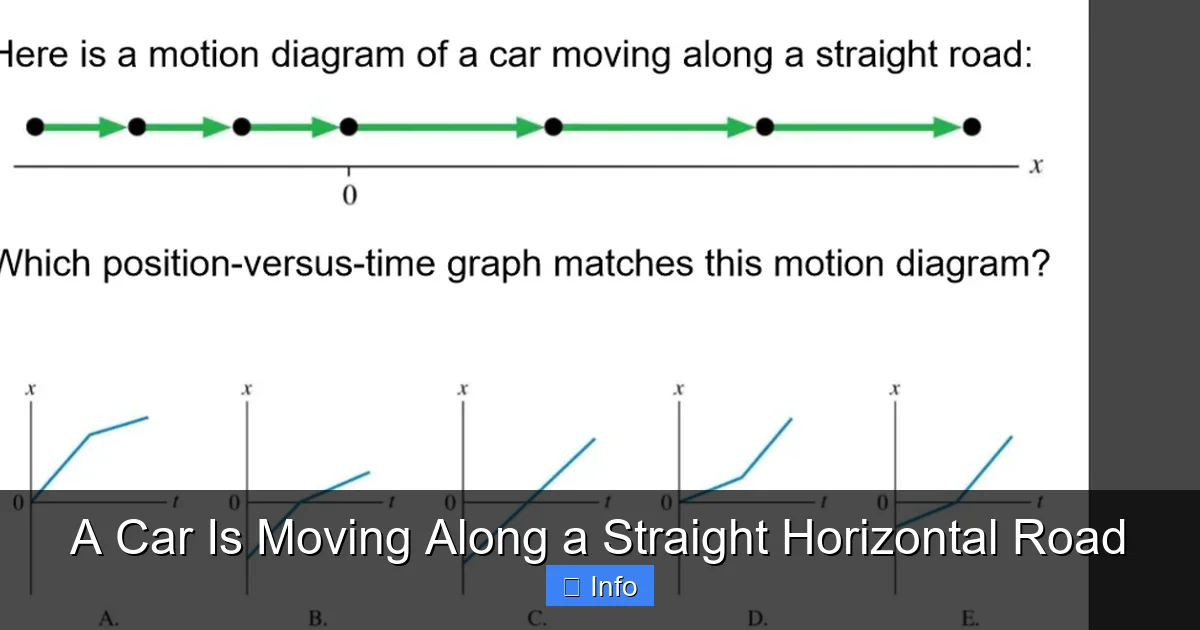
Even on a flat road, gravity is always pulling your car toward the center of the Earth. Because the road is horizontal, the ground pushes back with an equal force called the normal force. These two forces cancel each other out in the vertical direction, which is why your car does not sink into the pavement or float upward.
Visual guide about A Car Is Moving Along a Straight Horizontal Road
Image source: d2vlcm61l7u1fs.cloudfront.net
This balance matters because it keeps your tires firmly planted. If the road were sloped, gravity would pull part of the car’s weight sideways or backward, changing how much effort the engine needs. On a straight horizontal road, the engine mainly works to overcome resistance, not to fight a hill.
Friction Between Tires and Road
Friction is what allows your car to move at all. When the engine turns the wheels, the tires push backward against the road. The road pushes forward on the tires, and that reaction is what moves the car. Without enough friction, your wheels would spin in place, like on ice.
On a dry, straight horizontal road, friction is usually reliable. But wet leaves, oil patches, or worn tire tread can reduce it. That is why good tires matter so much. If you drive a Toyota, you may have heard about traction control. Systems like Toyota A-TRAC help manage wheel slip when traction is low, keeping you moving safely.
Air Resistance at Higher Speeds
As your car picks up speed, air resistance becomes a bigger factor. You have probably felt this if you have ever stuck your hand out the window and felt the wind push against it. At highway speeds, the engine has to work harder just to push through the air.
This is one reason why fuel economy often drops when you drive faster. The car is still on a straight horizontal road, but the force of air pushing against the front of the vehicle increases. Keeping your windows closed and removing roof racks when you do not need them can help reduce this drag.
Why Speed and Acceleration Matter
Constant Speed vs. Acceleration
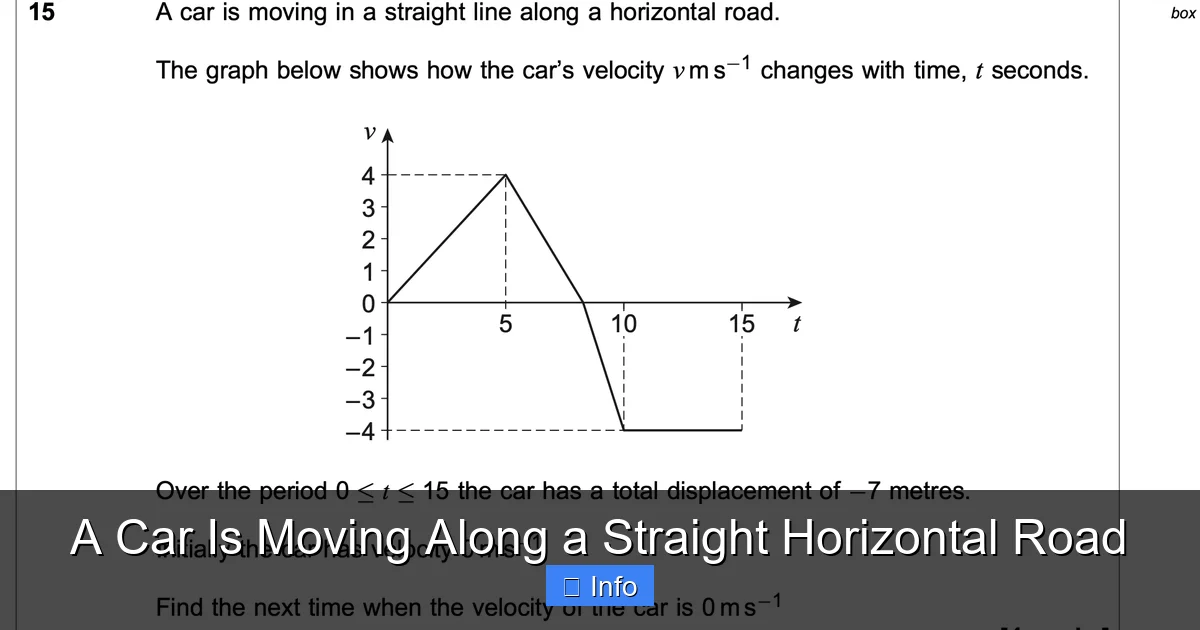
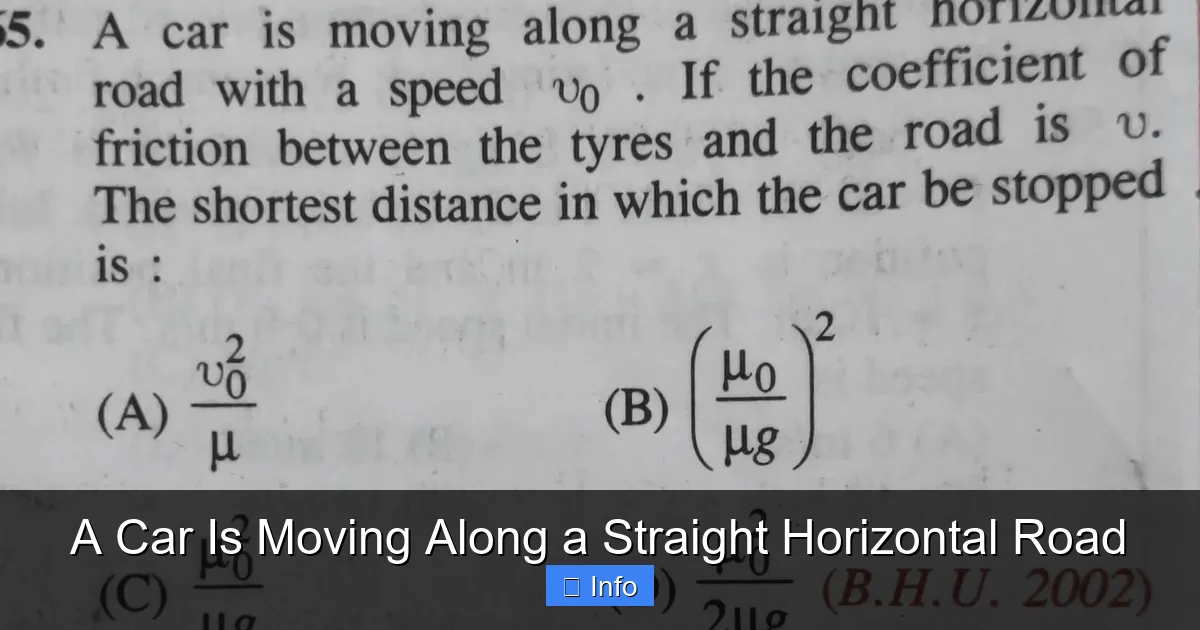
When a car is moving along a straight horizontal road at a constant speed, the forces are balanced. The engine produces just enough force to overcome friction and air resistance. If you take your foot off the accelerator, the car will gradually slow down because those resisting forces are no longer canceled out.
Visual guide about A Car Is Moving Along a Straight Horizontal Road
Image source: media.kunduz.com
Acceleration happens when you press the gas pedal and the engine provides more force than resistance. The car speeds up. Deceleration, or braking, is the opposite. The brakes create friction that slows the wheels, and the car loses speed. Understanding this difference helps you anticipate how long it takes to stop or pass another vehicle safely.
How Braking Fits In
Braking on a straight horizontal road is straightforward compared to braking on a downhill slope. Gravity is not adding extra speed, so your brakes do not have to work as hard. Still, stopping distance depends on your speed, the condition of your brakes, and your tires.
A good rule of thumb is to leave plenty of space between you and the car ahead. On a flat, straight road, it is easy to lull yourself into a sense of safety. But if traffic suddenly stops, you need that gap to react. Keeping your brake system in good shape is non-negotiable.
Fuel Efficiency and Energy Use
How Road Grade Affects Fuel Use
A straight horizontal road is ideal for fuel efficiency because the engine does not have to spend energy climbing hills. Every time you go uphill, your car works against gravity. On flat ground, that energy is saved, though you still pay for overcoming air resistance and tire friction.
This is why highway driving often gets better miles per gallon than city driving, provided you maintain a steady speed. Stop-and-go traffic wastes fuel because you are constantly accelerating and braking. A long, flat stretch lets you cruise efficiently.
Simple Ways to Save Fuel
You do not need a hybrid to save fuel on a straight road. Small habits add up. Accelerate gently instead of flooring the pedal. Use cruise control when traffic allows. Keep your tires inflated to the recommended pressure. Underinflated tires create more rolling resistance, which makes the engine work harder.
If you are unsure about your tire pressure, a faulty sensor can give you false confidence. Learning how to tell which TPMS sensor is bad on a Toyota can save you from driving on low tires without realizing it.
Safety Tips for Straight Highway Driving
Staying Alert on Long Straight Roads
One of the biggest dangers of a car is moving along a straight horizontal road is boredom. When the scenery does not change and the steering wheel stays straight, it is easy to zone out. This is sometimes called highway hypnosis. Your reaction time slows, and you might not notice a car merging ahead until it is too late.
To stay sharp, take breaks every couple of hours. Open a window for fresh air if you feel drowsy. Keep the cabin temperature comfortable but not too warm. Avoid heavy meals that make you sleepy. If you are traveling with a passenger, share the driving when possible.
What to Do in an Emergency
Even on a straight road, emergencies happen. A tire could blow out. An animal could dart into the lane. If you feel a sudden vibration or hear a loud noise, grip the wheel firmly and ease off the gas. Do not slam the brakes unless you have to. Steer smoothly to the shoulder and turn on your hazard lights.
Weather also changes the equation. Rain, snow, or ice reduce the friction we talked about earlier. Some vehicles have special modes for slippery conditions. For example, the snow button in a Toyota Highlander adjusts throttle response and traction settings to help you maintain control on slick surfaces.
Real-World Examples and Quick Checks
Example: Commute on a Flat Highway
Picture a driver named Maya. She lives in a suburb and works in a city about 25 miles away. Most of her route is a straight horizontal road with a speed limit of 65 miles per hour. She sets her cruise control, keeps a safe following distance, and checks her mirrors regularly. Because the road is flat, her fuel economy stays close to the manufacturer’s estimate. She also knows that if it rains, she needs to increase her following distance because wet roads reduce tire grip.
Maya’s routine shows how understanding the basics turns into safer, cheaper driving. She is not fighting hills or sharp turns, so she can focus on speed management and awareness.
Maintenance Checklist Before a Long Drive
Before you head out on a long stretch of straight road, take five minutes to check a few things:
- Tire pressure and tread depth
- Engine oil and coolant levels
- Brake responsiveness
- Windshield washer fluid and wiper condition
- Spare tire and jack
These checks take little time but can prevent breakdowns. A flat tire on a straight road is easier to handle than on a curve, but it is still stressful. Being prepared means you can fix the issue and get back to your trip quickly.
| Speed (mph) | Estimated Fuel Economy (mpg) | Approximate Stopping Distance (feet) |
|---|---|---|
| 50 | 34 | 230 |
| 65 | 30 | 310 |
| 75 | 26 | 400 |
These numbers are general estimates. Your actual results depend on your vehicle, load, tire condition, and weather. The table shows a clear trend: as speed goes up on a straight horizontal road, fuel economy tends to drop and stopping distance grows.
Conclusion
When a car is moving along a straight horizontal road, it might seem like nothing much is happening. But under the surface, forces are balancing, fuel is being consumed, and your attention is being tested. By understanding gravity, friction, air resistance, and braking, you become a more informed driver.
I have learned that the simplest drives often teach the most. A flat highway is not just a path from point A to point B. It is a chance to practice smooth acceleration, steady speeds, and good habits that keep you and your passengers safe. Check your tires, stay alert, and respect the road. Your car will thank you, and so will your wallet.
Drive safely, and enjoy the open road.
Frequently Asked Questions
What is the net force on a car is moving along a straight horizontal road?
If the car moves at constant velocity, the net force is zero because all forces cancel. When the car accelerates, the net force equals its mass times the acceleration.
How does the velocity change if the car accelerates uniformly?
With uniform acceleration, the velocity increases linearly over time. The change in velocity is given by acceleration multiplied by the time interval.
What is the relationship between distance and time for a car is moving along a straight horizontal road?
If the car moves at constant speed, distance equals speed multiplied by time. When accelerating, distance follows a quadratic relationship with time.
Can the car maintain constant speed without any external force?
In an ideal frictionless environment, the car could keep moving at constant speed due to inertia. In real conditions, friction and air resistance require a force to sustain motion.
How does friction affect the motion of a car is moving along a straight horizontal road?
Friction opposes the direction of motion, causing the car to slow down if no driving force is applied. To maintain speed, the engine must provide a force equal to the frictional resistance.
What is the acceleration when the car’s speed increases from rest to 20 m/s in 5 seconds?
The acceleration is the change in velocity divided by the time taken, which is 4 m/s². This constant acceleration results in a linear increase in speed over the interval.