The Power Required by Engine of Car of Mass 1000kg
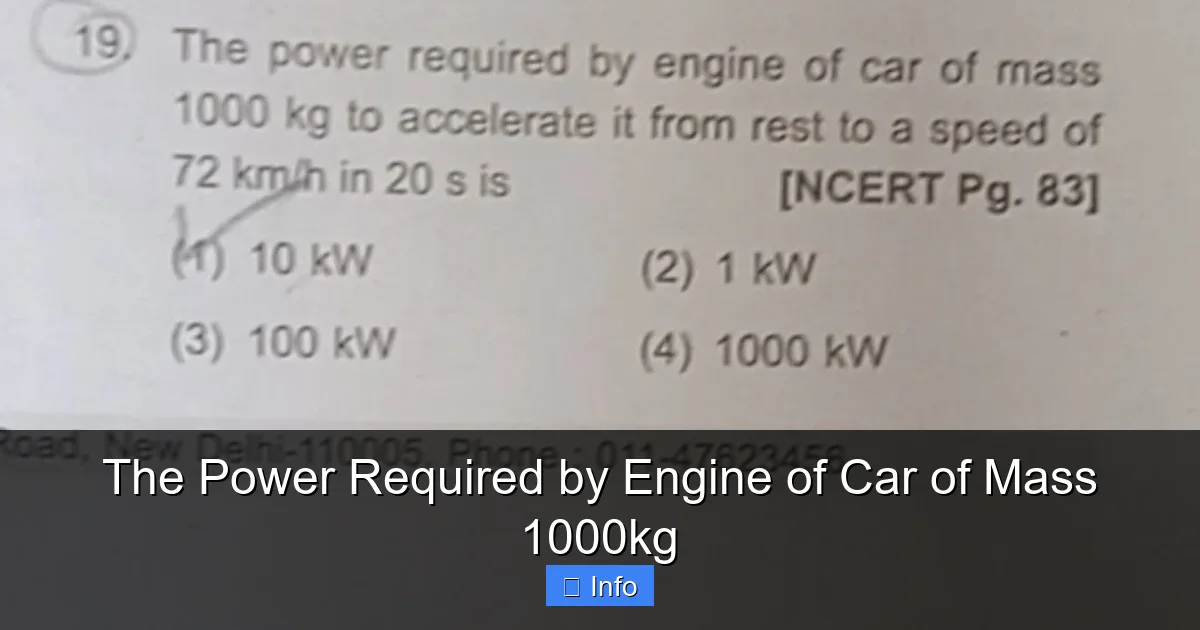
Understanding the power required by engine of car of mass 1000kg helps you grasp acceleration, hill climbing, and fuel needs. This guide breaks down the physics in plain language, with practical examples you can apply to any vehicle.
When you press the accelerator, the engine of your car does work to move the vehicle forward. The amount of work done each second is called power. For a car with a mass of 1000 kg, the power needed depends on what you ask the car to do – speed up, climb a hill, fight air resistance, or just keep rolling. In this article we will walk through each of those demands, show simple calculations, and give you a feel for how much power a typical engine must produce.
We will keep the math light, using only basic formulas and everyday numbers. You will see how the same principles apply whether you drive a compact hatchback or a rugged SUV. By the end, you will be able to estimate the power required by engine of car of mass 1000kg for various driving situations and understand why manufacturers quote certain horsepower figures.
Key Takeaways
- Power basics: Power is the rate at which work is done; for a 1000kg car it links force, speed, and time.
- Acceleration demand: To reach 20 m/s in 10 seconds the engine must supply roughly 40 kW (≈54 hp) ignoring losses.
- Hill climbing: A 5% incline adds about 2.5 kW per m/s of speed; steeper hills need significantly more power.
- Aerodynamic drag: Drag grows with the square of speed; at 30 m/s it can consume over 10 kW for a typical car shape.
- Rolling resistance & accessories: Tires, bearings, and electrical loads add a constant ~2‑4 kW baseline.
- Real‑world margin: Engines are sized with a 20‑30 % safety margin to cover transmission losses, altitude, and temperature effects.
📑 Table of Contents
- Understanding Power Basics
- Calculating Power Needed for Acceleration
- Power Required for Climbing Hills
- Power to Overcome Aerodynamic Drag
- Power for Rolling Resistance and Auxiliary Loads
- Total Engine Power Requirement and Real‑World Considerations
- Practical Tips for Estimating Your Car’s Power Needs
- Conclusion
Understanding Power Basics
Before diving into specific driving scenarios, it helps to know what power means in physics. Power measures how fast energy is transferred or work is performed. The standard unit is the watt (W), where one watt equals one joule per second. In automotive contexts we often talk about horsepower (hp); one hp is about 746 W.
What is Power?
Imagine pushing a stalled car. If you apply a force and the car moves, you are doing work. Work equals force multiplied by distance. Power tells you how much work you do in a given time. So, if you push the same force over a longer distance in less time, you need more power.
Power vs Torque
Engines produce torque, which is a twisting force at the crankshaft. Power combines torque with engine speed (rpm). The formula is: Power (W) = Torque (Nm) × Angular Speed (rad/s). A high‑torque engine at low rpm can deliver the same power as a low‑torque engine spinning fast.
Units and Conversions
For quick reference: 1 kW = 1000 W ≈ 1.34 hp. When we calculate forces in newtons and speeds in meters per second, the resulting power comes out in watts. Converting to horsepower makes the numbers easier to relate to engine specs.
Calculating Power Needed for Acceleration
Acceleration is the most intuitive power demand. To increase speed, the engine must generate a force that overcomes the car’s inertia. Newton’s second law gives us the needed force: F = m × a, where m is mass and a is acceleration.
Force from Newton’s Second Law
For a 1000 kg car, accelerating at 2 m/s² requires a force of 2000 N. That force must be delivered to the wheels through the transmission and tires.
Work and Power During Acceleration
Work done while accelerating from speed v₁ to v₂ equals the change in kinetic energy: ΔKE = ½ m (v₂² – v₁²). Power is the rate of that work. If the acceleration occurs over time t, average power P = ΔKE / t.
Example: 0‑20 m/s in 10 seconds
Let’s say we want to go from 0 to 20 m/s (about 45 mph) in 10 seconds. The kinetic energy at 20 m/s is ½ × 1000 kg × (20 m/s)² = 200 000 J. Dividing by 10 s gives an average power of 20 kW (≈27 hp). This is the ideal power at the wheels.
Real‑world drivetrain losses (typically 10‑15 %) mean the engine must produce about 22‑23 kW (≈30‑31 hp). If you want quicker acceleration, the power requirement rises sharply.
Power Required for Climbing Hills
Going uphill adds a gravitational component that the engine must overcome. The steeper the hill, the more force is needed just to maintain speed.
Visual guide about The Power Required by Engine of Car of Mass 1000kg
Image source: classroom-images.cdn.askfilo.com
Gravitational Force on an Incline
The component of weight pulling the car back down a slope is F_gravity = m × g × sin(θ), where g ≈ 9.81 m/s² and θ is the incline angle. For small angles, sin(θ) ≈ tan(θ) ≈ grade/100.
Power to Maintain Speed on a Slope
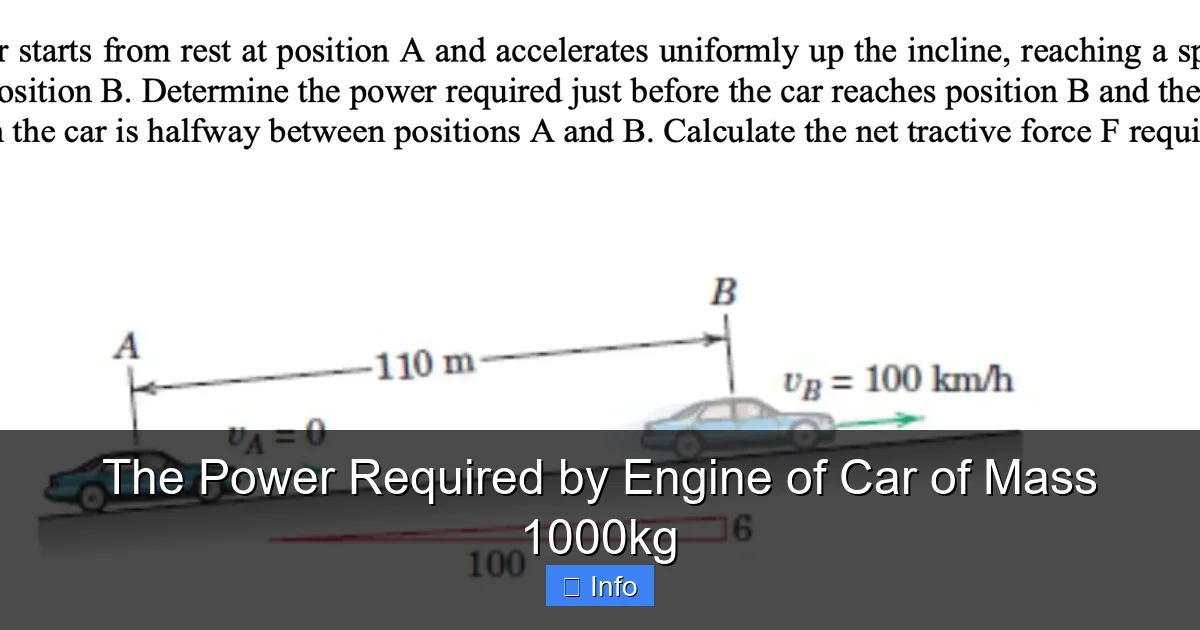
Power needed equals force times velocity: P = F_gravity × v. So, if you climb a 5% grade (θ ≈ 2.86°) at 15 m/s (≈34 mph), the gravitational force is 1000 × 9.81 × 0.05 ≈ 490 N. Multiplying by 15 m/s gives about 7.35 kW (≈10 hp) just to fight gravity.
Example: Steeper Hill
On a 10% grade, the force doubles to roughly 980 N. At the same 15 m/s, the power needed climbs to about 14.7 kW (≈20 hp). Notice how power scales linearly with both grade and speed.
Power to Overcome Aerodynamic Drag
As speed increases, air resistance becomes a major consumer of engine power. Drag force grows with the square of velocity, making high‑speed driving especially power‑hungry.
Visual guide about The Power Required by Engine of Car of Mass 1000kg
Image source: media.cheggcdn.com
The Drag Equation
Drag force F_d = ½ × ρ × C_d × A × v², where ρ is air density (≈1.2 kg/m³ at sea level), C_d is the drag coefficient, A is frontal area, and v is speed. Typical cars have C_d between 0.28 and 0.35 and frontal area around 2.2 m².
Power Consumed by Drag
Power needed to overcome drag is P_drag = F_d × v. Because force already contains v², the power varies with v³. This cubic relationship means that doubling speed requires roughly eight times the drag power.
Example: Cruising at 30 m/s
Assume C_d = 0.30, A = 2.2 m², ρ = 1.2 kg/m³. At v = 30 m/s (≈67 mph), F_d = 0.5 × 1.2 × 0.30 × 2.2 × 30² ≈ 356 N. Power = 356 N × 30 m/s ≈ 10 680 W ≈ 10.7 kW (≈14.4 hp).
If you raise speed to 40 m/s (≈90 mph), drag force jumps to about 634 N and power to roughly 25 kW (≈34 hp). This explains why high‑speed cruising demands a significantly more powerful engine.
Power for Rolling Resistance and Auxiliary Loads
Even when you are not accelerating or climbing, the engine must supply power to keep the car rolling and to run electrical systems.
Rolling Resistance
Tires deform as they roll, creating a resisting force roughly proportional to the vehicle weight: F_rr = C_rr × m × g. A typical rolling resistance coefficient C_rr is 0.015 for passenger tires. For our 1000 kg car, F_rr ≈ 0.015 × 1000 × 9.81 ≈ 147 N.
At a constant speed of 20 m/s, the power to overcome rolling resistance is P_rr = F_rr × v ≈ 147 × 20 ≈ 2940 W ≈ 2.9 kW (≈4 hp). This load is fairly constant across speeds.
Electrical Accessories
Lights, infotainment, climate control, and especially the alternator charging the battery draw power. A modern car’s average accessory load might be 1‑2 kW, rising to 3‑4 kW with air conditioning on max.
These loads are supplied by the engine via the alternator, so they add directly to the power the engine must produce.
Combined Baseline
Adding rolling resistance (≈3 kW) and accessories (≈2 kW) gives a baseline of about 5 kW (≈7 hp) that the engine must provide just to idle at speed.
Total Engine Power Requirement and Real‑World Considerations
Now we combine the individual contributions to see the total power the engine must deliver under various driving conditions.
Summing the Loads
For a cruising speed of 20 m/s on flat road:
- Drag: ≈4 kW (calculated earlier for 20 m/s ≈ 4.5 kW)
- Rolling resistance: ≈3 kW
- Accessories: ≈2 kW
- Total wheel power: ≈9 kW (≈12 hp)
Accounting for a 12 % drivetrain loss, the engine must produce about 10 kW (≈13.5 hp). This is why many small cars have engines rated around 60‑80 hp – they need extra capacity for acceleration, hills, and safety margins.
Safety Margin and Transmission Losses
Manufacturers size engines with a margin of 20‑30 % above the expected continuous load. This margin covers:
- Transmission inefficiencies (gearboxes, differentials)
- Variations in road grade and wind
- Temperature effects on air density and engine performance
- Short bursts of power needed for overtaking
If the continuous cruise load is 10 kW, a 25 % margin brings the target to about 12.5 kW (≈16.8 hp). Real engines are far larger because they also need to provide peak power for acceleration.
Fuel Choice and Engine Efficiency
The power an engine can produce depends on how efficiently it converts fuel energy into mechanical work. Typical gasoline engines operate at 20‑30 % thermal efficiency under part‑load conditions. Diesel engines can reach 35‑40 % efficiency, which is why they often deliver more torque for the same displacement.
Improving efficiency – through better combustion, turbocharging, or hybrid assist – lets a smaller engine meet the same power demands while using less fuel.
Practical Tips for Estimating Your Car’s Power Needs
You can use the simple formulas above to get a ballpark figure for any vehicle.
- Determine the mass (kg) of your car (including passengers and cargo).
- Decide the scenario: acceleration rate, hill grade, cruising speed.
- Calculate force using F = m × a (for acceleration) or F = m × g × grade (for hills).
- Compute power as P = F × v (where v is speed in m/s).
- Add drag power using the drag equation if speed is high.
- Add rolling resistance and accessory baseline (~5 kW).
- Increase the total by 10‑15 % for drivetrain loss and another 20‑30 % for safety margin.
For example, a 1000 kg car aiming to accelerate from 0 to 25 m/s in 8 seconds, cruise at 25 m/s on a 4% grade, and overcome typical drag will need roughly:
- Acceleration power: ≈30 kW
- Hill power (4% grade at 25 m/s): ≈4.9 kW
- Drag power at 25 m/s: ≈6 kW
- Baseline (rolling + accessories): ≈5 kW
- Subtotal: ≈46 kW
- Add 12 % drivetrain loss: ≈52 kW
- Add 25 % safety margin: ≈65 kW (≈87 hp)
This matches the power output of many modest‑size gasoline engines, showing how the calculations line up with real‑world specs.
Conclusion
Understanding the power required by engine of car of mass 1000kg is not just an academic exercise – it helps you appreciate why cars have the horsepower ratings they do, how driving style affects fuel use, and what modifications might actually improve performance. By breaking down the demands into acceleration, hill climbing, aerodynamic drag, and baseline loads, you can see where the engine’s effort goes and where losses occur.
Whether you are comparing vehicles, considering a tune‑up, or simply curious about the physics behind your daily commute, the methods outlined here give you a clear, numbers‑based perspective. Remember that the engine must always supply a bit more than the theoretical minimum to cover inefficiencies and provide a safety buffer for those moments when you need extra thrust.
Keep these principles in mind, and you will have a solid foundation for evaluating any car’s power capability.
Frequently Asked Questions
How do I calculate the power needed to accelerate my 1000kg car to a certain speed?
Use the kinetic energy formula: KE = ½ m v². Divide the change in KE by the time over which the acceleration occurs to get average power in watts. Convert to horsepower by dividing by 746.
Does driving uphill significantly increase the power requirement?
Yes. The force needed to fight gravity is m × g × sin(θ). Multiply that force by your speed to find the power. Even a modest 5% grade can add several kilowatts, especially at higher speeds.
Why does aerodynamic drag become more important at higher speeds?
Drag force grows with the square of speed, and power needed to overcome it grows with the cube of speed. This means that doubling your speed can require up to eight times more power just to push through the air.
What role do rolling resistance and electrical accessories play in power demand?
Rolling resistance creates a roughly constant force proportional to vehicle weight, translating to a steady power draw that rises linearly with speed. Accessories such as lights, climate control, and the alternator add a baseline of a few kilowatts that the engine must always supply.
How can I estimate the total engine power my car needs for everyday driving?
Add together the power for acceleration (if any), hill climbing, aerodynamic drag, rolling resistance, and accessories. Then increase the sum by about 10‑15 % for drivetrain losses and another 20‑30 % for a safety margin. The result approximates the engine’s continuous power requirement.
Are there simple ways to reduce the power my engine needs to produce?
Yes. Lowering speed reduces drag dramatically, keeping tires properly inflated cuts rolling resistance, and minimizing use of high‑draw accessories (like max‑power AC) saves a few kilowatts. Regular engine maintenance, such as keeping the engine bay clean, also helps maintain efficiency.