Toyota 4runner Years to Avoid

The Toyota 4Runner is one of the most reliable SUVs on the road, but not every model year is created equal. If you’re shopping for a used 4Runner, you’ll want to steer clear of certain years that have documented problems with their AISIN automatic transmissions, frame rust, and VSC warning lights. Focus on model years 2010 and later for the most trouble-free ownership experience.
If you’re in the market for a used Toyota 4Runner, you’ve picked one of the best SUVs you can buy. The 4Runner has earned its reputation as a tank that just keeps going, year after year. But here’s the thing—not every model year of the 4Runner is equally reliable. Some years are genuinely great, while others can leave you stranded on the side of the road with expensive repair bills.
Let me walk you through everything you need to know about which Toyota 4Runner years to avoid. I’ve done the research so you don’t have to, and I’m going to share it all with you in plain English.
Key Takeaways
- 2003-2005 models: These years had serious AISIN automatic transmission problems that could leave you stranded without warning.
- Frame rust issues: Third-generation 4Runners (1996-2002) from salt-belt states often have severe undercarriage corrosion.
- VSC and trac warning lights: Fourth-generation models commonly trigger these warning indicators, often related to speed sensors.
- Best reliability: Model years 2010 and newer offer significantly fewer mechanical problems and more modern features.
- Pre-purchase inspection: Always get a thorough inspection, especially checking for frame rust and transmission health on earlier models.
- Higher mileage isn’t always bad: Well-maintained older 4Runners with documented service records can be excellent choices.
- Consider your needs: If you need serious off-road capability, focus on 4th and 5th generation models for better technology.
📑 Table of Contents
Why the 4Runner Stands Out
The Toyota 4Runner has been a favorite among outdoor enthusiasts, families, and anyone who needs a vehicle that can handle rough roads and still drive like a comfortable daily commuter. It’s built on the same platform as the Toyota Tacoma pickup truck, which means it shares that legendary Toyota reliability.
What makes the 4Runner special is its body-on-frame construction. Unlike many modern SUVs that use unibody designs, the 4Runner keeps things old school with a separate frame. This makes it tougher for off-road adventures and easier to repair when things go wrong. The part-time four-wheel-drive system gives you options for different terrains, and features like DAC (Downhill Assist Control) help you navigate steep descents with confidence.
But even the best vehicles have their bad years, and the 4Runner is no exception.
The Problematic Early Fourth Generation (2003-2005)
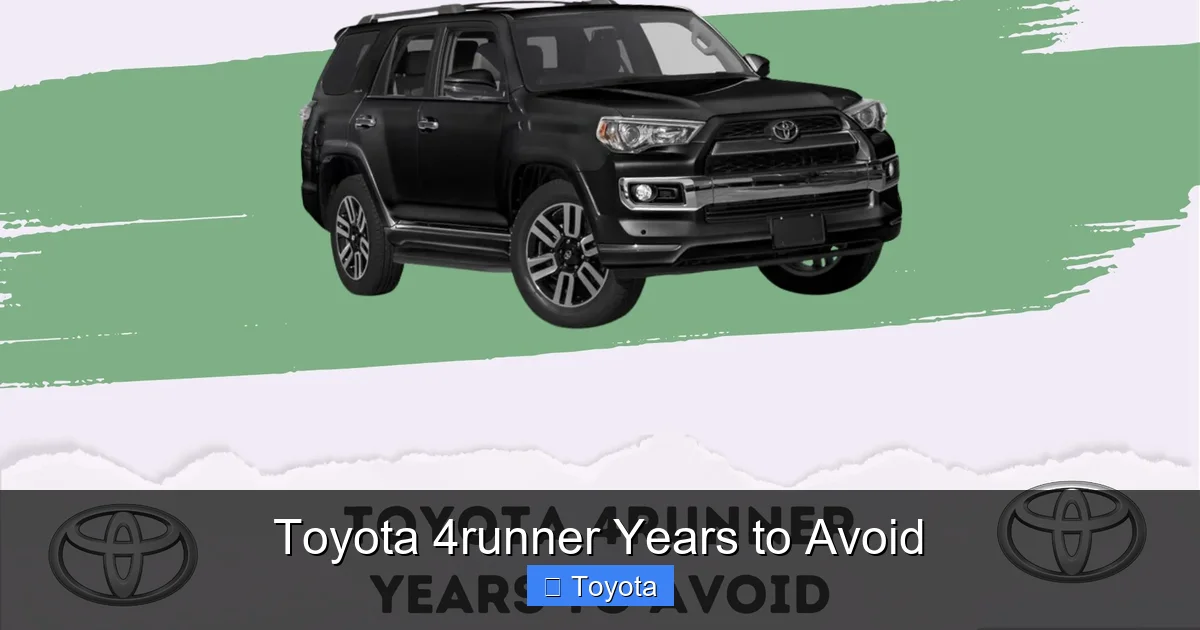
Visual guide about Toyota 4runner Years to Avoid
Image source: carscounsel.com
If you see a 2003, 2004, or 2005 Toyota 4Runner for sale, you need to be very careful. These early fourth-generation models had some serious issues that have since become well-documented among 4Runner enthusiasts and mechanics.
The biggest problem was with the AISIN automatic transmission. Starting in 2003 when Toyota introduced the new fifth-generation 4Runner with the 4.0-liter V6 engine, there were transmission failures happening at relatively low mileages. Some owners reported their transmissions failing completely at 80,000 miles or even less. This wasn’t normal wear and tear—this was a defect.
If you’re looking at one of these years, you absolutely need to check the transmission fluid. Is it dark or burned-smelling? Has the transmission been replaced already? These are red flags you shouldn’t ignore.
Another common issue on these model years involves the VSC (Vehicle Stability Control) and trac warning lights. If you’ve ever seen that dashboard warning pop up, you know how alarming it can be. The good news is that this issue is often related to speed sensor problems and can be fixed without breaking the bank. If you need help understanding what those warning lights mean, you can learn how to turn off the VSC trac light on a Toyota 4Runner with some simple steps.
Third Generation Frame Rust Issues (1996-2002)
Visual guide about Toyota 4runner Years to Avoid
Image source: yotashop.com
The third-generation 4Runners are beautiful trucks, and many people love their classic styling and proven reliability. But there’s a dark secret lurking underneath these vehicles, especially if they spent any time in northern states where roads get salted in the winter.
Frame rust became a massive problem on these models. The issue was so significant that Toyota eventually extended warranties and launched a special Rust Coverage Program for affected vehicles. Even today, you can find 4Runners from this era with completely rotted frames that look fine from the outside but are dangerous to drive.
When you’re inspecting a 1996-2002 4Runner, you need to get underneath it and look closely. Check the frame rails, the suspension mounting points, and anywhere water might collect. Use a screwdriver to poke at suspicious areas—if it goes through, you’ve got rust problems. Some of these frames are so corroded that repairs aren’t even worth it.
If you live in the snow belt and you’re looking at a third-gen 4Runner, assume it has rust until proven otherwise. Cars from Arizona, California, or other dry states will typically be much cleaner underneath.
Understanding the 4WD System on Older Models

Visual guide about Toyota 4runner Years to Avoid
Image source: carsmite.com
One thing to keep in mind when looking at older 4Runners is the part-time four-wheel-drive system. This setup is fantastic for off-road performance, but it requires driver knowledge to operate correctly. If you’re not familiar with how to engage and disengage 4WD, you could potentially cause damage to the drivetrain.
The good news is that these systems are actually pretty simple once you understand them. If you’re considering a 4Runner and you’re new to part-time 4WD, take some time to learn the ins and outs. Understanding how to get a Toyota 4Runner out of four-wheel-drive mode properly will save you headaches down the road.
Most 4Runners from the fourth generation onward have a knob or lever in the cab that controls the 4WD system. The process is straightforward, but there are right ways and wrong ways to do it.
Which Years Are Actually Good?
Now for the good news—plenty of 4Runner model years are excellent choices. If you want the most reliable experience possible, here are the years that tend to give owners the fewest problems.
Fifth-generation 4Runners from 2010 to 2020 are generally considered the most reliable. By this point, Toyota had worked out all the early issues from the fourth generation. The 4.0-liter V6 engine is proven and powerful, the transmissions are solid, and you get modern features like touchscreen infotainment and better safety equipment.
The 2010 model year specifically marked a significant redesign that addressed many of the earlier problems. If you can afford a 4Runner from this era, you’ll be getting a vehicle that should give you years of trouble-free service.
Fourth-generation models from 2006 onward are also good choices, particularly if you’re on a budget. By 2006, Toyota had fixed most of the AISIN transmission issues that plagued the early 2003-2005 models. Look for one that has had the transmission serviced regularly and has documentation showing no major repairs.
Even older 4Runners from the 1990s can be great options if you find one that has been well-maintained and comes from a dry climate. These are simpler vehicles without a lot of electronic complexity, and many of them are still running strong with well over 200,000 miles.
Tips for Buying a Used 4Runner
Whether you’re looking at a 2003 model or a 2020, there are some things every used 4Runner buyer should check.
First, get a vehicle history report. Services like Carfax or AutoCheck can show you accidents, title problems, and service records. A clean history report isn’t a guarantee of a perfect car, but it’s a great starting point.
Second, have a mechanic you trust inspect the vehicle. This is especially important for older models where hidden problems are more likely. A good pre-purchase inspection typically costs $100-$200 but can save you thousands in unexpected repairs.
Third, check for modifications. Many 4Runner owners love to modify their trucks with lift kits, larger tires, and aftermarket parts. These modifications aren’t necessarily bad, but they can indicate hard use. Ask about what parts were installed and whether they were done professionally.
Fourth, look at the little things. How do the seats wear? Is the interior clean and odor-free? Do all the power outlets work? These details can tell you a lot about how the previous owner treated the vehicle.
Finally, trust your gut. If something feels off about the deal or the vehicle, walk away. There are plenty of 4Runners for sale, and you don’t need to settle for a problematic example.
Making Your Final Decision
At the end of the day, buying a used 4Runner comes down to balancing your budget against your needs. The 2003-2005 models can be had for very attractive prices precisely because people know about their issues. If you’re mechanically inclined and comfortable doing your own repairs, one of these could be a reasonable purchase. Just make sure you budget for potential transmission work.
For most buyers, though, I’d recommend stepping up to a 2006 or later model if you’re looking at fourth-generation trucks, or going all the way to the fifth generation if your budget allows. Yes, you’ll pay more upfront, but you’ll likely save money in the long run with fewer repairs and more peace of mind.
The Toyota 4Runner remains one of the most capable and reliable SUVs you can buy, used or new. By knowing which years to approach with caution and which ones represent the best of what this vehicle has to offer, you’re well on your way to finding the perfect 4Runner for your needs.
Remember, every vehicle is an individual. A well-maintained 2004 with 150,000 miles and complete service records might be a better buy than a neglected 2015 with 80,000 miles on the clock. Do your homework, take your time, and you’ll find a 4Runner that will serve you faithfully for years to come.
Frequently Asked Questions
What years of Toyota 4Runner have the most problems?
The 2003-2005 model years had the most documented problems, particularly with AISIN automatic transmissions that could fail prematurely. The 1996-2002 generation also suffers from severe frame rust in northern states.
Is it worth buying a 2004 Toyota 4Runner?
A 2004 4Runner can be worth buying if you get it at a significant discount and budget for potential transmission repairs. However, for most buyers, a 2006 or newer model offers better reliability without the known issues.
How long do Toyota 4Runners typically last?
With proper maintenance, a Toyota 4Runner can easily last 300,000 miles or more. Many owners report their 4Runners running strong well past 200,000 miles with routine service.
Are 2010 Toyota 4Runners reliable?
Yes, 2010 and later 4Runners are considered among the most reliable model years. The fifth generation addressed earlier issues and offers modern features with proven mechanicals.
What causes the VSC light to come on in a 4Runner?
The VSC light often comes on due to faulty wheel speed sensors, loose gas caps, or ABS sensor issues. It’s typically not a critical problem but should be diagnosed to rule out more serious concerns.
Should I avoid all 4Runners with frame rust?
Minor surface rust on a 4Runner frame might be acceptable if you live in a dry climate and the structural integrity is intact. However, severe frame rust compromises safety and repair costs often exceed the vehicle’s value.