How Much for Oil Change at Toyota
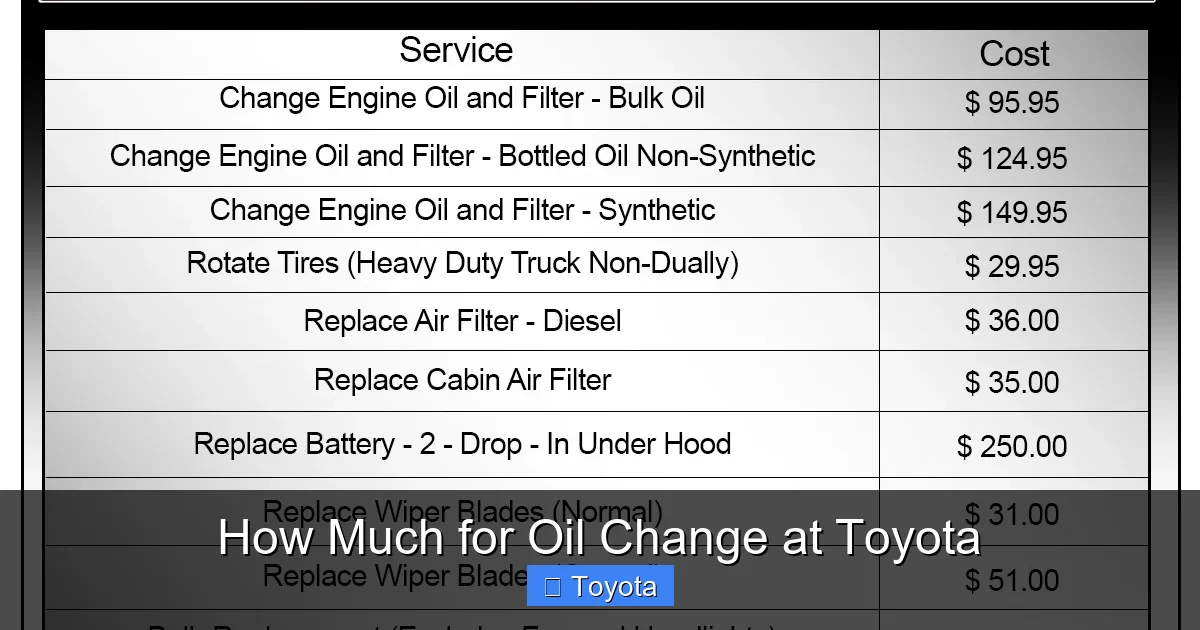
A Toyota oil change typically costs $50 to $120 at dealerships depending on your model and oil type. Independent shops often charge $35 to $80 for the same service. Synthetic oil changes cost more but last longer between intervals.
If you own a Toyota, you already know these vehicles are built to last. But even the most reliable engine needs fresh oil on a regular schedule. The question every Toyota owner asks at some point: how much for oil change at Toyota dealerships versus other options? The answer isn’t a single number. It depends on your specific model, the type of oil your engine requires, where you live, and whether you choose a dealership or independent shop.
I’ve helped countless Toyota owners navigate this exact question. Some swear by dealership service for the peace of mind. Others save hundreds over the years by using trusted local mechanics or even doing it themselves. There’s no wrong choice — only the right choice for your situation, budget, and comfort level. Let’s break down everything you need to know so you can make an informed decision next time that maintenance light illuminates.
Key Takeaways
- Dealership prices range $50-$120: Toyota dealers charge more but use OEM parts and factory-trained technicians
- Independent shops save 20-40%: Local mechanics often charge $35-$80 for comparable service
- Synthetic oil costs more upfront: Full synthetic runs $70-$120 but extends change intervals to 10,000 miles
- Model matters for pricing: Larger engines like the Tundra V8 need more oil than a Corolla four-cylinder
- Coupons and packages reduce cost: Toyota offers rotating service specials and prepaid maintenance plans
- DIY changes cost $25-$45: Doing it yourself saves labor but requires tools and proper disposal
- Warranty stays valid anywhere: Federal law protects your warranty regardless of where you service
📑 Table of Contents
Understanding Toyota Oil Change Basics
What Toyota Recommends for Oil Type
Toyota has specific oil requirements for each engine. Most modern Toyotas call for 0W-20 full synthetic oil. This includes popular models like the Camry, Corolla, RAV4, and Highlander. Older models or trucks with larger engines might specify 5W-30 conventional or synthetic blend. Your owner’s manual lists the exact specification. Using the wrong viscosity can affect fuel economy, engine protection, and even warranty coverage if a related failure occurs.
The shift to 0W-20 synthetic across most of the lineup happened around 2010-2011. This ultra-thin oil reduces internal friction, improving fuel economy by 1-2%. It also flows faster at startup, protecting critical engine components during those first few seconds. If your Toyota is a 2010 or newer passenger car, it almost certainly takes 0W-20 full synthetic.
Factory Maintenance Intervals
Toyota’s recommended oil change interval has evolved. Older models suggested every 5,000 miles or six months. Current models with synthetic oil specify 10,000 miles or 12 months — whichever comes first. However, there’s an important caveat. Toyota classifies certain driving conditions as “severe” which drops the interval back to 5,000 miles. Severe conditions include frequent short trips under five miles, extreme temperatures, stop-and-go traffic, towing, and dusty environments.
Most drivers actually fall into the severe category without realizing it. If you commute in traffic, make short trips, or live where winters get cold or summers get hot, you’re in the severe service bracket. Many Toyota dealers and independent shops recommend the 5,000-mile interval regardless, which provides extra protection for minimal additional cost.
Dealership Oil Change Pricing Breakdown
Standard Pricing by Model Category
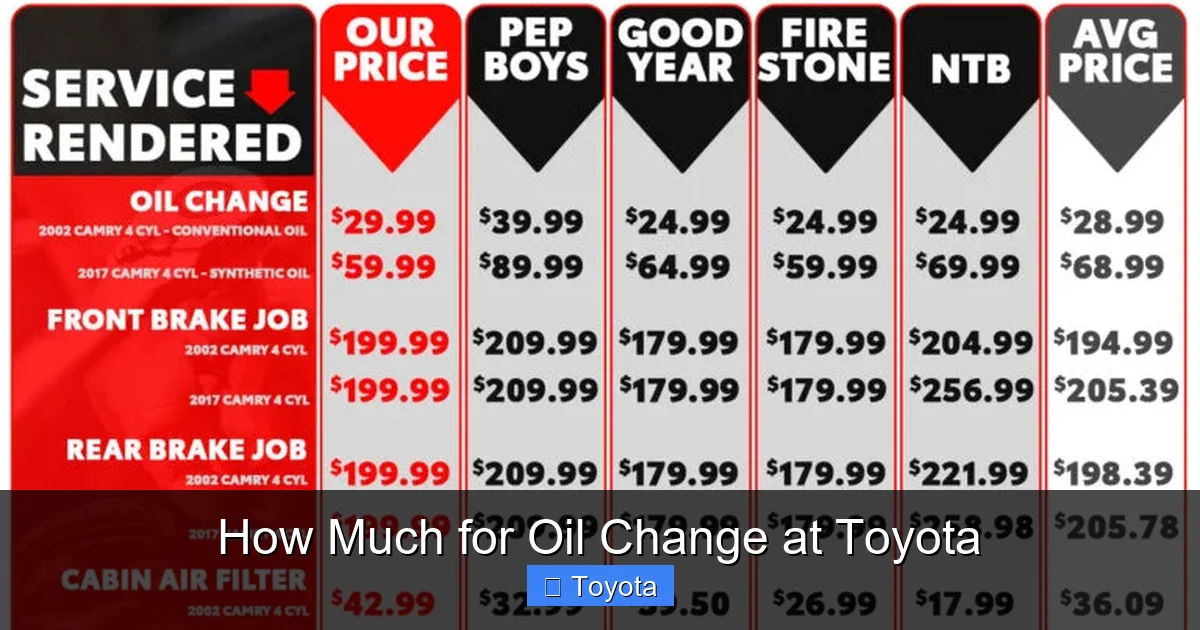
When you ask how much for oil change at Toyota dealerships, the answer varies by vehicle class. Compact cars like the Corolla, Yaris, and Prius typically run $50-$75 for conventional oil and $70-$95 for full synthetic. Mid-size sedans and SUVs including Camry, RAV4, and Highlander range from $60-$85 conventional and $80-$110 synthetic. Trucks and large SUVs like Tundra, Sequoia, and Land Cruiser cost $75-$100 conventional and $95-$125 synthetic due to larger oil capacity — some Tundra V8 engines hold nearly 8 quarts.
Visual guide about How Much for Oil Change at Toyota
Image source: diycarexpert.com
These prices include oil, filter, labor, and basic multi-point inspection. Dealerships use genuine Toyota oil filters and Toyota-branded oil (manufactured by Mobil 1 or similar major brands). Technicians are factory-trained and follow Toyota’s exact procedures. The multi-point inspection checks brakes, tires, fluids, belts, hoses, and battery health — often catching issues early.
What’s Included in Dealership Service
A typical Toyota dealership oil change appointment includes more than just draining and filling. The service advisor reviews your vehicle’s service history and any open recalls. The technician performs the oil change using a torque wrench on the drain plug (critical for aluminum oil pans). They reset the maintenance light, top off washer fluid, check tire pressures, and perform the multi-point inspection. You receive a printed report with photos if any issues are found.
Many dealerships also wash your vehicle and vacuum the interior as a courtesy. Loaner cars or shuttle service may be available for longer waits. Some locations offer express service lanes for oil changes without appointments, typically completing the work in 45-60 minutes. These conveniences factor into the higher price compared to quick-lube chains.
Dealership Coupons and Service Specials
Toyota dealerships rotate monthly service specials. Common offers include $39.95 conventional oil changes, $59.95 synthetic specials, or package deals adding tire rotation for $20-$30 more. Many dealers honor competitor coupons. Signing up for the dealer’s email list or checking their website before scheduling can save $15-$30. Some dealers offer prepaid maintenance plans covering 3-5 years of scheduled service at a discounted rate — worth calculating if you plan to keep the vehicle long-term.
Independent Shop and Quick-Lube Alternatives
Independent Mechanic Pricing
Local independent shops typically charge $35-$60 for conventional oil changes and $55-$80 for full synthetic on most Toyotas. They often use quality aftermarket filters (Wix, NAPA Gold, Mobil 1) and major-brand oils meeting Toyota specifications. Labor rates run $80-$120 per hour versus $130-$180 at dealerships. Many independent mechanics are former dealership techs who opened their own shops — same expertise, lower overhead.
Visual guide about How Much for Oil Change at Toyota
Image source: toyotaautodealer.com
The key is finding a shop that documents the service properly. Keep receipts showing the oil specification (0W-20 API SN/SP), filter part number, mileage, and date. This documentation protects your warranty. Many independent shops use digital inspection systems that email you photos and reports similar to dealerships.
Quick-Lube Chain Considerations
National chains like Jiffy Lube, Valvoline Instant Oil Change, and Take 5 offer convenience and speed — often 15-20 minutes without appointments. Prices range $40-$70 conventional and $65-$95 synthetic. However, quality varies significantly by location. Some chains use bulk oil from major brands. Others may use lesser-known brands meeting minimum specifications. The biggest risk is undertorqued or overtightened drain plugs, stripped threads, and missed inspections.
If you use a quick-lube, watch the service if possible. Verify they use the correct oil viscosity and a quality filter. Decline upsells for engine flushes, fuel system cleaners, or transmission flushes unless your maintenance schedule specifically calls for them. Toyota does not recommend engine flushes under normal conditions.
Comparing Value Beyond Price
When evaluating how much for oil change at Toyota versus alternatives, consider total value. Dealerships provide brand-specific expertise, genuine parts, warranty-friendly documentation, and comprehensive inspections. Independent shops offer similar quality at lower prices with more personal relationships. Quick-lubes win on speed and convenience but carry higher risk of errors. Your choice depends on what matters most: peace of mind, cost savings, or time.
DIY Oil Change Cost Analysis
Parts and Supplies Needed
Changing your own Toyota’s oil costs $25-$45 in materials. You’ll need 4.4-7.9 quarts of 0W-20 full synthetic ($25-$40), a genuine Toyota or quality aftermarket filter ($8-$15), and a crush washer for the drain plug ($1-$3). Tools are a one-time investment: 14mm socket or wrench for the drain plug, 64mm or 65mm oil filter wrench ($10-$15), drain pan ($10), funnel ($3), and jack stands or ramps ($40-$80). Many Toyotas use cartridge filters requiring a specific housing socket.

Visual guide about How Much for Oil Change at Toyota
Image source: toyotaautodealer.com
For a 2018 Camry with the 2.5L engine, you need 4.8 quarts of 0W-20 and a cartridge filter. Toyota filter 04152-YZZA1 costs about $12. Mobil 1 0W-20 5-quart jug runs $28 at most retailers. Total parts cost: roughly $40. Your time investment: 30-45 minutes once familiar with the process.
Step-by-Step DIY Process
Warm the engine for 5 minutes — warm oil drains faster and carries more contaminants. Safely lift and support the vehicle. Remove the engine undercover if equipped (10mm bolts). Position drain pan, remove drain plug with 14mm wrench, let drain completely. Replace crush washer, reinstall drain plug, torque to 30 ft-lbs. Remove old filter, lubricate new filter gasket with fresh oil, install new filter hand-tight plus 3/4 turn. Reinstall undercover. Lower vehicle. Add 4.4 quarts, check dipstick, add remaining oil to reach full mark. Reset maintenance light per owner’s manual procedure.
Dispose of used oil at any auto parts store or recycling center — never pour down drains or on ground. Most retailers accept up to 5 gallons free. Keep receipts for oil and filter purchases with date and mileage for warranty records.
When DIY Makes Sense (And When It Doesn’t)
DIY saves $30-$60 per change versus dealership pricing. Over 100,000 miles (10-20 changes), that’s $300-$1,200 saved. It makes sense if you have workspace, basic tools, physical ability, and interest in learning your vehicle. It doesn’t make sense if you live in an apartment without parking, lack tools, have physical limitations, or simply value your time more than the savings. There’s no shame in paying a professional — that’s why they exist.
Special Considerations for Popular Toyota Models
Toyota Prius and Hybrid Models
Hybrid Toyotas including Prius, Camry Hybrid, RAV4 Hybrid, and Highlander Hybrid have unique oil change considerations. The gasoline engine runs intermittently, so oil doesn’t heat up as consistently. This can lead to fuel dilution and moisture accumulation. Toyota still recommends 10,000-mile intervals with 0W-20 synthetic, but many hybrid specialists suggest 5,000-mile changes for engines that frequently start cold and run short cycles.
The Prius uses a cartridge filter accessed from the top — no need to lift the car for the filter. Drain plug is standard 14mm. Total capacity is 4.4 quarts. Some early Prius models (2004-2009) have a known issue with the oil cooler line leaking — inspect during changes. Hybrid battery cooling system is separate and doesn’t affect oil service.
Toyota Trucks and SUVs with Larger Engines
Tundra, Sequoia, Land Cruiser, and 4Runner models with V6 or V8 engines hold 6.4-7.9 quarts of oil. This increases material cost by $15-$25 per change versus four-cylinder models. The 5.7L V8 in Tundra/Sequoia takes 7.9 quarts. These vehicles often tow or haul, placing them firmly in severe service territory — 5,000-mile intervals are wise. The 4Runner’s 4.0L V6 takes 6.4 quarts and has a skid plate requiring removal for drain access (adds 10 minutes).
If you’re researching how much for oil change at Toyota for a truck, budget $90-$125 at dealerships for synthetic. Independent shops: $70-$95. DIY materials: $45-$65. The larger oil capacity is the main cost driver.
Toyota GR Performance Models
GR Corolla, GR Supra, and GR86 have performance engines with specific requirements. GR Corolla’s 1.6L turbo three-cylinder takes 0W-20 but benefits from 5,000-mile intervals due to high specific output. GR Supra (BMW B58 engine) requires BMW LL-01 approved 0W-20 — not all 0W-20 oils meet this spec. GR86/Subaru BRZ boxer engine takes 0W-20 but the filter is mounted horizontally — expect some spillage. Dealership expertise is valuable for these models to ensure correct oil specifications.
Warranty Protection and Documentation
Magnuson-Moss Warranty Act Rights
Federal law (Magnuson-Moss Warranty Act) prohibits manufacturers from voiding warranties simply because you used non-dealer service or aftermarket parts. Toyota cannot require dealership service to maintain your warranty. They can only deny a specific claim if they prove the aftermarket service or part caused the failure. For oil changes, this means: use the correct oil specification, correct filter, change at recommended intervals, and keep records.
Dealerships sometimes imply warranty risk with outside service — this is misleading. Your warranty remains valid regardless of where you change oil, provided you follow the maintenance schedule and use proper materials. Many independent shops provide warranty-compliant documentation automatically.
Record-Keeping Best Practices
Maintain a folder (physical or digital) with every service receipt. Each record should show: date, mileage, VIN, oil type and viscosity (0W-20 API SP), filter brand and part number, quantity of oil, service provider name and address, and technician signature if possible. Photos of the oil container showing specification and the filter box add extra protection. Apps like CARFAX Car Care, MyCarFax, or simple spreadsheets work well.
If you do it yourself, create a log entry with date, mileage, oil brand/viscosity/quantity, filter part number, and photos of receipts. Staple receipts to a printed log page. This level of documentation exceeds what most dealers provide and completely protects your warranty rights.
Prepaid Maintenance Plans
Toyota offers ToyotaCare Plus and other prepaid maintenance plans extending the complimentary 2-year/25,000-mile ToyotaCare coverage. Plans typically cover 3-5 years or 35,000-60,000 miles of scheduled maintenance including oil changes, tire rotations, and fluid inspections. Cost ranges $600-$1,200 depending on model and term. Compare against expected out-of-pocket costs — these plans often save 15-25% versus pay-as-you-go dealership pricing and lock in current rates.
Prepaid plans transfer with the vehicle, adding resale value. They’re honored at any Toyota dealership nationwide. If you plan to keep your Toyota 5+ years and prefer dealership service, run the numbers. For those who prefer independent shops or DIY, prepaid plans rarely pencil out.
Money-Saving Strategies for Toyota Oil Changes
Timing Your Service Visits
Dealerships run predictable promotional cycles. End-of-month, end-of-quarter, and holiday weekends often bring aggressive specials. January and July are historically strong for service coupons. Many dealers offer “service lanes” with no-appointment oil changes at discounted rates during slower hours (typically weekday mornings). Calling the service department and asking about current specials takes 30 seconds and can save $20+.
Bundling Services for Value
Tire rotations every 5,000 miles align perfectly with oil changes on severe schedules. Many dealers bundle rotation with oil change for $20-$30 versus $40-$50 standalone. Brake inspections, cabin air filter replacement (every 20,000 miles), and engine air filter replacement (every 30,000 miles) can be combined efficiently. Bundling reduces labor overlap — the wheels are already off for rotation, making brake inspection free labor-wise.
Loyalty Programs and Credit Card Offers
Many Toyota dealers have loyalty programs rewarding cumulative service spending with discounts on future visits. Some manufacturer-affiliated credit cards offer 3-5% back on dealership service purchases. Warehouse clubs (Costco, Sam’s Club) sometimes partner with local dealers for member pricing. AAA members often receive 10% labor discounts at participating shops. Stack these where possible — a 10% AAA discount on a $79.95 synthetic special brings it under $72.
Buying Your Own Oil and Filter
Some independent shops allow you to bring your own oil and filter, charging only labor ($20-$40). You buy 5 quarts of Mobil 1 0W-20 ($28) and a Toyota filter ($12) = $40 materials + $30 labor = $70 total versus their $80-95 package price. Savings: $10-$25. Call ahead — not all shops allow this due to liability and warranty documentation concerns. Dealerships almost never allow customer-supplied parts.
Conclusion
So how much for oil change at Toyota really? At a dealership, expect $50-$125 depending on your model and oil type. Independent shops: $35-$80. Quick-lube chains: $40-$95. DIY: $25-$45 in materials. The “right” choice balances cost, convenience, expertise, and peace of mind for your specific situation.
If you value factory-trained technicians, genuine parts, comprehensive inspections, and the simplest warranty documentation — pay the dealership premium. It’s not unreasonable for what you receive. If you have a trusted local mechanic who knows Toyotas, you’ll save 20-40% with equivalent quality. If you’re handy and have driveway access, DIY saves the most and connects you with your vehicle.
Whatever you choose, consistency matters most. Change your oil on schedule using the correct specification. Keep records. Address issues caught during inspections promptly. A Toyota maintained this way will reliably serve you for 200,000+ miles. That’s the real return on investment — not the $20 saved or spent on any single oil change, but the decades of dependable service from one of the world’s best-engineered vehicles.
Next time that maintenance light comes on, you’ll know exactly what to expect and how to choose the best option for you and your Toyota. Safe travels.
Frequently Asked Questions
How much does a Toyota dealership charge for a synthetic oil change?
Toyota dealerships typically charge $70-$125 for full synthetic oil changes depending on your model. Compact cars like Corolla run $70-$95 while trucks like Tundra with larger oil capacity cost $95-$125. Prices include genuine Toyota filter, factory-specified 0W-20 synthetic oil, labor, and multi-point inspection.
Can I use conventional oil in my Toyota to save money?
Most modern Toyotas (2010+) require 0W-20 full synthetic oil per manufacturer specifications. Using conventional oil in these engines can reduce fuel economy, increase wear, and potentially void warranty coverage for engine-related failures. Check your owner’s manual — only older models specify conventional or synthetic blend.
Does changing oil at an independent shop void my Toyota warranty?
No. The Magnuson-Moss Warranty Act protects your right to use any qualified repair shop. Toyota cannot void your warranty for using independent service. You must follow the maintenance schedule, use the correct oil specification and filter, and keep detailed records including receipts showing oil type, viscosity, filter part number, date, and mileage.
How often should I really change my Toyota’s oil?
Toyota officially recommends 10,000 miles or 12 months for synthetic oil. However, most drivers operate in “severe conditions” (short trips, traffic, extreme temperatures, towing) which drops the interval to 5,000 miles. Many technicians recommend 5,000-mile intervals regardless for maximum engine protection, especially on turbocharged or high-mileage engines.
What oil filter does Toyota recommend?
Toyota recommends genuine Toyota oil filters (part numbers vary by engine: 04152-YZZA1 for most 4-cylinders, 04152-31090 for some V6/V8). These filters are manufactured by Denso or Toyo Roki to Toyota’s exact specifications. Quality aftermarket equivalents from Wix, NAPA Gold, Mobil 1, or Denso meet or exceed OEM standards and are acceptable for warranty compliance.
Can I bring my own oil and filter to a Toyota dealership?
Most Toyota dealerships do not allow customer-supplied parts due to liability, warranty documentation, and quality control policies. They use bulk Toyota-branded oil and genuine filters to ensure consistency. Independent shops are more likely to accept customer-supplied oil and filters, typically charging labor only ($20-$40). Always call ahead to confirm policy.