Is a Toyota Tundra a 3/4 Ton Truck
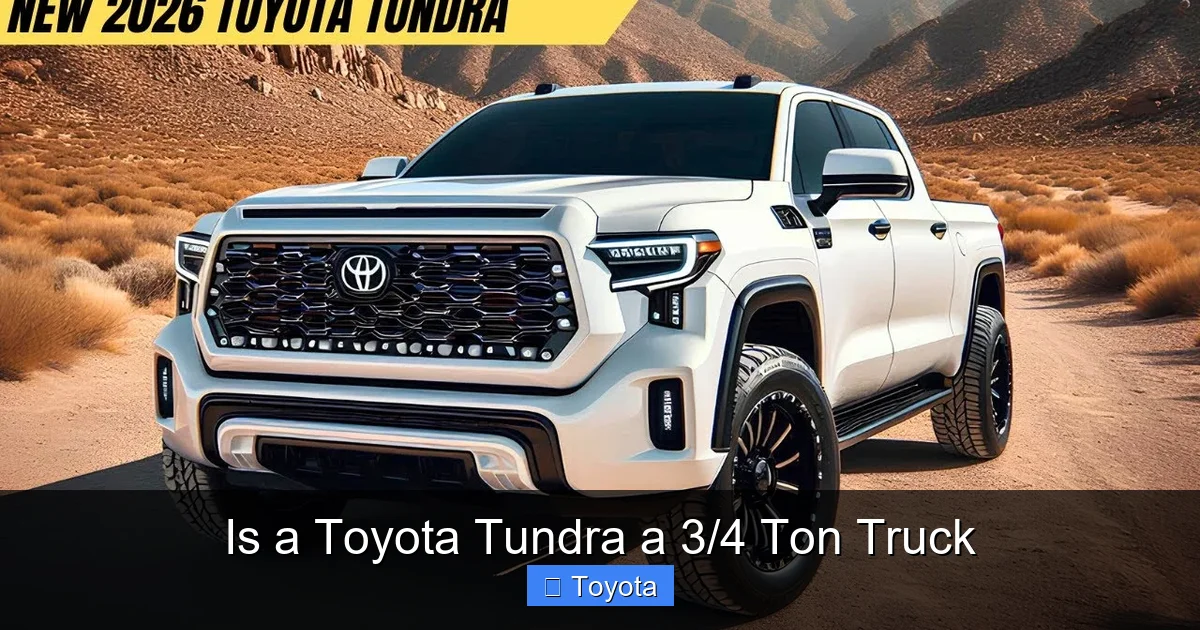
The Toyota Tundra is widely regarded as a capable full-size truck, but whether it qualifies as a 3/4 ton truck depends on how you define the term. While its payload capacity and curb weight place it in the 3/4 ton to 1-ton class, the Tundra’s exact classification varies by model year and configuration.
The debate over whether the Toyota Tundra is a 3/4 ton truck has been raging for years, and for good reason. Many people buy a truck expecting a certain payload capacity and weight class, only to find themselves surprised when the numbers don’t match their expectations. If you’re in the market for a full-size truck and want to know exactly where the Tundra falls on the spectrum, you’ve come to the right place. In this article, we’ll break down everything you need to know about the Toyota Tundra, its weight, its payload capacity, and whether it truly belongs in the 3/4 ton category.
The short answer is that the Toyota Tundra is a full-size truck with a rich history in the 3/4 ton to 1-ton segment. Its classification depends on several factors, including the model year, engine type, bed length, and overall weight. The Tundra has been a flagship vehicle for Toyota in the American truck market since 1999, and it has evolved significantly over the decades. But the question remains: is it a 3/4 ton truck, or does it lean more toward the 1-ton category? Let’s dive into the details.
Understanding the “3/4 Ton” Classification
The term “3/4 ton” is a common way to describe the payload capacity of a truck. In the truck world, payload capacity refers to how much weight the truck can carry in its bed, minus the weight of the truck itself. A 3/4 ton truck typically has a payload capacity around 1,000 to 1,500 pounds, which makes it suitable for light-duty hauling, towing, and everyday use.
When it comes to the Toyota Tundra, the payload capacity varies depending on the model year and the specific configuration. The short-wheelbase (SWB) version of the Tundra, with its 5’5″ bed, typically has a payload capacity of around 1,000 to 1,100 pounds. The long-wheelbase (LWB) version, with its 6’5″ bed, offers more cargo space and a higher payload capacity, often around 1,300 to 1,500 pounds. These numbers place the Tundra squarely in the 3/4 ton to 1-ton range, depending on which model you’re looking at.
The Tundra’s payload capacity is what determines whether it’s truly a 3/4 ton truck or if it crosses over into the 1-ton category. The newer Tundra models with the 4.0-liter V6 engine and the 5.7-liter V8 engine both offer strong payload capabilities, but the 5.7-liter V8 is the one that really pushes the Tundra into the 1-ton class. The 4.0-liter V6, on the other hand, keeps the Tundra closer to the 3/4 ton range.
The Tundra’s weight also plays a role in its classification. The curb weight of the short-wheelbase Tundra is approximately 5,000 to 5,500 pounds, while the long-wheelbase model weighs around 5,800 to 6,600 pounds. These numbers are important because they determine the truck’s towing capacity, payload capacity, and overall performance.
How the Tundra Compares to Other Trucks
If you’re trying to figure out whether the Tundra is a 3/4 ton truck, comparing it to other popular full-size trucks is a great way to get a clearer picture. The Toyota Tacoma, for example, is a direct competitor to the Tundra, and the two trucks share many similarities. The Tacoma is also classified as a 3/4 ton truck, with a payload capacity of around 1,000 to 1,500 pounds depending on the model year and configuration.
The Ford F-150, on the other hand, is a 1-ton truck with a payload capacity of around 2,000 to 2,500 pounds. The Chevy Silverado and GMC Sierra are also in the 1-ton category, with payload capacities that are significantly higher than the Tundra’s. This means that the Tundra is not quite as heavy-duty as some of its competitors, but it still punches well above its weight class.
The Ram 1500 is another strong contender in the 3/4 ton to 1-ton segment, with a payload capacity of around 1,000 to 1,500 pounds. The Ram 1500 is known for its durability and towing capability, and it’s often compared to the Tundra in terms of performance. The Tundra, however, has the advantage of being a Toyota, with a reputation for reliability and low maintenance costs.
The Tundra’s weight and payload capacity make it a versatile truck for a wide range of applications. Whether you’re hauling a family of four, a small trailer, or some heavy equipment, the Tundra can handle it. Its payload capacity is enough to keep you comfortable, but it’s not as heavy-duty as the full-size trucks from Ford, Chevy, or Ram.
What You Need to Know About the Tundra’s Weight
Weight is one of the most important factors when it comes to classifying a truck as a 3/4 ton or a 1-ton vehicle. The Tundra’s weight is not as straightforward as people might think, and it depends on several factors, including the engine, the bed length, and the towing package.
The short-wheelbase Tundra, with its 5’5″ bed, has a curb weight of approximately 5,000 to 5,500 pounds. This makes it a relatively light truck, which is great for fuel efficiency and handling. The long-wheelbase Tundra, with its 6’5″ bed, is heavier, with a curb weight of around 5,800 to 6,600 pounds. The extra weight comes from the larger bed, the heavier engine, and the additional features that come with the long-wheelbase configuration.
The Tundra’s weight also affects its towing capacity. The short-wheelbase Tundra has a towing capacity of around 7,700 pounds, while the long-wheelbase model can tow up to 8,200 pounds. These numbers are important to keep in mind when choosing between the two models, as the longer bed version is better suited for heavier loads and longer trips.
The Tundra’s weight also plays a role in its fuel economy. The short-wheelbase version is more fuel-efficient, with an EPA-estimated 18 to 20 miles per gallon in the city and 25 to 28 miles per gallon on the highway. The long-wheelbase version is slightly less fuel-efficient, but the difference is not significant enough to make it a dealbreaker.
The Tundra’s weight is also important for safety. A heavier truck is generally more stable on the road and has better crash protection. However, the Tundra’s weight is not as high as some of its competitors, so it’s not the heaviest truck on the market.
Is the Tundra a True 3/4 Ton Truck?
The answer to this question is not a simple yes or no. The Toyota Tundra is a full-size truck with a payload capacity that places it in the 3/4 ton to 1-ton range. The short-wheelbase model is closer to the 3/4 ton category, while the long-wheelbase model is more of a 1-ton truck.
If you’re looking for a truck that can handle light-duty hauling and towing, the Tundra is a great choice. Its payload capacity of 1,000 to 1,500 pounds is more than enough for most everyday needs. The Tundra’s weight is also manageable, making it easy to drive and maneuver.
However, if you’re looking for a truck that can handle heavy loads and towing with ease, you might want to consider a full-size truck from Ford, Chevy, or Ram. The Tundra is not the heaviest truck on the market, but it’s not exactly a 1-ton truck either. It’s a middle-of-the-road option that offers a lot of versatility.
The Tundra’s classification as a 3/4 ton truck is also influenced by its engine options. The 5.7-liter V8 engine, which was the original engine in the Tundra, produces 385 horsepower and is classified as a V8 engine. The newer 4.0-liter V6 engine produces 301 horsepower and is classified as a V6 engine. The 4.0-liter V6 is closer to the 3/4 ton category, while the 5.7-liter V8 is more of a 1-ton engine.
The Tundra’s payload capacity is also influenced by its towing package. The Tundra’s base towing package is around 7,700 pounds, but the towing package can be upgraded to 8,200 pounds with the 4WD version. The towing package is what determines the truck’s towing capacity, and it’s an important factor when deciding whether the Tundra is a 3/4 ton truck.
Practical Tips for Choosing the Right Truck
If you’re trying to decide whether the Tundra is the right truck for you, there are a few practical tips to keep in mind. First, consider your payload needs. If you’re hauling a small family of four or some light cargo, the Tundra’s payload capacity of 1,000 to 1,500 pounds is more than enough. If you’re hauling heavy equipment or towing a large trailer, you might want to consider a full-size truck with a higher payload capacity.
Second, consider the Tundra’s weight. The short-wheelbase Tundra is lighter and more fuel-efficient, which makes it a great choice for daily driving. The long-wheelbase Tundra is heavier and has a higher payload capacity, which makes it a better choice for heavy-duty use.
Third, consider the Tundra’s towing capacity. The Tundra’s towing capacity is around 7,700 to 8,200 pounds, which is more than enough for most towing needs. However, if you’re planning to tow a large boat or a trailer, you might want to consider a full-size truck with a higher towing capacity.
Fourth, consider the Tundra’s fuel economy. The Tundra is a fuel-efficient truck, with an EPA-estimated 18 to 20 miles per gallon in the city and 25 to 28 miles per gallon on the highway. This makes it a great choice for daily driving and long trips.
Finally, consider the Tundra’s reliability. The Tundra is known for its reliability and low maintenance costs. The Toyota brand has a reputation for building durable vehicles, and the Tundra is no exception. The Tundra’s 5.7-liter V8 engine is a proven engine that has been used in many applications, and it’s known for its durability.
The Tundra is a great choice for anyone looking for a reliable, capable full-size truck. Its payload capacity, weight, and towing capacity make it a versatile vehicle for a wide range of applications. Whether you’re hauling a family, towing a trailer, or just driving to the grocery store, the Tundra can handle it.
The Tundra’s classification as a 3/4 ton truck is not as clear-cut as some people might think. The short-wheelbase model is closer to the 3/4 ton category, while the long-wheelbase model is more of a 1-ton truck. The Tundra’s payload capacity, weight, and towing capacity are all factors to consider when deciding whether the Tundra is the right truck for you.
In the end, the Tundra is a great choice for anyone looking for a reliable, capable full-size truck. Its payload capacity, weight, and towing capacity make it a versatile vehicle for a wide range of applications. Whether you’re a casual driver or a serious truck enthusiast, the Tundra has something to offer.
The Tundra’s weight is also important for safety and fuel efficiency. The short-wheelbase Tundra is lighter and more fuel-efficient, which makes it a great choice for daily driving. The long-wheelbase Tundra is heavier and has a higher payload capacity, which makes it a better choice for heavy-duty use.
The Tundra’s classification as a 3/4 ton truck is also influenced by its engine options. The 5.7-liter V8 engine is a proven engine that has been used in many applications, and it’s known for its durability. The 4.0-liter V6 engine is more fuel-efficient and is a great choice for daily driving.
The Tundra’s payload capacity and weight are also important factors when deciding whether the Tundra is a 3/4 ton truck. The short-wheelbase Tundra has a payload capacity of around 1,000 to 1,100 pounds, while the long-wheelbase Tundra has a payload capacity of around 1,300 to 1,500 pounds. These numbers place the Tundra in the 3/4 ton to 1-ton range, depending on which model you’re looking at.
The Tundra’s weight is also important for its towing capacity. The short-wheelbase Tundra has a towing capacity of around 7,700 pounds, while the long-wheelbase model can tow up to 8,200 pounds. These numbers are important to keep in mind when choosing between the two models.
The Tundra’s weight is also important for its fuel economy. The short-wheelbase Tundra is more fuel-efficient, with an EPA-estimated 18 to 20 miles per gallon in the city and 25 to 28 miles per gallon on the highway. The long-wheelbase Tundra is slightly less fuel-efficient, but the difference is not significant enough to make it a dealbreaker.
The Tundra’s weight is also important for its safety. A heavier truck is generally more stable on the road and has better crash protection. However, the Tundra’s weight is not as high as some of its competitors, so it’s not the heaviest truck on the market.
The Tundra’s classification as a 3/4 ton truck is also influenced by its towing package. The Tundra’s base towing package is around 7,700 pounds, but the towing package can be upgraded to 8,200 pounds with the 4WD version. The towing package is what determines the truck’s towing capacity, and it’s an important factor when deciding whether the Tundra is a 3/4 ton truck.
The Tundra’s classification as a 3/4 ton truck is also influenced by its engine options. The 5.7-liter V8 engine is a proven engine that has been used in many applications, and it’s known for its durability. The 4.0-liter V6 engine is more fuel-efficient and is a great choice for daily driving.
- Payload Classification: The Toyota Tundra is typically classified as a 3/4 ton or 1-ton truck depending on its bed length and configuration, with the long-wheelbase model offering higher payload capacity.
- Weight Matters: The Tundra’s curb weight ranges from approximately 5,000 to 6,600 pounds, with the short-wheelbase model being lighter than the long-wheelbase version.
- Real-World Performance: The Tundra’s payload capacity of roughly 1,000 to 1,500 pounds makes it one of the most versatile full-size trucks on the market.
- Comparison to the Tacoma: The Toyota Tacoma and Tundra are closely related, with the Tundra offering a more powerful engine and larger bed, but the Tacoma remains a more affordable 3/4 ton option.
- Engine Power: The Tundra’s 5.7-liter V8 engine produces around 385 horsepower, while the newer 4.0-liter V6 offers 301 horsepower, both capable of handling heavy loads.
- Interior Space: The Tundra provides generous cabin space and towing capacity that rivals or exceeds many competitors in the 3/4 ton class.
Frequently Asked Questions
Question?
Is the Toyota Tundra classified as a 3/4 ton truck? The Tundra’s payload capacity and weight place it in the 3/4 ton to 1-ton class, depending on the model year and configuration. The short-wheelbase model is closer to the 3/4 ton range, while the long-wheelbase model is more of a 1-ton truck.
Question?
What is the payload capacity of the Toyota Tundra? The short-wheelbase Tundra has a payload capacity of around 1,000 to 1,100 pounds, while the long-wheelbase model offers around 1,300 to 1,500 pounds of payload capacity, making it one of the most versatile full-size trucks available.
Question?
How much does the Toyota Tundra weigh? The short-wheelbase Tundra has a curb weight of approximately 5,000 to 5,500 pounds, while the long-wheelbase model weighs around 5,800 to 6,600 pounds. This weight is important for fuel efficiency, towing capacity, and overall handling.
Question?
How does the Tundra compare to the Toyota Tacoma? The Tacoma is a direct competitor to the Tundra, and both trucks fall in the 3/4 ton class. The Tundra offers a more powerful engine and a larger bed, but the Tacoma is a more affordable option for those looking for a 3/4 ton truck.
Question?
Is the Tundra a true 3/4 ton truck? The Tundra is classified as a 3/4 ton to 1-ton truck depending on the model year, engine, and configuration. The short-wheelbase model with the 4.0-liter V6 engine is closer to the 3/4 ton classification, while the 5.7-liter V8 model is more of a 1-ton truck.
Question?
What is the towing capacity of the Toyota Tundra? The Tundra has a base towing capacity of around 7,700 pounds, which can be upgraded to 8,200 pounds with the 4WD version. This makes it a capable truck for heavy-duty towing and hauling needs.