Are All Toyota Dealerships the Same?
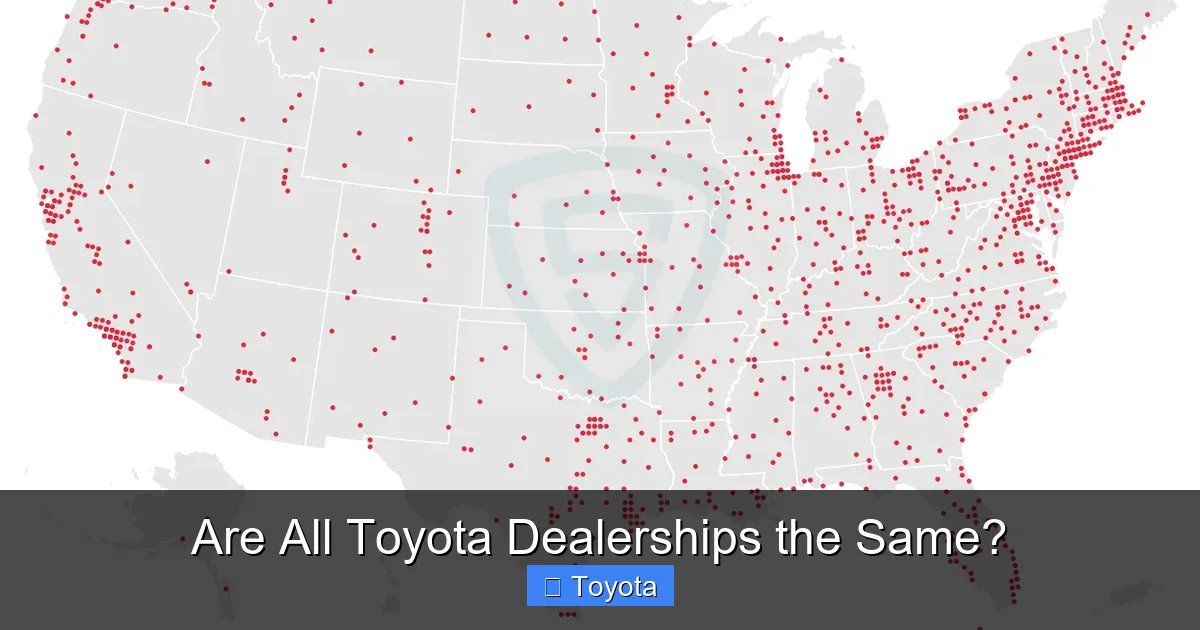
Not all Toyota dealerships are the same. While they sell identical vehicles, each location operates independently with unique pricing, service quality, and customer experiences. Smart buyers compare multiple dealers to find the best deal and service for their needs.
You walk into a Toyota dealership expecting the same experience as the one across town. Same cars. Same prices. Same service. But here is the thing. That assumption could cost you thousands of dollars and countless headaches. I learned this the hard way when helping my sister shop for a Camry last year. The first dealer quoted her $2,000 more than the second one for the exact same trim. The service department at the first place had a two-week wait. The second got her in within two days. Same brand. Completely different experiences.
Toyota builds fantastic vehicles. Their reputation for reliability is earned. But the dealership network? That is a different story. Toyota Motor Sales USA sets standards. They provide training. They allocate inventory. But they do not own the dealerships. Local business people own them. Families own them. Large automotive groups own them. Each one makes independent decisions about pricing, staffing, facilities, and customer service philosophy. Understanding this distinction changes how you shop.
Key Takeaways
- Independent ownership: Each Toyota dealership is independently owned and operated, not corporate-run.
- Pricing varies: Dealer fees, markups, and discounts differ significantly between locations.
- Service quality differs: Technician expertise, wait times, and amenities vary by dealership.
- Customer experience matters: Sales pressure, transparency, and follow-up care are not standardized.
- Inventory selection varies: Some dealers stock more models, trims, or colors than others.
- Certified programs help: Toyota’s dealer standards provide baseline consistency but allow flexibility.
- Research pays off: Comparing 2-3 dealerships can save thousands and improve your ownership experience.
📑 Table of Contents
- How Toyota Dealerships Actually Work
- Where the Real Differences Show Up
- Inventory and Allocation: Not Every Dealer Gets Everything
- Certified Programs and What They Mean for You
- How to Compare Dealerships Effectively
- Red Flags and Green Flags
- The Long Game: Building a Dealer Relationship
- Special Considerations by Model Type
- Online Buying and the Changing Landscape
- Making Your Final Decision
- Conclusion
How Toyota Dealerships Actually Work
The Franchise Model Explained
Think of Toyota dealerships like fast food franchises. McDonald’s corporate sets the menu. They design the logo. They approve the equipment. But the local owner decides whether the fries come out hot or cold. They decide if the dining room gets cleaned every hour or once a day. They hire the manager who sets the tone for every employee.
Toyota works the same way. A dealer signs a franchise agreement. They get the right to sell new Toyotas. They get access to factory training. They receive vehicle allocations based on their sales history and market size. But the dealer principal — the owner — makes daily operational decisions. They set the “market adjustment” on a hot RAV4 Prime. They decide whether to hire three master technicians or one. They choose the CRM system that tracks your service visits.
What Toyota Corporate Actually Controls
Toyota does enforce some standards. Every dealer must meet facility requirements. Showrooms need specific signage. Service bays need factory-approved tools. Technicians must complete certification programs. The “Toyota Certified Used Vehicle” program has strict inspection criteria. Warranty work follows factory procedures exactly.
But here is the gap. Corporate standards are minimums. They are floors, not ceilings. A dealer can exceed them dramatically or barely meet them. Both remain “authorized Toyota dealers.” You would never know the difference from the sign out front.
Where the Real Differences Show Up
Pricing and Fees: The Biggest Variable
This is where most buyers lose money. The MSRP on a Toyota Corolla is the same everywhere. But the out-the-door price? That varies wildly. Let me break down the moving parts.
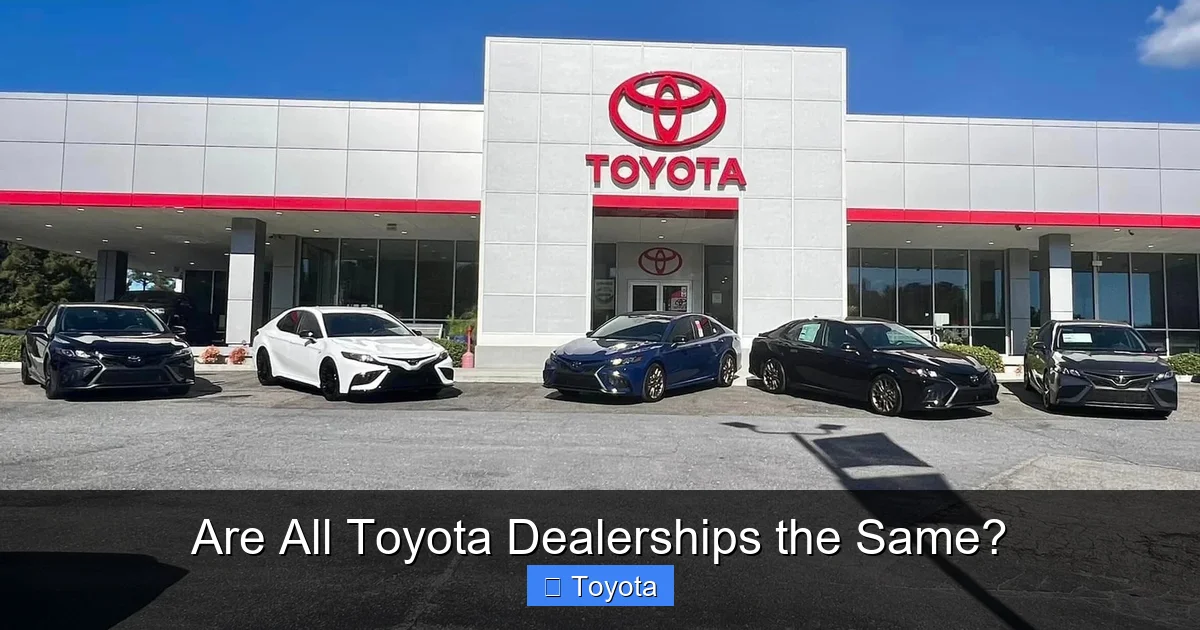
Visual guide about Are All Toyota Dealerships the Same?
Image source: kutecar.com
Dealer documentation fees range from $150 to $899 depending on the state and the dealer. Some states cap them. Most do not. “Market adjustments” on high-demand models like the GR Corolla or hybrid Sienna can add $3,000 to $10,000 over MSRP. Some dealers refuse these markups on principle. Others stack them aggressively.
Then there are the add-ons. Nitrogen-filled tires. Paint protection film. Fabric guard. Window etching. LoJack. These are pure profit items. One dealer includes $2,500 of them “standard.” Another sells the car clean. You need to ask for an itemized out-the-door price before visiting. If you’re researching specific models, check out how much is a new Toyota Corolla to understand baseline pricing before dealer fees.
Service Department Quality: Your Long-Term Relationship
You buy a car once. You service it for years. The service department matters more than the sales floor. Yet most buyers never visit service before purchasing.
Technician skill varies enormously. Master technicians take years to develop. Some dealerships invest heavily in retention. They pay above-market wages. They buy the latest diagnostic equipment. They schedule 30-minute appointment slots for complex work. Others run lean. They hire entry-level techs. They double-book appointments. They push “recommended services” that Toyota does not require.
Wait times tell the story. Call three dealers. Ask for the next available oil change appointment. Ask about a check-engine light diagnosis. The answers reveal capacity and prioritization. A dealer booking two weeks out for basic maintenance will be a nightmare when your transmission acts up.
Sales Experience: Pressure vs. Partnership
Some dealers still run the old playbook. Four-square worksheets. “Let me talk to my manager.” Artificial deadlines. “This price is only good today.” Others have moved to transparent pricing. One-price stores. Online deal structures. Home delivery. The culture starts at the top.
Ask friends about their recent purchases. Read Google reviews filtering for “sales” and “finance.” Look for patterns. One bad review is an outlier. Twenty reviews mentioning “bait and switch” or “finance pressure” is a culture problem.
Inventory and Allocation: Not Every Dealer Gets Everything
How Allocation Actually Works
Toyota builds cars based on global forecasts. They allocate to regions. Regional distributors allocate to dealers. A high-volume dealer in a metro area gets first pick. They get more hybrids. They get more TRD models. They get the limited editions. A rural dealer selling 30 cars a month gets what is left.
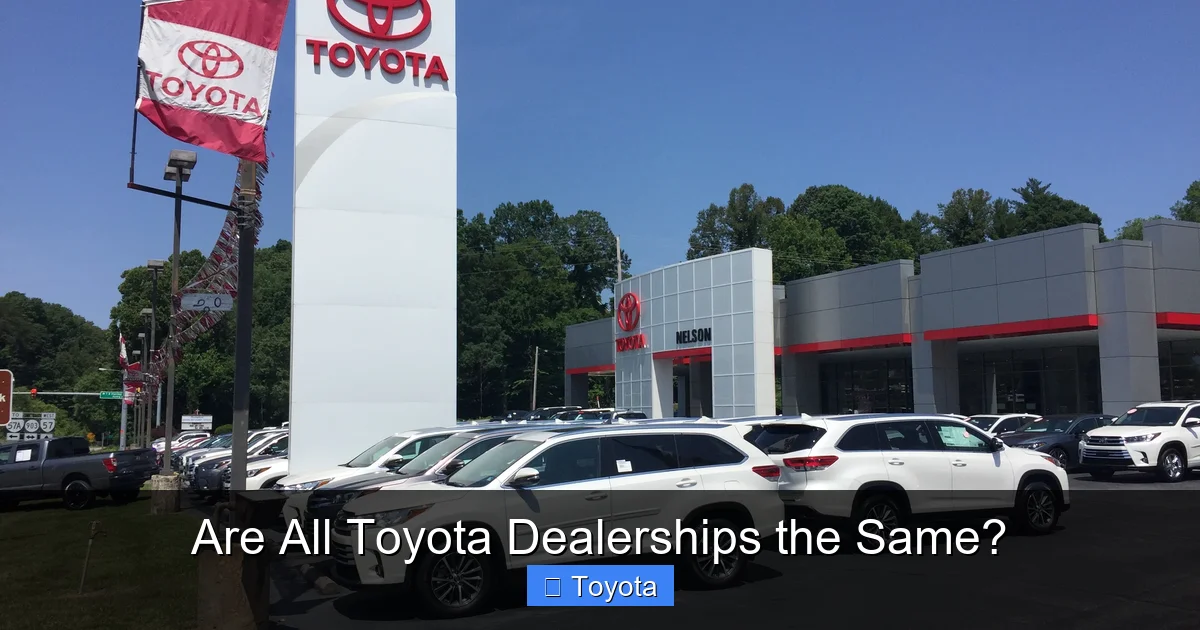
Visual guide about Are All Toyota Dealerships the Same?
Image source: assets.cai-media-management.com
This means the specific RAV4 Hybrid XSE in Blueprint with the premium package might only exist at three dealers within 100 miles. If your local dealer does not have it, they can dealer-trade. But that adds cost and complexity. And you lose leverage. The holding dealer knows you want that specific car.
Special Orders and Wait Times
Some dealers embrace special orders. They walk you through the build sheet. They set realistic expectations. They communicate updates. Others discourage orders. They want to sell from stock. They may not even know how to structure a factory order correctly.
If you want a specific configuration, ask the dealer: “How many factory orders have you placed this year? What is the current lead time for this model? How do you communicate updates?” Their answers reveal competence.
Certified Programs and What They Mean for You
Toyota’s Dealer Standards Program
Toyota runs a “Dealer Standards” program. It measures customer satisfaction (CSI), facility compliance, training completion, and operational metrics. Dealers get rated. High performers get better allocation. Low performers get improvement plans.
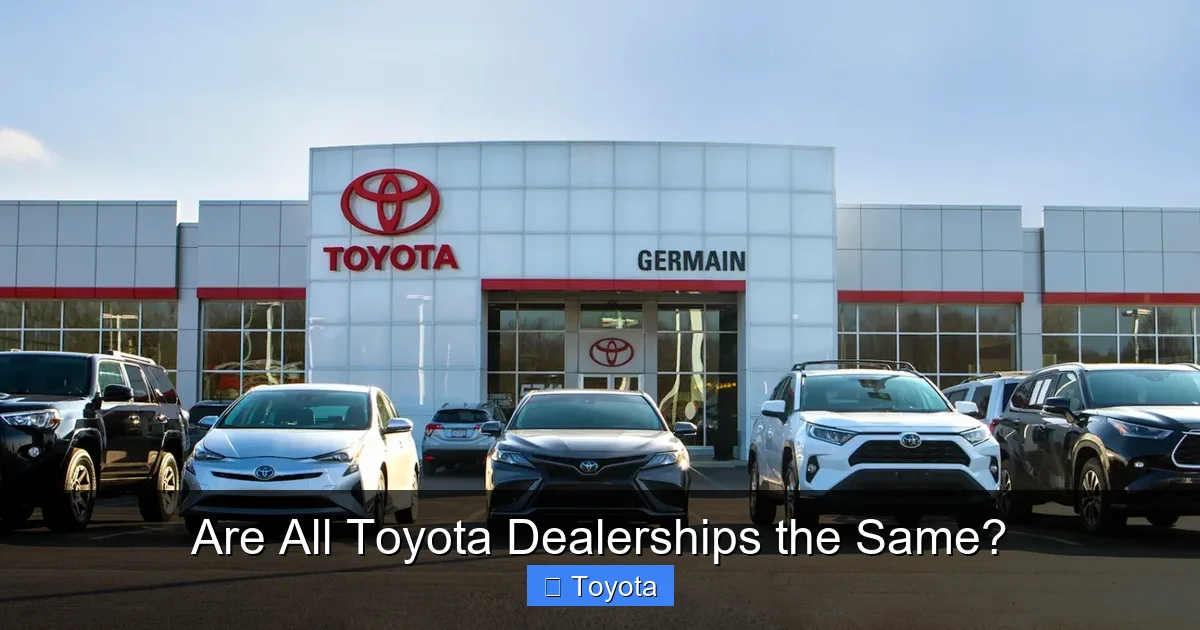
Visual guide about Are All Toyota Dealerships the Same?
Image source: di-uploads-pod11.dealerinspire.com
But — and this is crucial — the program measures compliance with Toyota’s processes. It does not measure competitive pricing. It does not measure whether the service advisor actually listens to your noise complaint. It measures whether the advisor followed the script.
President’s Award and President’s Cabinet
You will see plaques in showrooms. “President’s Award Winner.” “President’s Cabinet Member.” These recognize top CSI scores and sales volume. They indicate a well-run operation generally. But a dealer can win the award while still charging $999 doc fees and marking up hot models. The award measures Toyota’s priorities, not necessarily yours.
How to Compare Dealerships Effectively
Before You Visit: Digital Reconnaissance
Start with the website. Is pricing transparent? Do they show actual inventory with real photos? Can you get an e-price without calling? Can you value your trade online? Can you schedule service online? A dealer’s digital maturity often reflects their overall operational maturity.
Check reviews across platforms. Google. DealerRater. Cars.com. Yelp. Filter for recent reviews. Look for responses from management. A dealer who responds thoughtfully to negative reviews cares about reputation. One who ignores them or argues publicly does not.
Call the service department. Ask a simple question: “My 2021 Camry has a vibration at 65 mph. What is your diagnostic process?” Listen. Do they explain? Do they quote a flat diagnostic fee? Do they mention Toyota technical service bulletins? The phone manner predicts the in-person experience.
The Test Visit: What to Observe
Visit on a Saturday morning. The busiest time reveals the true operation. Is the lot clean? Are the cars washed? Is the showroom staffed? How long before someone acknowledges you?
Ask to see the service drive. Are customers waiting comfortably? Is there a shuttle? Loaner cars? WiFi? Coffee that does not taste like burnt rubber? These details signal investment in customer experience.
Request a written quote on a specific VIN. Watch the process. Do they print a buyer’s order? Do they itemize every fee? Do they explain each line? Or do they hand you a single number on a scrap of paper?
Leveraging Competition Ethically
Get quotes from three dealers. Use the same VIN or identical configuration. Compare line by line. Present the best offer to the others. “Dealer A offered this out-the-door price. Can you match or beat it?” This is not rude. This is how markets work.
But be reasonable. If Dealer A is 200 miles away and Dealer B is 5 miles away, Dealer B has value in convenience. Service warranty work. Recall repairs. Future purchases. A $300 difference might be worth the local relationship.
Red Flags and Green Flags
Walk Away If You See These
- Refusal to provide written out-the-door pricing
- Mandatory add-ons you cannot remove
- Pressure to submit credit application before showing numbers
- Service department with no loaners and 3-week waits
- Sales staff who badmouth other dealers
- Finance manager who won’t show the buy rate vs. contract rate
- No certified technicians on staff
Green Flags Worth Driving For
- Transparent pricing on website and in person
- Master technicians with 15+ years tenure
- Service advisors who are former technicians
- Loaner fleet for warranty work
- Dedicated delivery specialist for new cars
- Follow-up calls at 7 days, 30 days, 90 days
- Active community involvement and local reputation
The Long Game: Building a Dealer Relationship
You are not buying a toaster. You are entering a 10-year relationship. The average Toyota owner keeps their vehicle 8-10 years. You will visit for oil changes, tire rotations, brake jobs, warranty repairs, recalls, and eventually your next purchase.
The dealer who earns your trust on the first transaction often becomes your partner for decades. They know your history. They prioritize your appointments. They advocate for you with the district service manager when a weird warranty issue arises. They text you when your favorite model arrives in the perfect color.
This relationship has monetary value. A dealer who knows you may hold a desirable trade-in for you. They may offer first right of refusal on a returning lease. They may squeeze you in for a same-day repair before a road trip. These things never appear on a price quote.
If you’re planning to keep your Toyota for the long haul, proper break-in matters too. Check out how to break in a new car Toyota for factory-recommended procedures that protect your investment.
Special Considerations by Model Type
High-Demand Models: GR, Hybrid, Limited Editions
Shopping for a GR Corolla? A hybrid Sienna? A TRD Pro anything? The rules change. Allocation is tight. Markups are common. Dealer relationships become currency. The dealer who gets two GR Corollas a year will sell them to repeat customers first. New buyers go on waitlists.
In these scenarios, expand your radius. A dealer three hours away with no markup beats the local dealer with a $10,000 adjustment. But verify they will honor warranty work locally. Toyota warranty is nationwide. Any dealer must perform it. But goodwill repairs — the “we’ll cover this even though it’s slightly out of warranty” decisions — favor local customers.
Fleet and Commercial Buyers
If you are buying for a business, look for a dedicated fleet manager. Not a salesperson who “handles fleet.” A true fleet department understands tax implications, upfitting, volume pricing, and total cost of ownership. They manage 50-unit orders differently than 1-unit retail deals.
Used and Certified Pre-Owned
Used car operations vary more than new. Some dealers cherry-pick the best trades. Others wholesale everything and buy at auction. Certified Pre-Owned adds a 160-point inspection and extended warranty. But the inspection quality depends on the technician performing it. Ask: “Who does your CPO inspections? Can I see the inspection sheet for this specific vehicle?”
Online Buying and the Changing Landscape
Digital Retailing: Hype vs. Reality
Every dealer now claims “buy online.” Most mean “start the process online.” True digital retailing — configure, price, trade value, credit approval, contract signing, delivery — without stepping foot in the store — exists at perhaps 10% of Toyota dealers.
Test it. Go to the website. Try to complete a deal to the “sign here” stage. See where it breaks. That break point reveals the dealer’s actual digital capability.
Third-Party Platforms
Carvana, Vroom, Shift — they source from the same auctions and trade-ins as dealers. Sometimes from Toyota dealers directly. Their prices include their overhead and risk. A local dealer can often match or beat them if you negotiate. And the local dealer services what they sell.
Making Your Final Decision
Create a simple scorecard. Weight factors by your priorities. Price (30%). Service convenience (25%). Sales experience (20%). Reputation (15%). Inventory access (10%). Score each dealer 1-5. Multiply. Total the weighted scores.
But do not ignore your gut. If Dealer A scores 4.2 and Dealer B scores 3.8, but Dealer B made you feel respected and Dealer A made you feel processed — choose B. The $200 difference disappears in the first service visit where B remembers your name and A loses your keys.
Remember: you can buy the car from Dealer A and service at Dealer B. Nothing prevents this. Warranty work can be performed at any authorized dealer. But the relationship benefits accrue where you spend consistently.
Conclusion
Are all Toyota dealerships the same? Absolutely not. They share a brand. They share a product lineup. They share factory training programs. But they are independent businesses run by different people with different values, different capabilities, and different priorities.
The Toyota sign out front guarantees the car meets factory standards. It does not guarantee the deal meets your standards. That part is up to you. Do the work. Compare dealers. Ask hard questions. Observe carefully. Trust your instincts.
The extra few hours of research can save you thousands upfront. The right dealer relationship pays dividends for a decade. Your Toyota will be reliable. Make sure your dealer is too.
And when you’re ready to understand the full cost picture including those often-overlooked dealer fees, take a look at how much are used car dealer fees to avoid surprises at signing.
Frequently Asked Questions
Do all Toyota dealerships charge the same price for the same car?
No. While the MSRP is set by Toyota, each dealer sets their own selling price, documentation fees, and add-ons. Out-the-door prices can vary by thousands between dealers for the identical vehicle.
Can I buy a Toyota from one dealer and get it serviced at another?
Yes. Any authorized Toyota dealership must honor factory warranty repairs regardless of where you purchased the vehicle. However, goodwill assistance and priority scheduling often favor customers who bought and service at the same location.
What is the difference between a Toyota dealer and a Toyota certified dealer?
All authorized Toyota dealers sell new vehicles. “Toyota Certified” typically refers to the Certified Pre-Owned program for used cars, which includes a 160-point inspection and extended warranty. Any authorized dealer can sell Toyota Certified Used Vehicles if they meet program requirements.
Why do some Toyota dealers have long service waits while others don’t?
Service capacity depends on the dealer’s investment in technicians, bays, and equipment. High-volume dealers with more master technicians and better scheduling systems typically offer shorter waits than understaffed locations.
Are Toyota dealer fees negotiable?
Documentation fees are often set by dealer policy and may be regulated by state law, making them difficult to negotiate. However, “market adjustments,” add-on packages, and accessory installations are fully negotiable.
How do I know if a Toyota dealership is reputable before visiting?
Check recent Google and DealerRater reviews, call the service department with a technical question to gauge competence, and ask for a written out-the-door quote via email. Transparent, responsive communication is a strong indicator of a well-run operation.