How Many Miles per Gallon Does a Toyota Venza Get?
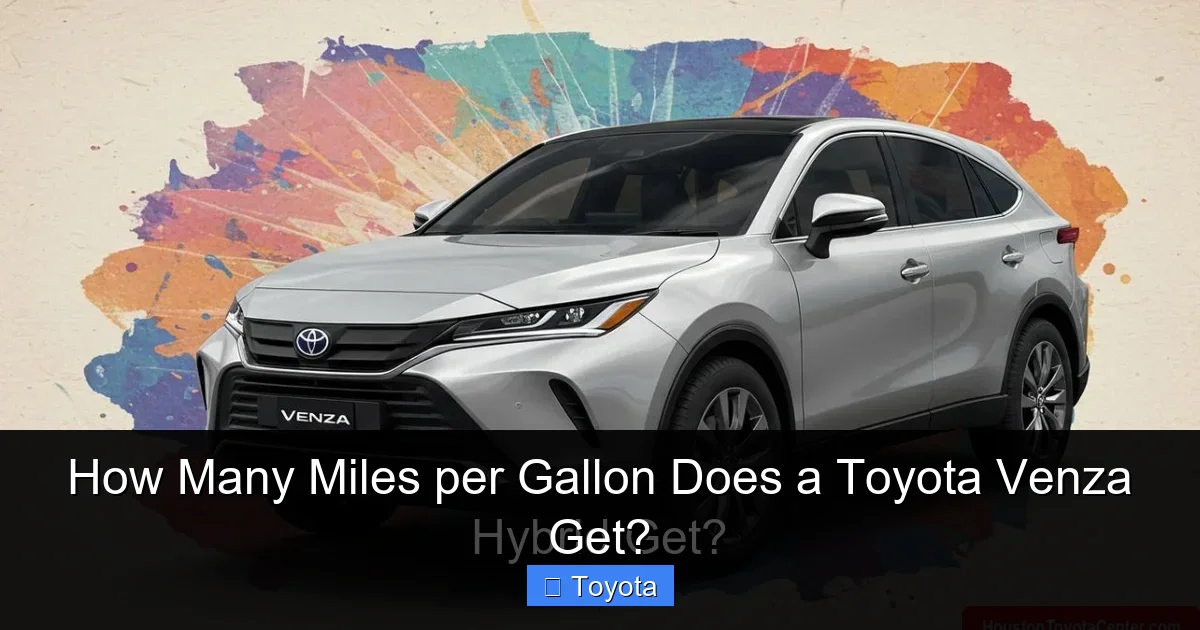
The Toyota Venza delivers impressive fuel economy thanks to its standard hybrid powertrain, achieving up to 40 MPG combined in newer models. All Venza trims come exclusively with a 2.5-liter four-cylinder hybrid system that balances power and efficiency for daily driving. Real-world results vary based on driving habits, weather, and terrain.
If you are shopping for a midsize crossover, fuel economy probably sits near the top of your priority list. The Toyota Venza has carved out a unique spot in the market by offering a standard hybrid powertrain across every trim level. That means you do not have to choose between efficiency and features. Every Venza leaves the factory with the same electrified setup. This approach simplifies the buying process and guarantees strong numbers at the pump. Let us dive into the details so you know exactly what to expect.
The Venza returned for the 2021 model year after a brief hiatus. Toyota positioned it as a more stylish and upscale alternative to the RAV4 Hybrid. It shares the same basic platform and hybrid system but wears a sleeker roofline and a more premium interior. That design choice does add a little weight and affects aerodynamics slightly. Still, the Venza manages to deliver excellent fuel economy that rivals smaller vehicles. Understanding the official ratings and real-world performance helps you plan your budget and driving habits.
Key Takeaways
- Standard hybrid powertrain: Every Toyota Venza uses a 2.5L four-cylinder hybrid system with no gas-only option available.
- EPA ratings reach 40 MPG combined: The 2021-2024 models achieve 40 city / 37 highway / 39 combined MPG for FWD versions.
- AWD slightly reduces efficiency: All-wheel-drive models drop to 39 city / 35 highway / 37 combined MPG due to added weight.
- Real-world averages hover near 35-38 MPG: Most owners report figures close to EPA estimates in mixed driving conditions.
- Driving style greatly impacts results: Gentle acceleration, coasting, and EV mode usage can push economy above 40 MPG.
- Cold weather reduces hybrid efficiency: Winter temperatures can drop MPG by 10-15% due to battery performance and heater use.
- No plug-in charging required: The self-charging hybrid system regenerates energy through braking and engine operation.
📑 Table of Contents
- Official EPA Fuel Economy Ratings by Model Year
- Real-World Fuel Economy Reports from Owners
- How the Venza Hybrid System Works
- Driving Tips to Maximize Your Venza MPG
- Venza MPG Compared to Key Competitors
- Long-Term Ownership Costs and Fuel Savings
- Frequently Overlooked Factors Affecting Venza MPG
- Conclusion
Official EPA Fuel Economy Ratings by Model Year
The Environmental Protection Agency tests every new vehicle under controlled conditions. These tests produce the city, highway, and combined MPG figures you see on the window sticker. For the Toyota Venza, the numbers have remained consistent since its relaunch. The 2021 through 2024 model years all share the same powertrain. Therefore, the EPA ratings are identical across those years. Front-wheel-drive models earn the highest marks.
Front-Wheel-Drive Venza MPG
If you choose the front-wheel-drive configuration, you get the best possible efficiency. The EPA rates these models at 40 MPG in city driving, 37 MPG on the highway, and 39 MPG combined. City driving benefits the most from the hybrid system. The electric motor handles low-speed movement and stop-and-go traffic with ease. The gasoline engine stays off more often in urban environments. That is why the city number exceeds the highway number, which is unusual for non-hybrid vehicles.
All-Wheel-Drive Venza MPG
Opting for all-wheel drive adds a rear electric motor that powers the back wheels when needed. This system is called Electronic On-Demand All-Wheel Drive. It engages automatically when the front wheels slip or during acceleration. The extra motor and associated hardware add weight. That weight penalty lowers the EPA estimates to 39 MPG city, 35 MPG highway, and 37 MPG combined. The drop is modest. Many buyers find the traction benefit worth the small fuel economy trade-off.
Comparison to the Previous Generation
The original Venza sold from 2009 to 2015. Those models used conventional gasoline engines. A 2.7-liter four-cylinder returned 19 city / 26 highway / 21 combined MPG. The optional 3.5-liter V6 dropped to 18 city / 25 highway / 21 combined MPG. The difference is night and day. The new hybrid Venza nearly doubles the combined fuel economy. That translates to huge savings over years of ownership. If you are coming from an older Venza, the improvement will feel dramatic.
Real-World Fuel Economy Reports from Owners
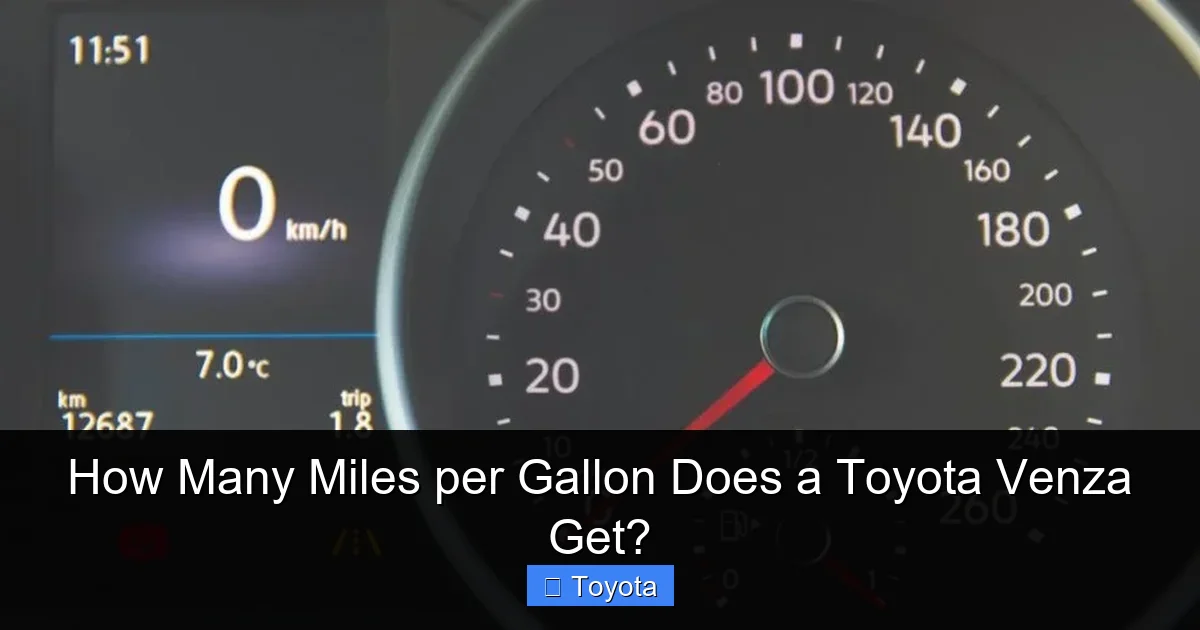
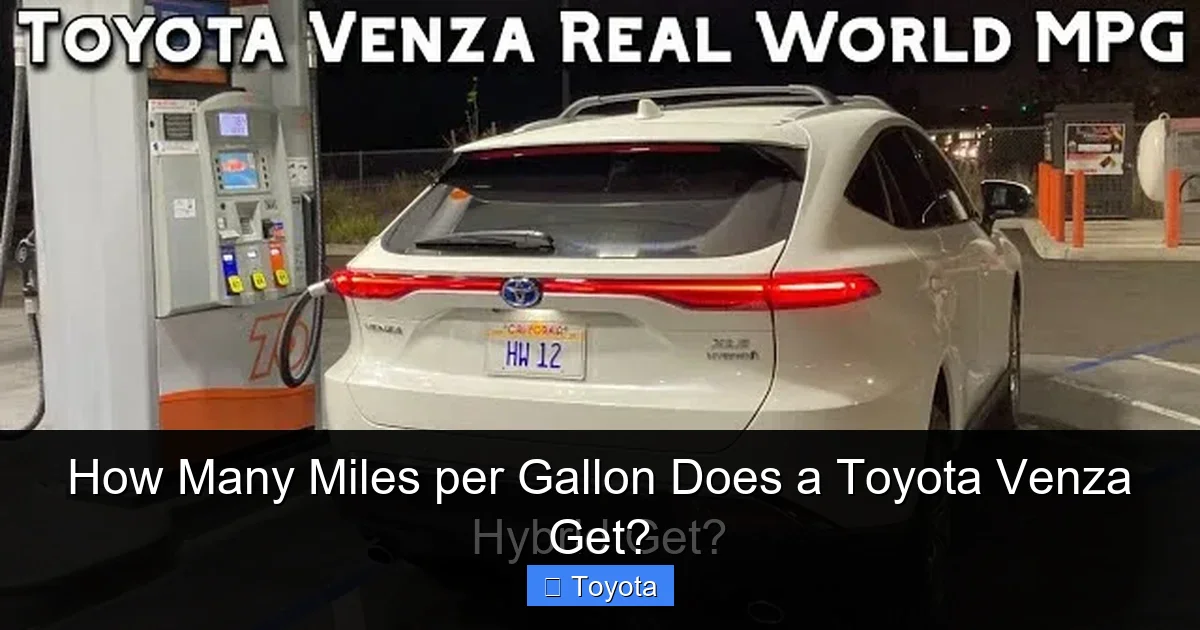
EPA numbers are useful benchmarks, but they rarely match everyday driving perfectly. Real-world data comes from owners who track their fuel fill-ups. Websites like Fuelly and forums such as VenzaTalk collect thousands of data points. The consensus shows most drivers achieve between 35 and 38 MPG combined. That is slightly below the EPA combined rating of 39 MPG for FWD models. Several factors explain the gap.
Visual guide about How Many Miles per Gallon Does a Toyota Venza Get?
Image source: aautomotives.com
Why Real-World MPG Differs from EPA Estimates
The EPA test cycle uses specific acceleration rates, speeds, and temperatures. Your daily commute likely involves faster highway speeds, more aggressive merging, and climate control use. Running the air conditioning or heater draws energy from the hybrid battery. That forces the gasoline engine to run more often to recharge the battery. Short trips in cold weather are the worst case. The engine must warm up, and the battery operates less efficiently in low temperatures. All of these factors reduce observed MPG.
Highway vs. City Real-World Results
Many owners report their best numbers in suburban mixed driving. Long highway stretches at 75-80 MPH typically yield 33-35 MPG. Aerodynamic drag increases exponentially at higher speeds. The Venza’s sloped roofline helps, but physics still applies. In dense city traffic, the hybrid shines. Owners often see 40-42 MPG in pure urban environments. The regenerative braking system recaptures energy every time you slow down. That energy powers the car at low speeds without using gas.
Seasonal Variations in Fuel Economy
Expect a noticeable drop in winter. Cold temperatures reduce battery capacity and increase internal resistance. The engine runs more frequently to provide cabin heat. Winter blend gasoline also contains less energy per gallon. Combined, these factors can lower your MPG by 3-5 points. A FWD Venza that averages 38 MPG in July might only manage 33 MPG in January. Summer heat has a smaller negative effect, mostly from air conditioning load. Spring and fall typically produce the best real-world numbers.
How the Venza Hybrid System Works
Understanding the technology helps you drive more efficiently. The Venza uses Toyota’s proven Hybrid Synergy Drive. This system combines a 2.5-liter four-cylinder gasoline engine with two electric motor-generators. The front motor drives the wheels and acts as a generator. The second motor handles engine starting, charging, and assists with propulsion. In all-wheel-drive models, a third motor powers the rear axle independently. There is no traditional transmission. Instead, an electronic continuously variable transmission (eCVT) blends power sources seamlessly.
Visual guide about How Many Miles per Gallon Does a Toyota Venza Get?
Image source: aautomotives.com
The Role of the Hybrid Battery
A sealed nickel-metal hydride battery pack sits under the rear seats. It stores energy captured during braking and coasting. The battery also provides electricity for EV mode. This allows the Venza to move at low speeds on electricity alone. The system manages the battery charge automatically. You never need to plug it in. The engine starts and stops imperceptibly to keep the battery in its optimal range. This self-charging design is the hallmark of Toyota’s hybrid approach.
EV Mode and When It Activates
Press the EV mode button, and the Venza will attempt to run on electricity alone. This works at speeds up to about 25 MPH. The battery must have sufficient charge. The climate control demands must be low. EV mode is perfect for parking lots, drive-thrus, and quiet neighborhoods. It disengages automatically if you press the accelerator hard or exceed the speed limit. Using EV mode strategically in stop-and-go traffic can boost your overall MPG by a small margin.
Regenerative Braking Explained
When you lift off the accelerator or press the brake pedal, the electric motor switches to generator mode. It converts the car’s kinetic energy back into electricity. This energy flows into the hybrid battery. The brake pedal feel remains normal because the system blends regenerative and friction braking smoothly. Anticipating stops and braking gently maximizes energy recovery. Hard braking wastes energy as heat through the friction brakes. Smooth driving habits directly improve fuel economy.
Driving Tips to Maximize Your Venza MPG
You have more control over fuel economy than you might think. Small adjustments to your driving style can add 2-4 MPG to your average. These techniques work for any hybrid but are especially effective in the Venza. The instantaneous fuel economy display on the dashboard provides real-time feedback. Use it as a game to keep the bar in the high-efficiency zone.
Visual guide about How Many Miles per Gallon Does a Toyota Venza Get?
Image source: aautomotives.com
Accelerate Gently and Maintain Momentum
Jackrabbit starts force the gasoline engine to work hard. The hybrid system prefers gentle acceleration. Allow the electric motor to do the initial work. Imagine there is an egg under your gas pedal. This approach keeps the engine in its most efficient operating range or keeps it off entirely. Once at speed, maintain a steady throttle. Use cruise control on flat highways. Avoid constant speed fluctuations. Every acceleration event consumes extra fuel.
Anticipate Traffic Flow
Look ahead. If you see a red light or slowing traffic, lift off the accelerator early. Let the car coast in regenerative braking mode. This recovers energy and saves brake wear. Coming to a complete stop wastes all the momentum you built. If you can time the light and keep rolling, you save significant fuel. This technique is called “driving with load” or “pulse and glide” in hypermiling circles. It works exceptionally well with the Venza’s responsive regen system.
Use Eco Mode for Daily Driving
The Venza offers drive mode selections: Normal, Eco, and Sport. Eco mode remaps the throttle response to be less sensitive. It also reduces climate control power draw. The air conditioning compressor runs less aggressively. The system prioritizes battery usage over engine power. For daily commuting and errands, Eco mode is ideal. You lose nothing in safety or merging capability. The car still accelerates adequately when you press the pedal deeper. Switch to Normal or Sport only for mountain roads or passing maneuvers.
Keep Tires Properly Inflated
Underinflated tires increase rolling resistance. That forces the powertrain to work harder. Check your tire pressure monthly and before long trips. The recommended pressure is listed on the driver’s door jamb. Do not exceed the maximum pressure on the tire sidewall. Proper inflation also improves handling, tire life, and safety. A drop of just 5 PSI below spec can reduce MPG by 1-2%. It is the easiest maintenance task with a direct fuel economy payoff.
Reduce Weight and Drag
Remove roof racks, cargo boxes, and bike carriers when not in use. They ruin aerodynamics, especially at highway speeds. Even an empty roof rack can cost 2-3 MPG at 70 MPH. Clean out the trunk and cabin. Extra weight hurts city MPG more than highway MPG. The Venza has ample cargo space. Use it, but do not treat it as permanent storage. If you need a roof box for a trip, install it only for the duration of that trip.
Venza MPG Compared to Key Competitors
The midsize crossover segment is crowded. Buyers cross-shop the Venza against several strong rivals. Most competitors offer hybrid or plug-in hybrid variants. Comparing EPA combined ratings gives a quick snapshot. Remember that real-world results depend on the same factors discussed earlier. The Venza holds its own but does not always lead the pack.
Toyota Venza vs. Toyota RAV4 Hybrid
The RAV4 Hybrid is the Venza’s corporate sibling. It uses the same 2.5L hybrid system. The RAV4 Hybrid achieves 41 city / 38 highway / 40 combined MPG. It beats the Venza by 1-3 MPG across the board. The RAV4 is lighter, boxier, and more upright. That shape is aerodynamically less efficient at speed but lighter weight wins in the EPA test cycle. The RAV4 also costs less. If maximum MPG is your only goal, the RAV4 Hybrid wins. The Venza counters with a quieter cabin, nicer materials, and standard features that are optional on the RAV4. For more on Toyota pricing, see how much does a Toyota cost.
Toyota Venza vs. Honda CR-V Hybrid
The Honda CR-V Hybrid is a top seller. It uses a 2.0L four-cylinder with two motors. EPA ratings stand at 43 city / 36 highway / 40 combined MPG for AWD models. The CR-V Hybrid beats the Venza AWD in city and combined figures. It matches the Venza FWD on combined MPG. The Honda system feels different. It uses a fixed-gear transmission for the engine at high speeds. Many reviewers praise its smoothness. The CR-V offers more cargo space and a lower starting price. The Venza offers a more upscale interior and standard AWD availability on all trims.
Toyota Venza vs. Ford Escape Hybrid
The Ford Escape Hybrid uses a 2.5L Atkinson-cycle engine with an eCVT. FWD models rate 44 city / 37 highway / 41 combined MPG. That tops the Venza by 2 MPG combined. The Escape Hybrid also offers a plug-in hybrid version with 37 miles of electric range. The Venza has no plug-in option. The Escape’s interior quality lags behind the Venza. Its infotainment system receives mixed reviews. The Venza feels more premium. The Escape costs less. Choose based on whether you prioritize peak efficiency or daily driving refinement.
Toyota Venza vs. Hyundai Santa Fe Hybrid
The Hyundai Santa Fe Hybrid uses a 1.6L turbocharged engine with a 6-speed automatic. It rates 33 city / 30 highway / 32 combined MPG. The Venza beats it handily. The Santa Fe is larger and offers three rows. It is a different class of vehicle. If you need seven seats, the Santa Fe Hybrid is a contender. If you want maximum efficiency in a two-row package, the Venza wins. The Santa Fe Plug-In Hybrid offers 31 electric miles but costs significantly more.
Long-Term Ownership Costs and Fuel Savings
Fuel economy directly impacts your wallet. Let us run some numbers. Assume you drive 15,000 miles per year. Gas costs $3.50 per gallon. A vehicle averaging 25 MPG costs $2,100 annually in fuel. A Venza averaging 37 MPG costs $1,419. That is $681 saved every single year. Over five years, that is $3,405. Over ten years, nearly $7,000. These savings help offset the Venza’s higher purchase price compared to non-hybrid rivals.
Hybrid Battery Longevity and Replacement Cost
Toyota hybrid batteries are famously durable. Many exceed 200,000 miles without issues. The warranty covers 10 years or 150,000 miles in CARB states (8 years/100,000 miles elsewhere). If replacement becomes necessary, a new pack from Toyota costs roughly $2,500-$3,500 installed. Refurbished packs cost less. However, the probability of needing replacement within normal ownership periods is very low. The battery is not a typical maintenance item. It is designed to last the life of the vehicle.
Maintenance Savings with Hybrid Technology
Hybrids save money beyond fuel. Regenerative braking reduces brake pad wear dramatically. Many Venza owners go 80,000-100,000 miles on original brake pads. The gasoline engine runs less often, reducing oil change frequency. The eCVT has no belts, clutches, or torque converters to wear out. There is no starter motor or alternator to fail. The hybrid system components are largely maintenance-free. These factors lower the total cost of ownership significantly.
Resale Value Considerations
Toyota hybrids hold their value exceptionally well. The Venza benefits from Toyota’s reputation for reliability and the growing demand for fuel-efficient vehicles. After three years, a Venza typically retains 55-60% of its original value. That is above average for the segment. Strong resale value reduces the effective cost of ownership. When you sell or trade, you recoup more of your initial investment. This makes the Venza a smart financial choice for long-term owners.
Frequently Overlooked Factors Affecting Venza MPG
Beyond driving style and weather, several subtle factors influence your real-world fuel economy. Awareness of these helps you set realistic expectations and troubleshoot unexpected drops.
Tire Choice and Tread Wear
The Venza comes with low-rolling-resistance tires from the factory. These tires prioritize efficiency over ultimate grip. When replacement time comes, sticking with similar tires preserves MPG. Switching to aggressive all-terrain or high-performance tires can drop fuel economy by 3-5 MPG. The tread pattern and rubber compound make a measurable difference. As tires wear down, rolling resistance actually decreases slightly. Worn tires can return marginally better MPG than new ones, though safety suffers. Replace tires at 4/32″ tread depth for optimal wet traction.
Fuel Quality and Ethanol Content
Most U.S. gasoline contains 10% ethanol (E10). Ethanol has about 33% less energy per gallon than pure gasoline. Some stations sell E15 or E85. The Venza is not rated for E85. Using higher ethanol blends reduces MPG proportionally. Top Tier gasoline contains detergent additives that keep injectors and valves clean. Clean engines run more efficiently. Using Top Tier fuel from major brands is a cheap insurance policy for long-term performance and economy.
Roof Rails and Crossbars
The Venza features integrated roof rails. They look sleek but disrupt airflow. Adding crossbars for a roof box or kayak rack increases drag significantly. Even without a load, crossbars can reduce highway MPG by 1-2 MPG. Remove them when not in use. If you frequently carry bulky items, consider a hitch-mounted cargo carrier instead. It sits in the vehicle’s wake and has less aerodynamic penalty. The Venza can tow up to 3,500 pounds when properly equipped, so a hitch is a viable option.
Remote Start and Idling Habits
Using remote start to warm up the cabin in winter burns fuel with zero miles gained. The engine runs to generate heat. A 10-minute warm-up consumes roughly 0.1-0.2 gallons. That lowers your tank average. Instead, use heated seats and steering wheel (standard on higher trims). They warm you directly using minimal electricity. Drive gently after 30 seconds. The engine warms faster under load. This approach saves fuel and reduces emissions. Modern engines do not need long idle periods.
Conclusion
The Toyota Venza delivers on its promise of excellent fuel economy in a stylish, comfortable package. With EPA combined ratings of 39 MPG for front-wheel drive and 37 MPG for all-wheel drive, it outperforms most non-hybrid competitors by a wide margin. Real-world averages of 35-38 MPG are achievable for most drivers who adopt smooth driving habits. The standard hybrid system requires no plug-in charging and offers proven reliability backed by a lengthy warranty.
Your actual mileage will vary based on climate, terrain, traffic, and how you drive. The tips outlined here — gentle acceleration, anticipation, Eco mode, proper tire inflation, and reducing drag — can help you meet or exceed EPA estimates. Compared to rivals like the RAV4 Hybrid, CR-V Hybrid, and Escape Hybrid, the Venza trades a few MPG for a quieter, more upscale experience. For many buyers, that balance hits the sweet spot. If you prioritize a premium feel without sacrificing efficiency, the Venza deserves a spot on your test-drive list. Before you visit the dealer, you might also want to check how to break in a new Toyota to protect your investment from day one.
Frequently Asked Questions
What is the MPG of a 2024 Toyota Venza?
The 2024 Toyota Venza achieves 40 MPG city, 37 MPG highway, and 39 MPG combined for front-wheel-drive models. All-wheel-drive versions rate 39 city, 35 highway, and 37 combined MPG.
Does the Toyota Venza require premium gas?
No, the Toyota Venza runs on regular unleaded gasoline (87 octane). Using premium fuel provides no performance or economy benefit for this hybrid powertrain.
How many miles can a Toyota Venza go on a full tank?
With a 14.5-gallon fuel tank and 39 MPG combined, a front-wheel-drive Venza can travel approximately 565 miles on a full tank. Real-world range typically falls between 500-550 miles.
Is the Toyota Venza a plug-in hybrid?
No, the Toyota Venza is a self-charging hybrid only. It does not offer a plug-in hybrid variant. The battery recharges through regenerative braking and engine operation.
Why is my Toyota Venza getting worse gas mileage than the EPA rating?
Common causes include cold weather, short trips, aggressive driving, underinflated tires, roof rack usage, and winter fuel blends. These factors can reduce real-world MPG by 10-15% below EPA estimates.
How does the Venza MPG compare to the RAV4 Hybrid?
The RAV4 Hybrid achieves 40 MPG combined (AWD) versus 37-39 MPG combined for the Venza. The RAV4 is lighter and more upright, giving it a slight efficiency edge despite sharing the same hybrid system.