Why Is My Toyota Corolla Cranking but Not Starting?
When your Toyota Corolla cranks but refuses to fire up, it can be frustrating. This guide walks you through the most common reasons—from fuel and ignition issues to battery problems—and offers step‑by‑step DIY diagnostics. You’ll also learn when it’s best to call a professional rather than guess.
Key Takeaways
- Point 1: Check the battery and connections first; a weak battery often mimics a no‑start condition.
- Point 2: Verify fuel delivery; a clogged injector or empty tank can stop the engine from starting after cranking.
- Point 3: Inspect the ignition system; faulty spark plugs, coils, or timing can prevent combustion.
- Point 4: Examine sensors and wiring; a bad crankshaft position sensor or broken wiring harness can stall the start.
- Point 5: Test the starter and alternator; they may need replacement if they cannot engage the engine.
- Point 6: Use a diagnostic scanner; modern Corollas store trouble codes that point directly to the problem.
📑 Table of Contents
Understanding the Cranking but Not Starting Issue
When you turn the key or press the start button, the engine cranks—meaning the starter motor spins the crankshaft—but the engine never fires. This is different from a silent no‑crank situation, where nothing moves at all. In a Toyota Corolla, a crank‑no‑start can be caused by many things, and the good news is that you can often narrow it down with a few simple checks.
What Does “Cranking but Not Starting” Mean?
Imagine the starter motor as a strong person trying to push a car that’s stuck in gear. The starter spins the engine over, but the fuel‑air mixture doesn’t ignite. You’ll hear the starter’s whine, maybe a slight knock from the engine, yet nothing explodes into life. This symptom usually points to a problem after the engine is being turned over—fuel, spark, or control circuits. It’s not a dead battery (which usually makes a click), and it’s not a broken starter (which may make a grind). The engine is alive, just not kicking.
Why It Happens in a Toyota Corolla
Modern Corollas rely on a delicate dance between fuel delivery, spark generation, and electronic control. If any part of that dance is off, the engine will crank but not start. Common culprits include a dead battery, a clogged fuel filter, faulty spark plugs, or a broken sensor. Even a simple thing like a disengaged clutch switch (on automatic models) can stop the computer from allowing a start. Drivers often notice the brake pedal is not fully depressed, which can trigger a safety lock‑out in newer models.
Common Early Warning Signs
Before the engine completely refuses to start, you may notice warning signs. The RPM gauge may fluctuate, the dashboard lights may dim, or you may smell gasoline. These clues can help you zero in on whether the issue is fuel, spark, or something else. Keeping an eye on these signs can save time and money.
When to Suspect Electronics
Sometimes the problem is not mechanical but electronic. A faulty crankshaft position sensor can tell the ECU the engine isn’t turning, so the ECU won’t allow fuel injection. Similarly, a bad immobilizer module can block the start sequence even though the starter spins. Using an OBD‑II scanner can quickly reveal these electronic fault codes.
If you want to learn more about the latest Corolla pricing, check out our new Toyota Corolla price guide. Knowing the market price can help you feel confident when you decide to buy or sell your vehicle.
Common Causes: Fuel System Problems
The fuel system is often the first suspect when a Corolla cranks but won’t start. The engine needs clean fuel, proper pressure, and a good air‑fuel mix to ignite.
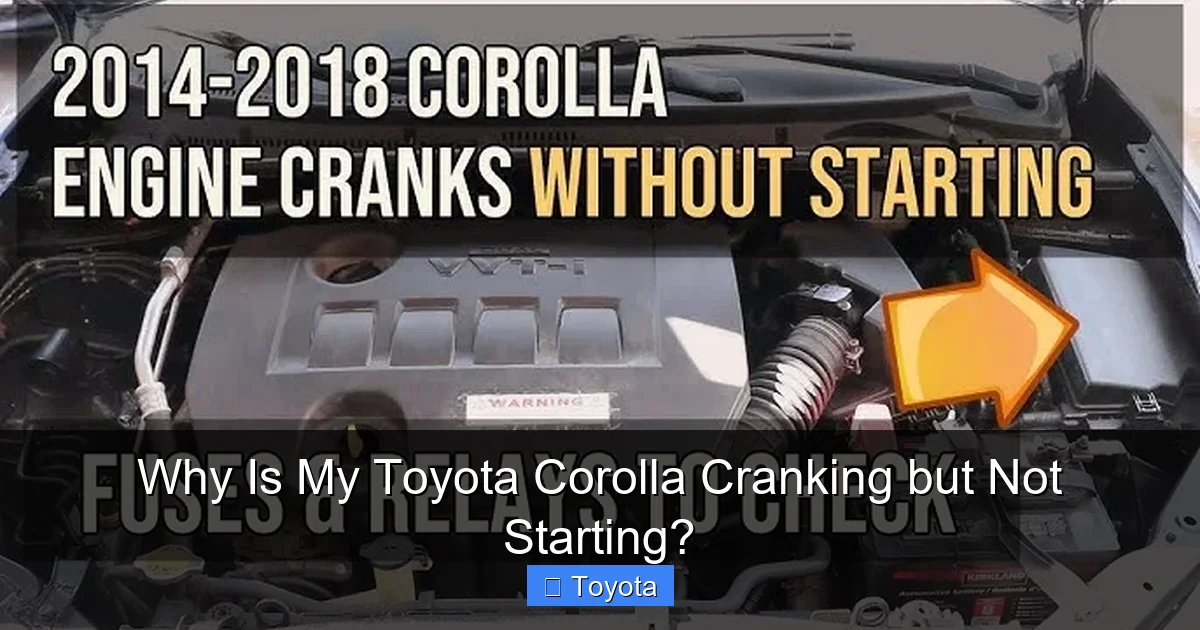
Visual guide about Why Is My Toyota Corolla Cranking but Not Starting?
Image source: automotivian.com
Empty or Stale Fuel
If the tank is empty, the engine obviously can’t start. Even a small amount of water or ethanol‑rich fuel that has sat for months can cause a no‑start. A quick fuel gauge check or a sniff for gasoline can confirm whether you have fuel. In older cars, using fuel stabilizer can prevent this problem.
Fuel Filter Clog
The fuel filter protects the engine from dirt. Over time, it can become clogged, restricting flow. When the engine cranks, it may receive just enough fuel to spin but not enough to fire. Replacing the filter is inexpensive and easy. Most Corolla owners should replace the filter every 30,000 miles, even if the mileage seems low.
Fuel Pump Failure
The fuel pump pushes gasoline from the tank to the engine. A failing pump may give intermittent flow, causing a crank‑no‑start. You’ll often hear a faint pump whine that fades when the key is on. A fuel pressure test can tell you if the pump is still delivering the correct pressure. If the pressure is low, the pump or the fuel lines may need repair.
Injector Issues
Each injector sprays a precise amount of fuel. A cracked injector or one that is stuck open can flood the engine or starve it. You may notice rough idle or a strong smell of gasoline. Cleaning or replacing the injectors often resolves the problem. It’s also wise to check for cylinder‑specific misfires, which can point to a bad injector.
Fuel Quality and Ethanol Mix
Modern gas stations often blend ethanol, which can absorb moisture and degrade over time. If you live in a humid climate, using fuel with a higher ethanol content can lead to phase separation, leaving water in the tank. This water can prevent the fuel pump from delivering proper fuel, causing a crank‑no‑start. Using fuel additives that stabilize ethanol blends can help.
Air‑Fuel Ratio Basics
Even with fuel present, the engine needs the right amount of air. A clogged air filter can starve the engine, while a vacuum leak can cause a too‑rich mixture. Checking the air filter and inspecting vacuum hoses for cracks are quick ways to ensure the air side is not the culprit.
Common Causes: Ignition System Failures
The ignition system creates the spark that lights the fuel‑air mix. When spark is weak or missing, the engine cranks but won’t start.
Visual guide about Why Is My Toyota Corolla Cranking but Not Starting?
Image source: aautomotives.com
Spark Plug Wear
Spark plugs wear down after 30k–100k miles. Dirty or fouled plugs can misfire, especially under load. Swapping them out is cheap and can restore normal starting after a few cranks. Choose the correct heat range for your Corolla model to avoid future fouling.
Ignition Coils
Each cylinder has its own coil (or a coil‑pack). A coil failure reduces spark energy. You may notice a misfire when the engine is running, or a complete lack of spark at start. Swapping a coil is straightforward with basic tools. Many owners find that replacing all coils at once prevents repeated failures.
Timing Belt or Chain Issues
If the timing belt slips or breaks, the pistons and valves get out of sync. The engine will crank but cannot fire safely. A rattling noise or a complete loss of power indicates a timing problem. Replacing the belt or chain is a major job, often best left to a shop. Timing marks must be checked to ensure correct installation.
Distributor (Older Models)
Older Corollas use a distributor to route high voltage. A bad rotor or cap can stop spark distribution. You’ll see oil leaks or corrosion around the distributor. Replacing it is simple and cheap. Make sure the rotor spins freely and the cap has no cracks.
Coil‑On‑Plug vs. Distributor
Modern Corollas use coil‑on‑plug (COP) systems, which are more reliable but can still fail. In COP, each cylinder has its own coil sitting directly on the spark plug. If a COP fails, you may notice a misfire on that cylinder. Diagnosing COP issues often requires a multimeter to test coil resistance.
Spark Plug Gap
Even with good plugs, an incorrect gap can limit spark strength. The gap should be checked with a gauge and adjusted to the spec in your service manual (usually 0.7–0.9 mm for newer Corollas). A proper gap ensures maximum spark energy for reliable starts.
Battery and Electrical Issues
The battery supplies the voltage needed for the starter and the engine control unit (ECU). Weak electrical power can cause a crank‑no‑start.
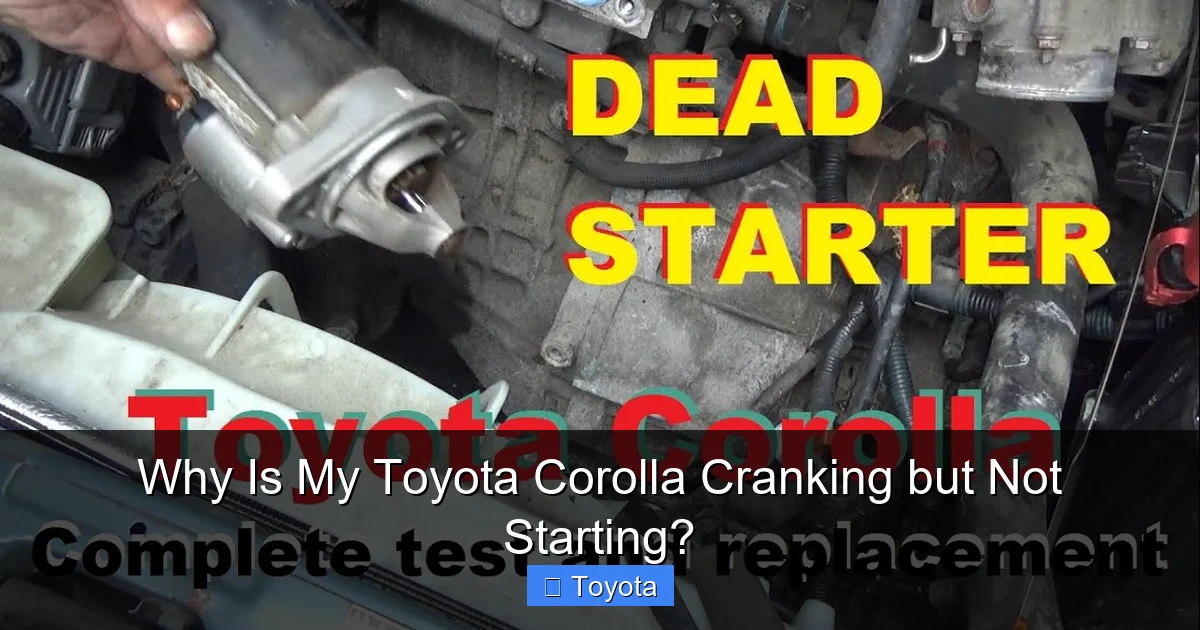
Visual guide about Why Is My Toyota Corolla Cranking but Not Starting?
Image source: i.ytimg.com
Battery Health
Check the battery terminals for corrosion. Use a multimeter to read voltage; a healthy 12.6V battery is good, while anything below 12.2V is weak. Cold weather can drop voltage temporarily, but persistent low readings mean replacement. A load test can also show if the battery holds a charge under starter draw.
Starter Motor
The starter draws a huge current. If it fails, you’ll hear a rapid click or a grinding noise. Sometimes the starter can spin slowly, giving the feeling of cranking but not enough torque to start. Replacing the starter often solves the problem. A quick test with a “starter relay” jump can sometimes confirm if the starter is the issue.
Alternator
While the alternator charges the battery, a failing alternator can drain it while you’re driving. If you start the car after a short drive and it won’t start again, the alternator may be at fault. A simple voltage test will confirm. A warning light on the dash (the battery icon) often accompanies alternator problems.
Electrical Connections
Loose or corroded ground straps can interrupt the flow of electricity. A quick tighten or cleaning of the negative terminal can restore proper operation. Also, ensure the brake pedal is fully up; some Corollas require the brake switch to be on for the ECU to allow starting. For more details, see our article on the brake pedal starting procedure. Additionally, check the fuse box for blown fuses that control the starter circuit.
Security and Immobilizer Systems
Modern Corollas have an immobilizer that requires a key with a transponder. If the key’s battery is dead or the antenna is faulty, the car will not start even though it cranks. Try a second key or have the immobilizer system checked. A simple test is to turn the key to the “on” position and see if the dashboard lights flash; if they don’t, the immobilizer may be locked out.
Power Steering Pump
Though not directly related to starting, a failing power steering pump can cause a whining noise that may be mistaken for starter issues. If the pump seizes, the steering becomes heavy, but the engine may still crank. Checking power steering fluid level and condition can prevent unexpected noises.
Other Potential Culprits: Sensors, Timing, and More
Even when fuel, spark, and battery look good, a range of sensors and mechanical parts can still stop a start.
Crankshaft Position Sensor
This sensor tells the ECU when the crankshaft is in the right position. A failure will make the ECU think the engine isn’t turning, so it won’t fire. You can test the sensor with a multimeter or replace it if it’s out of spec. The sensor is usually located near the crankshaft pulley. A faulty sensor will often trigger a “no start” code P0335.
Camshaft Position Sensor
Similar to the crank sensor, the cam sensor helps set valve timing. A bad cam sensor can cause rough starts or a complete no‑start. Replacement is common and inexpensive. Look for codes P0340 or P0341 when the sensor fails.
Throttle Body Issues
The throttle body controls air flow. If it’s dirty or stuck, the ECU may think the engine is flooded, preventing start. Cleaning the throttle body with a specialized cleaner often solves it. A visual inspection can reveal carbon buildup on the butterfly valve.
Intake Manifold Runner Control
Some newer Corollas have an intake manifold runner control that adjusts airflow. A faulty control can cause a no‑start condition. Resetting the control by disconnecting the battery for a few minutes may clear the issue temporarily.
Security and Immobilizer Systems
Modern Corollas have an immobilizer that requires a key with a transponder. If the key’s battery is dead or the antenna is faulty, the car will not start even though it cranks. Try a second key or have the immobilizer system checked. A simple test is to turn the key to the “on” position and see if the dashboard lights flash; if they don’t, the immobilizer may be locked out.
Low Brake Fluid and Starting
While brake fluid does not directly power the engine, extremely low levels can trigger safety circuits in some vehicles. If you suspect this, our article on low brake fluid and starting issues explains how it can be linked and what to do. Checking brake fluid level is quick and may reveal a leak.
Engine Harness or Wiring Harness Damage
Corrosion or water damage to the main engine harness can cause intermittent communication between components. This may result in a crank‑no‑start that appears random. A visual inspection of the harness for cracked insulation or corroded pins can help. If you find damage, repair or replace the affected section.
Software or ECU Updates
Occasionally, a software glitch in the ECU can prevent the start sequence. Dealerships or independent shops can run a full ECU reset or flash the latest firmware. This is less common but worth considering if all hardware checks pass.
How to Diagnose and Fix the Problem (DIY Steps and When to Call a Pro)
Diagnosis is a step‑by‑step process. Follow these checks before you call a mechanic.
Step 1: Visual Inspection
Look for obvious signs—corroded terminals, cracked hoses, or fluid leaks. Tighten any loose connections and clean corrosion with a wire brush and baking soda solution. Also check for any error codes displayed on the dash; write them down for later reference.
Step 2: Battery Test
Use a digital multimeter. Connect the red lead to the positive terminal and black to negative. A reading of 12.6V means the battery is healthy. If it’s below 12.2V, charge it or replace it. Perform a load test by turning on the headlights while measuring; a good battery will keep the voltage above 10.5V.
Step 3: Fuel System Check
Listen for the fuel pump humming when you turn the key to “ON”. If you hear nothing, the pump may have failed. Also, check the fuel filter for debris. Replacing the filter is a quick fix. If the pump works but the pressure is low, inspect the fuel lines for kinks or leaks.
Step 4: Spark Verification
Remove one spark plug, hold it near the engine block, and crank the engine. You should see a bright blue spark. No spark means a coil or ignition issue. Test the coil resistance with a multimeter; typical values are around 0.5–2 ohms depending on the model.
Step 5: Sensor Tests
Many sensors can be tested with a multimeter. For the crankshaft position sensor, check resistance values against the service manual. If the readings are off, replace the sensor. The camshaft sensor can be checked similarly. Also, inspect the throttle position sensor for proper voltage changes as the throttle is moved.
Step 6: Use a Diagnostic Scanner
Modern Corollas store DTCs (diagnostic trouble codes). Plug a cheap OBD‑II scanner into the dash port (usually under the steering column) and read the codes. Write them down—codes like P0340 (camshaft sensor) or P0335 (crankshaft sensor) point directly to the failing part. Clear the codes after fixing the issue to see if the engine starts.
Step 7: Test the Starter and Solenoid
With the battery good, you can test the starter by listening for a “click” when you turn the key. If you hear a rapid click, the solenoid may be loose. A “tap” the starter with a wrench can sometimes get it working temporarily, but a proper replacement is safer.
When to Call a Pro
If any of the following happen, hand the keys to a mechanic:
- The starter or alternator needs replacement (these parts often require disassembly).
- The timing belt or chain is damaged (this is a major job).
- The immobilizer or security system is faulty (requires specialized tools).
- You have followed all DIY steps and the engine still cranks without starting.
A qualified technician will have access to factory service manuals, pressure gauges, and the ability to reset the ECU after repairs. Remember that a persistent no‑start can be a sign of a deeper mechanical issue that may be expensive to fix.
Final Tips
Keep a simple maintenance log. Record oil changes, filter replacements, and battery checks. Regular upkeep reduces the chance of a crank‑no‑start. Also, store your car in a dry garage if possible; temperature extremes can stress the battery and fuel system.
Finally, never ignore warning lights on the dash. A check engine light may seem minor, but it often relates to sensors that control starting. Catching problems early saves money and keeps your Corolla reliable. If you ever feel uncertain, it’s always better to ask a professional than to risk further damage.
Frequently Asked Questions
Why does my Toyota Corolla crank but not start?
The most common reasons are a weak battery, fuel delivery problems, or ignition failures such as bad spark plugs or coils. A quick check of these systems can often reveal the cause.
Can a dead battery cause a crank‑no‑start?
Yes. A battery that is below 12.2V may not provide enough power for the starter or ECU, so the engine cranks slowly or stalls immediately.
What should I check first when my Corolla won’t start after cranking?
Start with the battery terminals for corrosion, then listen for the fuel pump, inspect spark plugs, and verify the brake pedal is fully up. These are the cheapest and easiest items to test.
Do I need a special tool to diagnose a no‑start issue?
Not necessarily. A multimeter, a basic OBD‑II scanner, and a simple socket set are enough for most DIY diagnoses. If you lack any of these, a professional shop can perform the tests for you.
When should I call a mechanic for a cranking but not starting Corolla?
If you have checked the battery, fuel, spark, and basic sensors and the problem persists, it’s time to call a mechanic. Complex issues like a failed starter, timing belt damage, or immobilizer faults require professional equipment and expertise.
Can low brake fluid affect starting?
While brake fluid does not directly power the engine, extremely low levels can trigger safety circuits in some vehicles, preventing the ECU from allowing a start. Our article on low brake fluid and starting issues explains more.