What Is Invoice Price Cover in Car Insurance
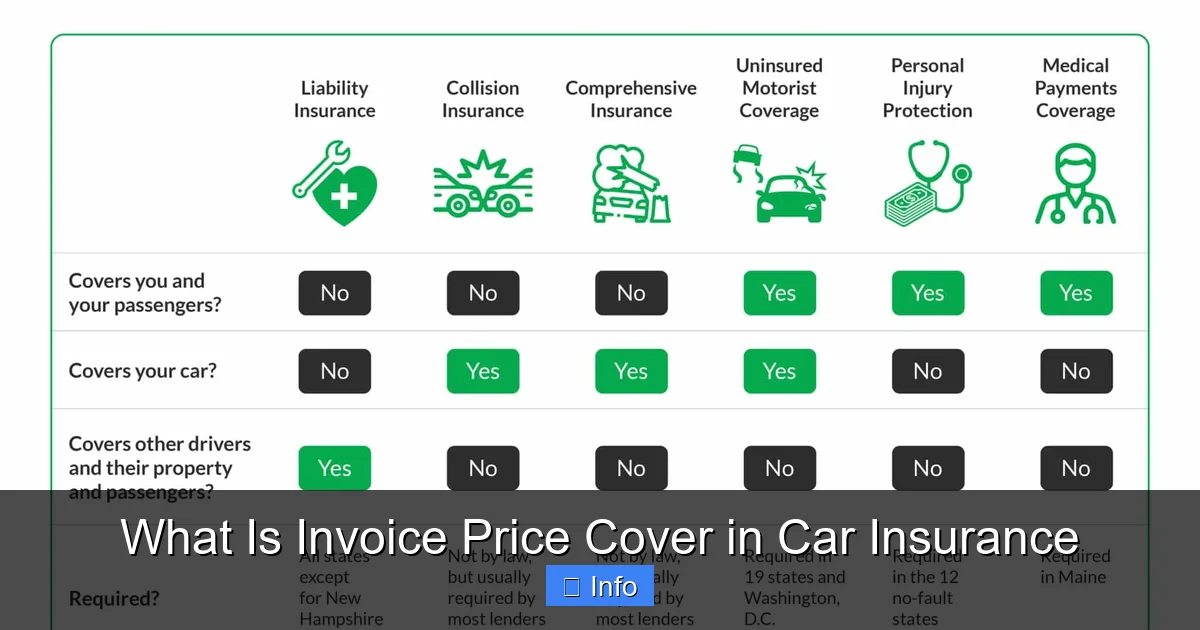
Invoice price cover is an add-on that pays the original invoice price of your car if it’s totaled or stolen, not just its depreciated market value. It bridges the gap between what you paid and what the insurer would normally pay, saving you from a financial shortfall on a new vehicle.
Buying a new car feels great. That new-car smell, the shiny paint, the peace of mind. But there is a hidden risk many drivers overlook. The moment you drive off the lot, your car loses value. Fast. If disaster strikes a year later, your standard insurance pays only what the car is worth then, not what you paid now. That difference can leave you thousands of dollars short. This is where invoice price cover steps in. It is a specific add-on designed to protect your original investment. Let us break down exactly what it is, how it works, and if you need it.
Most people assume their comprehensive policy covers everything. It does not. Standard policies pay the actual cash value (ACV) at the time of the claim. ACV factors in age, mileage, and wear. On a new car, that number drops fast. Invoice price cover ignores that drop. It looks at your sales invoice. It promises to pay that exact figure if the car is written off or stolen. It sounds simple, but the details matter. We will walk through the mechanics, the costs, and the fine print so you can decide with confidence.
Key Takeaways
- Invoice price cover reimburses the original purchase price: It pays the amount on your sales invoice if your car is a total loss, ignoring depreciation.
- It is different from gap insurance: Gap insurance covers the difference between the market value and your loan balance, while invoice cover targets the original price you paid.
- Best for brand-new cars: This add-on is most valuable during the first few years when depreciation is steepest.
- Usually time-limited: Most insurers offer it only for cars up to a certain age, often 12 to 24 months old.
- Costs extra on top of comprehensive policy: You pay a higher premium for this enhanced protection.
- Check for exclusions: Accessories, registration fees, and insurance costs may not be included in the payout.
- Compare with return-to-value cover: Some policies pay the market value at policy start, not the invoice price, so know which you are buying.
📑 Table of Contents
- What Is Invoice Price Cover in Car Insurance?
- Why You Might Need Invoice Price Cover
- How Invoice Price Cover Works in Practice
- Invoice Price Cover vs. Gap Insurance
- Cost and Availability of Invoice Price Cover
- Tips for Buying Invoice Price Cover
- Common Misconceptions About Invoice Price Cover
- Invoice Price Cover for Used Cars
- Real-World Claim Stories
- How to Make a Claim on Invoice Price Cover
- Alternatives to Invoice Price Cover
- Conclusion
What Is Invoice Price Cover in Car Insurance?
Definition and Basics
Invoice price cover is an optional rider you add to a comprehensive car insurance policy. It guarantees that if your car is declared a total loss—due to accident, theft, fire, or flood—the insurer pays the price shown on your original purchase invoice. This includes the base model cost, factory-fitted options, and often dealer-fitted accessories if they were on the invoice. It does not cover fuel, routine maintenance, or aftermarket mods added later.
The keyword here is invoice price cover. It locks in the value at the moment of purchase. Standard policies use market value guides like Glass’s or CAP. Those guides reflect what a similar car sells for today. Invoice cover ignores the market. It looks at your paperwork. If you paid £30,000 and the market value is £22,000 at claim time, the add-on pays £30,000 (minus your excess). That £8,000 difference stays in your pocket.
How It Differs from Standard Coverage
Standard comprehensive insurance indemnifies you. It puts you back in the same financial position as before the loss, using current market value. Invoice price cover goes further. It aims to put you in the position to buy the exact same car again, brand new, at the price you originally paid. It is a “new for old” style benefit but extended beyond the first 12 months that some standard policies offer.
Many standard policies include a “new car replacement” clause for the first year only. If your car is under 12 months old and you are the first registered keeper, they may replace it with a new one. Invoice price cover extends that protection. It typically runs for 24, 36, or even 48 months. It also applies if you are not the first keeper, provided you bought from a dealer and have the invoice. This makes it useful for nearly-new or pre-registered cars too.
Why You Might Need Invoice Price Cover
Depreciation and Its Impact
Depreciation is the silent thief of car value. A new car can lose 15–35% in year one alone. By year three, it might be worth half its invoice price. If you have a loan or lease, you owe the finance company the original amount (plus interest). The insurer pays the current market value. You pay the shortfall. Invoice price cover eliminates that shortfall by paying the invoice price.
Visual guide about What Is Invoice Price Cover in Car Insurance
Image source: create.onlineinvoices.com
Consider a £40,000 car. After two years, market value might be £26,000. You still owe £32,000 on finance. Standard insurance pays £26,000. You owe £6,000 out of pocket. With invoice price cover, you get £40,000. You clear the £32,000 finance and have £8,000 left for a deposit on the next car. That is the power of this add-on.
Loan or Lease Considerations
If you bought outright with cash, you still lose the depreciation hit. You paid £40,000; you get £26,000 back. You lost £14,000 in equity. Invoice cover returns your full £40,000. For financed cars, the risk is sharper. Negative equity traps people in debt cycles. They roll the shortfall into the next loan, paying interest on the gap. Invoice cover breaks that cycle. It is especially relevant if you put down a small deposit or took a long-term loan (5+ years). The loan balance stays above market value for longer.
Lease contracts (PCP, PCH) often include gap insurance as standard or mandatory. But gap insurance covers the finance shortfall, not your deposit or equity. Invoice price cover can protect your cash deposit and any equity built up. Check your lease terms. Some finance houses require specific gap products. You may not be allowed to substitute invoice cover. Always verify with the lessor before buying.
How Invoice Price Cover Works in Practice
Claim Scenario Example
Let us walk through a real-world example. Sarah buys a new hatchback for £28,500 on-the-road. She adds invoice price cover for three years. Eighteen months later, her car is stolen and not recovered. The insurer’s engineer values the car at £19,200 based on age, mileage, and condition. Sarah’s excess is £350.
Visual guide about What Is Invoice Price Cover in Car Insurance
Image source: vedantu.com
Without the add-on: Insurer pays £19,200 minus £350 = £18,850. Sarah loses £9,650 of her original money.
With invoice price cover: Insurer pays £28,500 (invoice) minus £350 = £28,150. Sarah recovers nearly all her cash. She can buy a similar new car again.
The claims process is straightforward. You provide the purchase invoice, finance settlement letter (if applicable), and proof of ownership. The insurer validates the invoice matches the car spec. They pay the invoice amount less excess. If you have finance, they pay the finance company first, then you get the remainder.
Payout Calculation
The payout is usually the lower of: the invoice price on your sales contract, or the cost of a brand-new equivalent model at claim time. If the manufacturer has increased the list price, some policies cap at the original invoice. Others pay the new list price. Read the wording. “Invoice price” means the figure on your VAT invoice from the dealer. It includes VAT, number plates, delivery, and factory options. It excludes fuel, first-year road tax (VED), and insurance premiums.
If you negotiated a discount, the invoice shows the discounted price. That is what you get. You do not get the list price if you paid less. Conversely, if you paid over list (rare, but happens with high-demand models), the policy may cap at manufacturer’s recommended retail price (RRP). Check the “maximum payable” clause.
Invoice Price Cover vs. Gap Insurance
Key Differences
People confuse these two. They are cousins, not twins. Gap insurance (Guaranteed Asset Protection) pays the difference between the market value and your outstanding finance/lease balance. It protects the lender’s interest (and yours by extension). Invoice price cover pays the difference between market value and your original invoice price. It protects your equity.
Visual guide about What Is Invoice Price Cover in Car Insurance
Image source: livemint.com
Gap insurance comes in flavors: Finance Gap, Return-to-Invoice (RTI), Vehicle Replacement (VRI). RTI gap is very similar to invoice price cover. The distinction is often regulatory. Gap insurance is typically a standalone product sold by dealers or specialists. Invoice price cover is an endorsement on your motor policy, regulated by the FCA as part of your insurance. This can make claims smoother—one insurer, one claim, one excess.
Another difference: Gap insurance often covers the insurance deductible (excess) up to a limit. Invoice price cover on your motor policy usually does not cover the excess; you still pay it. However, some comprehensive policies waive the excess for total loss if you have this add-on. Check your schedule.
Which One Should You Choose?
If you have a loan or lease, you need gap protection of some sort. If the dealer includes gap in the finance package, compare its cost and coverage to a standalone policy or the invoice price add-on. If you bought cash or have a small loan, invoice price cover is often better because it returns your full purchase price, not just the loan payoff.
For a cash buyer with a £30k car, gap insurance is useless (no finance gap). Invoice price cover returns £30k. For a PCP buyer with £5k deposit and £25k balloon, RTI gap returns the £30k invoice (clearing finance and giving deposit back). Vehicle Replacement gap goes further: it pays for a new equivalent car even if prices rose. Invoice price cover sits between Finance Gap and RTI Gap. It is simpler, often cheaper, and integrated into your main policy.
Cost and Availability of Invoice Price Cover
Factors Affecting Premium
The cost of adding invoice price cover varies. Expect to pay 10–25% more on your comprehensive premium. For a £500 annual premium, that is £50–£125 extra per year. Factors include: car value, car age, policy term (2, 3, or 4 years), your postcode, driver profile, and insurer appetite. High-performance or luxury cars cost more to cover because the potential payout is higher.
Some insurers bundle it with “new car replacement” for year one, then charge for years two and three. Others sell it as a standalone three-year product. You usually must buy it at policy inception or within 30–90 days of buying the car. You cannot add it mid-term after an accident (obviously) or years later. The car must be under the age limit (often 12 months from first registration) when you buy the cover.
Where to Buy It
You can buy invoice price cover from:
- Your main motor insurer (Direct Line, Aviva, Admiral, LV=, etc.) as an add-on.
- Specialist gap/RTI providers (ALA, Click4Gap, Warranty Direct) as a standalone policy.
- Car dealers at point of sale (often pricier, but convenient).
Dealer-sold products are often Return-to-Invoice Gap, not an endorsement on your motor policy. They work similarly but are separate contracts. Compare total cost over 3 years. Dealer prices can be £300–£500 for three years. Insurer add-ons might be £150–£300 total. However, dealer policies sometimes cover the insurance excess (up to £250) and have fewer exclusions. Read both documents side by side.
If you are shopping for a new policy, check how much is car insurance with and without the add-on. Comparison sites often let you tick “invoice price cover” or “RTI gap” as an option. Get quotes both ways.
Tips for Buying Invoice Price Cover
Read the Fine Print
Every policy has exclusions. Common ones:
- Cars older than 12 months at policy start (some allow up to 24 months for pre-reg).
- Mileage limits (e.g., 10,000 miles per year). Exceeding may void or reduce payout.
- Commercial use (courier, taxi, driving instructor) often excluded.
- Modified cars (non-factory mods) may be excluded or require declaration.
- Total loss must be settled by your comprehensive insurer. If liability is disputed, invoice cover waits.
- Accessories not on original invoice (tow bar, mats, phone holder) not covered.
Also check the “market value cap” clause. Some policies say: “We pay the lower of invoice price or cost of new equivalent.” If the model is discontinued, they may pay invoice. If the model is current but price dropped, they may pay new price (good). If price rose, they may cap at invoice (bad). Know which way it works.
Compare Providers
Do not auto-renew with your current insurer without checking. Use comparison sites. Filter for “invoice price cover” or “return to invoice.” Look at:
- Maximum claim limit (some cap at £50k, £75k, £100k).
- Policy duration options (2, 3, 4, 5 years).
- Excess waiver on total loss.
- Cancellation terms (pro-rata refund if you sell the car early?).
- Claims service ratings (Trustpilot, Which?, Defaqto stars).
If you have a Toyota, you might encounter Toyota-specific gap products. It is worth understanding what does Toyota gap insurance cover to see how manufacturer offerings stack up against generic invoice price cover. Manufacturer gap is often RTI or VRI. Compare the price and term.
Consider Your Ownership Plans
If you keep cars 5+ years, invoice cover for 3 years may not be worth it. Depreciation slows after year 3. The add-on cost over 3 years might exceed the likely gap. Do the math: Estimate depreciation vs. premium cost. If you change cars every 2–3 years, it is more valuable. If you have a large deposit (30%+), your equity buffer reduces the need. If you have zero deposit and 5-year PCP, need is high.
Also, if you are a young driver, premiums are already high. Adding this cover increases cost further. Check how much is teen car insurance to gauge baseline costs before adding extras. Sometimes a higher voluntary excess saves more than the add-on costs.
Common Misconceptions About Invoice Price Cover
“My Comprehensive Policy Already Covers This”
Many drivers think “comprehensive” means “covers everything.” It means comprehensive perils (fire, theft, accidental damage, third party). It does not mean comprehensive valuation. The valuation basis is market value unless you buy an endorsement. Do not assume. Check your policy schedule for “Invoice Price Protection,” “Return to Invoice,” or “New Car Replacement Extended.” If not listed, you don’t have it.
“It Pays for My Aftermarket Upgrades”
You added a £2,000 sound system and £1,500 alloys after purchase. They are not on the dealer invoice. Invoice price cover will not pay for them. You need to declare modifications to your main insurer and possibly increase your sum insured. Some specialist policies let you add “accessories cover” for a set amount (e.g., £3,000). But standard invoice cover sticks to the original invoice.
“I Can Buy It Anytime”
You cannot buy it after an accident. You usually cannot buy it if the car is over 12 months old (from first registration). Some insurers allow up to 180 days after purchase if you have proof of purchase date. But the norm is: buy with the policy or within 30 days. Plan ahead.
“It Covers Mechanical Breakdown”
No. Invoice price cover only triggers on total loss: write-off (Category A, B, sometimes S/N if uneconomical to repair) or theft not recovered. It does not pay for engine failure, gearbox failure, or wear and tear. That is what a warranty or mechanical breakdown insurance is for.
Invoice Price Cover for Used Cars
Can You Get It on a Used Car?
Yes, but with restrictions. Most insurers offer “Return to Invoice” on used cars bought from a franchised dealer (VAT-registered) within the last 30–90 days. The car must usually be under a certain age (e.g., 5–7 years old) and mileage. The cover then pays the invoice price you paid the dealer, not the original new price. This protects the dealer’s margin and your deposit.
Private purchases are almost never eligible. No VAT invoice, no cover. Auction purchases? Rarely, unless from a dealer with a proper invoice. If you buy a 3-year-old car for £18,000 from a main dealer, you can often get RTI cover for 2–3 years. If it’s written off in year 2, you get £18,000 back. That is valuable because used car depreciation is still significant in years 3–5.
Return-to-Value vs. Return-to-Invoice
Some used car products are “Return to Value” (RTV). They pay the market value at the time you bought the policy (Glass’s guide retail), not your invoice price. If you negotiated a great deal below book price, RTV pays more than you paid. If you paid over book, invoice pays more. RTV is cheaper. Invoice is more precise. Know which you are buying.
Real-World Claim Stories
Story 1: The Commuter’s Write-Off
Mark bought a new EV for £42,000. He added 3-year invoice cover for £85/year. At 2 years 3 months, a truck hit his parked car. Total loss. Market value: £28,500. Finance settlement: £34,000. Invoice cover paid £42,000. Finance cleared. Mark got £8,000 cash. He put it toward a new EV. Without cover, he would have owed £5,500 after the £28,500 payout. He calls it “the best £255 I ever spent.”
Story 2: The Stolen SUV
Lisa leased a premium SUV. Lease included mandatory gap insurance (Finance Gap). She also bought invoice price cover separately for £120/year. Car stolen at 18 months. Market value: £38,000. Invoice: £55,000. Lease payoff: £48,000. Finance gap paid £10,000 (£48k – £38k). Invoice cover paid £55,000. But she couldn’t double-dip. Her motor insurer paid £38,000. Gap paid £10,000 to finance. Invoice cover paid the difference to reach £55,000? Actually, coordination of benefits applies. Usually, the motor policy with invoice cover pays £55,000 total. The gap policy becomes redundant. She learned she didn’t need both. She cancelled gap next year.
Story 3: The Near-Miss
Ahmed bought a used approved car for £22,000. He declined invoice cover to save £180/year. At 11 months, flood damage wrote it off. Market value: £17,500. He lost £4,500. He now buys it every time. “The one year I skipped, I needed it. Never again.”
How to Make a Claim on Invoice Price Cover
Step-by-Step Process
- Report the incident to your comprehensive insurer immediately. Get a claim reference.
- If theft, report to police. Get crime reference number.
- Insurer appoints engineer. They assess if total loss.
- If total loss, insurer makes market value offer. You accept or negotiate.
- Once market value agreed, you (or insurer) trigger the invoice cover endorsement.
- Submit: Purchase invoice (VAT), Finance settlement letter (if any), V5C logbook, Proof of ID/address.
- Invoice cover provider calculates top-up: Invoice price minus market value already paid.
- They pay the top-up (minus any applicable excess) to you or finance company.
- You sign discharge forms. Ownership transfers to insurer.
Tip: Keep your invoice, finance agreement, and GAP/invoice cover certificate in a folder (digital and physical). In a stressful total loss, finding paperwork is hard. Photograph the invoice pages showing price, VAT, dealer stamp, VIN, and date.
Disputes and Delays
Disputes arise over: Is it a total loss? (Category S/N can be repaired). What is the true market value? (You can hire an independent engineer). Does the invoice match the spec? (Dealer swapped options). Is the car within age/mileage limits? Most resolve in 2–4 weeks. Complex cases (disputed liability, fraud suspicion) take months. The Financial Ombudsman Service handles unresolved complaints after 8 weeks.
Alternatives to Invoice Price Cover
New Car Replacement (Standard)
Many comprehensive policies include free new car replacement for 12 months if you are the first registered keeper. It replaces with a new same model. If model discontinued, they pay list price. This covers year one. Invoice cover extends to years 2–4. If you only keep cars 12 months, you don’t need invoice cover.
Agreed Value Policies
Classic, modified, or high-value cars can be insured on “agreed value.” You and insurer agree a value upfront (supported by valuation). In total loss, they pay that agreed value. No depreciation argument. Premiums higher. Requires professional valuation. Good for appreciating assets.
Self-Insuring the Gap
Set aside the premium you would pay for invoice cover into a savings account. If no claim, you keep the money. If claim, you have a fund to cover the gap. Risk: early total loss before savings build up. Math: £150/year x 3 years = £450 saved. Potential gap: £8,000. Self-insure only if you can absorb the hit.
Conclusion
Invoice price cover is a smart, targeted add-on for anyone buying a new or nearly-new car from a dealer. It locks in your purchase price against the steep depreciation curve of the first few years. It is not the same as gap insurance, though they overlap. It protects your equity—your cash—where gap protects the finance company’s money. The cost is modest relative to the potential shortfall. The peace of mind is significant.
Before you buy, read the policy wording. Check the age limit, mileage limit, excess treatment, and maximum payout cap. Compare standalone gap products vs. insurer endorsements. Consider your deposit, loan term, and ownership horizon. If you change cars every 2–3 years, finance with low deposit, or simply want your exact purchase price back, invoice price cover is a strong choice. If you keep cars long-term or buy old bangers, skip it.
Insurance is about transferring risks you cannot afford to bear. The risk of a £10,000+ depreciation gap on a new car is real. Invoice price cover transfers that risk for the price of a few tanks of fuel per year. That sounds like a good deal to me. Drive safe, and protect your investment.
Frequently Asked Questions
What exactly does invoice price cover pay out?
It pays the original purchase price shown on your dealer VAT invoice if your car is written off or stolen, minus your policy excess. It does not pay for fuel, road tax, insurance, or aftermarket accessories added after purchase.
Is invoice price cover the same as gap insurance?
No. Gap insurance covers the shortfall between market value and your outstanding finance balance. Invoice price cover covers the shortfall between market value and your original invoice price, protecting your deposit and equity.
Can I buy invoice price cover for a used car?
Yes, many insurers offer it for used cars bought from a franchised dealer within the last 30–90 days, usually up to 5–7 years old. It pays the price you paid the dealer, not the original new price.
How long does invoice price cover last?
Typically 2, 3, or 4 years from the policy start date. You must usually buy it when the car is under 12 months old (from first registration) or within a short window after purchase.
Does invoice price cover pay my insurance excess?
Usually not. The payout is invoice price minus your comprehensive policy excess. Some policies waive the excess for total loss claims if you have this add-on; check your schedule.
What happens if the car manufacturer has increased the list price since I bought it?
Most policies pay the lower of your original invoice price or the current manufacturer’s list price for an equivalent new model. If prices rose, you get your invoice price. If prices fell, you might get the lower current price.