How to Use Sport Mode in a Toyota Camry
Sport Mode in a Toyota Camry sharpens throttle response, holds gears longer, and tightens steering for a more engaging drive. This guide explains exactly how to activate it, when to use it, and how it affects fuel economy and transmission behavior. Master your Camry’s sportier side with confidence.
If you own a modern Toyota Camry, you have likely noticed a button labeled “Sport” or an “S” position on your gear shifter. Maybe you have pressed it once, felt the car change character, and wondered what actually happens under the hood. You are not alone. Many Camry drivers treat Sport Mode like a mystery switch—either avoiding it entirely or using it all the time without knowing why.
The truth is simple: Sport Mode in a Toyota Camry transforms your daily driver into something more responsive without voiding warranties or requiring modifications. It adjusts throttle mapping, shift points, and steering weight through software. No mechanical parts change. Understanding when and how to use it makes every drive more enjoyable, whether you are merging onto a busy freeway or carving through canyon roads on a weekend trip.
Key Takeaways
- Activation is simple: Press the “Sport” button or move the shifter to “S” position depending on your model year.
- Throttle response sharpens: The engine reacts faster to pedal input without adding actual horsepower.
- Transmission holds gears longer: RPMs stay higher before upshifting, keeping power ready for passing or corners.
- Steering feels heavier: Electric power steering firms up for better road feedback and control.
- Fuel economy drops: Expect 2-4 MPG less during spirited driving due to higher engine speeds.
- Best for highways and twisty roads: Use Sport Mode for merging, passing, or winding routes—not daily commuting.
- Does not require premium fuel: Your Camry runs fine on regular unleaded even in Sport Mode.
📑 Table of Contents
- What Sport Mode Actually Changes in Your Camry
- How to Activate Sport Mode by Model Year
- When to Use Sport Mode for Maximum Benefit
- Sport Mode vs. Manual Shifting: What Is the Difference?
- Fuel Economy Impact: Real Numbers
- Common Myths About Sport Mode Debunked
- Pro Tips for Getting the Most from Sport Mode
- Maintenance Considerations for Frequent Sport Mode Users
- Sport Mode in the Camry Hybrid: Special Notes
- Conclusion
What Sport Mode Actually Changes in Your Camry
Let us start with the basics. Sport Mode does not add horsepower. It does not unlock a hidden turbocharger. What it does is reprogram how your car responds to your inputs. Think of it as a personality shift for your Camry’s computer brain.
Throttle Mapping Gets Aggressive
In Normal mode, the throttle pedal is calibrated for smoothness. Press it halfway, and you might get 30% power. The computer prioritizes comfort and fuel efficiency. Switch to Sport Mode, and that same halfway press delivers 60% or more. The curve steepens. The engine feels eager, almost jumpy at first. This is intentional. Toyota engineers want you to feel connected to the powertrain.
You will notice this most when pulling away from a stoplight. The car surges forward with less pedal travel. Merging onto highways becomes easier because you access passing power sooner. Just remember: aggressive throttle mapping means aggressive fuel consumption. Your right foot controls both.
Transmission Logic Rewrites Shift Points
This is where Sport Mode in a Toyota Camry shines. The eight-speed automatic transmission (or CVT on some trims) changes its entire strategy. Instead of upshifting early to keep RPMs low, it holds each gear longer. Revs climb higher before the next gear engages. Downshifts happen quicker when you lift off the gas or brake.
On a 2018-2024 Camry with the eight-speed automatic, you might see 3,500 RPM in second gear where Normal mode would shift at 2,200. The engine stays in its power band. This helps when climbing hills or navigating tight corners where you need instant torque. The transmission also downshifts more willingly during braking, providing engine braking that saves your brake pads.
Steering Weight Increases for Feedback
Electric power steering systems can feel numb. Sport Mode adds artificial weight to the steering rack. The wheel resists your inputs slightly more. This does not make the car turn sharper—it makes you feel the road surface better. You sense groove wander, pavement changes, and front tire grip limits through your fingertips.
On straight highways, the extra weight reduces wandering. On twisty backroads, it builds confidence. Some drivers find it tiring during long commutes. That is why Sport Mode exists as a toggle, not a permanent setting.
How to Activate Sport Mode by Model Year
Toyota has moved the Sport Mode control around over the years. Here is how to find it on your specific Camry.
2018-2024 Camry (XV70 Chassis)
These models feature a dedicated “SPORT” button on the center console, usually near the drive mode selector dial. Press it once. A green “SPORT” indicator lights up on the instrument cluster. Press again to return to Normal. Some trims also offer an “ECO” mode—three distinct settings total.
If your shifter has an “S” gate, you can also slap the lever left from “D” into “S.” This activates Sport Mode and enables manual shift control via paddle shifters or the lever itself. Tap forward to upshift, pull back to downshift. The computer will still protect the engine from over-revving.
2012-2017 Camry (XV50 Chassis)
Older models keep it simple. Look for the “S” position on the gear selector. Move the lever from “D” down to “S.” That is it. No button. The dashboard shows “S” instead of “D.” These six-speed automatics hold gears aggressively in “S” but lack the throttle and steering changes of newer cars. It is mostly a transmission mode.
2025+ Camry (XV80 Chassis)
The newest generation integrates Sport Mode into the drive mode selector on the center console. Rotate the dial to “Sport.” The digital instrument cluster changes theme—often to a red tachometer with a sportier font. You also get paddle shifters standard on most trims. The hybrid models include Sport Mode too, though it behaves differently with the e-CVT.
When to Use Sport Mode for Maximum Benefit
Sport Mode is a tool, not a lifestyle. Using it correctly preserves fuel, reduces wear, and keeps you safe.
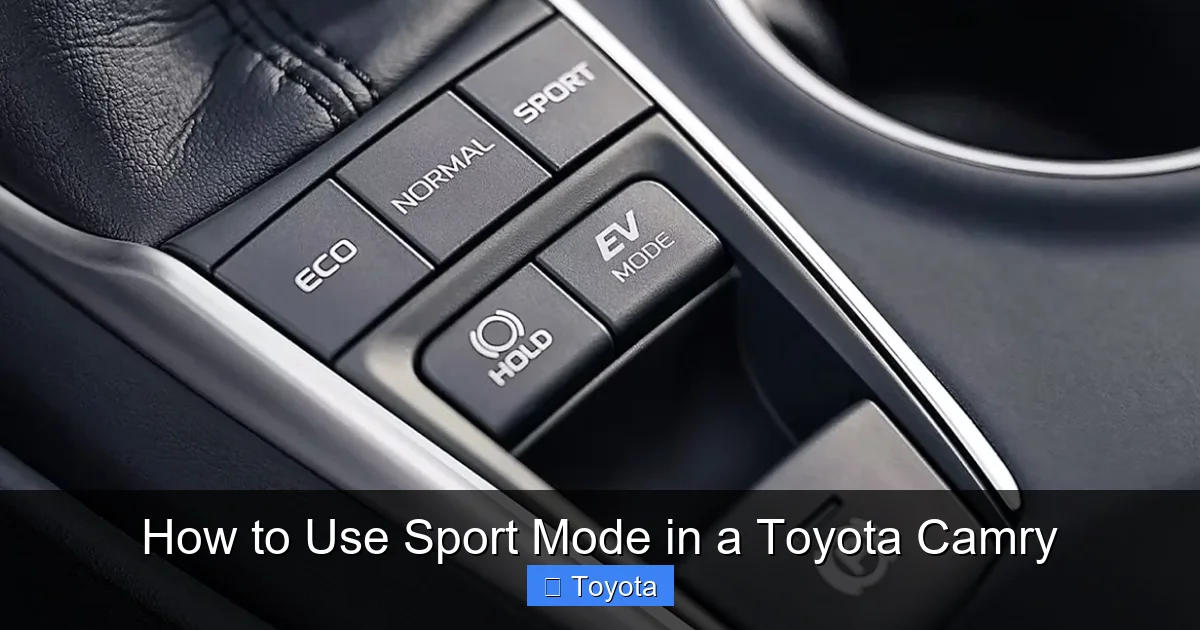
Visual guide about How to Use Sport Mode in a Toyota Camry
Image source: di-enrollment-api.s3.amazonaws.com
Highway Merging and Passing
This is the number one use case. You are on a short on-ramp. Traffic moves fast. You need speed now. Sport Mode lets you floor it from 40 mph and stay in third or fourth gear all the way to 70. No waiting for the transmission to “think.” The power arrives instantly.
Same for passing on two-lane roads. Drop a gear, accelerate hard, complete the pass, shift back up. Done safely and quickly.
Winding Mountain Roads
Headed to the canyons? Sport Mode keeps the engine in its torque peak between corners. You brake into a turn, the transmission downshifts early, and you power out with zero lag. The heavier steering helps you place the front tires exactly where you want them.
Pro tip: Use the paddle shifters to pre-select a gear before a tight hairpin. The car will not upshift unexpectedly mid-corner.
Towing Light Loads
Your Camry can tow up to 1,000 pounds properly equipped. Sport Mode helps by preventing constant hunting between gears on hills. The transmission stays locked in a lower gear, reducing heat buildup. Engine braking on descents saves your brakes. Just remember: Sport Mode does not increase tow rating. Stay within limits.
When NOT to Use Sport Mode
Stop-and-go traffic. The aggressive throttle makes smooth creep difficult. You will lurch forward and brake constantly. Fuel economy tanks. Transmission temperatures rise. Leave it in Normal or ECO.
Rain, snow, or ice. Sharp throttle response can break traction unexpectedly. Heavier steering masks slip angles. Stability control works overtime. Switch to Normal or Snow mode if equipped.
Long highway cruises at steady speed. You gain nothing. The engine spins 300-500 RPM higher at 70 mph. Noise increases. Fuel burns faster. Save Sport Mode for the fun sections.
Sport Mode vs. Manual Shifting: What Is the Difference?
Many drivers confuse Sport Mode with manual mode. They are related but distinct.

Visual guide about How to Use Sport Mode in a Toyota Camry
Image source: i.ytimg.com
Sport Mode Is Automatic with Attitude
You select Sport Mode. The computer still chooses gears. It just chooses them differently—later upshifts, earlier downshifts. You drive normally with pedal and wheel. The car handles the rest. This is perfect for 90% of spirited driving situations.
Manual Mode Gives You Total Control
Move the shifter to “M” or use paddles while in Sport. Now you decide every shift. The computer only intervenes to prevent redline or lugging. This is for track days, steep descents, or drivers who simply enjoy rowing gears.
Here is the catch: modern transmissions shift faster than any human. Manual mode is for engagement, not speed. Use it when you want to feel involved. Use Sport Mode when you want to go fast with less effort.
Fuel Economy Impact: Real Numbers
Let us talk money. Sport Mode in a Toyota Camry costs you at the pump. How much depends entirely on how you drive.
EPA Estimates vs. Reality
A 2023 Camry LE gets 28 city / 39 highway MPG combined. That rating assumes Normal mode driving. Switch to Sport Mode for your daily commute, and you might see 24-26 combined. That is a 10-15% penalty. Over 15,000 miles a year at $3.50/gallon, you spend roughly $250-350 extra.
Hybrid Models Tell a Different Story
The Camry Hybrid uses an e-CVT. Sport Mode here mostly sharpens throttle response and increases regenerative braking aggression. The engine still runs at optimal RPM for efficiency. MPG drop is smaller—maybe 2-3 MPG. If you own a hybrid, feel free to use Sport Mode more often.
Tracking Your Own Numbers
Reset your trip computer when you fill up. Drive one tank in Normal, one in Sport. Same route, same habits. Compare the results. Your right foot matters more than the mode.
Common Myths About Sport Mode Debunked
Internet forums spread misinformation. Let us clear the big ones.
Myth: Sport Mode Voids Your Warranty
False. Sport Mode is a factory-designed feature. Using it as intended cannot void your warranty. Toyota built the transmission, engine, and cooling systems to handle the extra heat and stress. Now, if you launch the car at 5,000 RPM repeatedly and grenade the transmission, that is abuse—not Sport Mode.
Myth: You Need Premium Gas
False. Every Camry since 2018 runs on 87 octane. The engine computer adjusts timing automatically. Sport Mode does not change compression ratio or boost pressure. Put in what the manual says. Save the premium for your lawnmower.
Myth: Sport Mode Wears Out the Transmission Faster
Mostly false. Higher RPMs mean more fluid shear and heat. But the transmission is designed for this. The real killer is heat from towing, not Sport Mode. Change your transmission fluid every 60,000 miles if you use Sport Mode frequently. That is cheap insurance.
Myth: It Makes the Car Faster 0-60
Technically true, but barely. Sport Mode might shave 0.1-0.2 seconds off a 0-60 run by eliminating shift delay. The engine power is identical. The difference is throttle response off the line. For actual speed, you need modifications—not a button.
Pro Tips for Getting the Most from Sport Mode
After years of driving Camrys in every mode, here are the tricks enthusiasts use.
Combine with Paddle Shifters for Corner Exits
Approach a corner in Sport Mode. Brake. The car downshifts. But sometimes it picks the wrong gear. Tap the downshift paddle once before turn-in. You lock in the perfect gear. Accelerate out cleanly. Upshift when you want. This hybrid approach—Sport Mode plus manual override—is the sweet spot.
Use “S” Gate for Engine Braking on Steep Grades
Descending a mountain pass? Shift into the “S” gate (or use paddles to drop two gears). The engine holds back the car. Your brakes stay cool for emergencies. This works in Normal mode too, but Sport Mode makes downshifts more immediate.
Customize Your Instrument Cluster
On 2018+ models with the 7-inch or 12.3-inch digital cluster, switch to the “Sport” display theme when in Sport Mode. You get a prominent tachometer, gear indicator, and sometimes a G-meter. It helps you drive smoother by watching RPM trends.
Know Your Trim Differences
TRD and XSE trims get unique Sport Mode tuning. Stiffer suspension bushings. Different steering rack ratio. More aggressive shift logic. If you test drove a base LE and bought an XSE, your Sport Mode feels sharper. That is intentional.
Maintenance Considerations for Frequent Sport Mode Users
If you enjoy Sport Mode daily, adjust your maintenance schedule slightly.
Transmission Fluid
Toyota says “lifetime fluid.” Enthusiasts say 60,000 miles. Higher RPMs shear fluid faster. A drain-and-fill costs $150-200 at a dealer. Cheap compared to a $4,000 transmission. If you track your car, do it every 30,000.
Brake Pads
Sport Mode encourages harder driving. You brake later and harder. Pads wear faster. Check them every oil change. Front pads on a Camry last 40,000-60,000 miles normally. Sport Mode drivers might see 30,000-40,000.
Tires
Aggressive cornering scrubs front tires. Rotate every 5,000 miles. Check alignment annually. The heavier steering in Sport Mode masks alignment pull until tires are ruined.
Engine Oil
Higher average RPMs mean more blow-by and fuel dilution. Stick to 5,000-mile changes with 0W-16 or 0W-20 synthetic. Do not extend to 10,000 even if the monitor says okay.
Sport Mode in the Camry Hybrid: Special Notes
The hybrid Camry deserves its own section. The e-CVT has no gears. Sport Mode works differently.
What Changes
Throttle mapping sharpens significantly. The gas engine runs more often and at higher RPM. Regenerative braking increases when you lift off the pedal—the car slows harder, putting more charge into the battery. Steering weight increases like the gas model.
What Stays Same
No shift points to hold. The e-CVT varies ratio continuously. You cannot “downshift” for engine braking the same way. The “B” mode on the shifter provides stronger regen for descents instead.
MPG Impact
Expect 3-5 MPG drop in mixed driving. The hybrid advantage shrinks but remains. You still beat any gas-only midsize sedan. Use Sport Mode freely—the battery buffers the engine stress.
Conclusion
Sport Mode in a Toyota Camry is one of those features that sounds marketing-fluff until you actually use it properly. It transforms the car from a comfortable appliance into a willing partner on interesting roads. The changes are subtle but meaningful: sharper throttle, smarter shifts, heavier steering. Together, they create a driving experience that respects the driver.
You do not need to be a car enthusiast to appreciate it. Next time you face a short merge lane or a winding detour, press that button. Feel the difference. Then switch it off when you return to the daily grind. Your Camry can be two cars in one. That is the beauty of modern engineering—versatility without compromise.
Just remember: Sport Mode is a tool. Use it when the situation calls for response. Save fuel when it does not. Maintain your car well. And above all, enjoy the drive. That is what your Camry was built for.
Frequently Asked Questions
Does Sport Mode use more gas in a Toyota Camry?
Yes, Sport Mode typically reduces fuel economy by 2-4 MPG because the engine runs at higher RPMs and the throttle response encourages more aggressive acceleration. The exact impact depends on your driving style and traffic conditions.
Can I switch to Sport Mode while driving?
Absolutely. You can activate Sport Mode at any speed by pressing the Sport button or moving the shifter to the S position. The transition is seamless and does not require stopping or slowing down.
Is Sport Mode bad for my Camry’s transmission?
No, Sport Mode is engineered by Toyota and will not damage your transmission. The system operates within factory-designed parameters. However, frequent high-RPM driving may warrant more frequent transmission fluid changes.
Does the Camry Hybrid have Sport Mode?
Yes, all current Camry Hybrid models include Sport Mode. It sharpens throttle response, increases regenerative braking, and runs the gas engine more frequently, though it works differently than the gas model since there are no traditional gears.
What is the difference between Sport Mode and the S gear position?
On newer Camrys, the Sport button and S position activate the same system. On older models (2012-2017), the S position only changes transmission shift points without affecting throttle mapping or steering weight.
Should I use Sport Mode in the rain or snow?
No. Sport Mode’s aggressive throttle response can cause wheel spin on slippery surfaces, and heavier steering may mask traction loss. Use Normal mode or Snow mode (if equipped) for wet or winter conditions.