How Long Do Struts Last on a Toyota
Toyota struts typically last between 50,000 and 100,000 miles depending on driving conditions and maintenance habits. Regular inspections and prompt replacement of worn components can help you avoid costly repairs and keep your Toyota riding smoothly for years to come.
If you own a Toyota, you probably appreciate its reputation for reliability and longevity. But even the most dependable vehicles have parts that wear out over time. One of those parts is the strut assembly. You might be wondering how long do struts last on a Toyota before they need attention. The answer isn’t a single number. It depends on your specific model, your driving habits, and the roads you travel every day.
In this guide, we will break down everything you need to know about Toyota strut life. We will cover the average mileage expectations, the factors that shorten or extend that lifespan, and the clear warning signs that tell you it is time for a replacement. Whether you drive a Camry, a Corolla, a RAV4, or a Tacoma, this information will help you plan for maintenance and keep your ride safe and comfortable.
Key Takeaways
- Average lifespan: Most Toyota struts last 50,000 to 100,000 miles under normal driving conditions.
- Driving habits matter: Rough roads, heavy loads, and aggressive driving can cut strut life significantly.
- Warning signs: Bouncing, nose-diving, uneven tire wear, and leaking fluid indicate worn struts.
- Model differences: Trucks like the Tacoma and Tundra may need earlier replacement due to heavier use.
- Replace in pairs: Always replace struts in axle pairs for balanced handling and safety.
- Alignment is critical: Get a wheel alignment after strut replacement to prevent premature tire wear.
- Inspect regularly: Check struts during every oil change or at least once per year.
📑 Table of Contents
What Are Struts and Why Do They Matter
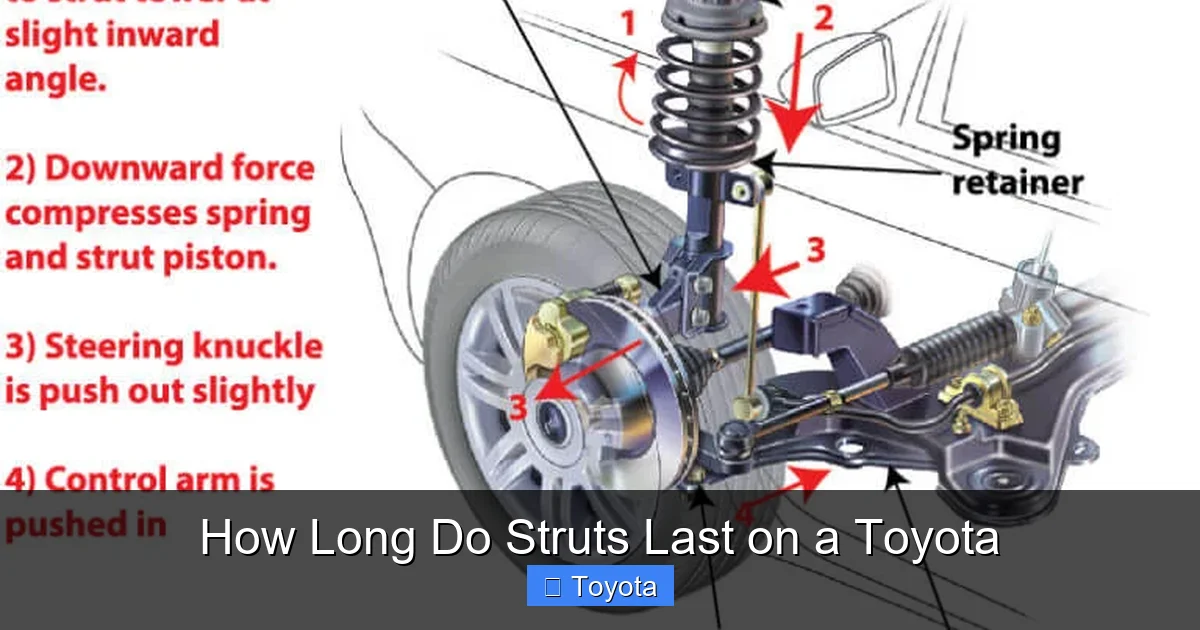
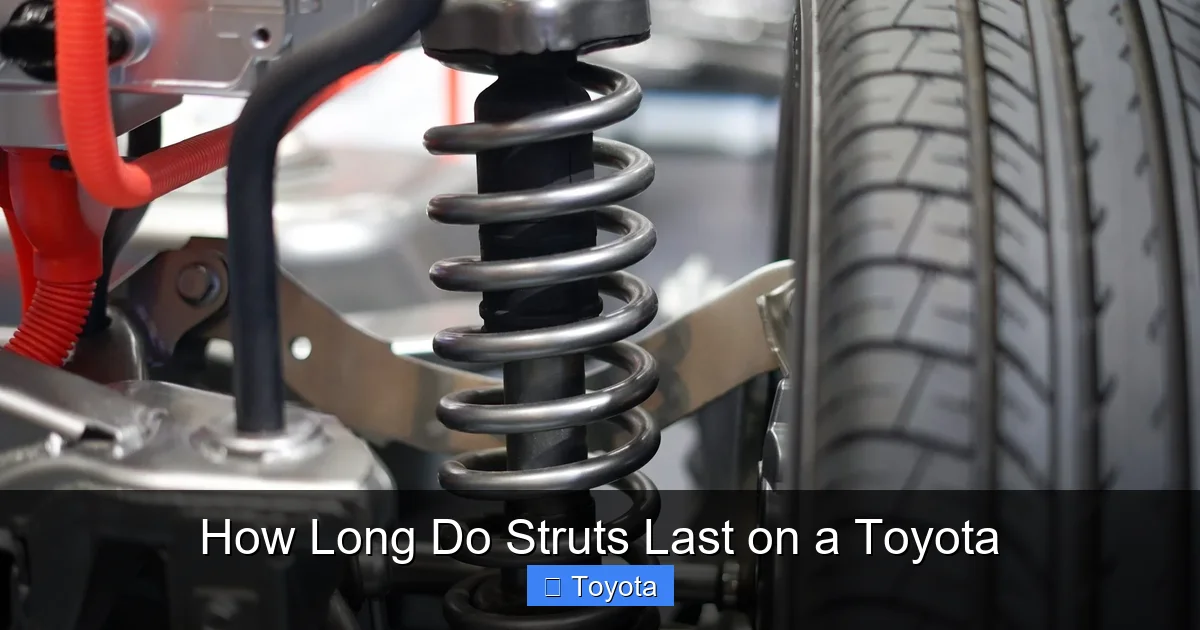
Before we dive into the numbers, let’s make sure we are on the same page about what struts actually do. Struts are a structural part of your Toyota’s suspension system. They combine a shock absorber and a coil spring into a single unit. This design saves space and reduces weight compared to separate shocks and springs.
The Role of Struts in Your Suspension
Struts perform two critical jobs. First, they support the weight of the vehicle. The coil spring portion holds up the car’s body. Second, they dampen the movement of the suspension. The shock absorber portion controls the up-and-down motion caused by bumps, potholes, and cornering forces. Without healthy struts, your Toyota would bounce uncontrollably after every bump.
Struts vs Shocks: The Key Difference
Many people use the terms interchangeably, but they are different. A shock absorber is a standalone cylinder that only controls motion. A strut is a structural component that also serves as a pivot point for the steering system. On most modern Toyotas, the front suspension uses struts (MacPherson strut design), while the rear may use either struts or separate shocks depending on the model and year.
Typical Lifespan of Toyota Struts
So, how long do struts last on a Toyota in the real world? The general industry guideline is 50,000 to 100,000 miles. However, Toyota struts are known for their durability. Many owners report getting 100,000 to 150,000 miles out of the original equipment on sedans like the Camry and Corolla when driven gently on good pavement.
Visual guide about How Long Do Struts Last on a Toyota
Image source: ricksfreeautorepairadvice.com
Mileage Guidelines by Vehicle Type
The type of Toyota you drive plays a big role in strut longevity. Here is a rough breakdown:
- Sedans (Camry, Corolla, Avalon): 80,000 – 120,000 miles typical.
- SUVs/Crossovers (RAV4, Highlander, 4Runner): 70,000 – 100,000 miles typical.
- Trucks (Tacoma, Tundra): 60,000 – 90,000 miles typical, often less if used for hauling/towing.
- Performance Models (GR Corolla, GR86, Supra): 50,000 – 80,000 miles due to stiffer tuning and spirited driving.
Time vs Mileage
Mileage isn’t the only factor. Rubber bushings, seals, and the hydraulic fluid inside the strut degrade over time. Even a garage-kept Toyota with low mileage can develop strut issues after 7 to 10 years. The seals dry out, and the fluid loses its viscosity. If your car is over 10 years old, have the struts inspected regardless of the odometer reading.
Factors That Affect Strut Longevity
Why do some Toyota struts last 150,000 miles while others fail at 40,000? It comes down to the conditions they endure. Understanding these factors helps you predict when yours might need service.
Visual guide about How Long Do Struts Last on a Toyota
Image source: i.ytimg.com
Road Conditions and Climate
This is the biggest variable. If you live in an area with smooth highways and mild weather, your struts will last much longer. Conversely, daily driving on pothole-ridden streets, gravel roads, or roads treated heavily with salt in winter will accelerate wear. Salt is particularly damaging. It corrodes the strut body, damages the chrome piston rod, and eats away at the mounting hardware.
Driving Style and Load
Aggressive driving—hard braking, fast cornering, hitting speed bumps without slowing down—puts immense stress on the valving inside the strut. Similarly, regularly carrying heavy loads or towing near your vehicle’s maximum capacity compresses the springs and works the dampers harder. A Tacoma used as a daily commuter will keep its struts far longer than an identical Tacoma used for construction work.
Maintenance Habits
Neglecting related components kills struts early. Worn control arm bushings, bad ball joints, or unbalanced tires transmit excess vibration and shock to the strut assembly. Keeping your overall vehicle wear and tear in check through regular inspections protects your suspension investment.
Quality of Replacement Parts
If you have already replaced your struts once, the brand you chose matters. Genuine Toyota parts or high-quality aftermarket brands (KYB, Monroe, Bilstein, Tokico) often match or exceed the original lifespan. Cheap, no-name struts from discount retailers might only last 20,000 to 30,000 miles. You truly get what you pay for here.
Signs Your Toyota Struts Need Replacement
Struts rarely fail catastrophically. They degrade slowly, which means the driver often adapts to the worsening ride without realizing it. Here are the clear signals that your struts are worn out.
Visual guide about How Long Do Struts Last on a Toyota
Image source: familyhandyman.com
The Bounce Test
This is the classic DIY check. Push down hard on one corner of the bumper and let go. The car should return to its resting position and stop immediately. If it continues to bounce more than 1.5 times, the damper is worn. Test all four corners. Note that this test is less reliable on heavy trucks like the Tundra where body mass dampens the motion naturally.
Nose Diving and Squatting
When you brake firmly, does the front end dip dramatically? That is nose dive. When you accelerate hard (or load the trunk), does the rear sag excessively? That is squat. Both indicate the struts can no longer control weight transfer effectively. This increases stopping distance and reduces stability.
Uneven Tire Wear Patterns
Worn struts allow the tire to bounce off the road surface microscopically. This creates a cupping or scalloping pattern on the tread. You will feel high and low spots if you run your hand along the tire. Cupped tires roar at highway speeds. If you see this, your struts are likely shot, and you will need tires too. Getting a proper steering alignment after strut replacement prevents this from happening to the new tires.
Leaking Fluid
Look behind the front wheels (and rear if accessible). Struts are sealed units. If you see oily residue running down the strut body from the top seal, the hydraulic fluid is escaping. A light film of “weepage” is sometimes considered normal on high-mileage units, but active dripping or a wet, dusty coating means the seal has failed. The strut will lose damping ability rapidly once fluid is lost.
Steering and Handling Changes
Does the steering feel loose or vague? Do you hear clunking noises over bumps, especially when turning? Worn strut mounts (the bearing plate at the top) cause binding and noise. Excessive body roll in corners suggests the struts aren’t controlling lateral weight shift. On trucks, a worn track bar or related components can mimic strut symptoms, so inspect the track bar as well if you drive a solid-axle Toyota truck.
How to Extend the Life of Your Struts
You cannot stop wear entirely, but you can definitely slow it down. A few simple habits add tens of thousands of miles to your strut life.
Drive Defensively for Your Suspension
Slow down for potholes, speed bumps, and railroad crossings. Avoid slamming on the brakes at the last second. Take corners at moderate speeds. These habits reduce the peak forces your struts must absorb. Think of it as “mechanical sympathy.” Your wallet will thank you.
Keep Your Tires Inflated and Rotated
Underinflated tires transmit more road shock to the suspension. Overinflated tires make the ride harsh and reduce the tire’s ability to absorb small bumps, transferring that energy to the struts. Check pressure monthly. Rotate tires every 5,000 to 7,500 miles to ensure even wear, which keeps the suspension loading balanced.
Don’t Overload Your Vehicle
Check the door jamb sticker for your Toyota’s Gross Vehicle Weight Rating (GVWR) and payload capacity. Exceeding these limits, even occasionally, overstresses the springs and blows out the strut valves. If you regularly haul heavy gear, consider upgrading to heavy-duty or load-leveling struts designed for that purpose.
Address “Minor” Issues Promptly
A torn CV boot, a leaking brake line, or a loose sway bar link might seem unrelated. But fluid contamination degrades rubber bushings and strut seals. Loose suspension parts create impact loads that hammer the struts. Fixing small problems early prevents a cascade of failures.
Wash the Undercarriage in Winter
If you live in the rust belt, get an undercarriage wash at least once a month during winter. Removing road salt prevents corrosion of the strut rod and housing. A corroded rod tears the seal instantly, leading to immediate fluid loss. This is the single best thing you can do for suspension longevity in snowy climates.
Replacement Costs and What to Expect
When the time comes, knowing the costs helps you budget and avoid surprises. Prices vary widely by model, location, and parts choice.
Parts Cost Breakdown
- Economy Aftermarket (pair): $100 – $200. Brands like Monroe OESpectrum or KYB Excel-G. Good for basic transportation.
- Premium Aftermarket (pair): $250 – $450. Brands like Bilstein B6, KYB AGX, or Monroe Quick-Strut assemblies. Better valving, longer life.
- Genuine Toyota (pair): $400 – $700+. Exact OE fit and tuning. Often the best value long-term for daily drivers.
- Complete Strut Assemblies (Quick-Struts): $150 – $350 per side. Includes spring, mount, and bearing. Saves labor time. Highly recommended for DIYers.
Labor Costs
Expect 2 to 4 hours of labor for a pair of front struts. Rear struts are often easier (1 to 2 hours). At a typical independent shop rate of $100-$150/hour, labor runs $200-$600 per axle. Dealerships charge more ($150-$200/hour) but use factory parts and techs who know your specific model.
Total Job Estimates
- Front Struts (Corolla/Camry): $450 – $900 total.
- Front Struts (RAV4/Highlander): $550 – $1,100 total.
- Front Struts (Tacoma/Tundra): $500 – $1,000 total.
- All Four Corners: Double the above, minus a slight labor overlap discount.
The Alignment Requirement
Never skip the alignment after strut replacement. Strut removal changes the suspension geometry. Even if the old struts were perfectly aligned, the new ones will sit slightly differently. Driving without an alignment destroys tires in a few thousand miles. Budget $100-$150 for a four-wheel alignment. It is mandatory, not optional.
DIY Considerations
Replacing struts is an intermediate DIY job. You need a floor jack, jack stands, impact wrench (highly recommended), spring compressors (if not using Quick-Struts), and a torque wrench. The danger lies in compressing coil springs. If a spring slips, it can cause severe injury or death. If you are not 100% confident, pay a professional. The labor savings aren’t worth the risk.
Model-Specific Strut Notes for Popular Toyotas
While the general principles apply to all Toyotas, certain models have quirks worth knowing.
Toyota Camry (1997-Present)
Camrys are gentle on front struts. The rear struts on XV40/XV50 generations (2007-2017) sometimes develop a “clunk” from the upper mount before the damper fails. Quick-Struts are widely available and affordable. The hybrid models carry extra battery weight, so expect slightly shorter front strut life.
Toyota Corolla (2003-Present)
Lightweight and easy on suspension. Corolla struts often last 120,000+ miles. The rear uses a simple shock absorber on many generations (not a strut), which lasts even longer. Check the rear shock mounts for rust on older models in salt states.
Toyota RAV4 (2006-Present)
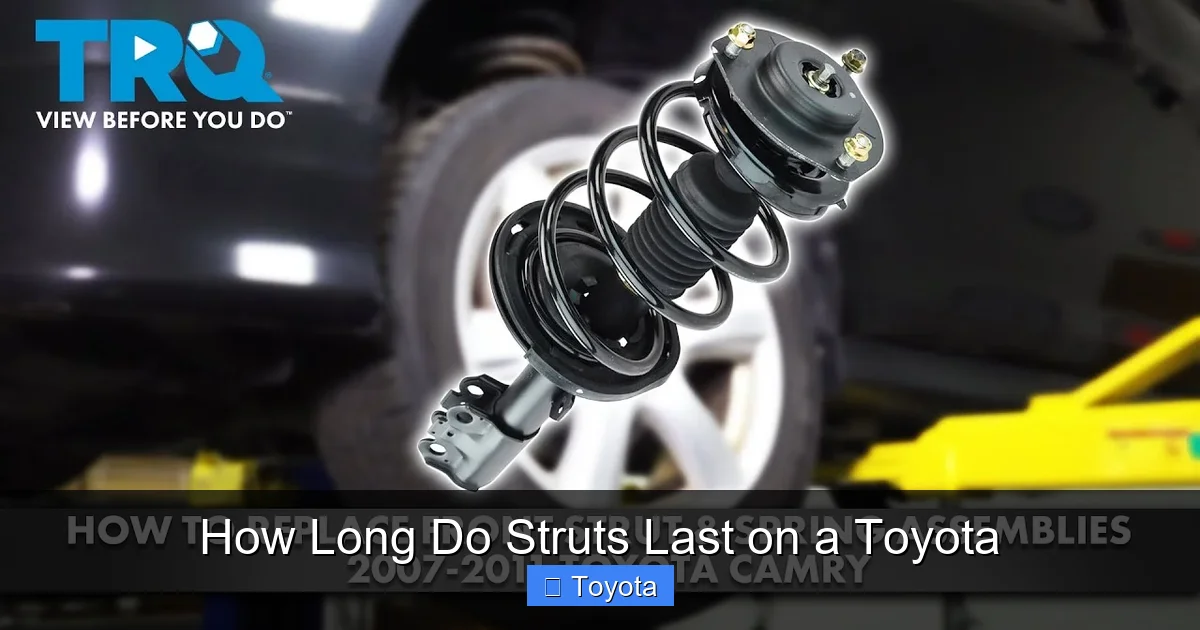
The RAV4’s higher center of gravity and heavier body work the struts harder. Third generation (2006-2012) front strut mounts are a known wear item. Fourth and fifth gen models benefit from Quick-Strut assemblies due to the integrated spring seat design.
Toyota Tacoma (2005-Present)
Second and third gen Tacomas use a coil-over front strut design. They are robust but the lower control arm bushings wear early, mimicking strut noise. If you lift your Tacoma, you need longer struts or spacers. Stock struts will top out and fail quickly on a lifted truck.
Toyota Tundra (2007-Present)
Tundras use front coil-overs similar to the Tacoma but heavier. The rear uses separate shocks and coil springs (or leaf springs on older models). Towing heavy trailers kills rear shocks fast. Consider Bilstein 5100s or similar heavy-duty units if you tow regularly.
Toyota 4Runner (2003-Present)
Fifth gen (2010+) front struts are durable but the KDSS (Kinetic Dynamic Suspension System) models have unique valving. KDSS struts are expensive and not interchangeable with non-KDSS units. Verify your VIN before ordering.
Conclusion
Understanding how long do struts last on a Toyota gives you the power to maintain your vehicle proactively. While the 50,000 to 100,000-mile range is a solid baseline, your actual experience will depend heavily on where and how you drive. The key takeaway? Don’t wait for a catastrophic failure. Pay attention to the subtle changes in ride quality, handling, and tire wear. Inspect your struts visually once a year. Replace them in pairs when the signs appear. And always, always get an alignment afterward.
Your Toyota was engineered for the long haul. With proper strut maintenance, it will deliver the smooth, controlled, and safe ride you expect for hundreds of thousands of miles. Treat your suspension well, and it will return the favor every time you hit a pothole, take a corner, or brake suddenly in traffic. Safe travels.
Frequently Asked Questions
How often should I replace struts on my Toyota?
Most Toyota struts need replacement between 50,000 and 100,000 miles. However, you should have them inspected annually after the 50,000-mile mark or if you notice any handling changes. Harsh climates and rough roads can shorten this interval significantly.
Can I drive with bad struts on my Toyota?
You can drive with worn struts, but it is not safe. Bad struts increase stopping distances, reduce cornering stability, cause uneven tire wear, and accelerate wear on other suspension components. Replace them as soon as symptoms appear.
Do I need to replace all four struts at once?
It is best practice to replace struts in axle pairs (both front or both rear) to maintain balanced handling. If the front struts are worn but the rears are still good, you only need to replace the front pair. However, if all four are high-mileage, doing them together saves on alignment costs.
What is the difference between a strut and a shock on a Toyota?
A strut is a structural suspension component that supports vehicle weight and serves as a steering pivot. A shock absorber only dampens motion. Most Toyotas use front struts (MacPherson design) and either rear struts or rear shocks depending on the model.
How much does it cost to replace struts on a Toyota Camry?
Replacing front struts on a Toyota Camry typically costs $450 to $900 for parts and labor combined. Rear struts are slightly less. A four-wheel alignment ($100-$150) is required after the job. Prices vary by location and parts quality chosen.
Will new struts improve my Toyota’s ride quality?
Yes, new struts restore the original ride quality, handling precision, and braking stability. You will notice less bouncing, better control over bumps, reduced body roll in corners, and the elimination of clunking noises from worn mounts. It feels like a new car again.