A Car Starts from Rest and Accelerates at 5 M/s2
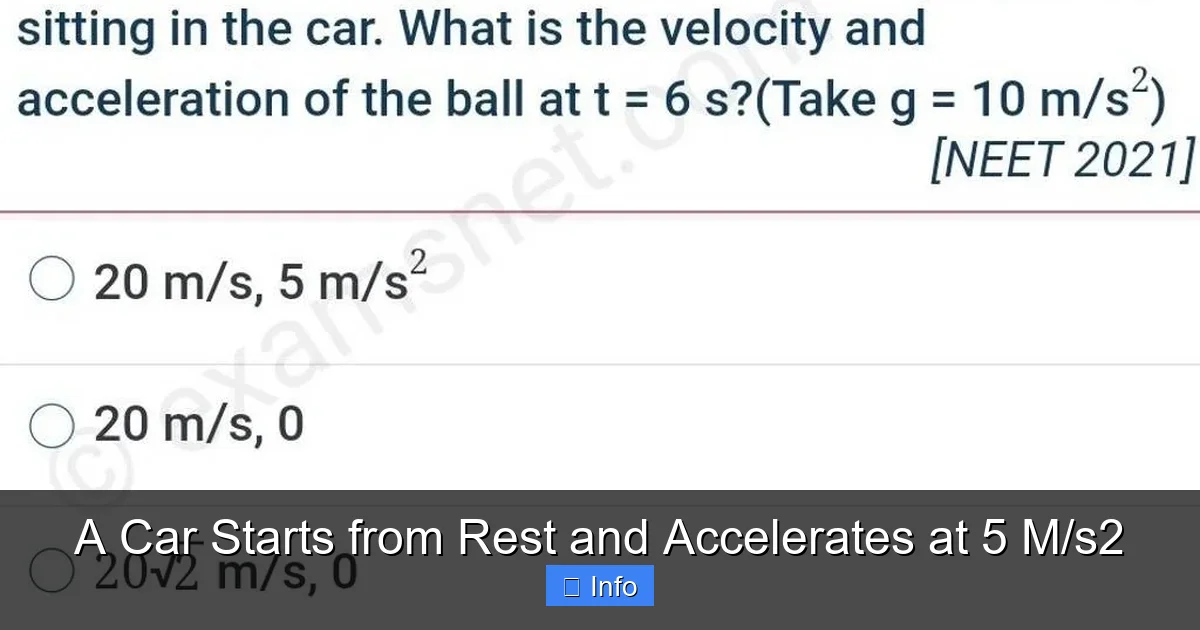
Understanding how a car starts from rest and accelerates at 5 m/s2 is crucial for both everyday commuting and advanced physics. This phenomenon defines the initial phase of vehicle motion where velocity builds rapidly from zero. Knowing this concept helps drivers anticipate acceleration limits and improves overall road safety.
Imagine sitting at a red light. The car next to you floors the accelerator, and suddenly, you are moving forward rapidly. That quick surge isn’t just magic; it is physics working right under your hood. Specifically, it is the moment when a car starts from rest and accelerates at 5 m/s2. This specific rate of acceleration is a benchmark in automotive physics. It tells us exactly how quickly a vehicle can gain speed under ideal conditions. Whether you are merging onto a highway or pulling into a tight parking lot, understanding this concept helps you drive smarter and safer. Let us dive deep into the mechanics behind this powerful acceleration and see what it truly means for your daily commute.
Key Takeaways
- Understanding a car starts from rest and accelerates at 5 m/s2: Provides essential knowledge
📑 Table of Contents
The Core Physics: Starting from Zero Velocity
To understand what happens when a car starts from rest, we first need to define our terms. When we say a car starts from rest, we mean its initial velocity is exactly zero. It is completely stationary before the engine kicks in and applies force to the wheels. Acceleration, on the other hand, is the rate at which velocity changes over time. An acceleration of 5 meters per second squared means that for every second the car is running, its speed increases by 5 meters per second. If it takes one second to go from zero to five meters per second, it takes another second to reach ten meters per second, and so continues. This constant rate makes the math predictable and easy to calculate. According to Newton’s Second Law of Motion, force equals mass times acceleration. A heavier truck will require more engine power to achieve the same 5 m/s2 acceleration as a lighter sports car. This is why acceleration rates vary so wildly between different vehicles on the road today. The engine must overcome inertia, which is the stubborn resistance of any object to change its state of motion.
Decoding the 5 m/s² Rate
So, what does an acceleration of 5 m/s² actually feel like in the real world? To put this into perspective, let us look at some concrete numbers. After one second of acceleration, the car is traveling at 5 meters per second, which is roughly 18 kilometers per hour or about 11 miles per hour. After two seconds, it reaches 10 m/s, which is about 36 km/h or 22 mph. After three seconds, it hits 15 m/s, translating to about 54 km/h or 33 mph. This is a very aggressive and noticeable rate of acceleration. For context, many standard family sedans have a top acceleration around 3 to 4 m/s². Sports cars often exceed this threshold easily. Therefore, a 5 m/s² acceleration indicates a vehicle with a reasonably powerful powertrain. It gives the driver a distinct sense of responsiveness and authority behind the wheel, making lane changes and highway merging much less tedious. You will feel the RPMs climb quickly, and the steering will become noticeably tighter as the car tries to conform to your inputs.
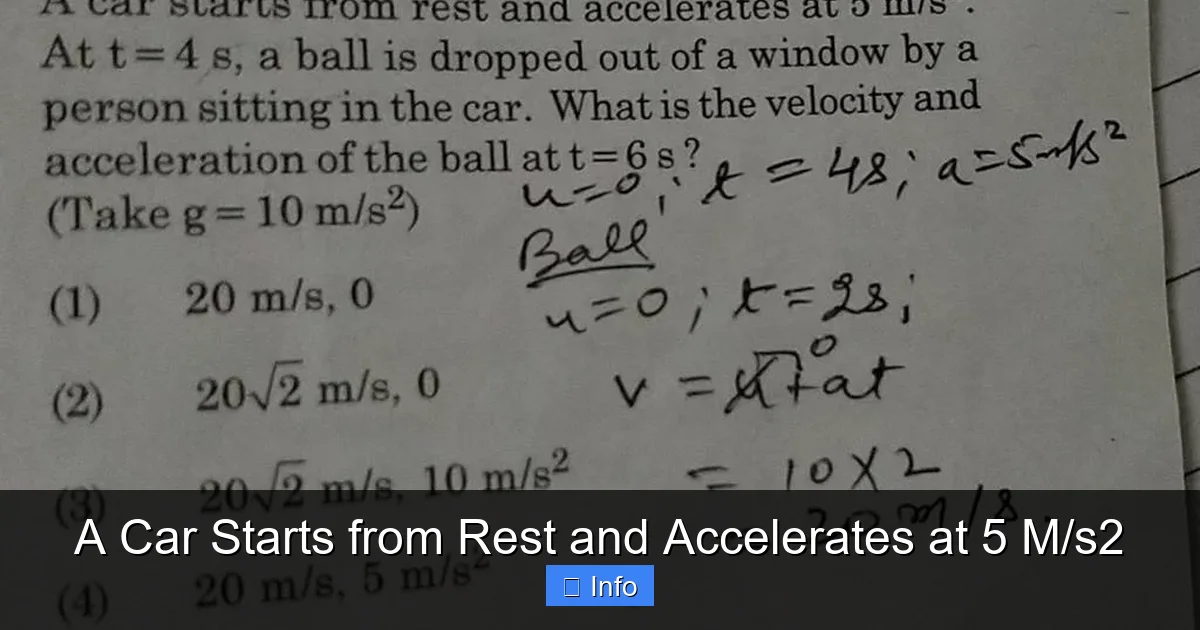
Visual guide about A Car Starts from Rest and Accelerates at 5 M/s2
Image source: static-images.findfilo.com
Calculating the Distance Covered
Knowing how fast the car goes is only half the picture. We also need to know how far the car travels while it is accelerating. We use a standard kinematic equation for this: distance equals initial velocity times time, plus one half times acceleration times time squared. Since the initial velocity is zero, the formula simplifies to distance equals half the acceleration multiplied by time squared. Let us plug in our numbers. In the first second, the distance covered is 0.5 times 5 times one squared, which equals 2.5 meters. In two seconds, the distance is 0.5 times 5 times four, which equals 10 meters. In three seconds, it is 0.5 times 5 times nine, equaling 22.5 meters. Notice that the distance does not increase linearly; it increases quadratically. This means the car covers much more ground in the later seconds than in the early ones. When merging onto a highway, this quadratic growth means you will cover a significant amount of distance in just a few seconds. This gives you a very limited window to react and find your lane safely. If you misjudge the merge, the extra distance covered in those crucial seconds could mean the difference between a safe lane change and a rear-end collision.

Visual guide about A Car Starts from Rest and Accelerates at 5 M/s2
Image source: classroom-images.cdn.askfilo.com
Real-World Driving Scenarios
Picture yourself approaching a fast-moving highway on-ramp. You need to accelerate to match the traffic speed. If you are driving a car that accelerates at 5 m/s², you will notice a distinct, brisk surge forward. Unlike a sluggish economy car that takes several seconds to gain speed, your vehicle maintains a quick pace. However, you must ensure you have enough space. Because the distance covered in the first few seconds is relatively small, you must start accelerating early. If you wait too long, you might not clear the merge point before the faster vehicles pass you. Always maintain a safe following distance when making these aggressive acceleration maneuvers. Furthermore, the steering will feel very direct. The front tires will push against the asphalt with strong force, turning the wheel with immediate precision. This makes passing slower vehicles easier, but it also requires sharp attention to avoid clipping the car ahead of you. Anticipating the flow of traffic is the best way to utilize this kind of acceleration safely.
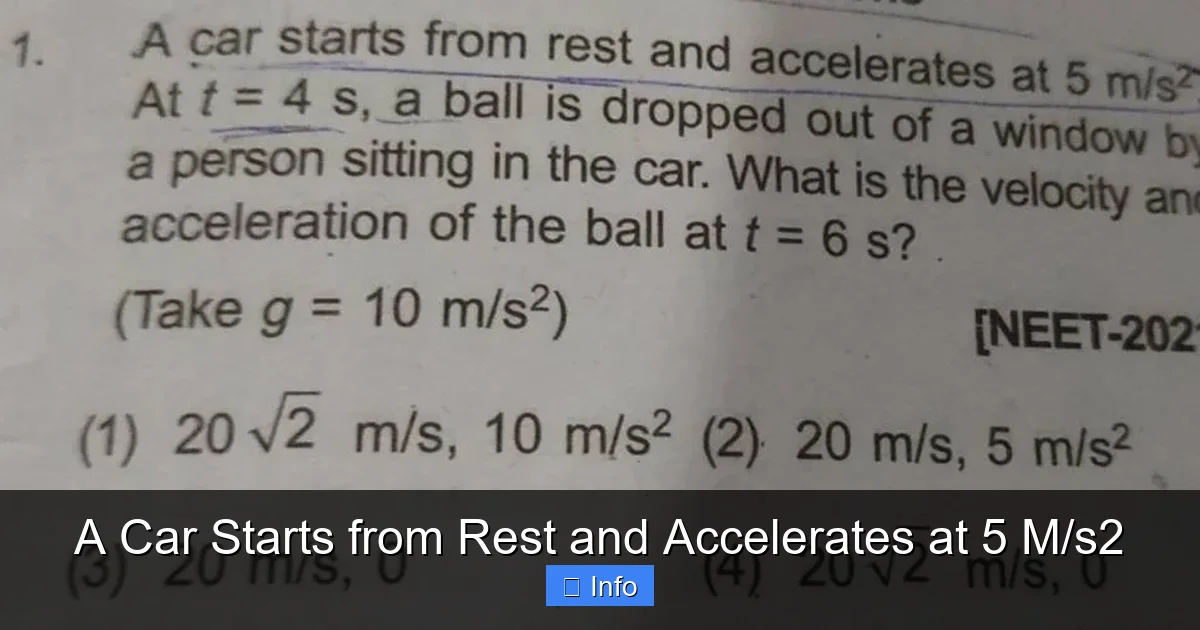
Visual guide about A Car Starts from Rest and Accelerates at 5 M/s2
Image source: classroom-images.cdn.askfilo.com
Safety and Vehicle Maintenance Considerations
Rapid acceleration demands absolute respect from the driver. When a car pushes 5 m/s², the tires grip the road firmly, and the vehicle feels highly responsive. This responsiveness can be a blessing in a passing lane, but it can also lead to loss of control if the driver is not prepared. Before taking full advantage of this power, make sure your tires are properly inflated and in excellent condition. Good tire tread ensures maximum friction, allowing the car to convert that aggressive acceleration into forward motion rather than spinning out uselessly. Furthermore, if you are driving a modern vehicle equipped with advanced safety features like electronic stability control, the system will intervene automatically if it detects you are losing traction. Always check your vehicle manual for recommended tire pressure and regular maintenance schedules to keep your car performing safely under heavy acceleration loads. If you ever need to lift the vehicle for minor repairs or replacements, having the right tools is essential. You can find reliable tools and sturdy jacks at Best Car Jacks For Every Need And Budget to ensure you are never caught off guard. Additionally, the physical components that absorb this sudden force—your shocks and struts—must be in top shape. Best Car Shocks And Struts For Smooth Ride articles explain how worn parts can turn a smooth acceleration into a bouncy, dangerous ride that risks losing traction.
Fuel Efficiency and Battery Life Impacts
Every time you demand 5 m/s² of acceleration, your engine works significantly harder. Gasoline engines burn fuel much faster under heavy load than they do at steady cruising speeds. This means aggressive acceleration drastically reduces your miles per gallon. If you are driving a hybrid vehicle, the situation is slightly different but still quite impactful. While hybrids can recapture energy during regenerative braking, continuous hard acceleration drains the hybrid battery much faster than gentle acceleration. To preserve your fuel economy and extend battery life, try to anticipate traffic lights and speed changes rather than reacting blindly. Modern onboard computers can optimize fuel injection, but they still struggle to overcome the sheer mechanical force required for sustained 5 m/s² acceleration. If you want to protect your investment and save money at the pump, smooth out your throttle inputs whenever possible. For those specifically driving Toyota hybrids, understanding how to charge the battery safely and correctly is paramount. How To Charge A Toyota Hybrid Battery Safely And Correctly guides help you maintain optimal charge levels without overworking the system. Also, consider the type of tires you run. High-performance tires provide better grip, meaning the car can utilize its power more effectively without wheelspin. Look into Best Car Tire Brands For Performance And Safety to find the right fit for your driving style.
Conclusion
Understanding the dynamics of a car starting from rest and accelerating at 5 m/s² transforms you from a passive passenger into an informed, confident driver. You now know that this specific acceleration rate represents a solid, quick response from the vehicle’s powertrain. You understand the underlying math behind the speed and distance, which allows you to predict exactly how your car will behave on the open road. Most importantly, you know how to handle this power responsibly. By maintaining good tire health, anticipating traffic flow, and avoiding wasteful throttle blanks, you can enjoy the thrill of rapid acceleration while keeping yourself and others safe. Physics might seem like an abstract academic subject, but when applied to your daily commute, it becomes a vital tool for secure and efficient driving. The next time you pull away from a stoplight, you will not just feel the rush; you will understand the science driving it.
Frequently Asked Questions
How long does it take for the car to reach 10 m/s?
It takes exactly 2 seconds. Since the acceleration is 5 m/s², the velocity increases by 5 m/s every second. Therefore, after 1 second it reaches 5 m/s, and after 2 seconds it reaches 10 m/s.
What does an acceleration of 5 m/s² mean in everyday terms?
It means the car’s speed increases by 5 meters per second every second. In practical terms, this is a brisk and noticeable rate of acceleration, similar to what you might experience in a compact sports car when merging onto a highway.
How far does the car travel in the first 3 seconds?
In 3 seconds, the car travels 22.5 meters. This is calculated using the formula distance equals one half times acceleration times time squared. Plugging in the numbers gives 0.5 times 5 times 3 squared, which equals 22.5 meters.
Is 5 m/s² considered a high acceleration rate?
Yes, compared to standard family sedans which typically accelerate at 3 to 4 m/s², 5 m/s² is considered quite aggressive and sporty. It indicates a vehicle with a reasonably powerful engine capable of rapid speed increases.
Does constant acceleration affect fuel efficiency?
Absolutely. Demanding 5 m/s² of acceleration forces the engine to work much harder, burning fuel significantly faster than at cruising speeds. This reduces your miles per gallon considerably. Smoothing out your throttle inputs is the best way to improve fuel economy in this scenario.
What should you do if you need to stop quickly after such acceleration?
You should ensure you have enough braking distance. Because the car was moving fast after only a couple of seconds of acceleration, stopping safely requires a substantial distance. Always check your tire condition and brake pads beforehand to ensure they can handle the sudden deceleration.