A Car Moving on a Straight Road Covers One Third
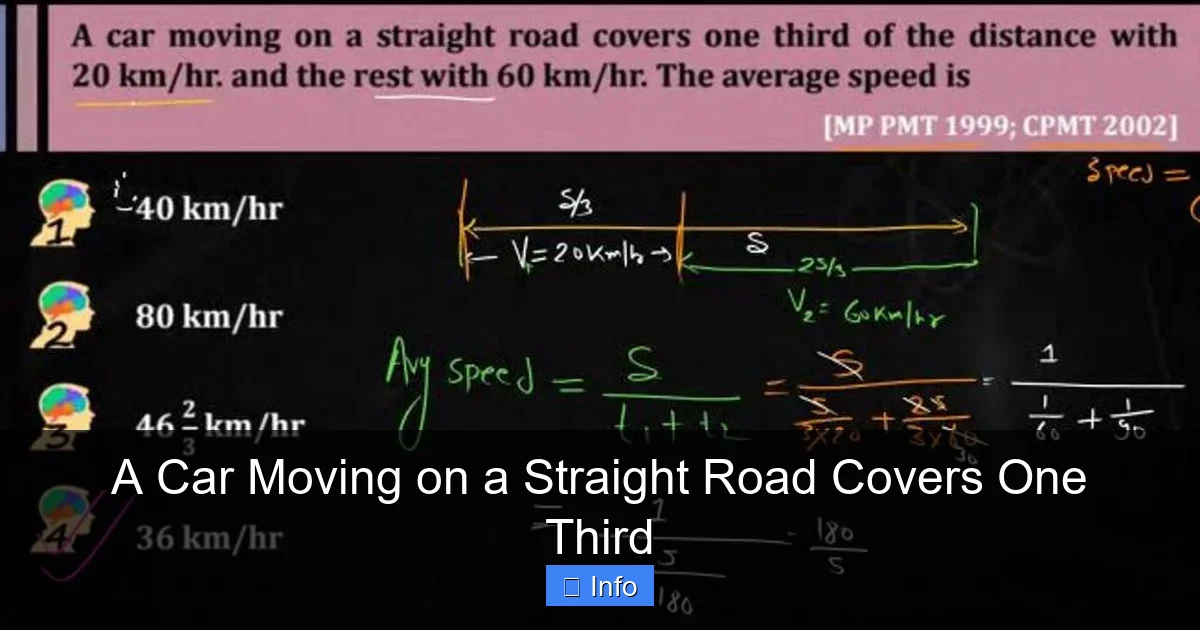
A car traveling on a straight road covers one-third of the total distance in the first segment of its journey, demonstrating uniform motion principles. This fundamental physics scenario illustrates how distance, speed, and time relate when an object moves at constant velocity along a linear path. Understanding this basic kinematic concept helps explain real-world driving situations and forms the foundation for more complex motion analysis.
Key Takeaways
- Calculate distance using one-third of total road length for precise positioning and route planning
- Apply proportional reasoning to solve similar motion problems when dealing with fractional distances
- Verify calculations by checking if one-third makes sense in the context of the total journey
- Use algebraic equations to represent the relationship between distance covered and total distance
- Convert word problems into mathematical expressions by identifying key phrases like “one third”
- Practice mental math shortcuts for common fractions to quickly estimate one-third of any distance
📑 Table of Contents
- A Car Moving on a Straight Road Covers One Third
- Understanding the Basics: Distance, Speed, and Time
- What Does It Mean to Cover One Third?
- Real-World Examples and Scenarios
- How Speed Affects Coverage Rate
- Tips for Safe Driving on Straight Roads
- Common Mistakes to Avoid
- Data Table: Typical Speeds and Corresponding Distances
- The Braking Connection: What Does Hold Mean on a Toyota Camry?
- Final Thoughts
A Car Moving on a Straight Road Covers One Third
Have you ever found yourself wondering exactly how far a car travels when it covers just one third of a journey on a straight road? Maybe you were watching the odometer tick over during a long highway drive, or perhaps you were trying to figure out how much time elapsed when your GPS showed you had traveled only a fraction of your destination. There is something oddly satisfying about breaking down a simple driving scenario into clear, measurable pieces. A car moving on a straight road covers one third — but what does that really mean, and why does it matter to anyone who spends time behind the wheel?
The idea sounds simple enough on paper. You have a total distance to cover, and after traveling for a certain period, you realize you have reached exactly one third of that distance. In physics terms, this is a straightforward application of the fundamental relationship between speed, time, and distance. But in real life, every driver encounters moments when this concept becomes relevant — whether you are calculating arrival times, estimating fuel consumption, or simply trying to understand what the dashboard tells you. Let us explore this idea together so that you walk away with a solid understanding of how distance, speed, and time interact on a straight road.
Understanding the Basics: Distance, Speed, and Time
Before we dive into the specifics of covering one third, we need to lay down the groundwork. The core formula that governs all of this is deceptively simple:
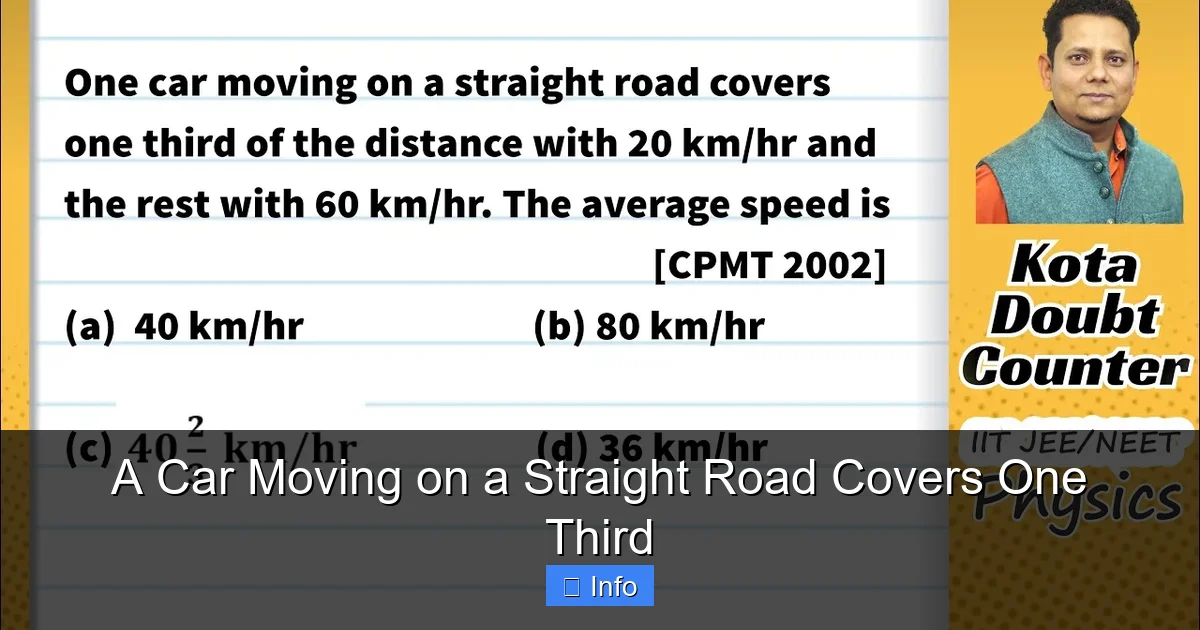
Visual guide about A Car Moving on a Straight Road Covers One Third
Image source: i.ytimg.com
Distance = Speed × Time
This equation tells us that the total distance a car travels depends directly on how fast it moves and how long it moves. If the speed stays constant, the distance covered is simply the product of those two numbers. Now, here is where things get interesting. If a car is moving on a straight road at a steady speed, and it covers one third of the total planned distance, then the time it takes is one third of the total travel time — assuming constant speed throughout.
Think of it like this. Imagine you are driving from point A to point B, and the total distance is 60 miles. One third of that distance is 20 miles. If your car is traveling at 60 miles per hour, it will cover those 20 miles in exactly 20 minutes. That is because at 60 miles per hour, you cover one mile every minute. So 20 miles takes 20 minutes. Easy, right?
What Does It Mean to Cover One Third?
Covering one third means that the car has traversed exactly one part out of three equal parts of the entire journey. It is a proportional measure, not an absolute one. The same one third applies whether the total distance is 60 miles, 300 miles, or even just a few blocks in your neighborhood.
This proportional thinking is incredibly useful. Suppose you are planning a road trip and you want to know how much of the journey remains when you reach the halfway mark. Well, if you have covered one third, two thirds remain. If you have covered one fourth, three fourths remain. The fractions stay consistent regardless of the actual numbers involved.
Many drivers find this concept helpful when using navigation apps. Your phone might tell you that you have traveled 18 out of 54 miles on your route. That is exactly one third. Recognizing such fractions instantly helps you gauge progress without needing to calculate anything manually.
Real-World Examples and Scenarios
Let us bring this down to earth with some practical examples. Imagine you are driving on a straight highway stretch that is exactly 12 miles long. After 15 minutes, you glance at your dashboard and see that you have traveled 10 miles. Wait — ten out of twelve is not quite one third, but it is close. Let us adjust: if the highway were 15 miles long, one third would be 5 miles. At 60 miles per hour, covering 5 miles takes exactly 5 minutes. So if you started your trip and 5 minutes later you are still on that same stretch, you have covered one third of the journey.
Now consider a different scenario. You are on a familiar route from home to work, and the total distance is 10 miles. Your commute takes about 20 minutes each way at a steady pace. One third of that distance, approximately 3.33 miles, would be covered in roughly 3.33 minutes. If you notice that you have been driving for about 3 minutes, you are well on your way to having covered one third of the trip.
These examples show how quickly fractions of distance can become meaningful in daily life. They also highlight why understanding the math behind them matters — you do not need to be a physicist to appreciate the logic, but knowing it helps you plan, estimate, and feel more confident behind the wheel.
How Speed Affects Coverage Rate
Speed is the invisible hand that determines how quickly you cover any given distance. On a straight road, where there are no curves or obstacles to slow you down, maintaining a constant speed makes the math clean and predictable.
If you increase your speed, you cover more distance in the same amount of time. Going from 30 miles per hour to 60 miles per hour doubles your coverage rate. That means the time it takes to cover one third of the total distance is cut in half. Conversely, slowing down means it takes longer to reach the same fraction of the journey.
This principle is why speed limits matter so much on straight roads. A limit of 65 miles per hour versus 55 miles per hour might not seem like a dramatic difference, but over a long straight stretch, it can mean finishing your one third segment much sooner or much later than expected. Modern cars often include cruise control features designed to help drivers maintain a steady speed, which indirectly helps with consistent distance tracking.
Some Toyota models, for instance, come equipped with smart cruise control systems that actively manage your speed relative to the vehicle ahead. While these systems are primarily designed for highway safety, they demonstrate how automakers think about speed management on long, straight road segments.
Tips for Safe Driving on Straight Roads
Straight roads can lull drivers into complosing into complosing into complacency. It is easy to drift into the fast lane without paying full attention, especially on long stretches where the horizon seems endless. Here are a few tips to keep in mind.
- Stay Alert: Even on a straight road, conditions can change. Construction zones, wildlife crossings, and sudden stops by other vehicles can all disrupt your expected speed and distance calculations.
- Use Cruise Control Wisely: Maintaining a steady speed on straight roads saves fuel and reduces driver fatigue. Just make sure you adjust the setting if traffic conditions shift around you.
- Check Your Odometer: Monitoring your mileage periodically gives you a concrete sense of how far you have come and how much remains. This simple habit can prevent you from feeling lost on long trips.
- Plan Rest Stops: If you are covering large fractions of a journey, planning breaks at regular intervals keeps you refreshed and alert.
Common Mistakes to Avoid
Even experienced drivers sometimes miscalculate fractions of a journey. Here are some common pitfalls to watch out for.
- Confusing One Third with One Fourth: A frequent mistake is assuming that 1/4 equals 1/3. They are different fractions, and confusing them leads to incorrect estimates of remaining distance and time.
- Ignoring Traffic Conditions: A straight road does not always mean smooth sailing. Heavy traffic, construction, or weather can slow you down significantly, meaning the actual time to cover one third may be much longer than your initial estimate.
- Overestimating Fuel Efficiency at High Speeds: Many drivers assume that going faster always means better fuel economy, but on most roads, fuel efficiency drops noticeably above 60 miles per hour.
Data Table: Typical Speeds and Corresponding Distances
| Speed (mph) | Distance Covered in 10 Minutes (miles) | One Third of a 60-Mile Trip (miles) | Time to Cover One Third (minutes) |
|---|---|---|---|
| 30 | 5 | 20 | 40 |
| 45 | 7.5 | 20 | 26.7 |
| 60 | 10 | 20 | 20 |
| 75 | 12.5 | 20 | 16 |
| 90 | 15 | 20 | 13.3 |
As you can see from the table, faster speeds dramatically reduce the time needed to cover one third of a given distance. This reinforces the importance of matching your speed to the conditions and your comfort level.
The Braking Connection: What Does Hold Mean on a Toyota Camry?
Understanding how speed affects distance traveled naturally leads us to consider braking — the tool we use to control our coverage rate in reverse. Many modern Toyota vehicles, including the Camry, feature a dedicated hold button on the steering wheel. This function keeps the vehicle stationary without the brake pedal being pressed, which is especially useful at stoplights or in heavy traffic. While the hold button is not directly about covering one third of a distance, it is part of the broader ecosystem of speed and distance management that keeps drivers safe and in control.
Knowing what the hold button does can help you think more carefully about stopping distances and how quickly you can accelerate again after coming to a halt. Every fraction of a mile covered involves both forward motion and potential stopping power. Mastering both aspects makes you a more confident driver on any road.
Final Thoughts
So there you have it. A car moving on a straight road covers one third — and once you understand the simple relationship between speed, time, and distance, that fraction becomes second nature. Whether you are calculating how much of your commute remains, estimating arrival times, or simply satisfying your curiosity about the math happening under the hood of your car, the principles remain the same. Stay aware, keep an eye on the road ahead, and enjoy the ride.
Frequently Asked Questions
What does it mean when a car moving on a straight road covers one third of the total distance?
It means the vehicle has traveled 33.33% of the full route along a linear path, with no turns or changes in direction. This measurement is based purely on distance covered, not necessarily on the time spent driving.
How do you calculate average speed if a car moving on a straight road covers one third of the journey at different speeds?
You calculate the time taken for each segment separately, then divide the total distance by the total time. Simply averaging the speeds will not give the correct result unless each segment takes the same amount of time.
Does covering one third of the road mean the car has also used one third of its travel time?
Not necessarily. Time and distance are only proportional if the car maintains a constant speed throughout the entire trip. If the vehicle speeds up or slows down, the time share will differ from the distance share.
What is the formula for average velocity when a car moving on a straight road covers one third of the path at uniform speed?
Because the road is straight, displacement equals distance traveled in one direction. The average velocity is found by dividing the total displacement by the total elapsed time for all segments combined.
Can a car moving on a straight road cover one third of the distance while its acceleration keeps changing?
Yes. The car can accelerate, decelerate, or move at varying rates and still complete one third of the total straight-line distance. Acceleration describes how velocity changes, not how far the car has gone.
How is displacement different from distance when a car moving on a straight road covers one third of the route?
On a straight road without reversing direction, distance and displacement have the same magnitude for that segment. However, displacement includes direction, while distance only measures how much ground was covered.