If a Car Travels 2/5th of the Total Distance
Understanding fractional distance problems helps you calculate remaining distance, time, and speed when a car travels 2/5th of the total distance. This guide breaks down the math into simple steps with practical examples you can use for trip planning, fuel estimates, and solving common word problems.
Have you ever stared at a math problem about a car traveling part of a journey and felt stuck? You are not alone. Problems where a car travels 2/5th of the total distance show up in textbooks, standardized tests, and even real-life trip planning. The good news is that once you understand the core concept, these problems become straightforward.
Think of it like slicing a pizza into five equal pieces. The car eats two slices. Three slices remain. That is the heart of it. But the math can get interesting when you add speed changes, time limits, or fuel consumption. This guide walks you through everything from basic fractions to multi-step word problems. We will keep the language simple and the examples practical.
Key Takeaways
- Fraction basics: 2/5th means two parts out of five equal parts of the total distance
- Remaining distance: Subtract 2/5 from 1 (or 5/5) to get 3/5th of the journey left
- Speed calculations: Use the formula Distance = Speed × Time for each segment
- Real-world use: Apply this for fuel stops, rest breaks, and arrival time estimates
- Problem variations: Problems may give speed, time, or distance for the first portion
- Unit consistency: Always match units (miles/kilometers, hours/minutes) across calculations
- Check your work: Verify that all segments add up to the total distance
📑 Table of Contents
- Understanding the Fraction 2/5th
- Finding the Total Distance When You Know the Part
- Calculating Time and Speed for Each Segment
- Real-World Applications
- Common Problem Variations
- Step-by-Step Problem Solving Framework
- Practice Problems with Solutions
- Tips for Mental Math
- When Fractions Get Messy
- Connecting to Vehicle Specifications
- Advanced Concept: Proportional Reasoning
- Teaching This to Others
- Common Mistakes to Avoid
- Practice Drills for Mastery
- Conclusion
Understanding the Fraction 2/5th
What Does 2/5th Actually Mean?
The fraction 2/5 represents a part-to-whole relationship. The bottom number (5) is the denominator. It tells you how many equal parts the whole is divided into. The top number (2) is the numerator. It tells you how many of those parts you have.
If the total distance is 100 miles, each fifth is 20 miles. Two-fifths is 40 miles. The remaining three-fifths is 60 miles. If the total distance is 250 kilometers, each fifth is 50 kilometers. Two-fifths is 100 kilometers. The remaining is 150 kilometers.
Visualizing the Journey
Draw a line. Divide it into five equal segments. Label the first two segments “Completed.” Label the last three “Remaining.” This visual trick works for any total distance. It helps you see that the remaining part is always larger than the completed part when the fraction is less than one-half.
You can also think in percentages. Two-fifths equals 40 percent. Three-fifths equals 60 percent. The car has covered 40 percent of the trip. Sixty percent lies ahead.
Finding the Total Distance When You Know the Part
Working Backwards from the Known Segment
Many problems give you the distance for the 2/5th portion and ask for the total. The rule is simple: divide the known distance by 2, then multiply by 5. Or multiply by 5/2 (which is 2.5).
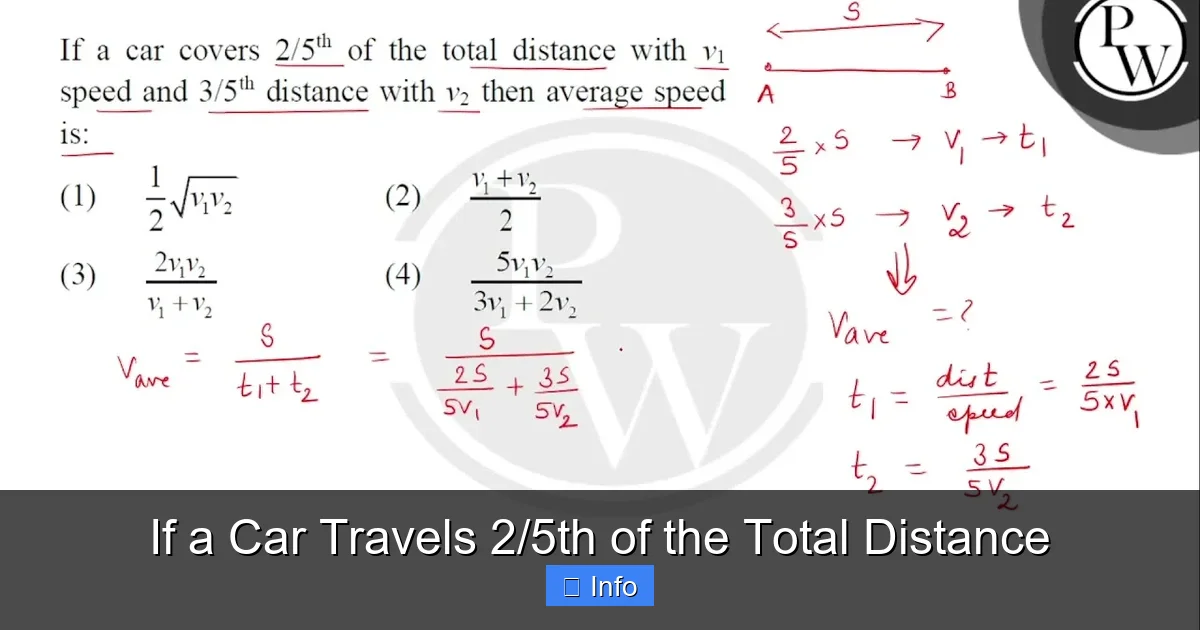
Visual guide about If a Car Travels 2/5th of the Total Distance
Image source: static-images.findfilo.com
Example: A car travels 2/5th of the total distance and covers 80 miles. What is the total distance?
Step 1: 80 miles ÷ 2 = 40 miles (this is one-fifth)
Step 2: 40 miles × 5 = 200 miles total
Check: 200 × 2/5 = 80 miles. Correct.
Algebraic Approach for Complex Problems
Let D represent the total distance. The equation is (2/5)D = known distance. Solve for D by multiplying both sides by 5/2.
Example: (2/5)D = 120 km
D = 120 × (5/2)
D = 120 × 2.5
D = 300 km
This method scales to any fraction. If a car travels 3/7th of the distance, multiply the known part by 7/3.
Calculating Time and Speed for Each Segment
Constant Speed Throughout
If the car maintains the same speed for the whole journey, the time for each segment is proportional to the distance. The first 2/5th takes 2/5th of the total time. The remaining 3/5th takes 3/5th of the total time.
Visual guide about If a Car Travels 2/5th of the Total Distance
Image source: storage.googleapis.com
Example: Total trip is 300 miles at 60 mph. Total time = 5 hours.
First segment (2/5): 120 miles. Time = 120 ÷ 60 = 2 hours. (2/5 of 5 hours = 2 hours)
Second segment (3/5): 180 miles. Time = 180 ÷ 60 = 3 hours. (3/5 of 5 hours = 3 hours)
Different Speeds for Different Segments
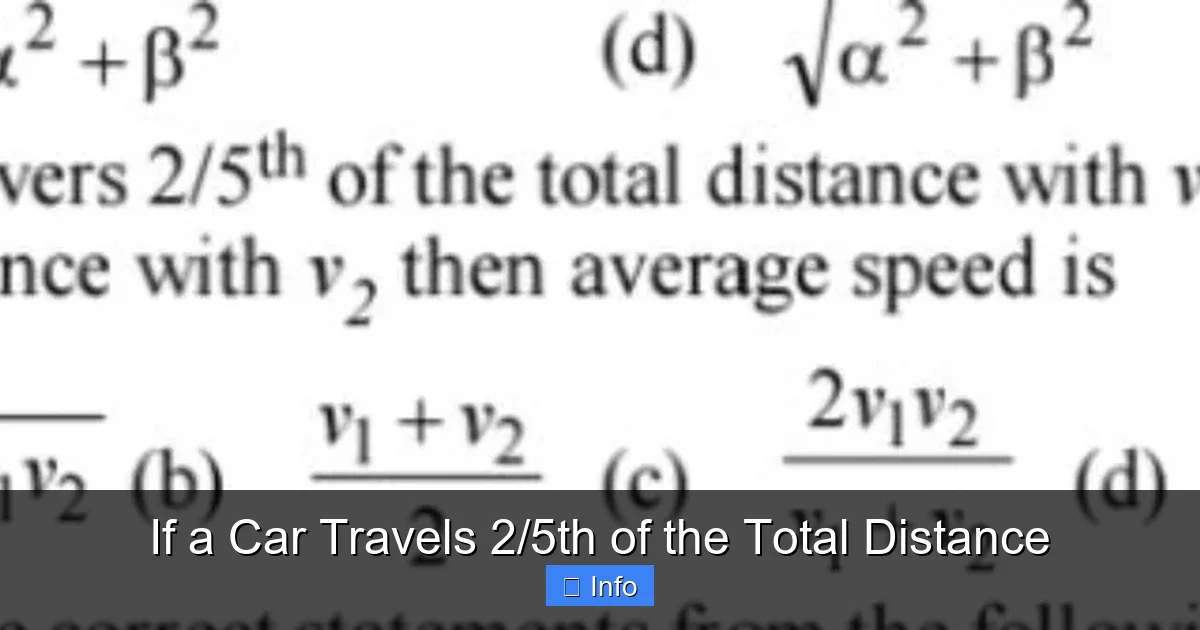
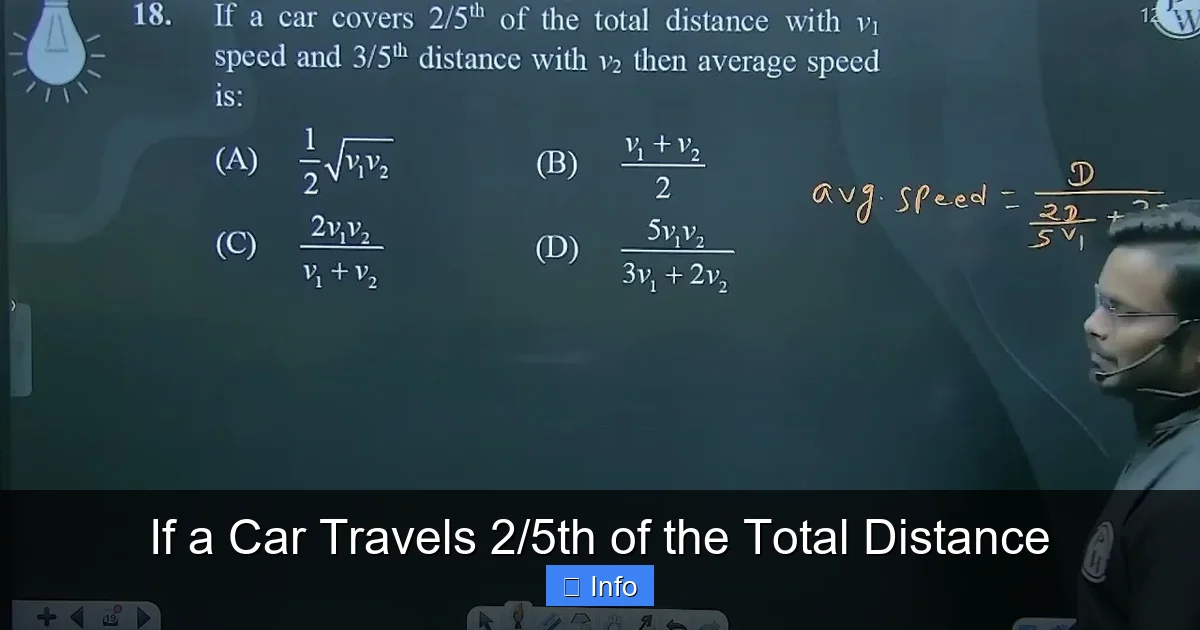
This is where it gets fun. The car might travel the first 2/5th at one speed and the rest at another. You calculate each segment separately.
Example: Total distance 500 km. First 2/5th (200 km) at 80 km/h. Remaining 3/5th (300 km) at 100 km/h.
Time for first part: 200 ÷ 80 = 2.5 hours
Time for second part: 300 ÷ 100 = 3 hours
Total time: 5.5 hours
Average speed: 500 ÷ 5.5 ≈ 90.9 km/h
Notice the average speed is not the simple average of 80 and 100. It is weighted by time spent at each speed.
Finding Speed When Time Is Given
Sometimes you know the time for the first 2/5th and the total time. You can find the speed for that segment.
Example: Trip is 400 miles. First 2/5th (160 miles) takes 4 hours. Speed = 160 ÷ 4 = 40 mph.
Real-World Applications
Planning Fuel Stops
Knowing fractional distances helps you plan where to refuel. If your car range is 300 miles and the trip is 500 miles, you need to stop before 300 miles. The 2/5th mark of a 500-mile trip is 200 miles. That is a safe spot for a fuel stop with 100 miles of buffer.
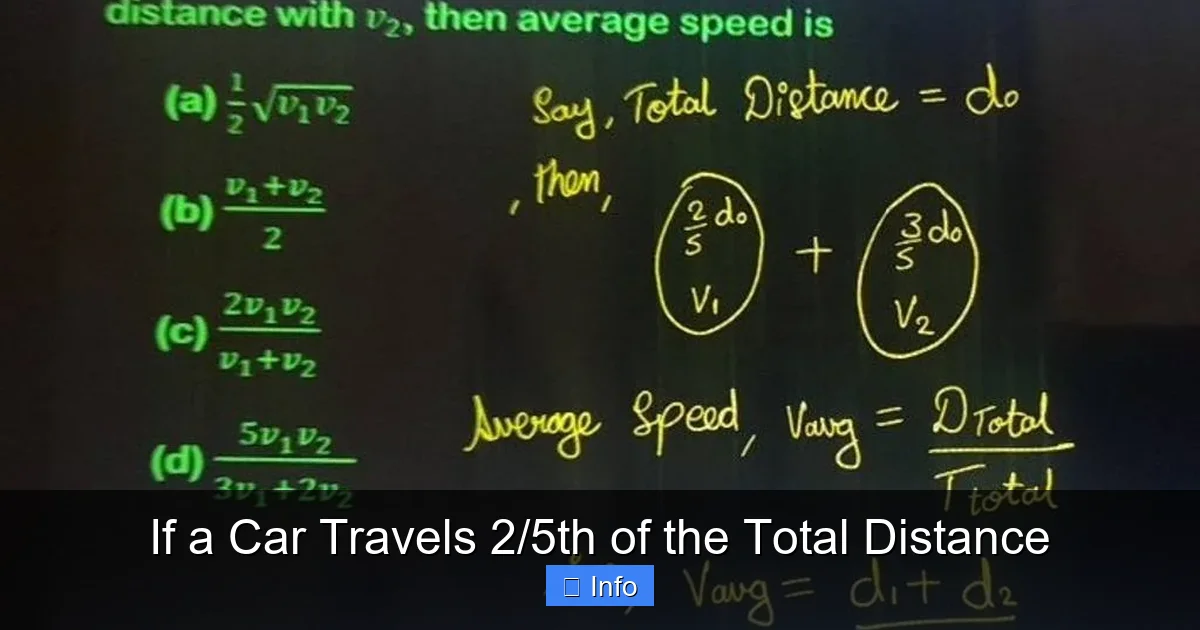
Visual guide about If a Car Travels 2/5th of the Total Distance
Image source: i.ytimg.com
If you drive a vehicle with a smaller tank, you might calculate the 1/3 or 1/4 mark instead. The principle stays the same. Divide total distance by the denominator. Multiply by the numerator.
Scheduling Rest Breaks
Long drives need breaks. A common rule is a 15-minute break every 2 hours. If your total drive time is 10 hours, the 2/5th time mark is 4 hours. That aligns perfectly with the second break. You can use distance fractions as proxies for time fractions when speed is roughly constant.
Estimating Arrival Time
You are 2/5th of the way there. You know your average speed so far. You can estimate the remaining time. Remaining distance is 3/5th. If you keep the same pace, remaining time is 1.5 times the time already spent (since 3/5 ÷ 2/5 = 1.5).
Example: You drove 2 hours to cover 2/5th. Remaining time ≈ 2 × 1.5 = 3 hours. Total trip ≈ 5 hours.
Common Problem Variations
Fraction of Distance vs Fraction of Time
Watch the wording carefully. “A car travels 2/5th of the total distance at 60 mph” is different from “A car travels for 2/5th of the total time at 60 mph.”
Distance fraction: The distance split is fixed. Time varies with speed.
Time fraction: The time split is fixed. Distance varies with speed.
Example of time fraction: Total trip 5 hours. First 2/5th of time (2 hours) at 50 mph = 100 miles. Remaining 3 hours at 70 mph = 210 miles. Total distance = 310 miles.
Multiple Fractional Segments
Some problems chain fractions. “A car travels 2/5th of the distance, then 1/3 of the remaining distance, then the rest.”
Break it down stepwise:
Start: Total = 1 (or 5/5)
After first leg: Remaining = 3/5
Second leg: 1/3 of remaining = 1/3 × 3/5 = 1/5 of total
Final remaining: 3/5 – 1/5 = 2/5 of total
So the journey splits into 2/5, 1/5, and 2/5. The middle segment is the smallest.
Return Trip Problems
“A car travels 2/5th of the distance to a town at 40 mph and returns the same way at 60 mph. Find average speed.”
This is a classic trap. You cannot average 40 and 60. Average speed = Total Distance ÷ Total Time.
Let one-way distance = D. Total distance = 2D.
Time there: (2/5 D) ÷ 40 + (3/5 D) ÷ 40 = D/40 (if same speed both ways)
But if speeds differ by segment, calculate each segment time separately.
Step-by-Step Problem Solving Framework
Read and Identify Knowns
Circle or list every number and unit. Identify what is asked. Is it total distance? Total time? Average speed? Speed of a segment?
Draw a Diagram
Sketch a line. Mark the fractions. Label known distances, speeds, times. This prevents confusion about which segment is which.
Choose Your Variable
Let the unknown be a variable. Usually total distance D or total time T. Write equations for each segment.
Solve Systematically
Substitute known values. Solve for the variable. Keep units attached to numbers. This catches errors like mixing miles and kilometers.
Verify the Answer
Plug your answer back into the original problem. Do all segments add up? Do times make sense? Is the average speed between the segment speeds?
Practice Problems with Solutions
Problem 1: Basic Distance
A car travels 2/5th of a journey, covering 140 km. How long is the whole journey?
Solution: 140 ÷ 2 = 70 km per fifth. 70 × 5 = 350 km total.
Problem 2: Two Speeds
A 600-mile trip. First 2/5th at 50 mph. Rest at 75 mph. Total time?
First distance: 600 × 2/5 = 240 miles. Time: 240 ÷ 50 = 4.8 hours.
Second distance: 600 – 240 = 360 miles. Time: 360 ÷ 75 = 4.8 hours.
Total: 9.6 hours (9 hours 36 minutes).
Problem 3: Average Speed Trap
Car goes 2/5th of distance at 40 km/h, 3/5th at 60 km/h. Average speed?
Assume total = 100 km (easy numbers).
First: 40 km at 40 km/h = 1 hour.
Second: 60 km at 60 km/h = 1 hour.
Total: 100 km in 2 hours. Average = 50 km/h.
Notice: Equal time at each speed makes average the arithmetic mean. This happens because 2/5 at 40 and 3/5 at 60 balance to equal time.
Problem 4: Find the Fraction
Car travels 180 miles of a 450-mile trip. What fraction is done?
180/450 = 18/45 = 2/5. Yes, it is 2/5th.
Problem 5: Multi-Stop Journey
Total 1000 km. First 2/5th at 80 km/h. Next 1/2 of remaining at 100 km/h. Final rest at 60 km/h. Total time?
Segment 1: 400 km at 80 = 5 hours. Remaining: 600 km.
Segment 2: 1/2 of 600 = 300 km at 100 = 3 hours. Remaining: 300 km.
Segment 3: 300 km at 60 = 5 hours.
Total: 13 hours.
Tips for Mental Math
Memorize Common Fifths
1/5 = 0.2 = 20%
2/5 = 0.4 = 40%
3/5 = 0.6 = 60%
4/5 = 0.8 = 80%
5/5 = 1.0 = 100%
Knowing these decimals lets you multiply quickly. Total distance 350 miles. 2/5th = 350 × 0.4 = 140 miles. Done in seconds.
Use Benchmark Numbers
If total distance is not divisible by 5, round to a nearby number for estimation. 347 miles ≈ 350. 2/5th ≈ 140. Actual: 347 × 0.4 = 138.8. Close enough for planning.
Halve and Double Trick
Multiplying by 5/2 is the same as multiply by 5, divide by 2. Or divide by 2, multiply by 5. Choose the easier order.
Known part: 126 miles. 126 ÷ 2 = 63. 63 × 5 = 315. Total = 315 miles.
When Fractions Get Messy
Non-Integer Results
Real distances often give decimals. A 100-mile trip. 2/5th = 40 miles. Clean. A 101-mile trip. 2/5th = 40.4 miles. That is fine. Keep decimals or fractions. 101 × 2/5 = 202/5 = 40 2/5 miles.
Mixed Numbers in Problems
“Car travels 2 1/2 fifths” — that is not standard. It means 2.5/5 = 1/2. Always convert to proper fractions. 2/5th is clear. 5/2 is 2.5 wholes, not a fraction of one whole.
Compound Fractions
“3/4 of the 2/5th distance.” Multiply: 3/4 × 2/5 = 6/20 = 3/10 of total. The car did 3/10 of the whole trip in that sub-segment.
Connecting to Vehicle Specifications
Understanding distance fractions becomes practical when you know your vehicle’s range and capacity. For instance, if you’re planning a long trip in an SUV, knowing the towing capacity affects how far you can go between stops. You might want to check how much a Toyota RAV4 can tow if you’re hauling a trailer, since extra weight reduces your effective range per tank.
Similarly, the physical dimensions of your vehicle matter for parking and maneuvering at rest stops. If you’re driving a truck, knowing how long a Toyota Tacoma truck bed is helps you plan whether you can fit in standard parking spaces during your 2/5th distance break.
And if you’re calculating fuel efficiency for each segment of your trip, the vehicle’s weight plays a role. Heavier vehicles consume more fuel per mile. You can find how much a Toyota RAV4 weighs to factor this into your distance-and-fuel calculations for each fifth of the journey.
Advanced Concept: Proportional Reasoning
Ratio of Distances Equals Ratio of Times (Constant Speed)
If speed is constant, distance ratio = time ratio. 2/5th distance takes 2/5th time. This is the foundation of many shortcuts.
Inverse Ratio for Speed (Constant Distance)
If two cars cover the same distance, speed ratio is inverse of time ratio. Car A takes 2 hours. Car B takes 3 hours. Speed ratio A:B = 3:2.
Applying to Segment Problems
Segment 1: 2/5 distance. Segment 2: 3/5 distance. Distance ratio 2:3.
If speeds are equal, time ratio is also 2:3.
If times are equal, speed ratio is 3:2 (inverse).
If total time given, split it 2:3 for equal speed case.
Teaching This to Others
Use Concrete Objects
Use a ruler. 30 cm total. 2/5th = 12 cm. Let them measure. Use toy cars. Move them along a paper road marked in fifths.
Relate to Money
Money is base-10 but fractions work the same. $100 trip budget. 2/5th spent = $40. $60 left. Kids grasp this faster than abstract miles.
Create Story Problems
“We are driving to Grandma’s. It’s 200 miles. We stop for lunch at the 2/5th mark. How far did we go? How far left?” Make it personal.
Common Mistakes to Avoid
- Confusing fraction of distance with fraction of time. Read carefully.
- Averaging speeds by adding and dividing by 2. Only works if times are equal. Use total distance over total time.
- Forgetting to subtract from the whole. If 2/5th done, remaining is 3/5th, not 2/5th.
- Mixing units. Miles and kilometers. Hours and minutes. Convert first.
- Using the wrong denominator. “2/5th of the remaining” uses a different whole than “2/5th of the total.”
- Not checking if answer is reasonable. If total trip is 100 miles, 2/5th cannot be 150 miles.
Practice Drills for Mastery
Drill 1: Quick Fraction Finder
Given total, find 2/5th. Do 10 in a row.
150, 200, 250, 300, 350, 400, 450, 500, 550, 600.
Answers: 60, 80, 100, 120, 140, 160, 180, 200, 220, 240.
Drill 2: Reverse Engineer
Given 2/5th distance, find total.
40, 60, 80, 100, 120, 140, 160, 180, 200, 220.
Answers: 100, 150, 200, 250, 300, 350, 400, 450, 500, 550.
Drill 3: Two-Speed Time
Total 500 km. First 2/5th at 50 km/h. Rest at 100 km/h. Find total time.
First: 200 km at 50 = 4 h. Second: 300 km at 100 = 3 h. Total 7 h.
Vary the numbers. Build speed.
Conclusion
The phrase “a car travels 2/5th of the total distance” is a gateway to proportional thinking. Whether you are a student facing a test, a driver planning a road trip, or someone who enjoys mental math, mastering this concept pays off. You learned to visualize the fraction, calculate the complement, handle different speeds, avoid the average speed trap, and apply it to fuel and rest planning.
The key steps are always the same: identify the whole, find the part, find the remainder, and watch your units. Draw a line. Mark the fifths. Label what you know. Solve what you don’t. With practice, you will glance at a 2/5th problem and see the answer structure immediately.
Next time you are on a long drive, try it in real time. Note the odometer at the start. Calculate the 2/5th mark. See how long it takes to get there. Compare your estimated remaining time to reality. Math is not just for classrooms. It is for the open road.
Frequently Asked Questions
What does it mean when a car travels 2/5th of the total distance?
It means the car has completed two out of five equal parts of the entire journey. The remaining distance is three-fifths (3/5th) of the total. For example, on a 100-mile trip, 2/5th equals 40 miles traveled and 60 miles remaining.
How do I find the total distance if I only know the 2/5th portion?
Divide the known distance by 2, then multiply by 5. Alternatively, multiply the known distance by 2.5 (which is 5/2). If 2/5th of the trip is 80 miles, the total distance is 80 ÷ 2 × 5 = 200 miles.
How do I calculate the time for each segment if the car changes speed?
Calculate each segment separately using Time = Distance ÷ Speed. Find the distance for each fraction of the total, then divide by the speed for that segment. Add the times together for the total trip time.
Why can’t I just average the two speeds to get the average speed?
Average speed is total distance divided by total time, not the arithmetic mean of speeds. You can only average speeds directly if the time spent at each speed is equal. Since 2/5th and 3/5th distances usually take different times, you must use the total distance over total time formula.
What is the difference between 2/5th of the distance and 2/5th of the time?
2/5th of the distance means the journey is split by miles or kilometers. 2/5th of the time means the journey is split by hours or minutes. They give different results unless the speed is constant throughout the entire trip.
How can I use 2/5th distance calculations for real trip planning?
Use it to schedule fuel stops, rest breaks, or check-in points. If your car’s range is 300 miles, plan a stop at the 2/5th mark of a longer trip to maintain a safety buffer. It also helps estimate arrival time based on progress so far.