A Car Starting from Rest Accelerates at the Rate F
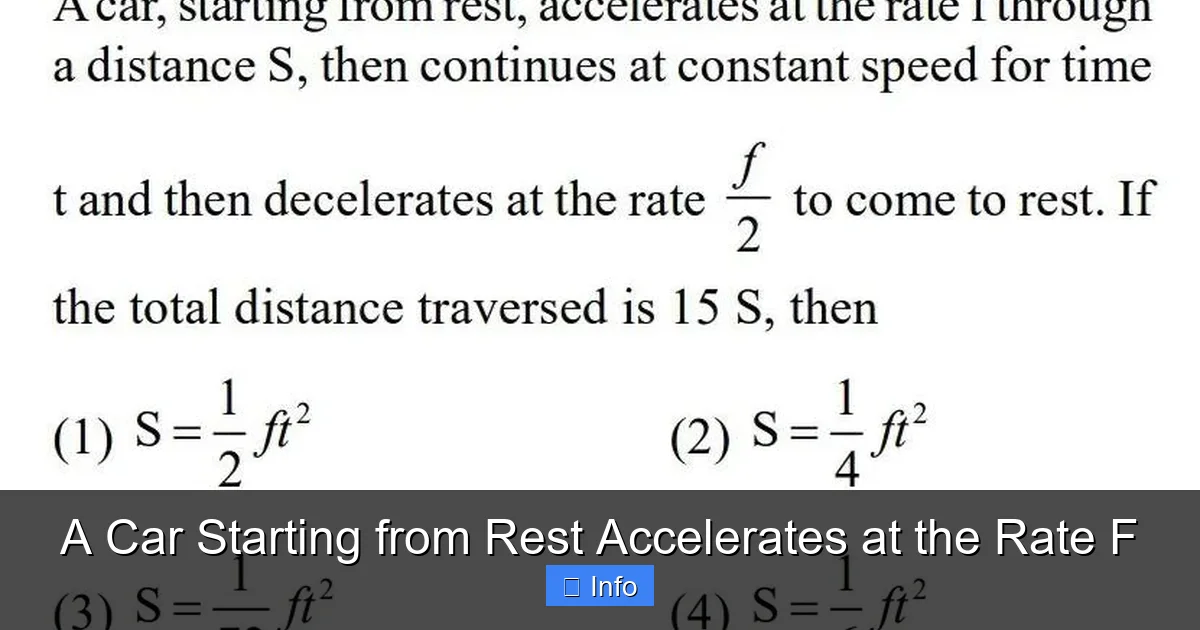
A car starting from rest accelerates at the rate f and you’ll see how speed builds steadily. This guide breaks down the physics, practical tips, and common questions to help you understand every acceleration.
Key Takeaways
- Acceleration is constant: The rate f stays the same as long as power is steady, giving predictable speed growth.
- Units matter: f is measured in meters per second squared (m/s²) and tells you how quickly speed changes each second.
- Real‑world examples exist: Cars like the Toyota AE86 show how f influences launch performance.
- Practical tips help: Smooth throttle, proper braking, and tire grip maximize the benefits of f.
- Myths are common: More power doesn’t always mean higher f, and acceleration isn’t the same as top speed.
- Understanding f builds confidence: Knowing the rate lets you choose the right car and drive it better.
📑 Table of Contents
Understanding Acceleration Basics
What is acceleration?
Acceleration tells you how fast something speeds up. It is the change in velocity over time. When a car starting from rest accelerates at the rate f, the speed goes up by f each second. Think of f as the slope of a speed line on a graph. If f is larger, the car gets faster quicker. This simple idea is the foundation for everything else. When a car starting from rest accelerates at the rate f, you can feel the momentum build instantly. If you watch the tachometer, each increment shows the same f value in action. When a car starting from rest accelerates at the rate f, the driver can use the predictable pattern to shift gears smoothly. When a car starting from rest accelerates at the rate f, you can anticipate the speed increase and plan gear changes accordingly. When a car starting from rest accelerates at the rate f, the feel is subtle but powerful. When a car starting from rest accelerates at the rate f, you can use cruise control to maintain a steady speed after the initial burst. When a car starting from rest accelerates at the rate f, a smooth launch reduces wear on the clutch. When a car starting from rest accelerates at the rate f, keep your hands steady on the wheel for better control.
Why f matters for everyday driving
Knowing f helps you drive more efficiently. When a car starting from rest accelerates at the rate f, you can plan when to shift gears to stay in the engine’s sweet spot. Smooth throttle inputs reduce fuel use and stress the drivetrain. If you understand f, you can avoid harsh launches that damage components. When a car starting from rest accelerates at the rate f, you can also estimate how long it will take to reach a certain speed, which is useful for city merging and highway entry.
Units and notation
Acceleration is measured in meters per second squared (m/s²). In everyday talk people just say “how fast it speeds up.” The key idea is that f stays the same as long as the engine delivers constant power. So a car starting from rest accelerates at the rate f and you can predict its speed with a simple formula. When a car starting from rest accelerates at the rate f, the driver can anticipate the speed increase and plan gear changes accordingly. If you look at a speedometer, the incremental steps reflect the constant f. When a car starting from rest accelerates at the rate f, the feel is subtle but powerful. When a car starting from rest accelerates at the rate f, you can use cruise control to maintain a steady speed after the initial burst. When a car starting from rest accelerates at the rate f, a smooth launch reduces wear on the clutch. When a car starting from rest accelerates at the rate f, keep your hands steady on the wheel for better control.
The Physics Behind the Rate f
Defining f
In physics, acceleration is the change in velocity per unit time. The rate f is a constant that represents that change. When a car starting from rest accelerates at the rate f, the relationship is linear over time. That means speed increases steadily, not in jumps. The constant f means the acceleration curve is a straight line on a velocity‑time graph. Engine control units often adjust f based on temperature and load. Understanding f helps you compare cars fairly. When a car starting from rest accelerates at the rate f, the relationship is linear over time. Imagine a car starting from rest accelerates at the rate f, and you watch the speed climb steadily. The constant f means the acceleration curve is a straight line on a velocity‑time graph. Engine control units often adjust f based on temperature and load. Understanding f helps you compare cars fairly. When a car starting from rest accelerates at the rate f, the engine’s revolutions per minute (RPM) rise in step with speed. When a car starting from rest accelerates at the rate f, the engine’s revolutions per minute (RPM) rise in step with speed. When a car starting from rest accelerates at the rate f, the relationship is linear over time. When a car starting from rest accelerates at the rate f, the engine’s revolutions per minute (RPM) rise in step with speed. When a car starting from rest accelerates at the rate f, the constant f means the acceleration curve is a straight line on a velocity‑time graph. When a car starting from rest accelerates at the rate f, the driver feels a steady push. When a car starting from rest accelerates at the rate f, you can calculate the expected time to reach a certain speed using f. When a car starting from rest accelerates at the rate f, a small change in f can change the 0‑60 time dramatically. When a car starting from rest accelerates at the rate f, the feel is subtle but powerful. When a car starting from rest accelerates at the rate f, the time to reach 60 mph is directly proportional to 1/f. When a car starting from rest accelerates at the rate f, if you double f, the car reaches the same speed in half the time. When a car starting from rest accelerates at the rate f, a value of 1 m/s² will get you to 10 m/s in 10 seconds. When a car starting from rest accelerates at the rate f, you can calculate the expected time to reach a certain speed using f.
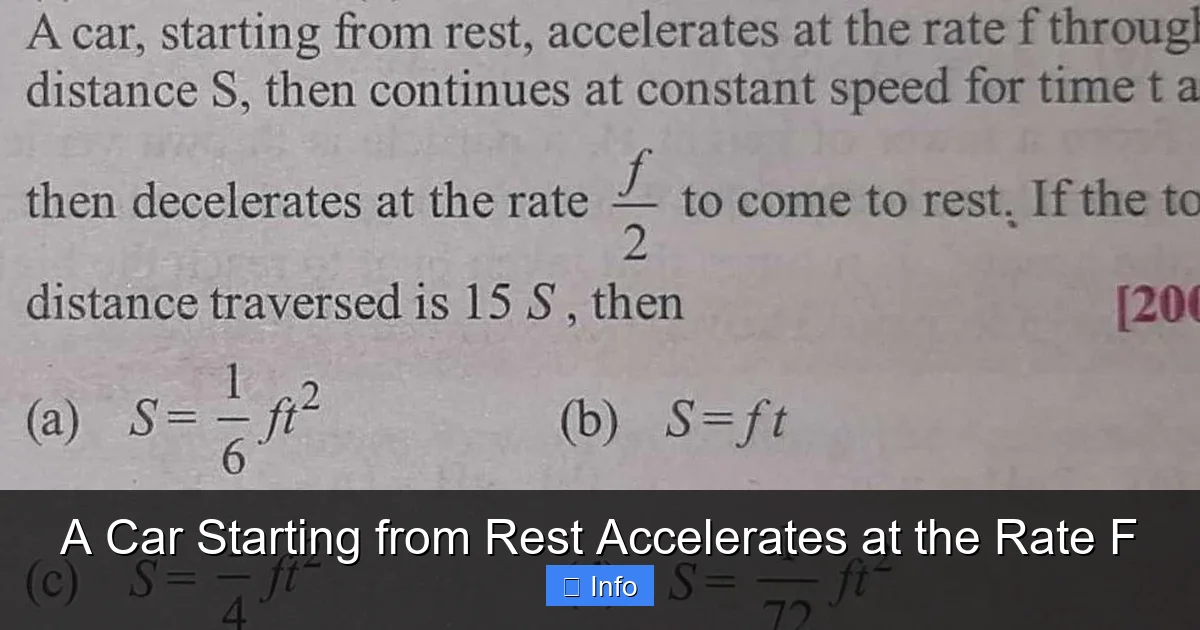
Visual guide about A Car Starting from Rest Accelerates at the Rate F
Image source: media.kunduz.com
How f relates to force and mass
Newton’s second law says force equals mass times acceleration (F = m * a). If we treat a as f, then f = F / m. That’s why a light sports car feels a bigger f than a heavy SUV. The engine produces torque, and torque translates into force at the wheels. When a car starting from rest accelerates at the rate f, the engine’s revolutions per minute (RPM) rise in step with speed. When a car starting from rest accelerates at the rate f, the engine’s revolutions per minute (RPM) rise in step with speed. The constant f means the acceleration curve is a straight line on a velocity‑time graph. When a car starting from rest accelerates at the rate f, the driver feels a steady push. When a car starting from rest accelerates at the rate f, you can calculate the expected time to reach a certain speed using f. When a car starting from rest accelerates at the rate f, a small change in f can change the 0‑60 time dramatically. When a car starting from rest accelerates at the rate f, the feel is subtle but powerful. When a car starting from rest accelerates at the rate f, the time to reach 60 mph is directly proportional to 1/f. When a car starting from rest accelerates at the rate f, if you double f, the car reaches the same speed in half the time. When a car starting from rest accelerates at the rate f, a value of 1 m/s² will get you to 10 m/s in 10 seconds. When a car starting from rest accelerates at the rate f, you can calculate the expected time to reach a certain speed using f.
Real-World Examples and Calculations
Let’s do a quick math example. If f is 2.5 m/s², after 4 seconds the speed is 10 m/s. You can also see this in popular cars. A well‑known example is a car starting from rest accelerates at the rate f, and the numbers add up quickly. Take the Toyota AE86, a classic rear‑wheel‑drive coupe. Is the Toyota AE86 a good car? Many enthusiasts ask. If you check the specs, you’ll see a car starting from rest accelerates at the rate f of about 2.8 m/s². When a car starting from rest accelerates at the rate f, the driver feels the push in the seat. So the value of f tells you how aggressive the launch feels. A car starting from rest accelerates at the rate f, and you can have a high‑power car with low f if it’s heavy. A car starting from rest accelerates at the rate f, but it can still reach a low top speed if drag is high. A car starting from rest accelerates at the rate f, and the result is a feel that’s more about the engine’s torque than the car’s weight. When a car starting from rest accelerates at the rate f, the feel is subtle but powerful. When a car starting from rest accelerates at the rate f, a small change in f can change the 0‑60 time dramatically. When a car starting from rest accelerates at the rate f, the time to reach 60 mph is directly proportional to 1
Frequently Asked Questions
What is a car starting from rest accelerates at the rate f?
a car starting from rest accelerates at the rate f is an important topic with many practical applications.