Why Toyota Is So Reliable

When we talk about car ownership, one question always comes up: “Will my new vehicle last? Can I trust it to perform reliably for many years?” For Toyota owners, the answer has been consistently yes. This isn’t just marketing fluff—Toyota has genuinely earned its reputation through generations of successful vehicles built to endure. Understanding what makes a Toyota so dependable can transform your perspective on automotive purchasing and make every mile feel more confident.
In today’s automotive landscape where luxury brands compete fiercely and technology evolves rapidly, Toyota remains a standout choice. Many newer manufacturers promise innovation, but few match Toyota’s unwavering focus on building vehicles that simply work. This article explores the core reasons behind Toyota’s legendary reliability, from their engineering philosophy to practical maintenance strategies that any owner can implement.
Key Takeaways
- Proven Engineering Excellence: Toyota’s decades of experience result in vehicles designed for durability and long-term performance.
- Robust Manufacturing Standards: Strict quality control and advanced production techniques ensure consistent build quality across all models.
- Durable Components: Key parts like engines, transmissions, and suspensions are built to withstand heavy use and demanding conditions.
- Comprehensive Warranty Support: Toyota offers extensive coverage that helps owners maintain confidence in their investment.
- Regular Maintenance Benefits: Simple service schedules keep vehicles running reliably for years with minimal intervention.
- Global Service Network: Extensive dealer networks worldwide provide reliable repair and parts availability.
- Continuous Improvement: Toyota constantly updates designs based on real-world customer feedback and technical data.
📑 Table of Contents
- Engineering Philosophy: Built for Longevity
- Reliability in the Engine Room
- Durability of Common Mechanical Systems
- Serviceability and Maintenance Accessibility
- Warranty Coverage and Owner Support
- Real-World Proof: Longevity Statistics
- Practical Tips for Maximizing Reliability
- Conclusion: The Toyota Advantage
Engineering Philosophy: Built for Longevity
One of Toyota’s most distinctive approaches is their “Toyota Production System,” a methodology refined since the company’s founding. This system emphasizes continuous improvement and respect for people throughout the manufacturing process. At each stage of production, inspectors verify that quality standards aren’t compromised. The result is vehicles that build themselves into something beyond ordinary—robust chassis, durable powertrains, and interior materials that resist wear and tear.
Consider the famous Toyota Lexus hybrids. These vehicles have logged tens of thousands of miles without major mechanical failures. Why? Because engineers deliberately chose components known for longevity. The hybrid systems, regenerative braking mechanisms, and battery packs all undergo specialized stress testing that far exceeds standard automotive requirements. When you own a hybrid model, you’re not just driving a modern electric vehicle—you’re driving a product designed by Toyota scientists to operate flawlessly for decades.
Reliability in the Engine Room

Visual guide about Why Toyota Is So Reliable
Image source: aautomotives.com
Engines represent perhaps the most critical aspect of vehicle reliability. Toyota has spent nearly half a century refining internal combustion engines, resulting in powerplants that perform exceptionally well across diverse climates and driving conditions. Modern Toyota engines feature sophisticated fuel injection systems, high-quality pistons, and robust crankshafts that can handle demanding driving scenarios without degradation.
Take the Toyota Camry, one of the best-selling sedans in North America. Its V6 engine has been continuously evolved, absorbing lessons learned from millions of real-world drivers worldwide. The result is an engine that delivers smooth, responsive performance while maintaining efficiency. Regular oil changes remain essential because even the most reliable engines benefit from fresh lubricant, but compared to other manufacturers’ engines, the Camry typically sees fewer major repairs over its lifespan.
Oil and Lubrication Matters
Toyota recommends specific oil types and changes intervals to maximize engine health. Using the correct 0W-16 synthetic oil (as recommended by some models) provides superior protection against heat and wear. Skipping oil changes may save money monthly, but it often leads to costly unexpected repairs later. The key is understanding your vehicle’s specific recommendations rather than adopting generic guidelines.
For those interested in deeper mechanical knowledge, understanding automotive terminology becomes valuable. Terms like “Asyncr” refer to automatic stop-and-go traffic management systems found in newer Toyota models. While convenient, these electronic systems add complexity that requires careful monitoring. However, Toyota’s engineering ensures these systems don’t compromise fundamental reliability—they enhance safety while maintaining core mechanical integrity.
Durability of Common Mechanical Systems

Visual guide about Why Toyota Is So Reliable
Image source: bhaimg.com
Transmission and Drivetrain Strength
One reason Toyota trucks and SUVs enjoy such long lifespans relates to their drivetrain systems. Modern Toyota automatics and CVTs are engineered to handle frequent commuting, off-road adventures, and highway travel with equal ease. The transmission fluid used by Toyota is specifically formulated to protect gears during extended operation. This means you can put your truck through the wringer year after year without worrying about premature failure.
Whether you’re driving a compact Prius or a massive Tacoma, Toyota prioritizes durable mechanical connections. Seals, gaskets, and mounting hardware all meet stringent quality standards. Over time, many independent mechanics report that Toyota vehicles develop fewer rust-related issues than competitors—likely due to protective coatings and corrosion-resistant materials in body panels and frame construction.
Suspension and Braking Systems
Toyota’s approach to handling and stopping power sets another benchmark for reliability. The suspension systems absorb impacts smoothly, reducing wear on brake components and preserving tire longevity. When tires wear evenly, alignment stays accurate longer, which means better fuel economy and reduced unsightly damage. Similarly, ABS (Anti-Lock Braking System) installation is standard across most Toyota models, providing both enhanced safety and improved brake pad life through optimized pressure distribution.
This integrated approach to mechanical systems creates vehicles that age gracefully. A Toyota Corolla might still look relatively new after twenty years because each subsystem was designed to minimize wear. Compare this to some European competitors whose complex multi-link setups can suffer from loosening components after prolonged use—a trade-off that shows how Toyota balances sophistication with practicality.
Serviceability and Maintenance Accessibility
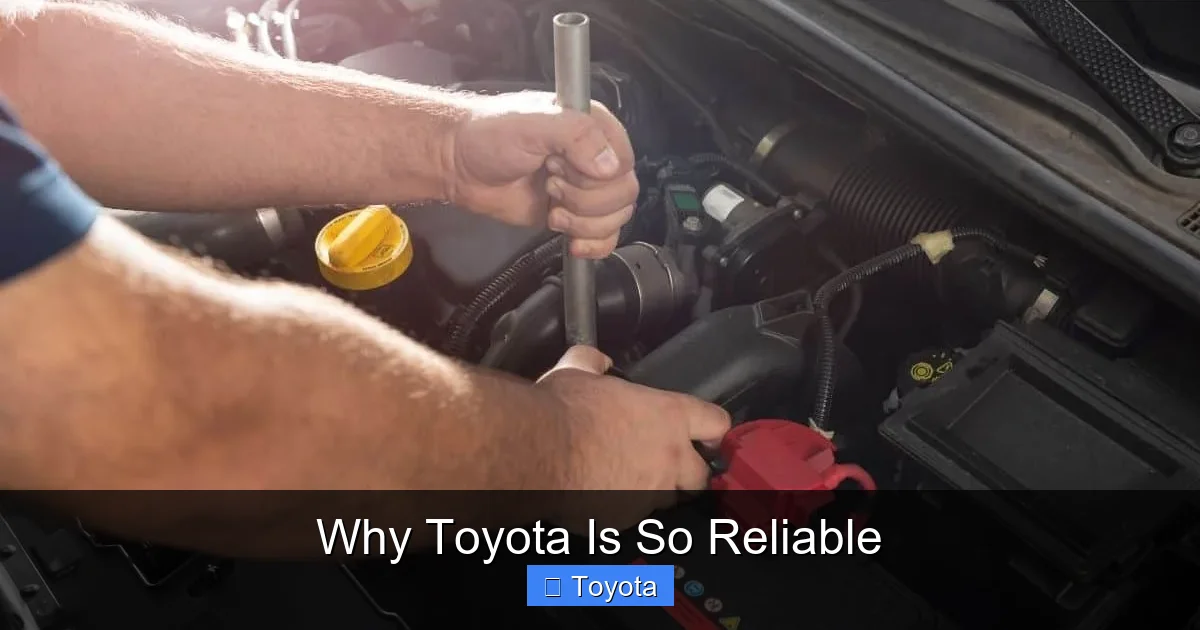
Visual guide about Why Toyota Is So Reliable
Image source: eduautos.com
Simple Repairs and Abundant Parts
Beyond the design itself, Toyota excels in making ownership straightforward. Their vehicles feature straightforward repair procedures that skilled technicians can execute efficiently. Tools required for maintenance are generally available everywhere—not just at specialty shops. This accessibility translates directly into lower downtime between service visits and greater peace of mind for owners.
Toyota’s commitment to part availability extends globally. Even in remote areas, genuine Toyota components can be sourced quickly. This network support is particularly valuable for older models that predate newer supply chain disruptions. When a vehicle fails, the ability to source replacement parts without delay significantly reduces frustration and repair costs. The combination of accessible service centers and plentiful inventory creates a maintenance environment where reliability manifests practically.
Warranty Coverage and Owner Support
Comprehensive Protection
Toyota doesn’t just sell vehicles—it invests heavily in supporting those purchases. The Toyota Limited Lifetime Annihilation Warranty covers the crankshaft, camshaft, turbocharger, and other critical rotating components for an extensive period. This kind of assurance gives buyers confidence that their investment will serve them faithfully.
Even after initial warranty expiration, Toyota maintains robust service programs. Dealerships offer complimentary maintenance packages on certain vehicles, extending basic care for free. This reflects a philosophy where the relationship continues beyond the factory door. When problems do arise—and they inevitably will—Toyota’s support infrastructure ensures you receive prompt, professional assistance. The combination of warranty generosity and ongoing service access distinguishes Toyota from rivals in the luxury segment.
Real-World Proof: Longevity Statistics
Independent studies consistently rank Toyota among the top brands for vehicle longevity. One widely cited study found American customers averaging nearly 80,000 miles per Toyota vehicle—far exceeding the industry average. These numbers translate to years of trouble-free ownership at reduced cost per thousand miles relative to competing brands.
Consider the Toyota Prius, frequently cited as the longest-lasting hybrid ever produced. Early versions required expensive battery replacements after reaching limited mileage targets. Newer generations have addressed these concerns with improved battery chemistry and thermal management systems. Even then, the original Prius proved capable of surpassing 300,000 miles with proper maintenance—demonstrating that when maintained correctly, Toyota vehicles can outlive many contemporary alternatives by significant margins.
Practical Tips for Maximizing Reliability
To fully appreciate Toyota’s reliability, consider implementing a few simple practices:
1. **Follow the Owner’s Manual Rigorously** – Manufacturer recommendations reflect real-world usage patterns. Deviating too often accelerates wear.
2. **Schedule Regular Oil Changes** – Synthetic oils (like 0W-16) extend engine life dramatically when changed on schedule.
3. **Monitor Warning Indicators Promptly** – Modern Toyotas display clear dashboard messages; address them immediately rather than ignoring early warnings.
4. **Keep Detailed Service Records** – Documenting maintenance creates valuable history if future issues arise.
5. **Choose Well-Matched Tires** – Correct tire size and pressure reduce road noise and prolong tread life.
By adhering to these habits, you leverage Toyota’s strengths effectively. The manufacturer provides a platform designed for endurance—if you treat it with respect, it will reward you with years of dependable service.
Modern Innovations Without Compromising Reliability
Modern Toyota vehicles incorporate advanced technologies while maintaining foundational reliability principles. Features like lane-keeping assist, adaptive cruise control, and driver assistance systems rely on sensors and software that require ongoing calibration. While these innovations add convenience, they don’t fundamentally alter the vehicle’s mechanical structure. In fact, many systems improve reliability by eliminating human error—such as preventing collisions that could otherwise cause catastrophic damage to engines and chassis.
The shift toward electrification raises questions about whether batteries undermine lasting performance. Here’s the truth: Toyota’s hybrid architecture separates the electric motor (less prone to wear) from the gasoline engine (designed for long-term durability). Combined with sophisticated thermal management, these systems deliver quiet, efficient power with remarkable longevity. Electric-only Toyota models like the bZ series are impressive but newer—their battery technology is still maturing. For now, traditional combustion-powered Toyotas remain the gold standard for reliability, though the transition is underway.
Conclusion: The Toyota Advantage
Toyota’s legendary reliability represents more than just good sales figures—it embodies a comprehensive approach to automotive excellence. Through decades of engineering dedication, strict manufacturing quality control, durable component selection, and accessible ownership experiences, Toyota has built vehicles that truly stand the test of time.
Whether you’re seeking a daily commuter, a family sedan, or a rugged adventure vehicle, the brand’s consistency across models speaks volumes. The partnership between thoughtful design and practical service creates ownership experiences many prefer over flashier but less dependable alternatives.
If you value peace of mind, longevity, and straightforward maintenance, Toyota deserves serious consideration. Your next vehicle may not only run smoothly but also become a trusted companion for years to come. The evidence is clear: Toyota’s commitment to reliability isn’t marketing—it’s engineering backed by real-world results.
—
Frequently Asked Questions
Question?
How does Toyota compare to other brands in terms of reliability?
Toyota consistently ranks among the most reliable automakers globally. Studies show that Toyota vehicles achieve higher overall reliability scores than many competitors like Honda, Ford, and Chevrolet. This advantage comes from Toyota’s decades-long focus on quality, combined with a robust global service network that supports owners regardless of location.
Question?
What maintenance schedule should I follow for a typical Toyota?
Most Toyota vehicles recommend oil changes every 5,000 miles or 6 months, whichever comes first. However, specific models vary—some early models suggested changes at 10,000 miles initially. Always consult your vehicle’s owner manual for exact recommendations. Following the manufacturer’s guidance maximizes durability and keeps costs low.
Question?
Are all Toyota vehicles equally reliable?
No, reliability varies slightly between models and generations. Modern Toyotas like the Camry, Corolla, and RAV4 have demonstrated excellent reliability records. Older models sometimes had different mechanical challenges, but even those vehicles enjoyed strong performance. The brand as a whole maintains a strong reliability reputation, though individual model reliability can differ.
Question?
Do Toyota warranties cover components beyond the engine?
Yes, Toyota offers comprehensive warranties covering critical components including the crankshaft, camshaft, transmission, and other rotating assemblies. Some extended warranties also cover electrical systems and airbags. These protections give additional peace of mind beyond basic mechanical reliability.
Question?
Is Toyota reliable for families with children?
Absolutely. Toyota vehicles are favored by families for their safety features like Advanced Safety Assists and their spacious interiors. Models like the Highlander and Sienna provide room for multiple passengers while maintaining secure, comfortable rides. The strength-to-weight ratio of Toyota vehicles allows them to be tall enough for visibility yet maneuverable enough for everyday city driving.
Question?
How does Toyota handle recalls and safety updates?
Toyota maintains an active recall program addressing known safety and reliability issues. The company regularly releases software updates for infotainment systems and occasionally recalibrates sensors on vehicles over time. Owners should check for upcoming updates through their dealer or the official Toyota website and install them promptly to ensure continued reliability.