What Is on the Toyota Assessment Test
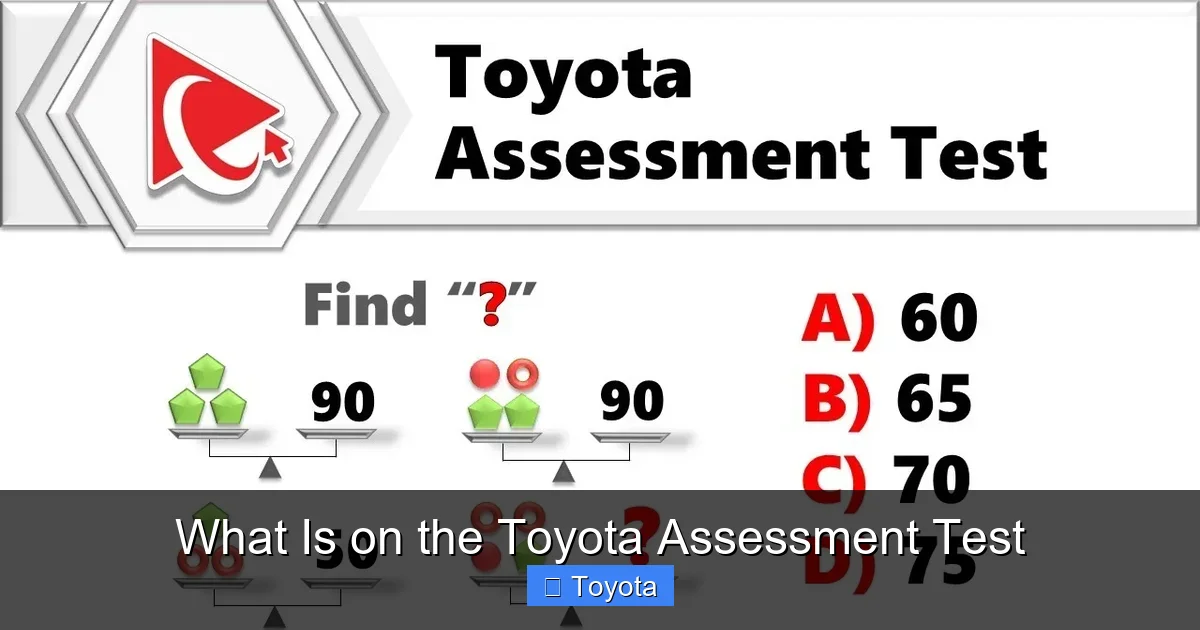
The Toyota Assessment Test evaluates candidates on cognitive ability, situational judgment, and role‑specific knowledge. Understanding its structure and preparing with targeted practice can significantly improve your performance and help you land a Toyota career.
Key Takeaways
- Core Sections: The test typically includes cognitive ability, situational judgment, and technical or role‑specific components.
- Purpose: Toyota uses the assessment to gauge problem‑solving skills, decision‑making style, and fit for the company’s culture.
- Preparation: Reviewing basic math, logical reasoning, and practicing situational judgment scenarios are key to success.
- Test Day Logistics: Expect a timed, online format with immediate scoring; know the login process and required equipment.
- Scoring Insight: Scores are benchmarked against a norm group; higher percentiles improve your chances of moving forward.
- Role‑Specific Tips: Tailor your study to the position—engineering roles need more technical focus, while sales roles benefit from customer‑service scenarios.
- Stay Calm: Managing time, taking brief breaks, and maintaining a positive mindset can reduce anxiety and boost performance.
📑 Table of Contents
Introduction
If you’re eyeing a career at Toyota, you’ve likely heard about the Toyota Assessment Test. This evaluation is a standard part of the hiring process for many positions, from entry‑level associates to engineers and managers. Understanding what the test covers can demystify the experience and give you a clear roadmap for preparation.
Toyota’s assessment is designed to measure not only what you know but also how you think and react in workplace situations. By breaking down each section, you can focus your study efforts where they matter most and approach the test with confidence.
In this guide, we’ll walk through the typical components of the Toyota Assessment Test, share proven preparation strategies, explain what to expect on test day, and offer practical tips for maximizing your score. Whether you’re applying for a role in manufacturing, sales, or corporate offices, the insights below will help you showcase your strengths.
Understanding the Toyota Assessment Test
Purpose and Overview
The primary goal of the Toyota Assessment Test is to identify candidates who align with Toyota’s core values of continuous improvement, respect for people, and long‑term thinking. Rather than testing memorization alone, the exam evaluates cognitive abilities, decision‑making skills, and job‑specific knowledge. This holistic approach helps Toyota select individuals who can thrive in its team‑oriented, Kaizen‑driven environment.
Visual guide about What Is on the Toyota Assessment Test
Image source: aautomotives.com
Most candidates encounter the test online, either through a secure portal or a third‑party assessment provider. The length varies by role but generally ranges from 60 to 90 minutes. Knowing the format ahead of time lets you allocate your study time effectively and reduces surprises on the day of the exam.
Components of the Assessment Test
While the exact mix can differ depending on the job family, three main sections appear consistently across Toyota’s assessments:
Visual guide about What Is on the Toyota Assessment Test
Image source: aautomotives.com
Cognitive Ability Section
This part measures logical reasoning, numerical aptitude, and verbal comprehension. You might see sequences of numbers or shapes that require you to identify the next item, word analogies, or basic arithmetic problems. The questions are timed, so speed and accuracy both matter.
For example, a typical numerical question could ask you to calculate the percentage increase in production output given two figures. A verbal question might present a short passage and ask you to infer the author’s main point. Practicing with sample logical‑reasoning tests and brushing up on fractions, percentages, and ratios will boost your performance here.
Situational Judgment Test (SJT)
The SJT presents realistic workplace scenarios and asks you to choose the most effective or least effective response. Toyota uses this section to gauge how well you align with its problem‑solving culture and customer‑focused mindset. Scenarios often involve teamwork, safety considerations, or handling a difficult customer.
Imagine a situation where a coworker notices a minor defect on the assembly line but is unsure whether to stop the line. Your task is to select the action that best reflects Toyota’s emphasis on quality and employee empowerment. Reviewing Toyota’s guiding principles, such as the Toyota Production System and the concept of “jidoka” (automation with a human touch), can help you identify the preferred responses.
Technical or Role‑Specific Knowledge
Depending on the position, you may face questions that test specific expertise. For engineering roles, expect topics like basic mechanics, fluid dynamics, or electrical principles. For sales or customer‑service positions, the focus might shift to product knowledge, sales techniques, or handling objections.
If you’re applying for a role that involves working with Toyota vehicles, familiarity with popular models can be useful. For instance, knowing the starting price of a new Toyota Corolla (How Much Is A New Toyota Corolla) or a Toyota Tundra (How Much Is A Toyota Tundra) demonstrates product awareness that may appear in a sales‑oriented SJT or technical question.
Preparation Strategies
Study Resources
Start by gathering materials that mirror the test’s content. Free online logical‑reasoning puzzles, numerical‑reasoning practice sets, and verbal‑comprehension passages are widely available. Many job‑prep websites offer timed simulations that mimic the pressure of the actual exam.
Visual guide about What Is on the Toyota Assessment Test
Image source: aautomotives.com
For the SJT, review Toyota’s public documents such as the Toyota Global Vision, the Environmental Challenge 2050, and the company’s safety policies. Understanding these frameworks will help you intuit the “best” answer in situational scenarios.
If the role demands technical knowledge, revisit relevant textbooks or online courses. For mechanical‑focused positions, Khan Academy’s physics sections on forces and energy can be helpful. For electrical topics, consider basic circuit tutorials from sites like All About Circuits.
Practice Tests
Taking full‑length practice assessments is one of the most effective ways to prepare. Aim to complete at least two timed practice tests under exam‑like conditions: no distractions, a reliable internet connection, and the same device you’ll use on test day.
After each practice test, review every question—especially the ones you got wrong. Identify whether the mistake stemmed from a knowledge gap, a misreading of the scenario, or time pressure. Adjust your study plan accordingly, focusing on weak areas while maintaining strengths.
Remember to incorporate the internal links naturally when discussing vehicle pricing. For example, you might note that awareness of the price range for a new Toyota Tacoma (How Much Is A New Toyota Tacoma) can be useful when answering questions about market positioning or customer inquiries.
What to Expect on Test Day
Logistics and Timing
On the scheduled day, you’ll receive an email with a secure link to the assessment platform. Make sure you log in at least 10 minutes early to complete any system checks, such as webcam or microphone requirements (if applicable). Most tests are administered through a browser, so having an updated version of Chrome, Firefox, or Safari will prevent technical hiccups.
The test is typically divided into sections with a visible timer. You cannot pause the timer once a section begins, so manage your pace carefully. If you finish a section early, you may use the remaining time to review answers within that section before moving on.
Scoring and Feedback
Toyota’s assessment is usually scored automatically, and you may receive a preliminary score report immediately after completion. The report often includes a percentile ranking for each section, showing how you performed relative to other candidates.
While you won’t see the exact questions again, the feedback can highlight strengths and areas for improvement. If you don’t advance to the next interview stage, consider using this information to refine your approach for future applications.
Tips for Success
Time Management
Because each section is timed, practicing with a clock is essential. A useful rule of thumb is to allocate roughly the same amount of time per question, then adjust based on difficulty. For instance, if a numerical problem looks complex, mark it for review and move on; return to it if time permits.
When tackling the SJT, read each scenario fully before looking at the answer choices. Eliminate options that clearly contradict Toyota’s core values, then choose the response that best balances effectiveness with alignment to those values.
Mindset and Stress Reduction
Approach the test as a chance to showcase your skills rather than a pass/fail hurdle. Simple techniques—deep breathing before each section, a quick stretch between blocks, and positive self‑talk—can keep anxiety at bay.
Remember that Toyota values continuous improvement. If you encounter a tough question, view it as an opportunity to demonstrate perseverance. Even if you’re unsure of the answer, selecting the most reasoned choice reflects the problem‑solving attitude Toyota seeks.
Conclusion
The Toyota Assessment Test is a multifaceted evaluation designed to identify candidates who fit both the skill requirements and the cultural ethos of the company. By understanding its sections—cognitive ability, situational judgment, and role‑specific knowledge—you can tailor your preparation effectively.
Leverage free online resources, take timed practice tests, and familiarize yourself with Toyota’s guiding principles. Pay attention to practical details such as product pricing (for example, knowing the cost of a new Toyota Corolla, Tundra, or Tacoma) as they may appear in scenario‑based questions.
On test day, manage your time wisely, stay calm, and let your problem‑solving shine through. With focused preparation and a confident mindset, you’ll be well positioned to move forward in Toyota’s hiring process and embark on a rewarding career with one of the world’s most respected automakers.
Frequently Asked Questions
What types of questions are on the cognitive ability section?
The cognitive ability section includes logical‑reasoning puzzles, numerical problems (such as percentages, ratios, and basic algebra), and verbal‑comprehension passages. Questions are multiple choice and timed, assessing how quickly and accurately you can process information.
How does the situational judgment test reflect Toyota’s values?
Scenarios in the SJT are drawn from real workplace situations at Toyota, focusing on teamwork, safety, quality, and customer service. The best answers align with the Toyota Production System principles, such as continuous improvement (Kaizen) and respect for people.
Do I need to know specific Toyota models for the test?
While not always required, familiarity with popular models like the Corolla, Tundra, or Tacoma can be helpful, especially for sales or customer‑service roles where product knowledge may be tested. Knowing basic pricing or features shows you’ve done your homework on the brand.
Can I retake the Toyota Assessment Test if I don’t pass?
Retake policies vary by region and position. Generally, if you don’t advance, you may be eligible to reapply after a certain waiting period, during which you can retake the assessment. Check the specific job posting or contact Toyota’s recruiting team for exact rules.
What equipment do I need to take the online assessment?
You’ll need a reliable computer or laptop, a stable internet connection, and an updated web browser. Some assessments may require a webcam or microphone for integrity checks, so ensure those are functional before starting the test.
How long does it take to receive my results?
Most candidates see a preliminary score report immediately after completing the test. Detailed feedback, if provided, is usually sent via email within a few business days, depending on the volume of applicants and the hiring timeline.