What Erp System Does Toyota Use?
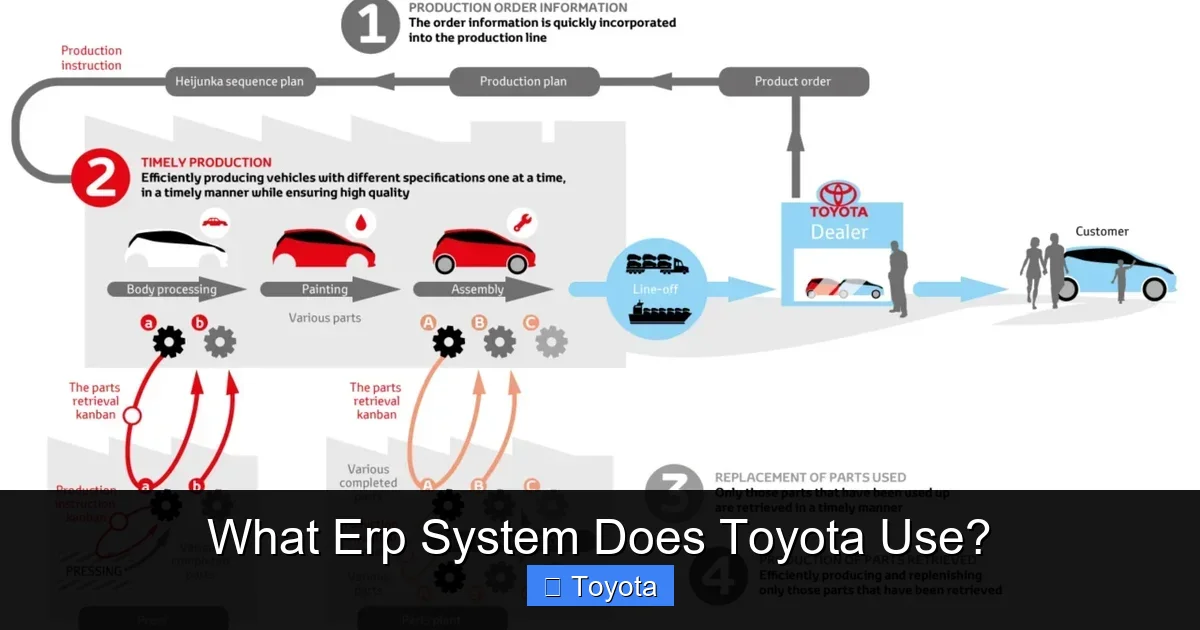
Toyota relies on a powerful Toyota ERP system, primarily built on SAP S/4HANA, to coordinate its global manufacturing, supply chain, and finance operations. This integrated platform helps the automaker maintain lean efficiency, real‑time inventory visibility, and data‑driven decision making across every region.
Key Takeaways
- Core Platform: Toyota uses SAP S/4HANA as the backbone of its Toyota ERP system, replacing legacy solutions with a modern, real‑time suite.
- Production Integration: The ERP system tightly integrates with the Toyota Production System (TPS), enabling Kaizen, just‑in‑time parts delivery, and continuous improvement.
- Global Supply Chain: From parts suppliers to finished‑vehicle logistics, the Toyota ERP system provides end‑to‑end visibility and demand forecasting.
- Financial Control: Real‑time financial reporting, cost allocation, and budgeting are centralized, helping Toyota keep tight control over model‑specific expenses.
- Scalability & Future‑Proofing: Toyota is moving portions of the ERP to the cloud and exploring AI‑driven analytics to stay ahead of market shifts.
- Operational Benefits: The system reduces inventory holding costs, improves plant utilization, and supports rapid model changes.
- Customer Impact: By streamlining operations, the Toyota ERP system indirectly contributes to higher vehicle quality and more competitive pricing.
📑 Table of Contents
Toyota ERP System Overview
When you think about the cars sitting on dealer lots, you probably picture assembly lines, robots, and thousands of parts coming together. Behind the scenes, a sophisticated network of software keeps everything synchronized. That network is known as the Toyota ERP system. ERP stands for Enterprise Resource Planning, and for Toyota, it is the digital backbone that ties together finance, manufacturing, supply chain, and human resources across the globe.
The phrase “Toyota ERP system” appears often in industry discussions because it reflects a massive undertaking. The automaker has invested billions of dollars over the past two decades to build a system that can handle the complexity of producing millions of vehicles each year. At its core, the Toyota ERP system is built on SAP S/4HANA, a platform that promises real‑time data processing and advanced analytics. This choice was not accidental; SAP’s reputation for handling large, globally distributed enterprises made it a natural fit for a manufacturer as big as Toyota.
Understanding the Toyota ERP system means looking at how it supports the Toyota Production System (TPS). TPS is famous for its focus on waste reduction, continuous improvement (Kaizen), and just‑in‑time production. The ERP system feeds TPS with accurate, up‑to‑the‑minute information about inventory levels, machine status, and labor availability. In turn, TPS provides the ERP with the operational data needed for better planning and forecasting. The result is a virtuous cycle of efficiency that helps Toyota stay lean while scaling worldwide.
Core Platform: SAP S/4HANA
Why SAP?
Toyota chose SAP for its Toyota ERP system because SAP could match the automaker’s demand for scalability and reliability. SAP’s cloud‑enabled architecture allows Toyota to roll out updates without shutting down entire factories. Moreover, SAP’s industry‑specific solutions for automotive manufacturing align well with the nuances of vehicle production.
Visual guide about What Erp System Does Toyota Use?
Image source: aautomotives.com
Implementation Timeline
The move to SAP began in the early 2000s and has been phased in over more than two decades. Early modules covered finance and manufacturing, while later phases added supply chain, human capital, and customer relationship management. Each phase was carefully planned to minimize disruption on the shop floor, reflecting Toyota’s respect for its production rhythm.
Key Modules in the Toyota ERP System
- Financial Management: Real‑time consolidation, cost accounting, and predictive budgeting.
- Supply Chain Management: Supplier collaboration, inbound logistics, and inventory optimization.
- Manufacturing Execution: Shop‑floor control, work‑order tracking, and quality assurance.
- Project & Asset Management: New‑model development costs and plant maintenance scheduling.
- Human Capital Management: Global payroll, talent acquisition, and learning platforms.
Each of these modules is interconnected within the Toyota ERP system, ensuring that a change in one area instantly reflects in others. This integration is a hallmark of SAP S/4HANA’s in‑memory computing capabilities.
Supply Chain and Logistics
Vehicle production is a marathon of parts moving from suppliers to assembly lines. The Toyota ERP system acts as the traffic controller for this flow. By aggregating demand signals from all factories, the system generates precise purchase orders, reducing excess inventory and lowering carrying costs.
Visual guide about What Erp System Does Toyota Use?
Image source: aautomotives.com
One practical example of this efficiency is how the ERP system accounts for vehicle weight. The weight of a Toyota Tundra influences freight costs, fuel consumption, and even structural design choices. The ERP system automatically factors the Tundra’s weight into logistics planning, ensuring that trucks are loaded optimally and routes are chosen to minimize carbon footprint and delivery time. You can read more about the Tundra’s specifications at Toyota Tundra weight details.
Moreover, the Toyota ERP system supports predictive analytics for supplier lead times. By analyzing historical data, the system can flag potential bottlenecks before they become problems. This proactive stance helps Toyota avoid costly production delays and keeps the just‑in‑time philosophy alive.
Manufacturing Execution and the Toyota Production System
Real‑Time Shop‑Floor Data
On the factory floor, operators use handheld devices and sensors that feed data directly into the Toyota ERP system. These devices capture everything from cycle times to defect rates. The ERP system then displays this information on dashboards for managers, enabling instant decision‑making.
Visual guide about What Erp System Does Toyota Use?
Image source: aautomotives.com
Just‑in‑Time (JIT) Coordination
JIT is a cornerstone of TPS, and the Toyota ERP system is the engine that makes it possible. The system calculates the exact quantity of parts needed for each shift based on current production schedules. If a machine goes down, the ERP automatically re‑balances the workflow, pulling parts from alternate buffers to keep the line moving.
Continuous Improvement (Kaizen)
Kaizen thrives on data. The Toyota ERP system collects suggestions from floor workers, tracks improvement projects, and measures their impact on key performance indicators (KPIs). This creates a feedback loop where every small improvement is captured, analyzed, and scaled across the organization.
When setting the price for a Camry, the ERP system factors in many variables, including the Camry’s weight, which directly influences transportation expenses. By integrating the Camry’s weight data into cost calculations, the ERP system ensures that pricing reflects true logistical costs. For a deeper look at the Camry’s weight specifications, visit Toyota Camry weight details.
Financial Management and Real‑Time Reporting
Consolidated Financial View
Because Toyota operates in dozens of countries, its financial landscape is complex. The Toyota ERP system consolidates financial data from every subsidiary into a single, real‑time view. This eliminates the need for manual month‑end closes and reduces the risk of errors.
Model‑Specific Costing
Each vehicle model has its own cost structure. The ERP system tracks material costs, labor hours, and overhead for every model, from the entry‑level Corolla to the high‑performance Supra. This granularity allows Toyota to set prices that accurately reflect each model’s profitability.
The ERP system also pulls data from the broader Toyota cost landscape, ensuring each model’s price reflects production, labor, and material costs. You can explore general pricing insights at Toyota cost overview.
Budgeting and Forecasting
Strategic planning relies heavily on accurate forecasts. The Toyota ERP system uses AI‑enhanced forecasting tools to predict demand based on market trends, seasonality, and promotional activities. This helps Toyota allocate resources wisely, avoiding over‑production or stockouts.
Future‑Ready ERP: Cloud, AI, and Mobility
Cloud Migration
Toyota is gradually moving non‑core ERP functions to the public cloud. This shift provides flexibility, reduces on‑premise maintenance costs, and enables rapid deployment of new features. The cloud strategy also supports remote collaboration, a critical capability in a post‑pandemic world.
Artificial Intelligence and Machine Learning
AI is becoming a cornerstone of the Toyota ERP system. Machine‑learning models analyze production data to predict equipment failures before they happen. Predictive maintenance reduces downtime and extends asset life, delivering tangible cost savings.
Mobile and IoT Integration
Mobile devices and IoT sensors are proliferating on the shop floor. The Toyota ERP system now supports mobile workflows, allowing workers to log issues, request parts, and approve changes from anywhere. This mobility improves responsiveness and empowers front‑line employees.
Challenges and Considerations
No ERP implementation is without hurdles. For a global giant like Toyota, the challenges include coordinating changes across hundreds of sites, ensuring data quality, and managing the cultural shift required for new processes. The company addresses these issues through rigorous change‑management programs, extensive training, and a phased rollout approach.
Security is also a top priority. The Toyota ERP system employs multi‑factor authentication, encryption, and continuous monitoring to protect sensitive intellectual property and financial data. As cyber threats grow, Toyota invests heavily in threat detection and incident response capabilities.
Conclusion
The Toyota ERP system is more than a collection of software modules; it is the digital nervous system that enables one of the world’s most respected manufacturers to operate with precision and agility. Built on SAP S/4HANA, the system integrates finance, supply chain, manufacturing, and human resources into a unified platform that supports the lean principles of the Toyota Production System. Real‑time data, predictive analytics, and continuous improvement loops ensure that every decision is informed and every process is optimized.
Through careful planning, incremental implementation, and a focus on user adoption, Toyota has turned its ERP system into a strategic asset. The system not only drives operational excellence but also contributes to competitive pricing, higher quality, and a stronger brand reputation. As Toyota looks ahead, the next wave of cloud services, AI, and IoT will further enhance the capabilities of the Toyota ERP system, keeping the company at the forefront of automotive innovation.
In short, the Toyota ERP system is a testament to how digital transformation can empower a legacy manufacturer to stay lean, responsive, and future‑ready in an ever‑changing industry.
Frequently Asked Questions
What ERP system does Toyota use?
Toyota primarily relies on SAP S/4HANA as the backbone of its Toyota ERP system. This platform integrates finance, supply chain, manufacturing, and human resources across the globe, supporting the Toyota Production System’s lean principles.
Why did Toyota choose SAP for its ERP?
SAP’s proven track record with large, globally distributed enterprises, its industry‑specific automotive solutions, and its ability to provide real‑time, in‑memory processing made it the ideal choice for Toyota’s complex manufacturing environment.
How does the Toyota ERP system support the Toyota Production System?
The ERP system feeds real‑time data on inventory, labor, and equipment into TPS, enabling just‑in‑time production, continuous improvement (Kaizen), and rapid response to disruptions on the shop floor.
What are the main benefits of Toyota’s ERP implementation?
Benefits include reduced inventory costs, improved plant utilization, accurate model‑specific costing, real‑time financial reporting, and enhanced scalability for future growth and technology adoption.
Is Toyota moving its ERP to the cloud?
Yes, Toyota is gradually migrating non‑core ERP functions to the cloud to increase flexibility, lower maintenance costs, and enable faster deployment of new features and mobile access.
How does the Toyota ERP system handle security?
The system employs multi‑factor authentication, data encryption, and continuous monitoring to protect sensitive intellectual property and financial information from cyber threats.