How Many Quarts of Oil Does a Toyota Camry Take?

Most Toyota Camrys require 4.4 to 5.4 quarts of oil when fully drained and refilled, with variations depending on engine size and model year. Always consult your owner’s manual for precise capacity, as older models like 2002-2006 typically need 4.4 quarts while newer V6 engines may require up to 6.1 quarts. Checking oil levels monthly and using the correct oil type ensures optimal engine performance and longevity.
Key Takeaways
- Model Year Variations: Oil capacity differs significantly between Camry generations, ranging from 4.4 quarts for older 4-cylinder models to 6.1 quarts for newer V6 engines.
- Engine Type Matters: 2.5L 4-cylinder engines typically use 4.4-5.4 quarts, while 3.5L V6 engines require 5.9-6.1 quarts for a complete oil change.
- Check Your Manual: Manufacturer specifications are the most reliable source for exact oil requirements specific to your Camry’s model year and engine configuration.
- Monitor Oil Levels: Regular checks using the dipstick prevent low oil situations that can damage your engine, especially during long drives or extreme temperatures.
- Quality Oil Impact: Using the correct viscosity and type of oil (conventional vs. synthetic) affects both performance and fuel efficiency in your Camry.
- Professional Maintenance: Visiting a certified Toyota dealer or qualified mechanic ensures accurate oil levels and proper disposal of used oil during changes.
📑 Table of Contents
Understanding Oil Capacity in Toyota Camrys
When you’re maintaining your Toyota Camry, one of the most critical yet often overlooked aspects is knowing exactly how much oil your vehicle requires. Think of engine oil as the lifeblood of your car – without the right amount, even the best engine will suffer. Whether you’re planning a DIY oil change or simply want to keep track of your maintenance, understanding your Camry’s oil capacity is essential for keeping your vehicle running smoothly for years to come.
The good news is that most Toyota Camrys fall within a relatively predictable range of oil capacities. However, there are important variations based on your specific model year, engine type, and whether you’re doing a complete drain or simply topping off existing oil. Getting this right isn’t just about following a number in your manual – it’s about protecting your investment and ensuring your Camry performs at its best.
Why Oil Capacity Matters for Your Camry
Engine oil serves multiple critical functions beyond just lubrication. It helps cool your engine by transferring heat away from moving parts, cleans contaminants by trapping them, and forms a protective barrier against corrosion. When you have too little or too much oil, these functions become compromised.
Too little oil can lead to catastrophic engine damage, including worn bearings, piston ring failure, and overheated components. On the other hand, too much oil can cause foaming, increased drag on engine components, and even damage the crankshaft. Both scenarios are expensive problems that could have been avoided by simply knowing and maintaining the correct oil level.
For Camry owners, understanding oil capacity also ties into fuel efficiency. Proper oil levels reduce friction within the engine, allowing it to operate more efficiently and potentially improving your vehicle’s gas mileage by 1-2%. Over time, these savings add up significantly.
Model Year Differences in Oil Requirements
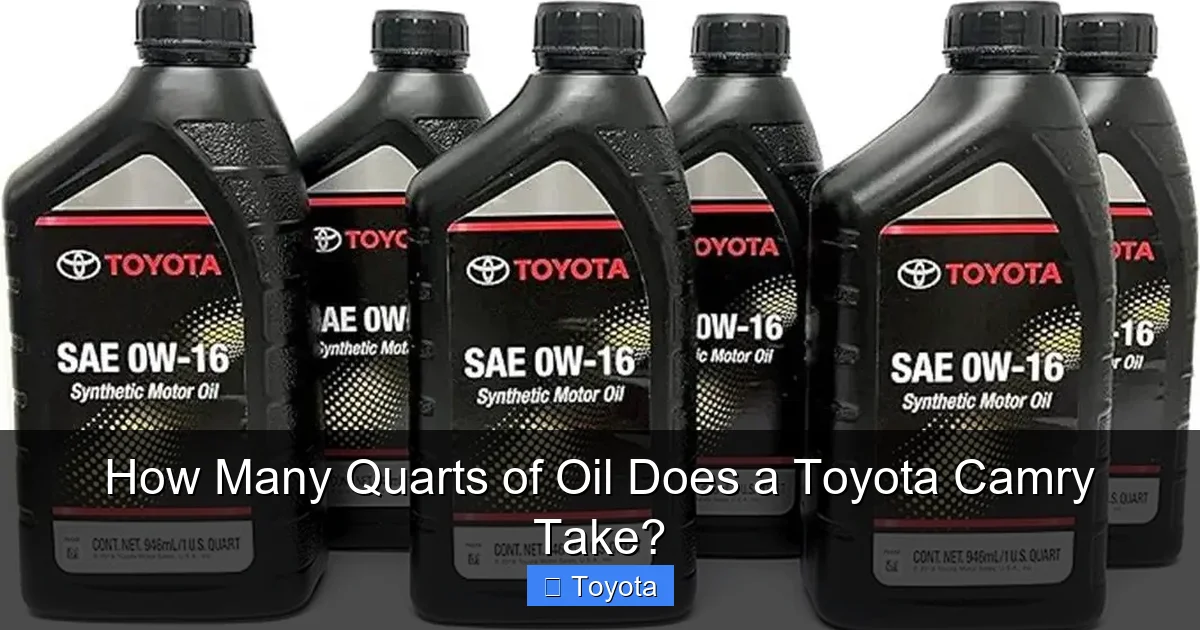
Visual guide about How Many Quarts of Oil Does a Toyota Camry Take?
Image source: takeuroil.com
Toyota Camrys from different model years have distinct oil capacity requirements, primarily due to changes in engine designs and manufacturing improvements over time. Understanding these differences is crucial, especially if you’re working on an older vehicle or comparing maintenance needs across different Camry generations.
2002-2006 Camry Models
The fourth-generation Camry (2002-2006) typically requires 4.4 quarts of oil when performing a complete drain and refill. These models usually featured 2.4L 4-cylinder engines or 3.0L V6 engines, both of which were designed to work efficiently with this oil amount. If you own one of these older Camrys, you’ll want to add oil gradually and check the level frequently until you reach the full mark on your dipstick.
It’s worth noting that these earlier models often had more conservative oil capacities compared to later generations. The smaller oil reservoir was sufficient for their engine designs, but it means you’ll need to be more precise when topping off oil between changes.
2007-2011 Camry Models
The fifth-generation Camry introduced some improvements in oil efficiency. Most models in this range require between 4.4 and 5.0 quarts of oil, depending on the specific engine variant. The 2.4L and 2.5L 4-cylinder engines generally fall on the lower end of this spectrum, while V6 models may require slightly more.
These Camrys also benefited from improved engine seals and gaskets that reduced oil consumption over time. Many owners of these models report going longer between oil changes without significant oil loss, making them popular choices for those seeking reliable daily drivers.
2012-Present Camry Models
Modern Camrys, particularly those from 2012 onwards, have evolved significantly in their oil requirements. Current models with 2.5L 4-cylinder engines typically need 4.4 to 5.4 quarts, while the 3.5L V6 engines require closer to 6.0 quarts for a complete oil change. These newer engines are designed for better fuel economy and reduced emissions, which sometimes means slightly higher oil capacities to maintain optimal operating conditions.
The introduction of Toyota’s Dynamic Force engines in recent years has further refined oil requirements. These engines are engineered to work with specific oil viscosities and capacities, so sticking to manufacturer recommendations is especially important for these models.
Engine Size and Configuration Impact

Visual guide about How Many Quarts of Oil Does a Toyota Camry Take?
Image source: toyotaautodealer.com
Beyond model years, the specific engine configuration in your Camry plays a significant role in determining oil requirements. Toyota has offered various engine options throughout Camry production, each with its own oil capacity specifications.
4-Cylinder Engines
Most Camry models throughout their history have featured 4-cylinder engines, which typically require between 4.4 and 5.4 quarts of oil. The 2.4L engine used in earlier models (2002-2006) generally needed the lower end of this range, while the newer 2.5L engines introduced in 2012 and later typically require 4.4 to 5.0 quarts.
These 4-cylinder engines are designed for efficiency and reliability, which is why their oil requirements are relatively consistent across model years. However, factors like driving conditions and oil type can still influence how frequently you need to check and top off oil levels.
V6 Engines
Camrys equipped with V6 engines have notably higher oil requirements. The 3.0L V6 found in 2002-2006 models required approximately 5.0 quarts, while the more recent 3.5L V6 engines introduced in 2012 require closer to 6.0 quarts. This increased capacity reflects the larger displacement and more complex design of V6 engines.
V6 engines produce more power but also generate more heat and require more lubrication due to having additional moving parts. As a result, Camry owners with V6 engines should pay extra attention to oil levels and consider more frequent checks, especially during heavy use or towing situations.
Hybrid Models
For Camry Hybrid models, oil requirements differ slightly from conventional gasoline engines. While specific capacities vary by model year, hybrids generally require similar amounts to their gasoline counterparts but may benefit from synthetic oil formulations that complement hybrid system efficiency.
The electric motor assistance in hybrids can actually reduce overall engine wear, potentially extending the time between oil changes. However, it’s still crucial to follow Toyota’s recommendations for oil type and capacity to maintain both hybrid and conventional engine components properly.
How to Check Oil Levels in Your Camry

Visual guide about How Many Quarts of Oil Does a Toyota Camry Take?
Image source: koala.sh
Knowing how to properly check your Camry’s oil level is just as important as understanding how much oil it takes. This simple maintenance task can prevent major engine problems and help you track oil consumption patterns over time.
Preparation Steps
Before checking your oil, make sure your vehicle is parked on level ground and has been turned off for at least 5-10 minutes. This allows the oil to settle back into the oil pan for an accurate reading. Warm engines (but not hot) provide the best results, as cold oil may not have drained completely, while extremely hot oil can cause burns.
Locate your oil dipstick, which is typically marked with a bright handle color (often yellow or orange) and labeled with an oil can symbol. Clean the dipstick thoroughly before removing it to avoid contamination from external dirt or debris.
Reading the Dipstick Correctly
Remove the dipstick and wipe it clean with a lint-free cloth or paper towel. Reinsert it fully until you hear it click into place, then remove it again to check the oil level. The dipstick will have two holes or marks – one for minimum and one for maximum levels.
Your oil level should fall between these two marks. If it’s below the minimum mark, you’ll need to add oil. If it’s above the maximum mark, you’ve added too much oil and should drain some out. Always check the oil level with the engine off and after the vehicle has been sitting for a few minutes.
Adding Oil Properly
When adding oil to your Camry, use a funnel to prevent spills and add oil slowly. Start with small amounts (about 0.5 quarts at a time) and recheck the level after each addition. This approach prevents overfilling, which can be just as problematic as having too little oil.
Remember that it may take a few minutes for the oil to settle after adding, so wait before checking the final level. Once you’ve reached the proper level, replace the dipstick securely to prevent contamination from dirt and debris.
Choosing the Right Oil for Your Camry
Not all oils are created equal when it comes to your Camry’s needs. Selecting the right type and viscosity of oil can impact both performance and longevity, making this decision one of the most important aspects of oil maintenance.
Conventional vs. Synthetic Oil
Conventional oil, derived from crude oil refining, is less expensive and works well for older Camrys with moderate mileage. However, synthetic oil offers superior protection against engine wear, better temperature stability, and longer change intervals. For newer Camrys or those with high mileage, synthetic oil is often recommended.
Synthetic oils also help prevent sludge buildup and varnish formation, which can be particularly beneficial for direct injection engines found in recent Camry models. While synthetic oil typically costs more upfront, the extended change intervals and improved engine protection can make it cost-effective over time.
Viscosity Grades to Consider
Toyota recommends specific viscosity grades for different model years and driving conditions. For most Camrys, 5W-30 or 0W-20 synthetic oils are commonly recommended. The “W” stands for winter, and the numbers indicate the oil’s flow characteristics at different temperatures.
In extremely cold climates, a lower viscosity oil like 0W-20 may provide better protection during startup. Conversely, in very hot climates or during heavy towing, a slightly thicker oil like 5W-30 might be more appropriate. Always consult your owner’s manual for the manufacturer’s specific recommendations for your region and driving conditions.
Mercedes-Benz Compatibility
If your Camry is equipped with certain European-spec engines or modifications, you may need oil that meets additional specifications beyond standard Toyota requirements. In these cases, oils meeting Mercedes-Benz standards (like MB 229.5) might be necessary to ensure proper lubrication and warranty compliance.
Always verify with a qualified technician if you’re unsure about oil specifications, especially if your vehicle has aftermarket modifications or specialized engine components.
Maintenance Tips for Optimal Oil Health
Proper oil maintenance goes beyond just knowing how much oil your Camry needs. Implementing these strategies can help extend engine life and maintain optimal performance.
Regular Monitoring Schedule
Check your oil level at least once a month, and more frequently if you notice unusual noises, decreased performance, or if your oil light illuminates. Long-distance drivers or those with severe driving conditions (frequent stop-and-go traffic, extreme temperatures) should check oil more often.
Keep track of your oil consumption patterns by recording readings over time. A gradual increase in oil consumption might indicate early signs of engine wear that warrant professional attention before they become serious problems.
Professional Service Considerations
While DIY oil changes can save money, visiting a certified Toyota dealer or qualified mechanic ensures proper oil levels and disposal of used oil. Professionals have the equipment and expertise to handle different Camry models correctly and can identify potential issues during the service.
Many dealerships offer loyalty programs or discounted service packages for regular maintenance, which can be more cost-effective than individual oil changes. Additionally, professional services often include multi-point inspections that can catch other maintenance needs early.
Environmental Responsibility
Proper disposal of used oil is crucial for environmental protection. Never dump used oil on the ground or in regular trash. Most auto parts stores, service centers, and municipal recycling facilities accept used oil for proper recycling.
Many retailers offer incentives for returning empty oil containers, encouraging responsible disposal practices. By recycling oil, you’re helping reduce environmental contamination and supporting sustainable practices in automotive maintenance.
Troubleshooting Common Oil Issues
Even with proper maintenance, Camry owners may occasionally encounter oil-related issues. Understanding how to diagnose and address these problems can save time and money.
High Oil Consumption
If your Camry is consuming oil faster than expected, several factors could be at play. Normal consumption is typically less than one quart every 2,000 miles, but higher rates may indicate worn piston rings, valve seals, or PCV system issues.
Start by checking for external leaks under the vehicle and around the engine. If no external leaks are visible, internal wear might be the cause. A compression test or leak-down test performed by a professional can help identify internal issues requiring attention.
Oil Leaks
Common oil leak sources in Camrys include the valve cover gasket, oil pan gasket, and front crankshaft seal. These leaks typically appear as dark spots or puddles under the vehicle. Regular visual inspections can help catch small leaks before they become major problems.
Minor leaks can often be addressed with DIY repairs using replacement gaskets and sealants. However, complex leaks near sensitive engine components are best handled by professionals to prevent damage from improper repairs.
Engine Noise
Unusual engine noises that change when oil levels are low often indicate lubrication problems. Ticking or rattling sounds typically suggest insufficient oil pressure or low oil levels. These symptoms require immediate attention to prevent permanent engine damage.
If you experience engine noise, first check and top off oil levels immediately. If the noise persists after adding oil, consult a mechanic promptly. Continuing to operate an engine with lubrication issues can result in costly repairs or complete engine replacement.
Conclusion
Understanding how many quarts of oil your Toyota Camry requires is fundamental to maintaining this reliable vehicle. While capacities vary by model year, engine type, and specific configuration, most Camrys fall within the 4.4 to 6.1 quart range. Always consult your owner’s manual for the most accurate specifications for your particular vehicle.
Regular monitoring of oil levels, using the correct oil type, and maintaining a consistent service schedule will help ensure your Camry delivers years of dependable performance. Whether you’re performing DIY maintenance or visiting a professional service center, staying informed about your vehicle’s oil needs is one of the best investments you can make in your car’s longevity and your peace of mind on the road.
Frequently Asked Questions
How much oil does a 2015 Toyota Camry take?
A 2015 Toyota Camry with the 2.5L 4-cylinder engine typically requires 4.4 to 5.4 quarts of oil when performing a complete drain and refill. The exact amount can vary slightly depending on whether you’re changing the oil filter and how much residual oil remains in the engine after draining. Always verify with your owner’s manual for the most precise specification for your specific model and engine configuration.
Can I use too much oil in my Camry?
Yes, using too much oil can cause several problems including engine foaming, increased crankcase pressure, and potential damage to the crankshaft or connecting rods. When oil is overfilled, it can aerate and create bubbles that reduce lubrication effectiveness. Additionally, excess oil may be forced past the piston rings into the combustion chamber, causing white smoke, reduced performance, and increased oil consumption. Always check your oil level with the dipstick after adding oil and never exceed the maximum mark.
How often should I check my Camry’s oil level?
You should check your Camry’s oil level at least once a month under normal driving conditions. If you’re driving in severe conditions such as frequent short trips, extreme temperatures, heavy traffic, or towing, you should check more frequently – potentially every two weeks or even weekly. Checking oil before and after long road trips is also recommended, as extended driving can increase oil consumption and help you catch any developing issues early.
Does my Camry require synthetic oil?
While not mandatory, synthetic oil is generally recommended for modern Toyota Camrys, especially newer models and those with higher mileage. Synthetic oil provides better protection against engine wear, improved flow characteristics in extreme temperatures, and longer change intervals compared to conventional oil. For hybrid Camrys, synthetic oil is particularly beneficial as it complements the efficiency-focused engine design. Always check your owner’s manual for Toyota’s specific recommendations, as some models may have particular viscosity requirements.
What should I do if my Camry is burning oil?
If your Camry is burning oil, first check the oil level and top it off if needed. Oil burning can result from various issues including worn piston rings, valve seals, or a PCV system problem. Continue monitoring the oil level regularly and top off as needed, but avoid driving extensively until the underlying issue is diagnosed. A mechanic can perform compression and leak-down tests to determine the cause and recommend appropriate repairs. Using high-mileage oil formulations may help temporarily reduce oil consumption in vehicles with normal wear.
Where can I find the oil capacity for my specific Camry model?
Your owner’s manual is the definitive source for your Camry’s exact oil capacity and recommended oil type. If you don’t have the manual, you can often find this information online through Toyota’s official website using your vehicle identification number (VIN). Many auto parts retailers also offer online lookup services that provide specifications for specific model years and trim levels. For the most accurate information, especially if your Camry has been modified or has non-standard engines, consulting with a Toyota dealer or qualified mechanic is recommended.
=== END OF ARTICLE ===