Is Car Insurance Deductible Tax Deductible
Car Insurance Deductible Tax Deductible: What You Need to Know This article explains whether your car insurance deductible is tax-deductible, which policies qualify for deductions, and how to maximize your tax savings. We’ll cover federal and state rules, common misconceptions, and practical strategies for reducing your tax burden through proper insurance planning.
- Deductibles themselves aren’t tax-deductible, but you can deduct medical expenses related to your car accident
- Some insurance policies like auto liability may have tax advantages depending on state laws
- Higher deductibles actually reduce your out-of-pocket costs when you file a claim
- You must itemize your deductions to claim the tax benefit
- State-specific rules vary significantly, especially in California and other high-tax states
- Proper documentation of medical expenses is crucial for claiming deductions
- Consider balancing deductible amounts with your overall insurance needs
📑 Table of Contents
Understanding Car Insurance Deductibles
When you think about car insurance, the deductible is often the most confusing part of the policy. A deductible is essentially the amount you agree to pay out-of-pocket before your insurance company starts covering the rest of a repair or claim. Think of it as your financial safety net before the insurance kicks in. Whether you’re driving a reliable sedan or a sports car, understanding how deductibles work is the first step toward making smart financial decisions.
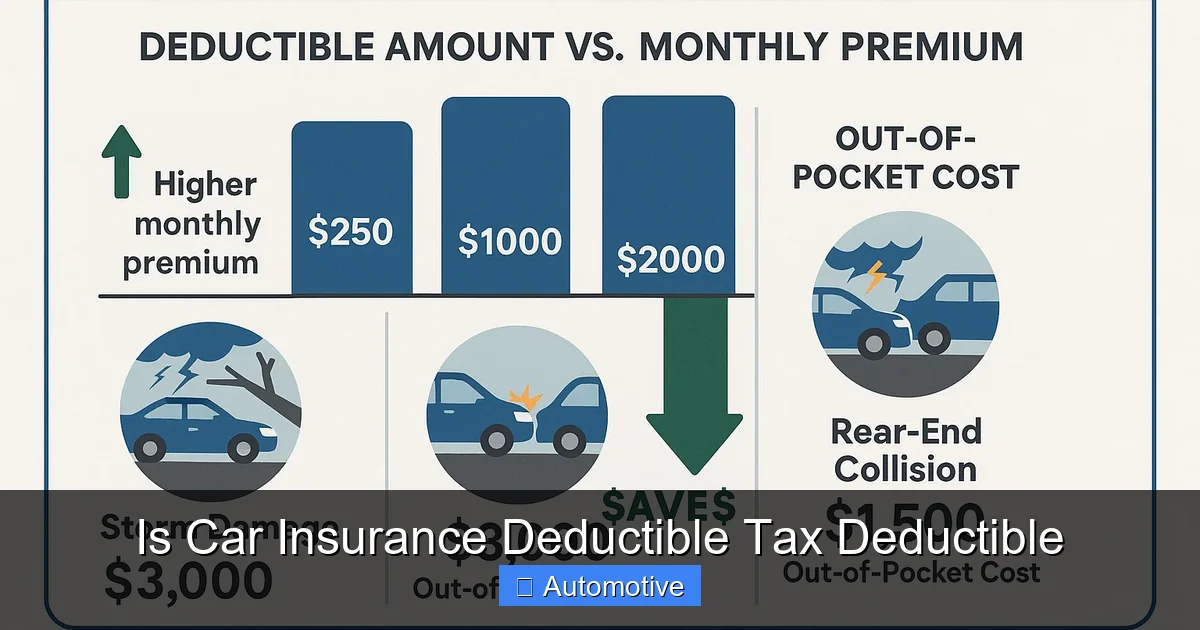
Most auto insurance policies have a deductible that ranges from $250 to $1,000 or more. This amount is subtracted from your claim when you file a repair request after an accident or damage. The lower the deductible, the more you pay upfront, but the less you pay out of pocket if you need repairs. Conversely, a higher deductible means you’re only responsible for a larger share of the cost when something goes wrong, but it also means you’ll pay more if you actually file a claim. Understanding this trade-off is essential for budgeting and long-term financial health.
What Is a Deductible?
A deductible is a pre-set amount that you must pay for covered losses before your insurance policy begins to pay for those losses. It acts as a threshold that must be met before your insurer’s coverage kicks in. For example, if your policy has a $500 deductible and your phone is damaged in an accident, your insurance company will only cover the $500 deductible, and you’ll be responsible for the remaining $450 of the repair cost. This structure encourages responsible driving habits because drivers who avoid accidents won’t have to pay as much when they do.
The deductible is a key component of your total insurance cost. While it’s not a tax-deductible expense, it’s a legitimate line item on your insurance statement that can affect your overall insurance budget. When you compare different policies, be sure to factor in both the premium (the annual cost) and the deductible (the amount you pay before coverage). A policy with a higher deductible might have a lower premium, which could save you money in the long run depending on your driving record and accident history.
How Deductibles Work
When an accident occurs and you file an insurance claim, the process typically follows a specific sequence. First, your insurance company assesses the damage and determines the cost of repairs. If the total cost exceeds your deductible, you pay the deductible amount and the insurance company covers the remainder. This means your deductible effectively caps your maximum out-of-pocket expense for that particular incident. The deductible amount can change based on your policy type and whether you have additional coverage like collision or comprehensive protection.
It’s important to note that deductibles apply to different types of coverage. Your liability deductible (what you pay for damages you cause to others) and your physical damage deductible (what you pay for your own car’s repairs) are separate amounts. Most states require that liability deductibles be at least $25,000 per person and $50,000 per accident, but these minimums don’t apply to your personal deductible for your own vehicle. Understanding these distinctions helps you plan for the worst-case scenario and avoid unexpected financial strain.
The Tax Deduction Question
One of the most common questions people have is whether their car insurance deductible is tax-deductible. The short answer is no — the deductible itself cannot be written off on your tax return. However, there are several nuances and exceptions that make this topic worth exploring. The confusion often stems from mixing up what is deductible (an expense you can subtract from your income) with what is exempt (a cost you pay but don’t get to deduct).

Visual guide about Is Car Insurance Deductible Tax Deductible
Image source: goodtogoinsurance.org
To understand how insurance deductibles interact with your taxes, it’s helpful to first recognize that insurance premiums (the amount you pay each month or year) are tax-deductible only if you itemize your deductions and your total itemized deductions exceed the standard deduction. The IRS sets a standard deduction for most taxpayers, which varies by filing status and income level. If you’re below that threshold, you can’t deduct your premiums at all. Only when you itemize can you potentially deduct your insurance costs.
Can You Deduct Your Deductible?
Directly answering the question: No, you cannot deduct the amount you pay as a deductible when you file your annual tax return. The deductible is an expense you pay to your insurer, not a cost incurred by you personally that is excluded from income. When you make a deductible payment, it reduces the amount of money you have in your pocket, but it doesn’t lower your taxable income. Instead, it lowers the total amount you owe the IRS.
For example, if you have a $500 deductible and you pay it when you file a claim, you’ve reduced your net income by $500. However, this $500 reduction doesn’t go on your tax return as a deduction. The tax benefit comes from your premiums, not your deductible payments. It’s a common misconception that because you’re paying money out of pocket for insurance, it should be tax-deductible. But insurance companies are considered an expense that can be deducted, while the deductible is simply the portion of that expense you cover yourself.
Which Insurance Policies Qualify?
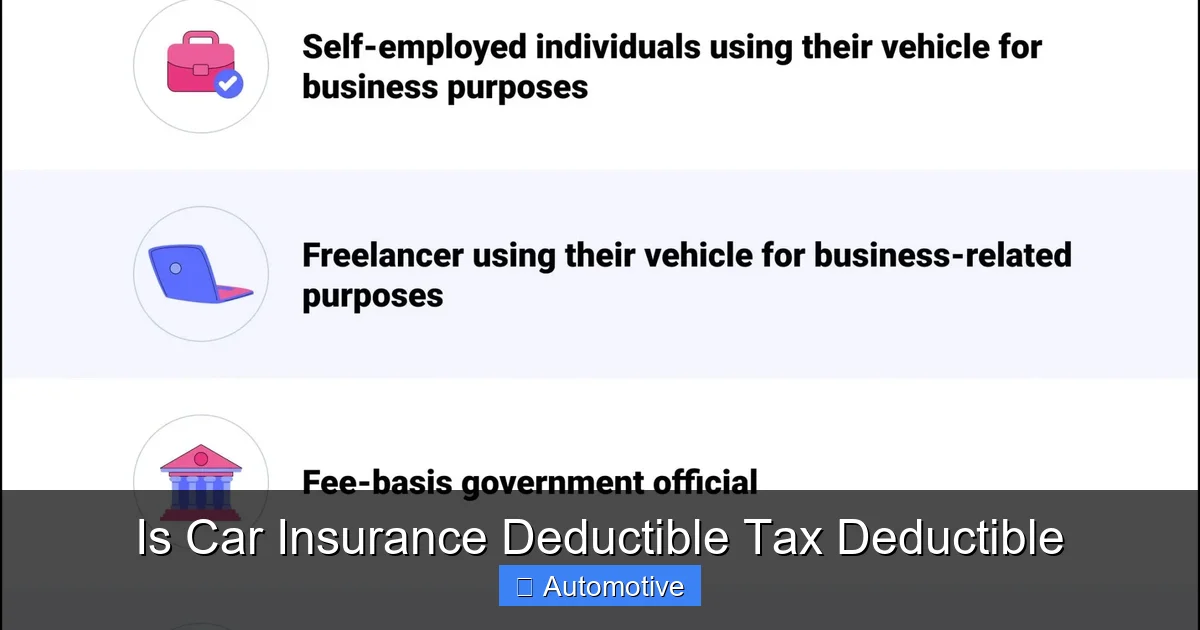
While the deductible itself isn’t deductible, some insurance policies have tax advantages that can reduce your overall tax burden. Auto liability insurance, for instance, is generally considered a business expense for self-employed drivers or those who use their vehicles for commercial purposes. This means the premiums can be deducted from your business income, even though the deductible amount remains non-deductible. Similarly, some policies like gap insurance (which covers the difference between what your insurance pays and what you owe on a loan if you total your car) may have different tax treatment depending on state laws and how the coverage is structured.
It’s also worth noting that certain types of insurance policies aren’t tax-deductible at all, even the premiums. Life insurance, health insurance, and disability insurance premiums are typically not deductible for individuals. Only specific business policies and certain policyholder benefits may qualify for tax treatment. The key takeaway is that while you can’t deduct the deductible itself, the right mix of policies and proper documentation can help you minimize your overall tax liability through strategic planning.
Practical Examples and Scenarios
Let’s look at some real-world scenarios to see how deductibles and tax deductions interact in practice. Understanding these examples will help you apply the concepts to your own situation.
Visual guide about Is Car Insurance Deductible Tax Deductible
Image source: images.bannerbear.com
Example 1: High Deductible Policy
Imagine you have a car insurance policy with a $1,000 deductible. Your annual premium is $1,200. You get into a fender-bender and your repair costs are $1,200. With this policy, you’d pay the full $1,000 deductible, and the insurance would cover nothing of the repair cost. Total out-of-pocket expense: $1,000. If you had a policy with a $500 deductible and a $1,000 premium, the same accident would cost you $500 out-of-pocket, and your insurance would cover $500. The difference is that with the lower deductible, you pay half as much when a claim occurs. While the insurance company takes on less risk (hence the lower premium), you also have less exposure in an accident.
From a tax perspective, both scenarios mean you paid premiums that are deductible only if you itemized. But the deductible amount itself didn’t change your tax situation. The only real tax difference might be if you had multiple policies — say, auto liability and auto collision. If you paid the deductible for your physical damage (the $1,000), that’s a personal expense, not tax-deductible. But if you had a gap insurance policy with a $500 deductible that covered the difference between your insurance payout and your loan balance, that premium might be deductible for business use, while the gap payout itself would be a refund to you.
Example 2: Multiple Vehicles
Many people have multiple cars covered under one policy or separate policies for each vehicle. Each car has its own deductible that applies independently. If you have a $500 deductible on your primary car and a $1,000 deductible on your second car, both deductibles are separate amounts you pay when filing claims. The tax treatment of these deductibles is the same — they’re personal expenses, not business expenses. However, if one of the cars is used for business purposes (like a delivery van), the premiums for that vehicle may be deductible as a business expense, regardless of the deductible amount. The deductible itself remains non-deductible on your tax return.
Another scenario: Suppose you have a car with a $300 deductible and you file two separate claims — one for a minor scratch and one for a major damage. You’d pay $300 for each claim, totaling $600 in deductible payments. From a tax perspective, these are simply personal expenses that reduce your net income. Whether you deduct the premiums (if you itemize) or not depends on your overall tax situation, not on the deductible amounts.
Maximizing Your Tax Savings
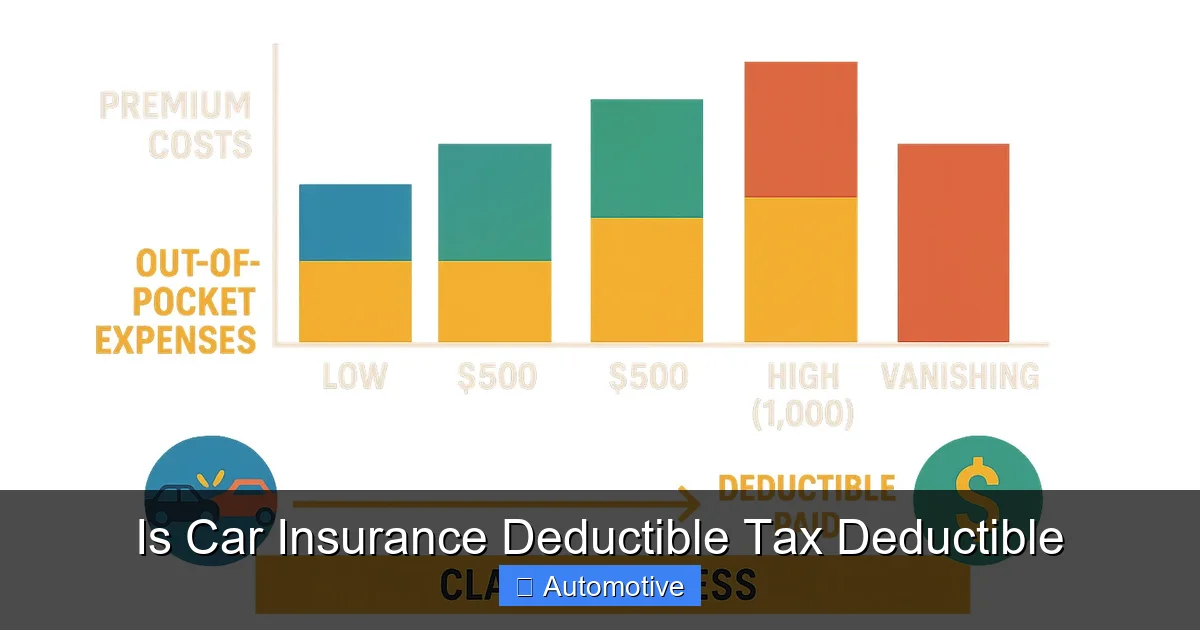
While you can’t deduct your deductible payments directly, there are strategies to maximize your overall tax savings through smart insurance planning. The first step is to understand that your deductible affects how much you’ll pay out-of-pocket when you file a claim. Lowering your deductible reduces your personal expense in an accident, but it also increases your premium. Finding the right balance between deductible amount and premium is a crucial part of insurance budgeting.
Visual guide about Is Car Insurance Deductible Tax Deductible
Image source: images.bannerbear.com
Strategies to Reduce Deductibles
One approach to reducing your deductible is to shop around for insurance quotes. Many insurers offer different deductible options, and some may even let you choose a lower deductible if you’re willing to pay a higher premium. If you’re confident you’ll rarely need to file a claim, a lower deductible can save you money. Conversely, if you drive in an area with high accident rates or have a history of accidents, a higher deductible might make more financial sense.
Another strategy is to increase your deductible if you’re comfortable with the higher premium. This is particularly useful if you want to avoid frequent claims. For example, if you’re on a fixed income, a high deductible can be a wise financial move because you’ll pay less if you ever need repairs. The key is to align your deductible with your ability to afford out-of-pocket costs and your risk tolerance.
Documenting Expenses Properly
Proper documentation is essential when claiming insurance benefits, including deductible payments. Keep detailed records of all insurance claims, receipts for repairs, and any medical expenses that result from accidents. If you have to pay out-of-pocket before your insurance kicks in (as with the deductible), those expenses should be documented separately from your insurance premium. When you file your tax return, you’ll need to itemize your deductions, and you’ll need to show that you’ve kept adequate records of your personal expenses. The IRS requires that you maintain records for at least three years in case of an audit, so organization pays off.
For example, if you had a $500 deductible and paid for a repair in cash, you should keep the receipt. If you paid with a credit card, the credit card statement will serve as documentation. Even better, keep digital copies of all receipts and bank statements. This habit ensures you can prove that you made necessary personal expenses and that your insurance coverage was working as intended.
Common Misconceptions
There are several misconceptions about car insurance deductibles and taxes that can lead to confusion and even costly mistakes. Let’s address some of the most common ones.
The “Full Coverage” Myth
Many people believe that having full coverage (which typically includes collision, comprehensive, and sometimes gap insurance) makes their deductible tax-deductible. This is a myth. Having full coverage is about the types of damage your insurance covers, not about the tax treatment of deductible payments. The coverage types don’t change whether a deductible is tax-deductible or not. Whether you have $0, $500, or $1,000 deductible, the tax treatment is the same. The confusion often arises because people associate “full coverage” with lower out-of-pocket costs, but that’s a separate consideration from tax benefits.
To clarify, full coverage refers to the extent of protection your policy provides — it determines what happens to your car in various scenarios (accidents, natural disasters, theft, etc.). Deductibles are a separate feature that sets the amount you pay before coverage applies. Understanding this distinction helps you make informed decisions about which coverage levels are right for your situation.
State-Level Differences
Tax treatment of insurance deductibles can vary significantly from state to state. While the federal IRS sets guidelines for itemizing deductions, individual states have their own rules. For example, California has specific requirements for auto insurance coverage that may affect how deductibles are handled. In California, the minimum liability deductible is $10,000 per person, and California law generally requires that deductible payments be reported as tax-exempt income. This means that if you pay the deductible in California, the amount is not deductible from your income, but it’s not added to your taxable income either. The key point is that state laws can create additional layers of complexity that you need to understand.
Other states may have different thresholds or additional requirements. Some states allow for more flexible deductible handling, while others impose stricter rules. If you live in a state with unique regulations, it’s wise to consult with a tax professional or your insurance agent to ensure you’re making the most of available deductions. The rules are designed to be fair and consistent, but they do vary, and understanding your specific state’s approach is crucial.
State-Specific Rules
California is one of the states that has specific rules regarding car insurance deductibles and taxes. In California, the minimum liability deductible is $10,000 per person, and California law treats deductible payments as tax-exempt income. This means that if you pay your deductible as a California resident, you don’t have to report it as income on your tax return. However, you still cannot deduct the deductible from your total itemized deductions unless your total itemized deductions exceed the standard deduction for your filing status.
For example, if you’re a single filer in 2024, the standard deduction is $13,850, which is higher than the total of your deductible payments. Even if you paid $5,000 in deductible payments during the year, you wouldn’t be able to deduct that amount because it doesn’t exceed the standard deduction. Your only way to claim a deduction for your deductible payments would be if your total itemized deductions (including mortgage interest, state and local taxes, charitable donations, and other deductions) were higher than $13,850.
In other states, the rules are more uniform. For instance, most states don’t have specific regulations that treat deductible payments differently from premiums. The primary distinction remains whether you itemize your deductions. If you choose the standard deduction, which is the default for most taxpayers, you won’t be able to deduct either your premiums or your deductible payments.
It’s also worth noting that some states have additional taxes on auto insurance, such as registration fees, annual licenses, and sales taxes. These state-specific charges are separate from insurance premiums and deductibles and follow their own tax rules. Understanding the full picture of your state’s insurance tax environment is important for accurate financial planning.
Frequently Asked Questions
Question?
Is my car insurance deductible tax-deductible?
No, the deductible itself is not tax-deductible. However, your insurance premiums may be deductible if you itemize your deductions and your total itemized deductions exceed the standard deduction.
Question?
How does my deductible affect my tax return?
Your deductible does not appear on your tax return directly. The only potential tax impact comes from your insurance premiums, which are deductible only if you choose to itemize your deductions and your total itemized deductions are higher than the standard deduction.
Question?
Can I deduct my deductible if I have a business vehicle?
If your vehicle is used for business purposes (such as a delivery van or a company SUV), the premiums may be deductible as a business expense. However, the deductible amount itself remains non-deductible. The key is that business use allows the premiums to be claimed, not the deductible payments.
Question?
What is the difference between a deductible and a premium?
A deductible is the amount you pay out-of-pocket before your insurance covers the rest of a claim. A premium is the amount you pay to the insurance company for coverage. Premiums are what you typically deduct from your income (if you itemize), while deductible payments are personal expenses that reduce your net income but don’t lower your taxable income.
Question?
Do I need to keep records of my deductible payments for tax purposes?
Yes, it’s highly recommended to keep detailed records of all deductible payments, including receipts, bank statements, and claim documentation. The IRS requires that you maintain records for at least three years in case of an audit. Proper documentation ensures that if you need to claim any deductions or prove your expenses, you’ll have solid evidence.
Question?
Are there any exceptions where deductible payments might be tax-deductible?
Yes, there are limited exceptions. For example, if you have a self-employed business that uses your car for business purposes, the premiums may be deductible. Additionally, some specific insurance policyholder benefits may be tax-deductible. However, the deductible amount itself is almost never deductible.