Which Mirror Is Used in Headlights of a Car
Most modern car headlights rely on a concave mirror, usually shaped as a parabola, to collect light from the bulb and throw it forward in a controlled beam. This reflector design maximizes visibility while keeping glare away from other drivers. Knowing which mirror is used in headlights of a car helps you understand beam alignment, headlight cleaning, and why reflector condition matters for nighttime safety.
Key Takeaways
- Concave mirror: The mirror used in headlights of a car is a concave reflector, typically shaped as a parabola.
- Light focus: It gathers light from the bulb and reflects it forward as a strong, parallel beam for road illumination.
- Reflector vs. projector: Both headlight styles use concave mirrors, but projector designs add a lens for sharper beam control.
- Materials matter: Headlight reflectors are usually made from polished aluminum or coated plastic, not ordinary glass.
- Different from side mirrors: Side mirrors are convex for a wide view, while headlight mirrors are concave to focus light.
- Maintenance is key: Clean lenses, proper alignment, and intact reflectors keep your headlights effective and safe.
📑 Table of Contents
- Introduction: The Hidden Mirror Inside Your Headlight
- The Short Answer: A Concave Mirror Does the Heavy Lifting
- How the Headlight Mirror Works
- Reflector Headlights vs. Projector Headlights
- Materials and Manufacturing
- Headlight Mirrors vs. Other Car Mirrors
- Maintenance, Cleaning, and Replacement
- Conclusion
Introduction: The Hidden Mirror Inside Your Headlight
Picture yourself driving down a dark country road at night. Your headlights cut through the darkness, revealing the asphalt, the shoulder, and the trees in the distance. You probably never stop to ask what makes that beam so focused. But behind the clear plastic cover, something is working hard to shape every ray of light.
If you have ever wondered which mirror is used in headlights of a car, you are asking about one of the most important hidden parts of your vehicle. It is not a bulb or a lens. It is a curved mirror tucked behind the light source, and its job is to gather light and send it exactly where you need it.
This article explains which mirror is used in headlights of a car in plain language. We will look at the science of concave reflectors, compare different headlight designs, and share practical tips for keeping your night vision sharp. Whether you drive a new sedan or an older truck, understanding this simple part can help you stay safer on the road.
The Short Answer: A Concave Mirror Does the Heavy Lifting
When someone asks which mirror is used in headlights of a car, the answer is a concave mirror. More specifically, most headlight systems use a concave parabolic reflector. This is a mirror that curves inward, like the inside of a bowl or a spoon.
Why Concave?
A concave mirror has a special ability to collect light. When a light source sits at its focal point, the mirror reflects the rays so they travel forward in parallel lines. That is exactly what a headlight needs. The bulb creates light in all directions, and the concave mirror grabs the light going backward and sideways, then bounces it forward.
Other mirror shapes would not work nearly as well. A flat mirror would simply reflect light at the same angle it arrived, scattering the beam. A convex mirror, which bulges outward, would spread the light even more and make it weaker. The concave shape is the only common mirror that can gather light efficiently and project it down the road in a strong, controlled beam.
The Parabolic Shape
The specific curve used in most headlights is called a parabola. A parabolic reflector is shaped so that light from the focal point reflects off the surface and moves in parallel lines. This creates a bright, even beam that reaches far ahead.
Real headlight reflectors are not always perfect mathematical parabolas. Engineers adjust the curve to create specific patterns. Some parts of the beam are brighter for long-distance viewing. Other parts are angled downward to avoid blinding oncoming drivers. But the basic idea stays the same: a concave parabolic mirror does the focusing work.
Common Myths About Headlight Mirrors
Some people believe that headlights use a magnifying mirror to make the light stronger. That is not quite right. The mirror does not amplify light like a magnifying glass. It collects and redirects light that already exists. The brightness comes from the bulb, not the mirror.
Another myth is that you can polish the reflector inside to make headlights brighter. In most cases, you cannot reach the reflector without opening the sealed assembly. And if the coating is damaged, polishing will not restore it. Replacement is usually the only fix.
Some drivers also think that brighter bulbs automatically mean better headlights. If the reflector is dirty or misaligned, a brighter bulb can actually make glare worse. The mirror and bulb must work together as a system.
How the Headlight Mirror Works
To understand which mirror is used in headlights of a car, it helps to follow the light from the moment you turn the switch on.

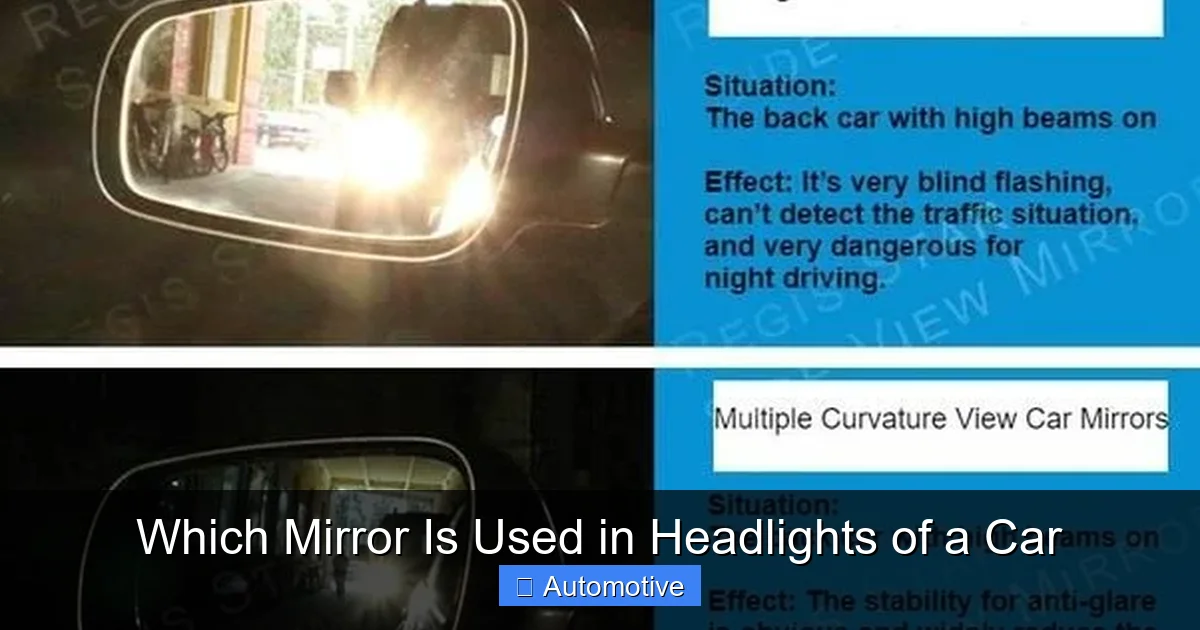
Visual guide about Which Mirror Is Used in Headlights of a Car
Image source: vahandunia.com
The Light Path
Electricity flows into the headlight bulb, which produces light in every direction. Some rays go straight forward through the lens. Many more rays travel backward or sideways toward the back of the housing. That is where the concave mirror comes in.
The mirror sits behind the bulb, positioned so the bulb is near its focal point. Light rays that strike the mirror bounce off at angles that send them forward through the lens. Without the reflector, much of the bulb’s light would be wasted inside the housing.
Focus and Beam Pattern
The exact position of the bulb matters. If the bulb shifts even a little, the beam pattern changes. The light might become too scattered, too narrow, or aimed too high into the eyes of other drivers. That is why headlight alignment is such a big deal for safety inspections.
The lens in front of the reflector also plays a role. Modern lenses have prisms and refractive elements that spread and shape the beam further. The mirror handles the heavy lifting of collecting light, while the lens fine-tunes where it lands on the road.
Low Beam vs. High Beam Reflectors
Many cars use separate reflectors or shutter systems for low and high beams. In a low beam, the mirror and lens work together to create a sharp cutoff line. This keeps light below the eye level of oncoming drivers. In a high beam, the reflector sends light higher and farther for maximum visibility on open roads.
Some vehicles use a single reflector with a movable shield. When you switch to high beams, the shield moves out of the way and the same concave mirror projects a brighter, wider beam. In other cars, there are two separate bulbs and reflectors, one for each mode.
Reflector Headlights vs. Projector Headlights
Not all headlights use mirrors in exactly the same way. The two most common designs are reflector headlights and projector headlights. Both rely on reflection, but the hardware looks different.
Traditional Reflector Headlights
In a reflector headlight, the concave mirror is the main optical element. The bulb sits in front of the reflector, and the whole assembly sits inside a housing. The mirror reflects light forward through a clear or textured lens. This design has been used for decades and is still found on many vehicles today.
Reflector headlights are simple and affordable to build. The downside is that the beam pattern can be less precise than newer designs. If the reflector gets damaged or the bulb is not seated correctly, you may see dark spots or excessive glare.
Modern Projector Headlights
Projector headlights also use a concave reflector, but they add a lens in front of the bulb. The reflector gathers the light and sends it toward a projector lens, which then focuses and projects the beam onto the road. This creates a sharper cutoff line and better control over light distribution.
Even though projector headlights use an extra lens, the mirror inside is still concave. So if you are asking which mirror is used in headlights of a car, the answer remains the same for both reflector and projector styles. What changes is how the reflected light is shaped after it leaves the mirror.
Beam Cutoff and Glare Control
One reason projector headlights became popular is their ability to control glare. The lens creates a distinct horizontal line in the beam. Above that line, there is little light. Below it, the road is brightly lit. This makes night driving safer for everyone because oncoming drivers are less likely to be blinded.
Materials and Manufacturing
The mirror inside a headlight is not made of ordinary glass. It must survive heat, vibration, and years of exposure to the elements.
What the Mirror Is Made Of
Most headlight reflectors are made from polished metal or plastic with a reflective coating. Aluminum is common because it is lightweight and reflects light well. Some reflectors use chrome-plated plastic, while others have a thin layer of silver or another reflective metal deposited onto the surface.
The surface must be extremely smooth. A scratch, pit, or cloudy spot on the mirror can scatter light and reduce beam quality. That is why reflectors are sealed inside the headlight assembly and protected by the outer lens.
Heat Resistance and Durability
Headlight bulbs generate a lot of heat, especially halogen and HID units. The reflector must handle that heat without warping or discoloring. Manufacturers test reflectors for thermal stability so they do not crack or peel over time.
LED headlights run cooler than halogen bulbs, but they still produce heat at the base of the diode. Reflectors in LED assemblies are designed to manage that heat while maintaining their shape and reflectivity.
From Sealed Beams to Replaceable Bulbs
Older vehicles often used sealed beam headlights. In these units, the bulb, reflector, and lens were all one piece. When the bulb burned out, you replaced the entire headlight assembly. The concave mirror was permanently fixed inside and could not be serviced separately.
Most modern cars use replaceable bulbs, such as halogen, HID, or LED. The reflector remains part of the headlight housing, but you can swap the bulb without replacing the mirror. This makes maintenance cheaper and easier.
With LED headlights, the design is evolving again. Some LED units use tiny reflectors for each diode, while others rely more on lenses and light guides. Still, the concave reflector concept remains widespread across the automotive industry.
Headlight Mirrors vs. Other Car Mirrors
Cars have several types of mirrors, and they are not all shaped the same way. Knowing the difference helps clarify which mirror is used in headlights of a car and why that shape matters.
Concave vs. Convex vs. Plane
The headlight mirror is concave, meaning it curves inward. A typical bathroom mirror is a plane mirror, which is flat and reflects light without changing its direction much. Your side mirrors are usually convex, meaning they bulge outward to give you a wider field of view.
Each shape serves a different purpose. A plane mirror shows things as they are. A convex mirror shows a wider area but makes objects look smaller and farther away. A concave mirror gathers and focuses light, which is exactly what a headlight needs to do.
Why Side Mirrors Are Convex
Side mirrors need to show you as much of the road behind as possible. A convex surface provides a wide angle of view, which helps reduce blind spots. The tradeoff is that objects appear farther away than they really are, which is why side mirrors carry the warning “objects in mirror are closer than they appear.”
Headlight mirrors have the opposite job. They do not need a wide view. They need to concentrate light into a beam. That is why they use a concave curve instead of a convex one.
Side Mirrors and the Law
Because side mirrors are so important for safety, most states have laws about them. If you want to know the rules for driving with a damaged or missing side mirror, you can read more about driving without a side mirror in Florida. While that article focuses on side mirrors, it is a good reminder that every mirror on your car serves a specific legal and safety role.
Rearview and Vanity Mirrors
Your interior rearview mirror is usually a plane mirror, though some have an anti-glare night setting. Vanity mirrors in sun visors are also plane mirrors. None of these are designed to project light like a headlight reflector. They exist purely for the driver’s vision.
Maintenance, Cleaning, and Replacement
Because the mirror is hidden inside the headlight assembly, many drivers forget it needs attention. Over time, heat, moisture, and road debris can affect how well it performs.
Cleaning the Outside Lens
If your headlights look dim, the problem is often the outer lens, not the mirror inside. Plastic lenses oxidize and turn yellow from UV exposure. This blocks light before it ever reaches the road. Cleaning the outside with a proper headlight restoration kit can make a big difference.
You should never try to clean the reflector directly unless you are a trained technician. The reflective coating is delicate, and touching it can leave scratches or fingerprints that scatter light.
Accessing the Headlight Assembly
To replace a bulb or inspect the back of the housing, you usually need to reach under the hood. On many vehicles, the headlight bulbs are accessible from the engine bay. If you are not sure where to start, this guide on how to open the hood of a Toyota Rav4 can help you find the access point for headlight service.
Once you have the hood open, you can often reach the bulb socket by twisting it counterclockwise. Always handle new bulbs with clean gloves or a cloth. Oils from your skin can create hot spots on halogen glass and shorten bulb life.
Headlight Restoration and Oxidation
Oxidation is one of the most common headlight problems. If the plastic looks cloudy, polishing it can restore clarity. Some drivers use toothpaste as a quick fix, but dedicated restoration kits last longer and protect against future UV damage.
If the reflector inside is corroded or the coating has peeled, cleaning the outside will not help. In that case, replacing the entire headlight assembly is usually the best option.
Bulb Types and Reflector Compatibility
Not every bulb works with every reflector. Halogen bulbs are designed for specific reflector shapes. HID bulbs need different housings because they create an arc of light rather than a filament glow. LED bulbs can be tricky because they emit light from a flat surface rather than a point. Putting the wrong bulb in a reflector housing can cause poor beam patterns and glare.
Always check your owner’s manual before upgrading bulbs. If you are switching to LED, make sure the bulbs are designed for your reflector type.
When to Replace the Whole Assembly vs. Just the Bulb
If your headlight is dim, start with the bulb. It is the cheapest and easiest part to replace. If the beam is still weak after a new bulb, the problem might be the lens or the reflector.
A cloudy lens can often be restored. A damaged reflector usually cannot. If you see dark spots in the beam, uneven light, or corrosion inside the housing, it is time to replace the entire headlight assembly. A new assembly comes with a fresh reflector, lens, and seal, restoring the beam to factory condition.
General Car Care Products
Maintaining your headlights is part of taking care of your whole vehicle. If you are looking for advice on choosing automotive cleaning and detailing products, you might want to explore the best interior cleaner for a car to see what works well for keeping your vehicle’s surfaces in good condition.
Conclusion
So, which mirror is used in headlights of a car? The answer is a concave mirror, most often shaped as a parabolic reflector. This curved surface sits behind the bulb and gathers light that would otherwise be wasted. It reflects those rays forward into a strong, focused beam that lights up the road ahead.
Without this simple optical part, headlights would scatter light in every direction. You would have poor visibility, and other drivers would deal with dangerous glare. The concave reflector is a quiet hero of nighttime driving, doing its job hidden behind the lens.
Understanding how it works can help you make smarter choices about maintenance and repairs. Keep your lenses clean, check your alignment, replace bulbs in pairs, and never ignore a dim or uneven beam. A well-maintained headlight system keeps you safer every time you drive after dark.
Next time you are on the road at night, take a moment to appreciate the mirror inside your headlight. It is small, hidden, and essential.
Frequently Asked Questions
What type of mirror is used in car headlights?
Car headlights use a concave mirror, typically shaped as a parabolic reflector. This curved mirror collects light from the bulb and projects it forward in a focused beam.
Why is a concave mirror used in headlights?
A concave mirror gathers light rays from the bulb and reflects them forward as parallel lines. This creates a bright, controlled beam that lights the road without wasting light inside the housing.
Do projector headlights use mirrors?
Yes, projector headlights still use a concave reflector to gather light. They add a projector lens in front of the bulb to sharpen the beam pattern and reduce glare.
Can I clean the mirror inside my headlight?
You should not try to clean the reflector directly unless you are a trained technician. The reflective coating is delicate, and cleaning it incorrectly can cause scratches that scatter light.
How is a headlight mirror different from a side mirror?
A headlight mirror is concave to focus light into a beam. A side mirror is convex to provide a wide field of view. Each shape serves a completely different purpose on your vehicle.
What happens if the headlight reflector gets damaged?
If the reflector is corroded, pitted, or loses its coating, the beam will look dim or uneven. Replacing the bulb will not fix this, so the entire headlight assembly usually needs to be replaced.