Is the Toyota Ae86 a Good Car?
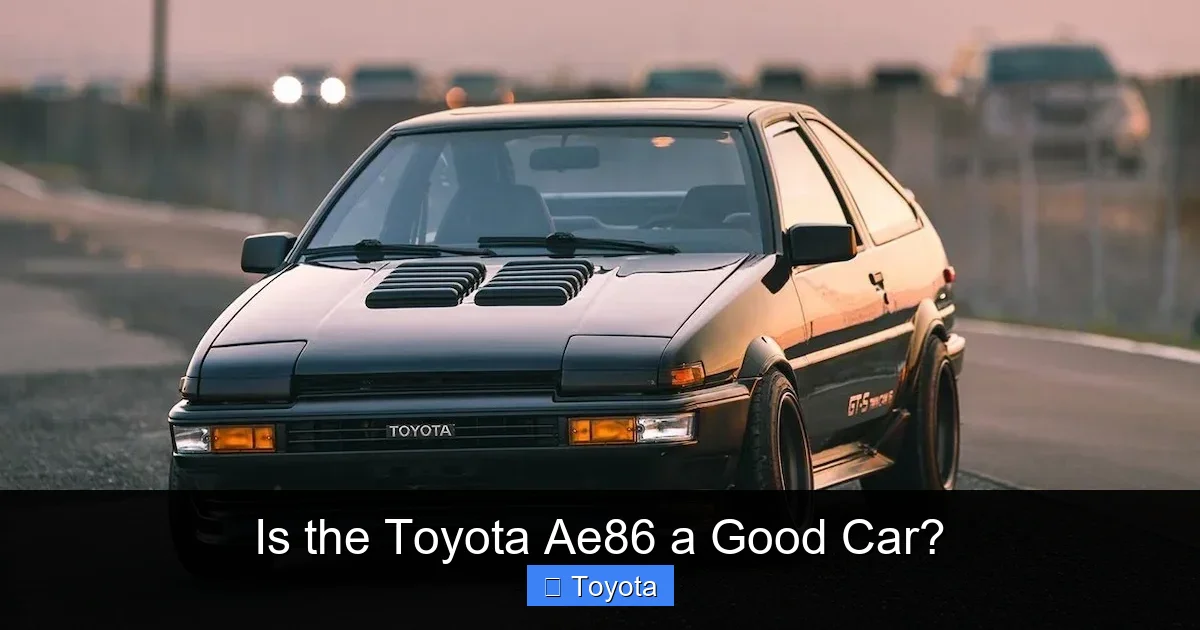
The Toyota AE86 remains a beloved driver’s car thanks to its lightweight chassis, rev‑happy 4A‑GE engine, and pure rear‑wheel drive fun. While it lacks modern comforts and safety tech, its simplicity, strong community support, and timeless appeal make it a great choice for enthusiasts who value engagement over convenience.
The Toyota AE86, often referred to simply as the “Hachi‑Roku,” occupies a special place in automotive history. Produced from 1983 to 1987 as the rear‑wheel‑drive variant of the fifth‑generation Toyota Corolla/Sprinter, this compact coupe earned fame not through luxury or power figures, but through its razor‑sharp handling and driver‑centric philosophy. For many enthusiasts, the question isn’t just “Is the Toyota AE86 a good car?” but rather “What makes it feel so special after all these years?”
To answer that, we need to look beyond spec sheets and consider what the AE86 offers to a modern driver. Its lightweight chassis, high‑revving 4A‑GE engine, and pure mechanical feedback create a connection between driver and road that many contemporary cars mute with electronic assists. At the same time, owning a 35‑year‑old vehicle brings practical considerations—parts availability, rust, and the absence of modern safety equipment. In the sections that follow, we’ll explore performance, reliability, ownership costs, everyday usability, and the intangible factors that keep the AE86 alive in garages and on winding roads worldwide.
Key Takeaways
- Iconic driving dynamics: The AE86’s 50/50 weight distribution, lightweight body, and responsive 4A‑GE engine deliver a pure, engaging driving experience that few modern cars can match.
- Strong aftermarket support: Decades of popularity mean abundant parts, tuning guides, and a passionate community ready to help with maintenance or modifications.
- Affordable classic: Compared to other JDM legends, the AE86 still offers relatively attainable pricing, though well‑kept examples are rising in value.
- Minimalist interior: Expect basic amenities, no airbags, and a spartan cabin—comfort and convenience are sacrificed for driver focus.
- Maintenance considerations: Routine items like tire rotation and oil change are inexpensive, but aging rubber, seals, and rust need attention.
- Limited modern safety: Lack of ABS, traction control (TRAC), and airbags means the AE86 relies on driver skill for safety.
- Cultural legacy: Popularized by manga/anime and drift culture, the AE86 enjoys a cult status that adds intangible value beyond specs.
📑 Table of Contents
Performance and Driving Experience
At the heart of the AE86’s appeal is its naturally aspirated 1.6‑liter 4A‑GE DOHC engine. Rated at around 130 horsepower in U.S. spec (and up to 150 hp in later Japanese versions), it may sound modest, but the engine loves to rev—redline sits near 7,800 rpm, delivering a thrilling, linear powerband that rewards keeping the engine on the cam. Coupled with a close‑ratio five‑speed manual transmission, the AE86 lets you extract every ounce of excitement from each gear.
The chassis is where the magic truly happens. Toyota’s engineers achieved a near‑perfect 50/50 weight distribution by placing the engine front‑mid and the transmission rearward. The suspension uses a MacPherson strut front setup and a live rear axle with leaf springs—simple, yet tuned for agility. The result is a car that rotates eagerly, communicates road surface through the steering wheel, and feels remarkably neutral when pushed into corners. Many drivers describe the AE86 as “go‑kart‑like” in its responsiveness, a quality that has made it a favorite for touge (mountain pass) driving and grassroots drifting.
Of course, the AE86 isn’t about outright speed. Its modest power means straight‑line acceleration is leisurely by today’s standards, and top speed tops out around 115‑120 mph. However, the joy comes from maintaining momentum, carrying speed through bends, and feeling the car’s feedback through your fingertips. For those who prioritize driving purity over outright velocity, the AE86 delivers an experience that few modern front‑wheel‑drive compacts can replicate.
Reliability and Mechanical Simplicity
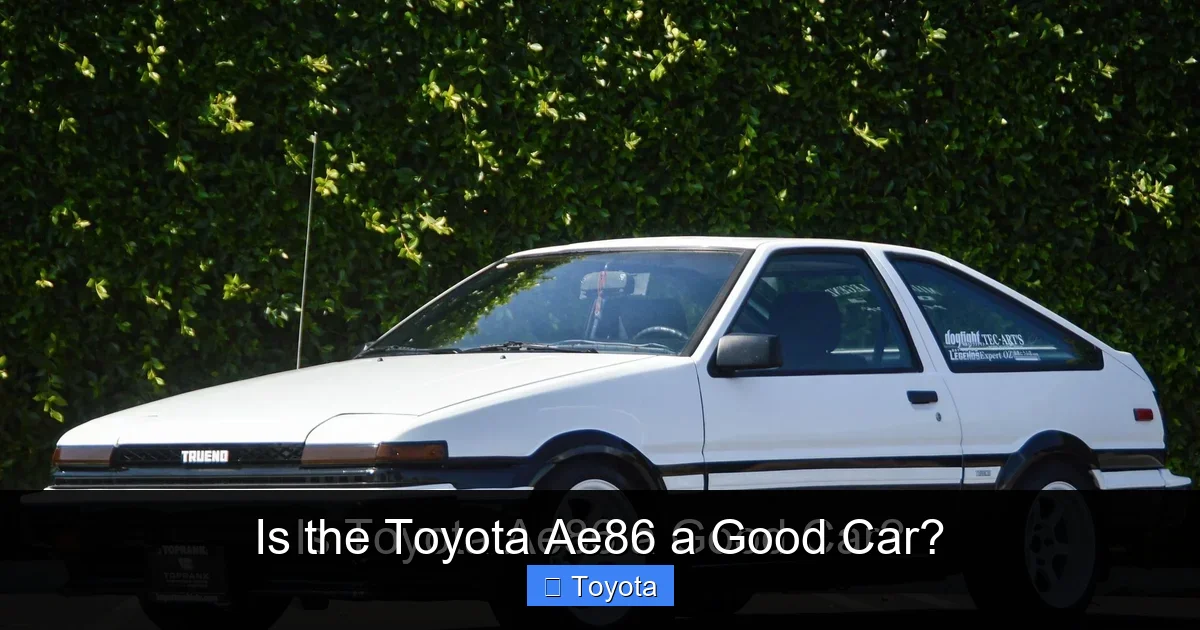
One of the AE86’s strongest suits is its mechanical simplicity. The 4A‑GE engine is renowned for durability when maintained properly—many examples have surpassed 200,000 miles with only routine service. The engine’s design features a robust cast‑iron block, forged internals, and a timing belt that, while requiring replacement every 60,000‑90,000 miles, is straightforward to service.
Visual guide about Is the Toyota Ae86 a Good Car?
Image source: aautomotives.com
The drivetrain is equally uncomplicated. The rear‑wheel‑drive layout eliminates the complexity of transverse‑mounted front‑wheel‑drive systems, and the lack of turbochargers, direct injection, or variable valve timing means fewer potential failure points. Owners often praise the AE86 for being “easy to work on”—basic tools and a service manual are sufficient for most maintenance tasks.
However, age brings its own challenges. Rubber components such as hoses, belts, and seals degrade over time, and the cooling system can develop leaks if not inspected regularly. The rear axle, while sturdy, can suffer from worn bushings or leaking differential seals. Rust remains the biggest enemy, especially in regions with road salt; wheel arches, floor pans, and the rear suspension mounts are common trouble spots. A thorough pre‑purchase inspection focusing on corrosion is essential.
Overall, if you stay on top of fluid changes, timing belt intervals, and rust prevention, the AE86 proves to be a dependable classic. Its simplicity also means that when something does go wrong, parts are generally affordable and repairs are less labor‑intensive than on modern, tightly packaged engines.
Ownership Costs and Practicality
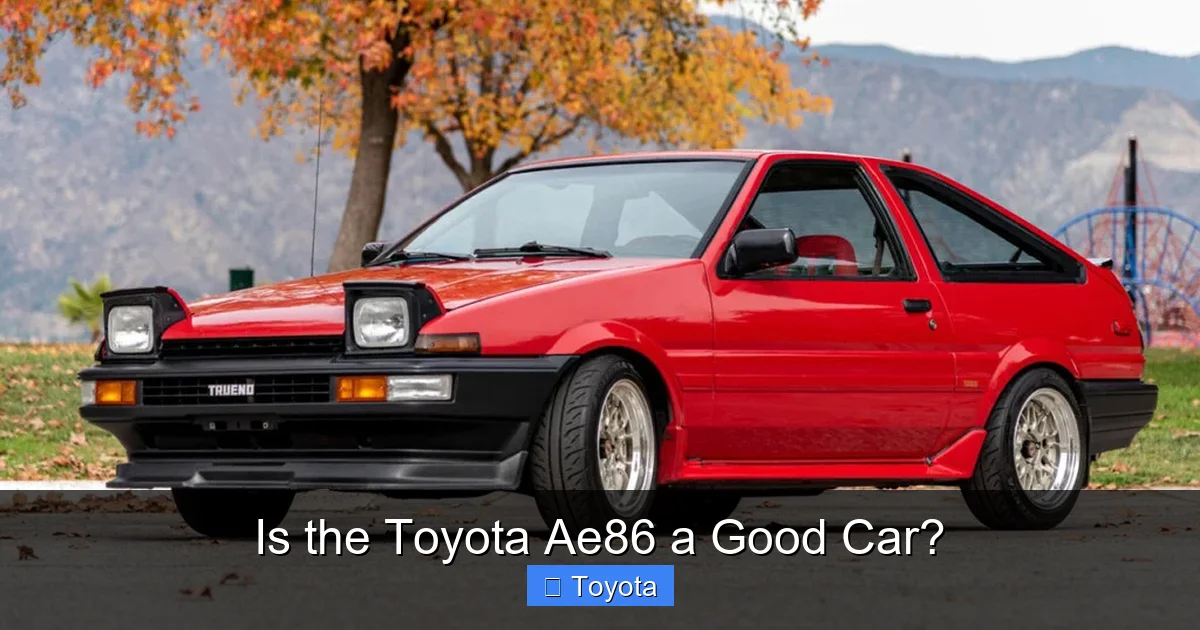
When evaluating whether the Toyota AE86 is a good car for daily life, ownership costs play a significant role. The good news is that routine maintenance is relatively inexpensive. A typical oil change at a Toyota dealership or reputable indie shop runs between $40 and $60, thanks to the engine’s modest oil capacity (around 4 quarts). Other fluids—coolant, brake fluid, gear oil—follow similar low‑cost patterns.
Visual guide about Is the Toyota Ae86 a Good Car?
Image source: motofutura.com
Tire wear is another consideration. The AE86’s lightweight nature means it’s easy on tires, but the car’s enthusiasm for spirited driving can lead to faster wear if you enjoy pushing it. A set of decent performance tires might cost $400‑$600, and a tire rotation every 5,000‑7,500 miles helps maximize lifespan. Alignment checks are advisable, especially if you modify suspension components.
Insurance premiums for classic cars can vary. Many insurers offer agreed‑value policies for vehicles like the AE86, which can be cost‑effective if you limit mileage. However, if you plan to use it as a daily driver, expect rates comparable to other sporty compacts of similar value.
Fuel economy is respectable for a car of its era—around 24‑28 mpg combined, depending on driving style. The small 1.6‑liter engine and low weight keep consumption reasonable, making the AE86 less of a gas guzzler than many modern performance cars.
Practicality, however, is limited. The cabin seats two comfortably in the front, with tiny rear seats best suited for children or cargo storage. Trunk space is modest, and there are no modern convenience features like Bluetooth, climate control, or advanced infotainment. If you need a car that doubles as a family hauler or a tech‑laden commuter, the AE86 will feel spartan. But for a weekend driver, a track‑day toy, or a stylish commuter who values engagement over amenities, its shortcomings are often seen as part of the charm.
Community, Culture, and Aftermarket Support
Few cars enjoy the level of aftermarket devotion that the AE86 does. Decades of popularity in Japan, the United States, Europe, and beyond have spawned a vast ecosystem of parts manufacturers, specialty shops, and online forums. Whether you need OEM‑spec replacement components, performance upgrades (camshafts, exhaust, suspension), or aesthetic enhancements (period‑correct wheels, body kits), the market is well‑stocked.
Visual guide about Is the Toyota Ae86 a Good Car?
Image source: ejwfh7pywrz.exactdn.com
This support extends to knowledge. Countless YouTube channels, build threads, and technical articles walk owners through everything from timing belt replacement to engine swaps (the popular 20V 4A‑GE or even SR20DET swaps). The community’s willingness to share tips makes ownership less intimidating, especially for those new to classic car maintenance.
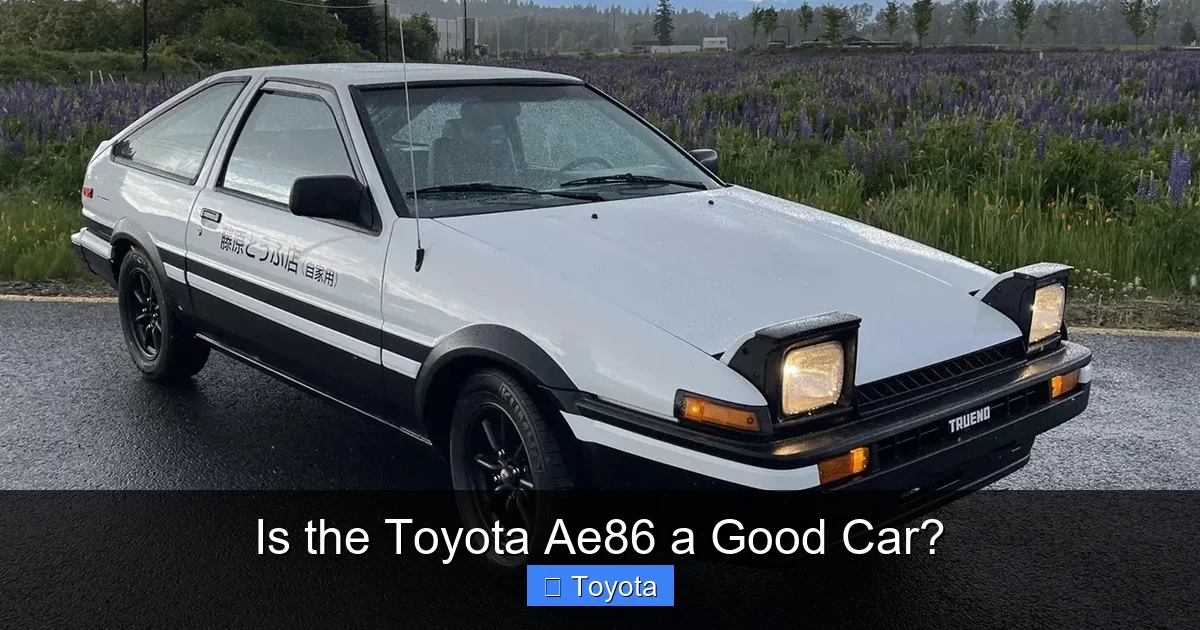
Culturally, the AE86’s fame skyrocketed thanks to the manga and anime “Initial D,” where protagonist Takumi Fujiwara drives a black AE86 touge master. The series turned the car into a global icon, linking it forever to drifting culture and mountain‑pass driving. This cultural capital adds intangible value—owning an AE86 often feels like joining a legacy rather than simply purchasing a used car.
Events such as meet‑ups, track days, and dedicated AE86 shows are common in many regions, offering opportunities to connect with fellow enthusiasts, learn new techniques, and showcase your build. For many, the sense of belonging is as rewarding as the drive itself.
Is the Toyota AE86 a Good Car? – Verdict
After examining performance, reliability, costs, and cultural factors, the answer to “Is the Toyota AE86 a good car?” depends largely on what you value in a vehicle. If you seek a car that delivers pure, unfiltered driving joy, rewards skillful driving, and connects you to a passionate community, the AE86 excels. Its lightweight chassis, rev‑happy engine, and rear‑wheel‑drive layout provide a driving experience that many modern cars mute with electronic assists and added weight.
Conversely, if you prioritize comfort, convenience, cutting‑edge safety features, or low‑maintenance ownership, the AE86 falls short. The lack of airbags, ABS, traction control (TRAC), and modern infotainment means you accept a higher level of personal responsibility for safety and comfort. Additionally, age‑related issues like rust and aging rubber require vigilance.
For enthusiasts who view a car as a hobby, a canvas for modification, or a conduit for driving pleasure, the Toyota AE86 remains an excellent choice. It offers a timeless blend of simplicity, engagement, and heritage that few vehicles—classic or modern—can replicate. Treat it with respect, maintain it diligently, and the AE86 will reward you with countless smiles on winding roads for years to come.
Conclusion
The Toyota AE86 stands as a testament to the idea that a car does not need massive horsepower or luxury trappings to be great. Its strengths lie in its balance, mechanical honesty, and the pure connection it fosters between driver and road. While it demands attentive maintenance and accepts the limitations of its era, the rewards—thrilling handling, a supportive community, and a slice of automotive culture—make it a worthy pursuit for those who crave an authentic driving experience.
Whether you’re considering a pristine low‑mileage example or a project car to restore and personalize, the AE86 offers a platform that is both accessible and deeply satisfying. In a world increasingly dominated by computerized interventions, the AE86 reminds us that sometimes, the best way to enjoy driving is to keep things simple, light, and utterly engaging.
Frequently Asked Questions
What engine does the Toyota AE86 have?
The AE86 is powered by a 1.6‑liter 4A‑GE DOHC inline‑four engine. It features dual overhead camshafts, electronic fuel injection, and a high‑revving nature, producing around 130‑150 horsepower depending on the market and year.
Is the AE86 suitable for daily driving?
While the AE86 can be driven daily, its minimalist comfort features, lack of modern safety equipment, and firm ride may make it less ideal for long commutes or adverse weather. Many owners use it as a weekend or fair‑weather driver.
How much does a typical Toyota AE86 cost today?
Prices vary widely based on condition, mileage, and modifications. As of 2025, decent driver‑quality examples often start around $12,000‑$18,000, while well‑maintained, low‑mileage or modified cars can exceed $25,000.
Does the AE86 have any modern safety features like airbags or ABS?
No. The AE86 predates widespread adoption of airbags, anti‑lock brakes, and traction control. Safety relies on the driver’s skill and proper maintenance of brakes, tires, and suspension.
What are common rust areas to inspect on an AE86?
Focus on the rear wheel arches, floor pans, rear suspension mounts, and the area around the fuel tank. These spots are prone to corrosion, especially in climates with road salt.
Can I install modern upgrades like a touchscreen stereo without ruining the car’s classic feel?
Yes. Many owners add discreet modern amenities—such as a Bluetooth‑enabled head unit that fits the original dash opening—while retaining the car’s classic aesthetic. Just be sure to preserve original components if you value concours correctness.